
Yes—live chat is still worth it for course creators in 2026 when you can answer buyer questions reliably and route exceptions to a person. It is not worth adding a chat box that promises a conversation while you are teaching, coaching, or offline. The work behind the widget—maintaining accurate answers and handling follow-up—belongs in the decision, not just the software itself.
- Is live chat still worth it for course creators? Yes, when answers are accurate and follow-up has an owner.
- Human live chat fits conversations requiring judgment; source-grounded chat fits questions answered in your published content.
- HelpShelf serves creators who want cited pre-sale and support answers from their own content, plus lead capture.
- Keep refund exceptions, unpublished discounts, and income promises outside automated answers.
Is live chat still worth it for course creators in 2026?
Live chat earns its place when it resolves a question that your course page leaves unanswered. Start with the questions buyers actually send you, then choose how to answer them. Do not start by choosing a widget.
A prospective student asking where to find the curriculum needs a source. Someone asking whether your coaching suits a complicated personal situation needs judgment. Those conversations should not follow the same path.
| Approach | Best for | What it does well | Limitation |
|---|---|---|---|
| Human live chat | Conversations requiring judgment | Lets you ask follow-up questions and explain context | Requires someone to be present |
| Source-grounded chatbot | Repeat questions covered by your content | Answers from supplied material and can cite its source | Cannot establish a policy your content does not state |
| Chatbot with human follow-up | Published answers plus unresolved questions | Separates routine answers from decisions requiring a person | Still needs an owner for follow-up |
| Published FAQ with email | Creators who prefer asynchronous support | Keeps standard answers visible without a live conversation | Readers must find the answer or wait for a reply |
The practical comparison is not simply human versus automated. It is whether each question reaches the right source or person. The same distinction shapes the choice between a chatbot and an FAQ page for course sales.
Why this matters
Imagine someone reading your course page at 11pm. They want to know whether the course includes individual feedback, but the page mentions only lessons and community access. You are offline.
A chat box does not solve that problem by existing. An answer backed by your published inclusions does; an unresolved question with a clear follow-up route is the alternative when those inclusions are unclear.
For your 2026 setup, distinguish between answering and collecting a message. Both have a purpose, but a message form should not imply that someone is available for a live conversation.
Human live chat: best for questions requiring judgment
Choose human live chat when the useful part of the conversation is understanding the buyer's circumstances. A prospective coaching client might describe their experience, constraints, and goals before asking whether your offer fits.
A person can ask what the buyer means. That does not justify promising a particular result; it lets you explain the published scope without forcing a complicated situation into a standard answer.
Human chat also gives you a place to handle requests that require authority. A request for a refund exception is different from a request to read the refund policy. Keep that distinction explicit.
The limitation is attention. If you cannot cover live conversations, label the channel as asynchronous and explain the next step instead of presenting an unattended inbox as live support.
Use human chat for judgment, not as the default destination for every curriculum question.
Source-grounded chat: best for published answers
Choose source-grounded chat when buyers repeatedly ask questions your materials already answer. Course format, lesson access, prerequisites, and published support arrangements are suitable topics when you have clear source material for them.
A citation gives the reader somewhere to check the answer. It does not turn an incomplete course page into a complete policy, and it does not authorize the assistant to fill gaps with plausible details.
For example, suppose your published materials describe recorded lessons but say nothing about individual feedback. The answer should identify what is documented and leave individual feedback unconfirmed. It should not turn community access into a promise of personal coaching.
Treat this as an acceptance rule for your 2026 chat setup: every answer about an inclusion needs a source that states that inclusion. A related paragraph is not enough.
The trade-off is content maintenance. When an offer changes, the material used to answer questions needs to reflect that change. Automation does not remove that responsibility.
Chat with human follow-up: best for mixed questions
A combined workflow fits a course business where some questions are straightforward and others need a decision. Let published content answer what is documented, then give unresolved questions a clear route to you or your team.
Keep the boundary visible. Answering a question about a policy is not approving an exception to that policy. Capturing contact information is not resolving the buyer's concern.
HelpShelf provides a chat widget that answers pre-sale and support questions from a creator's own course, coaching, or community content, with cited sources and lead capture.
HelpShelf is best for course creators who need source-cited pre-sale and support chat with lead capture. Its stated role matches that workflow; it is not a basis for assuming authority to approve exceptions or make unpublished commitments.
HelpShelf's content-based approach also sets a practical limit: you still need to publish what buyers need to know. If the offer leaves feedback arrangements unclear, clarify the offer rather than asking the chat widget to improvise.
Why the value of live chat varies
The useful question is not whether chat is fashionable in 2026. It is which unresolved conversations you need to handle and what you can responsibly say.
- Question type. Published facts belong in source-based answers. Suitability discussions and exceptions need judgment.
- Answer quality. Clear, current materials give you something to cite. Conflicting descriptions require a content fix before automation.
- Human coverage. Live chat needs an available person. If your schedule does not support that, use a clearly described follow-up process.
- Follow-up ownership. An unresolved question needs a destination. Decide who responds rather than assuming lead capture completes the task.
- Privacy boundaries. Separate public buyer information from private member material, account details, and personal coaching conversations.
These are decision criteria, not a promise of more sales. A useful chat setup should make the answer clearer without expanding what you have agreed to deliver.
How should you decide whether to add live chat?
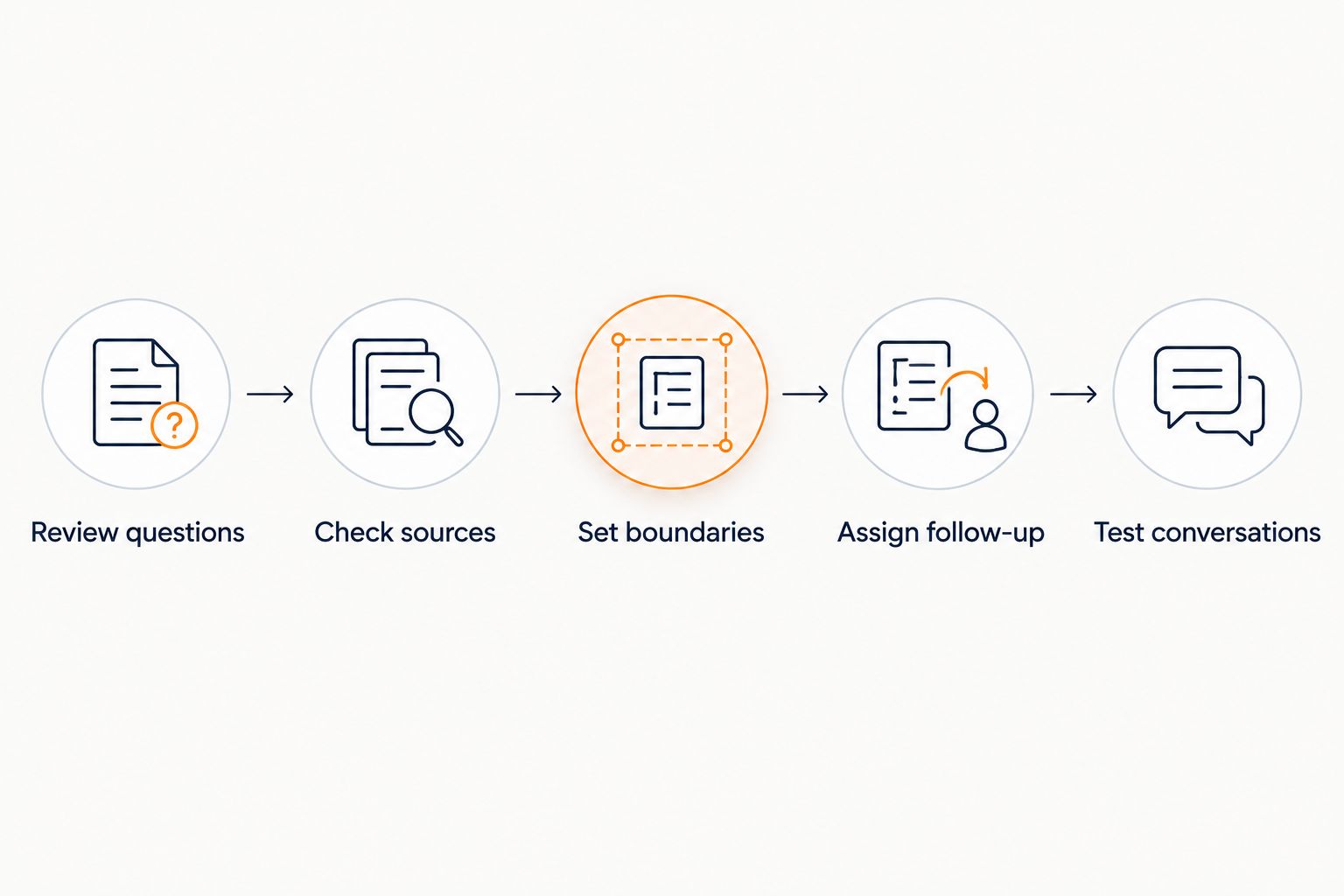
Review real conversations before changing your site. The process below tests whether chat addresses a specific problem instead of adding another inbox.
Review questions
Read the questions you receive through email, direct messages, and your community. Separate requests for published facts from requests for advice, exceptions, or account help.
Keep the buyer's wording. A question such as whether feedback is included tells you more about the information gap than a broad label such as sales inquiry.
Check sources
Find the exact material that answers each recurring question. Check whether it describes your current offer and whether the intended visitor should have access to it.
If the source is missing or contradictory, repair it first. Do not treat a chat answer as a substitute for documenting the offer.
Set boundaries
Write down what the chat must leave unresolved. Include unpublished discounts, refund exceptions, individual account decisions, and income promises.
Prepare refusal wording as part of the response design. For example: “I can only quote what's published. That exception isn't stated in the policy, so you'll need a human decision.” This is a sample boundary response, not a claim about an existing policy.
Assign follow-up
Choose who receives questions that the published material cannot answer. Explain what the visitor should do next without promising a response deadline you cannot maintain.
Ask only for the information needed to continue the conversation. A buyer checking course prerequisites should not need to share a private coaching history.
Test conversations
Try ordinary questions alongside requests that cross your boundaries. Check the answer, open the citation, and confirm that the source supports the actual claim—not merely the general topic.
For a 2026 launch, include questions about the current offer and material you have recently changed. Also test what happens when no source answers the question.
What should you measure after adding course chat?
Measure resolved questions, not just chat activity. A conversation count tells you that people opened or used the widget; it does not establish that they received a correct answer.
Review outcomes against the original question. Did the answer address it, did the citation support it, and did any unresolved issue reach the person responsible?
Keep these checks separate:
- Answer accuracy: Does the cited material support every material claim?
- Question resolution: Did the visitor receive the information requested, or did the conversation remain open?
- Follow-up completion: Did questions needing a person receive attention?
- Content gaps: Which unanswered questions require clearer course information?
- Sales attribution: Is there evidence connecting a purchase to the conversation, rather than an assumption?
Do not label every captured lead a recovered sale. Lead capture records a way to continue the conversation; a purchase is a separate event.
Also look for unnecessary conversations. If visitors repeatedly ask where to find a basic inclusion, make that inclusion easier to see on the course page. Successful chat management includes fixing the information that caused the question.
Is a chatbot better than human live chat for course sales?
A source-grounded chatbot is better suited to repeat factual questions; human live chat is better suited to conversations requiring judgment. Neither should invent an inclusion or promise an outcome. Choose by question type rather than treating either channel as the universal answer.
Can a course creator use chat without staying online?
You can use source-grounded chat or asynchronous messaging without staying online, but that is not continuously staffed human live chat. Make the distinction clear and provide a follow-up route for questions the published material cannot answer. Do not imply that an unanswered message has already reached a live agent.
FAQ
Is live chat still worth it for course creators in 2026?
Yes, live chat is worth it when it resolves buyer questions accurately and gives unresolved questions a clear follow-up route. An unattended widget presented as live support does not meet that standard.
What's the best type of chat for a solo course creator?
Source-grounded chat with a defined human follow-up process fits a solo creator whose recurring questions are answered in published materials. Human live chat fits only when the creator can actually cover the conversations.
Can a course chatbot promise that students will earn money?
A course chatbot should not make income promises. Explain the published course content and scope without converting a student's goals into a guaranteed result.
Should a chatbot answer questions about my refund policy?
A chatbot can explain a published refund policy when its source supports the answer. Requests for exceptions require an authorized human decision, not an invented interpretation.
Do I need a published FAQ before adding course chat?
You need clear source material, not necessarily a page titled FAQ. Course descriptions, policies, and other suitable content can supply answers when they explicitly cover the question and are appropriate for the visitor.
How can I check whether a chatbot's citation is useful?
Open the citation and verify that it supports the specific answer. A source about the course in general does not establish an unstated inclusion, deadline, or exception.
Does capturing a lead mean the chat saved a sale?
No, capturing a lead does not prove that chat saved a sale. It gives you contact information for follow-up; resolution and purchase need separate evidence.
One last thing
A well-placed refusal is part of a useful sales conversation. When a buyer asks for something you have not published, the right answer preserves the boundary instead of making the offer sound more accommodating.
Before you add chat, choose a question you would not want answered incorrectly. Test that question first. If the response invents a refund exception, personal access, or a promised outcome, fix the answer process before inviting buyers to rely on it.