
Yes, a chatbot can capture leads before someone buys a course by answering a pre-sale question and asking whether the visitor wants follow-up. The useful outcome is a contact who has asked for a specific next step—not just an email address collected before the visitor gets an answer.
- Can a chatbot capture leads before someone buys a course? Yes—answer the question, then offer relevant follow-up.
- HelpShelf combines source-grounded pre-sale answers, citations, and lead capture for course creators, coaches, and community owners.
- A captured lead is not a purchase, and a follow-up request is not permission for unrelated marketing.
- Keep missing information visible: no invented discounts, no refund exceptions, and no income promises.
Can a chatbot capture leads before someone buys a course?
Yes. A chatbot can collect a prospective student's contact details during a conversation before checkout. For a course creator, the key is connecting that request to the question the visitor actually asked.
Helpshelf provides a chat widget that answers pre-sale and support questions from a creator's own content, cites sources, and captures leads. That puts answering and lead capture in the same conversation; it does not turn every conversation into a qualified prospect.
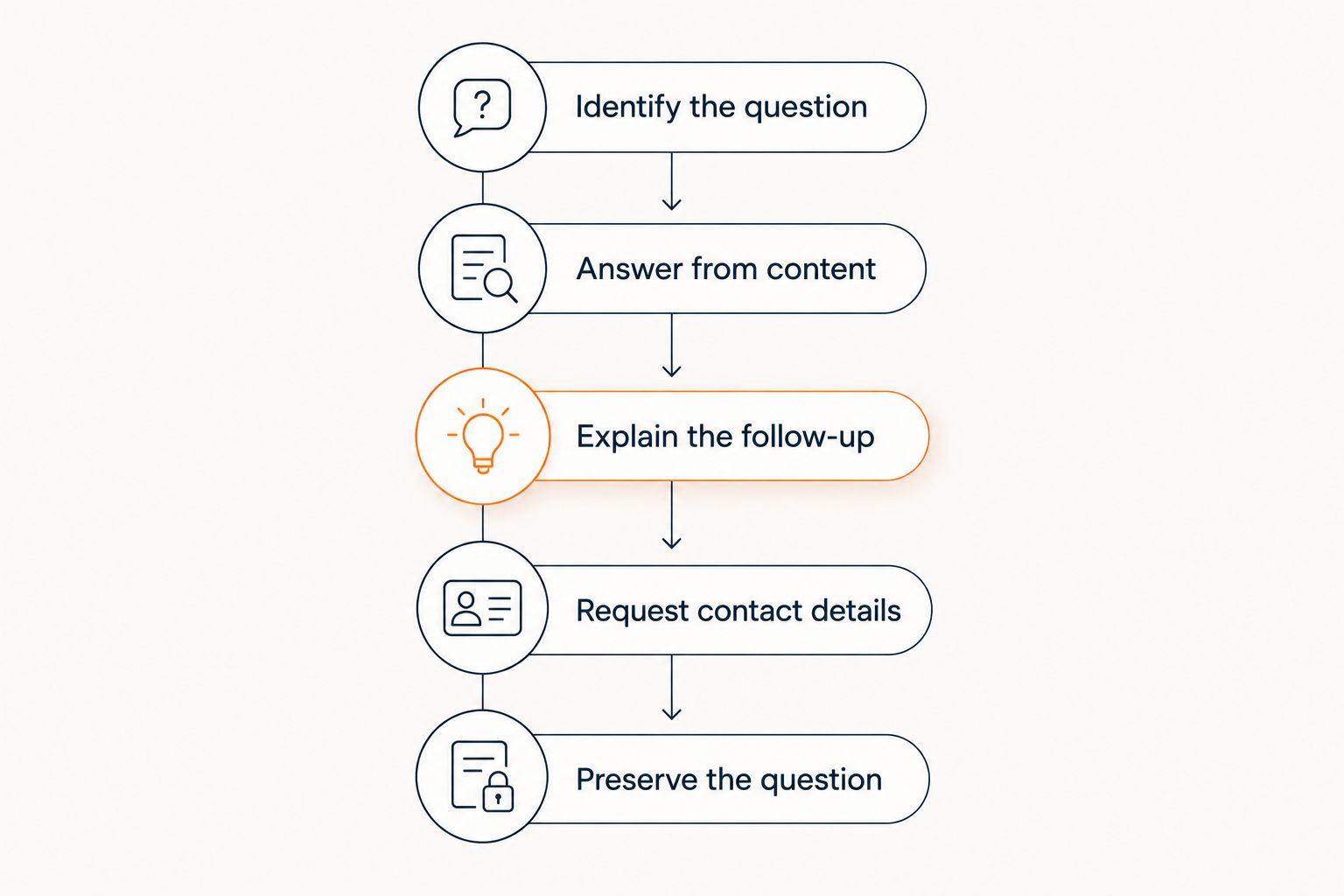
The right sequence is question, supported answer, requested follow-up. Use the following workflow as your 2026 launch checklist rather than treating an email gate as the whole lead-capture strategy.
1. Identify the question
Start with what the visitor needs to decide. A question about prerequisites calls for different information from a question about access or coaching support.
Do not treat every visitor as ready to enroll. Someone asking whether a course covers a particular topic needs evidence about that topic, not an immediate enrollment pitch.
An illustrative exchange starts with a visitor asking whether your course suits beginners. The chatbot's first task is to find your published entry requirements—not to infer that anyone can succeed.
2. Answer from published content
Give the supported answer and cite the source. If the source discusses prerequisites but says nothing about individual feedback, the response should stop at prerequisites.
A citation gives the visitor somewhere to check the claim. It is not permission to stretch that claim into a broader promise.
For example, a published curriculum can support a statement that a topic is covered. It cannot, by itself, support a promise that the student will master the topic or earn income from it.
3. Explain the follow-up
Offer a next step that fits the unresolved question. If the visitor needs a creator to clarify course fit, explain that purpose before asking for contact details.
Keep the distinction clear: receiving an answer, requesting a reply, and subscribing to marketing are separate actions. Do not describe an email request as necessary to read information that is already public.
An illustrative invitation is: leave your email if you want the creator to reply about the prerequisite question. This describes the reason for collecting the address without promising an unconfirmed response time.
4. Request contact details
Ask only for details needed for the stated next step. An email address can support an email reply; extra questions should have an identifiable purpose.
Make refusal an ordinary outcome. A visitor who does not want follow-up should still be able to understand the supported answer.
This is a workflow recommendation, not a claim that every chatbot offers the same form controls. Check the actual capture behavior before publishing your widget.
5. Preserve the question
Design your follow-up process so the person replying can see what remains unanswered. An address without context leaves the creator guessing why the visitor shared it.
Separate the supported answer from the unresolved request. That prevents a later reply from treating the chatbot's uncertainty as a promise already made.
For your 2026 review, walk through the conversation as both visitor and creator: can the visitor explain what happens next, and can the creator explain why they are replying?
Why this matters
Picture a prospective student opening your course page at 11pm. They want to know whether the material matches their experience, but the page does not settle their exact question.
A contact request alone does not answer that question. A chat response that guesses does something worse: it puts an unsupported claim between the visitor and the purchase decision.
Answering and collecting contact details are different jobs. Your 2026 pre-sale workflow should do both without making either depend on an invented promise.
For course creators, the useful information is the reason someone is considering the course and the uncertainty that remains. That context gives you a specific follow-up task instead of a generic sales message.
Which lead-capture approach fits your course?
Compare the conversation structure before choosing how to ask for an email. The following options are workflow choices, not claims about a particular platform's features.
| Approach | Best for | Advantage | Limitation |
|---|---|---|---|
| Answer-first chatbot | Published course questions with optional follow-up | Gives the visitor information before asking for contact details | Needs suitable source content and a clear boundary around unknown answers |
| Contact-first form | Visitors explicitly requesting a personal reply | Makes the contact request straightforward | Does not itself resolve the pre-sale question |
| Human conversation | Individual suitability questions requiring judgment | Lets the creator ask clarifying questions | Requires a person to participate |
Use an answer-first chatbot for questions your published content can settle. Offer personal follow-up when the question needs judgment or information that is not published.
A contact-first form is still appropriate when the visitor's goal is to contact you. The problem is presenting a form as an answer to a question it never addresses.
Human judgment also has a clear place. A visitor describing their personal circumstances is not necessarily asking something a curriculum document can decide.
Helpshelf is best suited to course creators, coaches, and community owners who want cited pre-sale answers and lead capture from their own content. Its source-grounded approach gives published material a role in the conversation; it does not replace a creator's judgment about an individual student's circumstances.
Why the lead-capture workflow varies
The same contact prompt does not fit every conversation. Build your 2026 workflow around these factors:
- Published content. A detailed course page gives the chatbot different material from a short description. Limit answers to what the sources actually support.
- Question type. Curriculum questions, coaching questions, and community questions need different evidence. Identify which kind of answer the visitor needs.
- Business model. A course, a coaching service, and a community are not interchangeable. Ask for follow-up that matches the offer under discussion.
- Unresolved information. When the answer is not published, explain the gap and offer a human next step instead of filling it in.
- Platform context. Creators on Kajabi, Skool, and Whop should check where visitors encounter the widget and how they move from a question to a follow-up request.
These factors describe what your process must handle. They are not a basis for predicting a capture rate or promising more sales.
What should the chatbot refuse to promise?
A pre-sale chatbot should not make commitments that your published content does not support. An email address is not a reason to relax that rule.
For Helpshelf pre-sale lead capture, the useful boundary is plain: no invented discounts, no refund exceptions, and no income promises. Apply the same boundary to the creator's eventual reply.
Unpublished exceptions
Suppose a visitor asks for a refund exception. If your published policy does not provide it, the chatbot should not approve it or suggest that approval is routine.
An illustrative refusal is: “I can only quote what's published.” A follow-up request can ask a person to review the question; it cannot imply that the exception has already been granted.
Unsupported results
Suppose a visitor asks whether taking the course guarantees income. A lesson outline describes instruction, not the visitor's future earnings.
Keep the response on the supported material: what the course covers and what requirements are published. Do not turn lead capture into an invitation to promise a result privately.
Missing details
Suppose someone asks whether personal feedback is included, but the source content does not say. The answer should identify that uncertainty rather than substitute a vague reassurance.
For more on the evidence boundary, read whether a chatbot can cite sources from your own content. The citation should support the exact claim being made, not merely point to a related page.
What information should I ask a prospective student for?
Ask for the contact detail needed for the requested reply and the question that needs answering. Explain why you need each additional field before adding it.
For an email follow-up, ask for an email address. If the conversation already contains the question, design the handoff to retain it rather than making the visitor repeat the entire exchange.
Do not assume that collecting more personal information makes the lead more useful. A specific curriculum question can give you a clearer next action than a long form with no explanation of the visitor's uncertainty.
Can a chatbot answer course questions without collecting an email?
Yes, answering a published course question and collecting an email are separate tasks. Your workflow can provide the answer first and offer contact capture only when the visitor wants a reply or another stated next step.
This preserves a useful distinction: an anonymous visitor can still receive information, while a contact request remains an intentional action. Check that your chosen configuration supports the sequence you want.
Does a captured lead mean someone is ready to buy?
No, a captured lead means you have contact information, not proof of purchase intent. The conversation tells you what the visitor wanted to know and whether they requested follow-up.
Someone asking about course fit needs a reply about course fit. Do not label that person ready to enroll simply because they shared an email address.
How should I check the workflow before publishing?
Test the visitor experience, not just whether a form submits. Your 2026 checks should include an answerable question, an unsupported request, and a visitor who declines follow-up.
- Answer check: Ask a question settled by published content. Confirm that the response stays within that source and provides a relevant citation.
- Boundary check: Ask for an unpublished exception or unsupported outcome. Confirm that the response refuses to invent one.
- Contact check: Request follow-up. Confirm that the prompt explains its purpose and that the receiving person has enough context to reply.
- Decline check: Refuse to share contact details. Confirm that the conversation does not turn that refusal into pressure or a fabricated urgency claim.
Inspect the captured record as well as the visible chat. A successful submission is only one part of the process; the follow-up still needs an accurate reason for contact.
Explore cited pre-sale answers
See Helpshelf's chat widget for source-grounded course answers and lead capture.
FAQ
Can a chatbot capture leads before someone buys a course?
Yes, a chatbot can collect contact details during a pre-sale conversation before checkout. Connect the request to a supported answer and an explicit reason for follow-up.
Should my course chatbot ask for an email before answering?
Answer public course questions before requesting contact details. A contact-first form fits visitors asking for a personal reply, but it does not itself answer their question.
What makes a chatbot lead useful to a course creator?
A useful chatbot lead has a clear question and a requested next step. An email address alone does not explain what the visitor needs or establish readiness to buy.
Can a course chatbot promise that students will earn money?
A course chatbot should not promise income from a curriculum description. Keep the answer limited to supported course content and refuse unsupported outcome claims.
What should the chatbot say when my content does not contain the answer?
The chatbot should say that the published content does not answer the question. Offer a clearly explained human follow-up rather than guessing or implying approval.
Does sharing an email mean the visitor agreed to marketing?
Do not treat a requested reply as permission for unrelated marketing. Make the purpose of contact capture clear and keep any marketing request separate.
Can this approach serve coaches and community owners too?
Yes, the same answer-first workflow applies to published coaching and community questions. Ground each answer in the relevant offer's content rather than treating every offer as a course.
One last thing
A useful pre-sale answer can end without an email address. The visitor might learn that the course does not address their question or match their needs.
Do not make every chat pursue contact capture at the expense of an accurate answer. When someone does request follow-up, carry the unresolved question forward—not an invented promise made to keep the conversation moving.