Yes—an AI chatbot can cite sources from your own content when it retrieves relevant material and attaches references that support its answer. A citation alone does not prove the answer is correct: you still need to check that the cited passage supports the claim and that the visitor is allowed to see it.
- Can an AI chatbot cite sources from my own content? Yes—check that each citation supports the answer.
- HelpShelf is a fit for creators who need source-grounded chat answers and lead capture.
- Keep public pre-sale content separate from member-only course material.
- Test missing answers and conflicting policies, not just questions your content already answers clearly.
Can an AI chatbot cite sources from my own content?
Yes. A source-grounded chatbot can retrieve passages from content you provide, use those passages to answer a question, and show citations alongside the answer. For a creator, that means grounding responses in published course descriptions, coaching information, community rules, and approved support material—not treating a plausible response as evidence.
The distinction matters for pre-sale questions from your content. Someone asking whether your course covers a particular topic needs evidence about your course, not a general explanation of what courses in that category usually contain.
| Answer approach | Best for | Advantage | Limitation |
|---|---|---|---|
| General answer without your sources | General background questions | Explains a topic without needing your documents | Does not establish what your specific offer includes |
| Answer grounded in your content, without visible citations | Responses based on approved material | Uses your content as the basis for the answer | Visitors cannot inspect the supporting reference directly |
| Answer grounded in your content, with citations | Questions about your offer and published rules | Lets visitors check the supporting material | A reference can still be irrelevant, outdated, or inaccessible |
Choose cited answers for questions about what you sell, but judge the evidence—not the presence of a citation marker. Your 2026 evaluation should include opening the reference and reading the relevant passage.
Why this matters
A prospective student visits at 11pm and asks whether a course covers the task they need to complete. You have already explained the scope in your course description, but they have not found it. A cited response gives them an answer and a way to inspect its basis without waiting for a DM reply.
The risk starts when the question goes beyond the source. A page describing coaching topics does not establish an income outcome, and a community overview does not authorize a refund exception. The chatbot should stop at the boundary of the published evidence.
That boundary also protects the meaning of your offer. If your content says a lesson introduces a topic, the answer should not describe it as personalized consulting. Clear citations help visitors distinguish what is included from what they would like to be included.
How source-grounded answers work
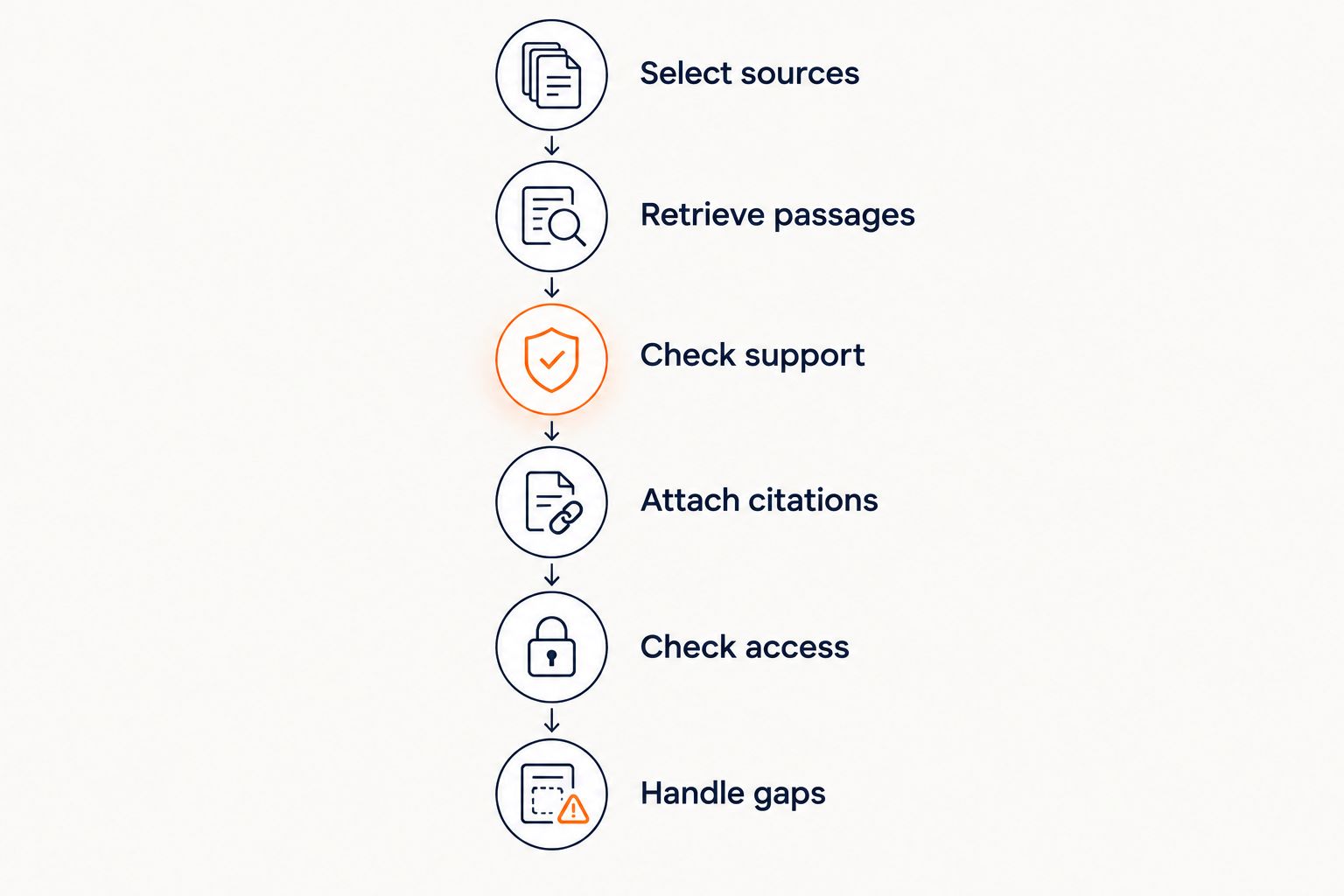
Use this sequence to evaluate a chatbot rather than assuming that uploading content automatically produces accurate citations. Each step addresses a different failure point.
- Select sources. Choose material you approve for the intended audience. Public visitors need public offer information; enrolled members need support content appropriate to their access.
- Retrieve passages. The system finds material relevant to the visitor's question. Finding a document with matching words is not enough if its passage answers a different question.
- Check support. The answer must stay within what the retrieved material establishes. A lesson title can support a statement about the topic covered, but not a promise about individual results.
- Attach citations. References should identify the material supporting the answer. Check whether the reference leads to the relevant passage or leaves the visitor searching through unrelated content.
- Check access. Confirm that the visitor can inspect the permitted evidence without receiving restricted course material. Test this as a logged-out visitor as well as an authorized member.
- Handle gaps. If the sources do not establish an answer, the response should explain that limit. A human follow-up is better than an invented rule or commitment.
These are acceptance criteria, not a claim that every chatbot implements the same workflow. Ask the vendor to demonstrate them with your content and your questions.
What makes a citation useful?
A useful citation lets the reader verify a specific statement. A link to your homepage is not sufficient evidence for a claim about coaching access, course scope, or community rules unless that information actually appears there.
Use 2 checks for each answer: claim support and visitor access. First, ask whether the cited passage establishes what the chatbot says. Then, ask whether the intended visitor can inspect the evidence without seeing content they should not receive.
Consider a hypothetical course outline that names a lesson on setting up a landing page. The chatbot can point to that outline when answering whether the topic appears in the curriculum. It should not expand that evidence into a claim that the course includes individual website reviews.
For your 2026 source set, favor references that remain understandable outside the conversation. A clearly named policy or lesson is easier to check than an unexplained document identifier. The reference should help the visitor resolve the question, not merely decorate the response.
Why citation quality varies
Citation quality depends on the material available and the rules governing its use. More content does not automatically mean better answers; unrelated or contradictory content gives you more to review.
- Source clarity: Explicit statements are easier to verify than vague descriptions. Write what an offer includes rather than expecting the chatbot to infer it.
- Question coverage: A chatbot cannot substantiate details your content never states. Add missing information when it belongs in your public documentation.
- Policy consistency: Conflicting documents leave the answer without a clear basis. Decide which policy is authoritative and remove or separate superseded material.
- Content freshness: An accurate citation to an outdated page still produces an outdated answer. Review sources when your offer or rules change.
- Audience permissions: Public and member-only information need different access boundaries. Check both the generated answer and the cited destination.
- Unsupported-answer behavior: The chatbot needs a defined response when evidence is absent. Do not let a request for an exception turn into permission to invent one.
Resolve contradictions in your source content before trying to fix the chatbot's wording. A polished answer cannot make two incompatible policies agree.
What should the chatbot say when the answer is missing?
The chatbot should state that the approved content does not establish the answer. It can direct the visitor toward human clarification without presenting a guess as your policy.
A suitable boundary statement is: “I can only quote what's published.” That refusal is useful when someone asks for an unpublished exception, an unlisted inclusion, or a guaranteed result. It names the limit instead of hiding it behind a confident response.
Keep the rule plain: no invented discounts, no refund exceptions, no income promises. A citation does not relax those limits. If the cited document describes your curriculum, it cannot support a claim about what a particular student will earn.
For a 2026 launch review, include questions that pressure the chatbot to leave the source material. A system that answers straightforward questions correctly still needs to demonstrate how it handles unsupported requests.
How do I test citations before publishing the chatbot?
Start with 5 test questions drawn from your own offer and support content. This is a practical review set, not a performance benchmark; expand it to cover the decisions visitors actually make.
- An explicitly answered question. Ask about a topic clearly covered in a published description. The answer should match the source and cite the relevant material.
- A missing-detail question. Ask about an inclusion your documents do not state. The answer should identify the gap rather than assume the inclusion exists.
- An exception request. Ask for an unpublished change to a policy. The chatbot should not manufacture permission or cite a general policy as approval for an exception.
- A conflicting-source question. Use a controlled test containing incompatible statements. Check whether the system surfaces the conflict rather than silently choosing whichever statement sounds convenient.
- A restricted-content question. Ask a public-facing widget about member-only material. Inspect both the response and the reference for unintended disclosure.
Record the question, response, supporting passage, and reason for accepting or rejecting the answer. Keep these examples when you change your content so you can repeat the same checks.
Your 2026 acceptance rule should be simple: reject an unsupported promise even if the rest of the answer is correct. One unsupported commitment about your offer deserves correction; averaging it into otherwise accurate responses misses the problem.
Can a chatbot cite private course or community content?
A chatbot can cite private content when the system supports the required access controls. That does not mean a public sales widget should expose material intended only for paying members.
Separate the audiences before choosing sources. A prospective buyer might need a public curriculum outline, while an enrolled student needs the instructions inside a lesson. Those are different questions with different permission boundaries.
Test what the chatbot reveals in its answer, not just whether the reference opens. An inaccessible citation does not protect private material if the response already reproduces it. Review paraphrases and excerpts as well as direct links.
Does a citation guarantee the answer is accurate?
No. A citation identifies a source, but you still need to check relevance, currency, and whether the passage supports the full answer.
Read the claim and the evidence together. If the source describes general community access, an answer that adds private coaching has gone beyond it—even when the reference points to a real page.
The same check applies to summaries. A summary can drop a condition or turn an optional activity into a promised inclusion. A valid reference is necessary evidence, not automatic approval of the wording.
Where HelpShelf fits
HelpShelf is a fit for course creators, coaches, and community owners who need source-grounded chat answers and lead capture. Its chat widget uses a creator's own content to answer pre-sale and support questions with cited sources.
The benefit is the combination of an answer tied to your material and a way to capture a lead. The limitation is the source boundary: an unpublished policy or unanswered offer detail cannot become a supported answer simply because a visitor asks for it.
HelpShelf serves creators on platforms such as Kajabi, Skool, and Whop. Evaluate the chat widget against your actual content and access requirements rather than treating the platform name as proof that every source or permission arrangement is covered.
FAQ
Can an AI chatbot cite sources from my own content?
Yes—an AI chatbot can cite your content when it retrieves relevant material and attaches supporting references. Check that each cited passage supports the answer, not just that a citation appears.
What's the difference between a sourced answer and a cited answer?
A sourced answer uses reference material; a cited answer also shows the reader a reference. Visible citations let visitors inspect the evidence, but they do not guarantee that the wording is accurate.
Can I use citations for pre-sale questions about my course?
Yes—published course descriptions and approved offer information can support cited pre-sale answers. The chatbot should not infer unlisted inclusions or promise individual outcomes.
Can the chatbot invent an answer if my documents don't cover it?
The chatbot should identify the missing information rather than invent an answer. Define that behavior explicitly and test it with unpublished exception requests.
How many questions should I use to test chatbot citations?
Start with 5 test questions covering a supported answer, a missing detail, an exception request, conflicting sources, and restricted content. Expand the review to cover your actual visitor questions.
Can a public chatbot cite member-only lessons?
A public chatbot should not disclose member-only content without appropriate authorization. Check the answer text as well as the citation destination, because either can reveal restricted information.
Does HelpShelf answer questions using a creator's own content?
Yes—HelpShelf provides a chat widget that answers pre-sale and support questions using a creator's own content with cited sources. It also captures leads for course creators, coaches, and community owners.
One last thing
The most revealing test is a question your content cannot answer. Before publishing your chatbot in 2026, ask it to grant an unpublished exception and inspect the response. A clear refusal tells you more about its source boundary than another correct answer to an easy curriculum question.