
AI chatbots can address avoidable causes of online-course refund requests, such as unanswered pre-sale questions and difficulty finding course information, but answering those questions does not prove that refunds will fall. Use a source-grounded chatbot to clarify what buyers receive and help enrolled students find answers—not to obstruct refunds, invent exceptions, or promise learning outcomes.
- Can AI chatbots reduce refund requests for online courses? Addressing confusion helps; a lower refund rate requires measurement.
- HelpShelf answers creator questions from supplied content with citations; course quality and refund decisions remain separate responsibilities.
- Publish clear course requirements, support boundaries, and refund terms before asking a chatbot to explain them.
- Judge the chatbot by resolved questions and buyer outcomes, not fewer messages containing the word refund.
Can AI chatbots reduce refund requests for online courses?
A chatbot addresses information gaps; it does not repair a course that fails to match its description. That distinction should guide your 2026 setup. A student who cannot find the opening lesson has a different problem from a student whose purchase does not meet their needs.
HelpShelf provides a chat widget that answers pre-sale and support questions from a creator's course, coaching, or community content, with cited sources and lead capture. HelpShelf is best suited to course creators, coaches, and community owners who need cited answers from their own content. Its relevance here is answering the question behind a refund request, not deciding whether that request should be approved.
The practical choice is not simply chatbot versus no chatbot. Decide which questions need a published answer and which need a person.
| Approach | Best for | Useful contribution | Limitation |
|---|---|---|---|
| Published course FAQ | Buyers checking standard requirements and terms | Gives readers a consistent reference | Readers must locate the relevant answer themselves |
| Source-grounded chatbot | Buyers and students asking questions covered by course content | Answers the question and points to supporting material | Missing or incorrect source material limits the answer |
| Human support | Account-specific problems, disputed facts, and exception requests | Reviews circumstances beyond published material | Requires someone to review and respond |
These approaches belong together. A chatbot needs source material, and a student still needs a clear route to human support when the source material does not settle the question.
Why this matters before and after enrollment
Consider an illustrative pre-sale scenario: a buyer asks whether a beginner can follow the course. Your published requirements say that prior experience is necessary. A useful answer explains those requirements before enrollment, rather than treating every visitor as someone who should buy.
Now consider an enrolled student who cannot locate a lesson. A citation to the relevant course instructions addresses the immediate question. It does not establish that the student will stay, finish the course, or withdraw a refund request.
For your 2026 course, separate these moments in your support plan:
- Before purchase: explain prerequisites, included material, and the support you actually offer.
- After purchase: help students find instructions and understand published course information.
- During a refund request: explain the published process without adding obstacles or deciding undocumented exceptions.
The same conversation can move between these categories. Once a student asks for a refund, answering a lesson question should not silently replace their request.
Pre-sale answers: clarify fit without promising results
Start with the questions a buyer needs answered to decide whether the course fits. These include who the course is for, what knowledge it assumes, what it covers, and what support is included. Each answer should point to material you have actually published.
For an illustrative buyer asking about individual feedback, the chatbot should distinguish course content from coaching support. If the source does not describe individual feedback, the answer should not imply that enrollment includes it. A friendly answer is still wrong if it expands the offer.
Use a refusal when the question exceeds the source. Example refusal wording: I can only quote what's published. The course information does not confirm individual feedback; ask the creator before enrolling. This is a sample response, not a claim about a particular course or a recorded customer conversation.
Your 2026 pre-sale review should also test requests for guaranteed earnings, special discounts, and unofficial refund arrangements. No invented discounts, no refund exceptions, no income promises. A chatbot should describe the offer, not improve it while answering.
For the broader source-based workflow, see the guide to answering pre-sale questions from your content.
Student support: answer the problem without hiding the request
An enrolled student's question often needs context. Asking where to begin is different from reporting that account access has failed. Published instructions can answer the first question; the second requires checking what is happening to that student's account.
Write support sources that distinguish directions from actions. A chatbot can explain published access instructions without claiming it has repaired access. Likewise, finding a lesson is not the same as confirming that the student has completed it.
Use these boundaries when designing responses:
- Point to the relevant lesson or instructions when the source supports the answer.
- Ask for clarification when the student's question does not identify the problem.
- Direct account-specific issues to your actual support process.
- Keep an explicit refund request visible even when another question is also answered.
Avoid a response that treats continued conversation as consent to abandon a refund. A student can appreciate an answer and still want to leave. Your support process must preserve that distinction.
Refund answers: explain published terms, not eligibility guesses
A refund question combines a published rule with a person's circumstances. The chatbot can explain the rule supported by its sources. It should not assume that it knows the purchase record, the student's account history, or how an exception will be decided.
For an illustrative request for an exception, sample refusal wording is: I can explain the published refund terms, but I cannot promise an exception. Please use the stated refund process for a decision. The wording sets a boundary without pretending that the request has already been reviewed.
A useful refund answer identifies the relevant source and the next action described there. It does not add a mandatory lesson, survey, or sales conversation that the published process does not require.
In 2026, review refund answers whenever you change the underlying terms. Check both the answer and its citation. A correct sentence linked to an outdated source is not a reliable explanation of the current process.
Why the effect on refund requests varies
The effect depends on what is causing the requests. Use these factors to decide whether better answers address the actual problem:
- Course fit: Clear prerequisites address uncertainty before purchase; they cannot make an unsuitable course suitable.
- Source coverage: The chatbot needs published material that answers the questions buyers and students actually ask.
- Source accuracy: Incorrect or conflicting course information remains a problem even when the answer includes a citation.
- Support boundaries: Instructions can explain a process; account corrections and disputed decisions require the appropriate person or system.
- Course delivery: Finding an answer does not replace missing content, promised support, or a course experience that matches its description.
- Refund access: A lower recorded request count is not a useful outcome if students cannot find or complete the refund process.
Fix the source before rewriting the chatbot response. If the course page and support document disagree, the response problem begins upstream.
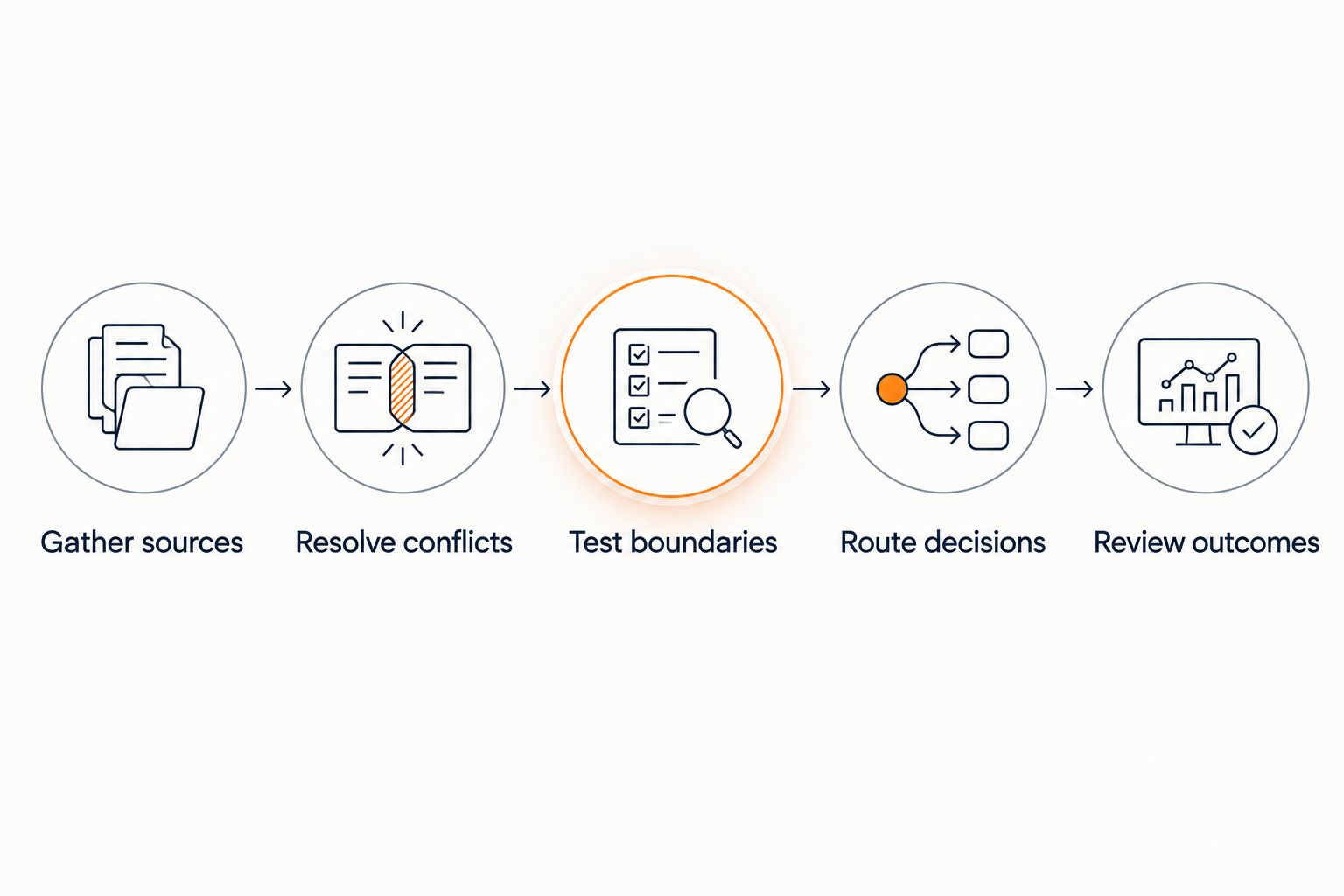
How should you set up a refund-aware course chatbot?
Treat the setup as a content and support workflow, not just a widget installation. HelpShelf's course-support chat widget uses a creator's own content; that makes the quality and scope of the supplied material central to the answers.
Gather sources
Collect the course description, prerequisites, lesson navigation, support boundaries, and refund terms you want the chatbot to explain. Use material that reflects the offer students are buying now. Keep a clear distinction between public sales information and material intended for enrolled students.
Do not use old promotional language as a substitute for current course documentation. If a promise is no longer part of the offer, it should not remain an answer source.
Resolve conflicts
Read the sources together before publishing the chatbot. Look for disagreements about included support, course access, or the refund process. Resolve those disagreements in the documents rather than expecting the chatbot to choose your preferred interpretation.
Give each important statement a clear home. This makes later reviews easier: you know which source needs correction when the offer changes.
Test boundaries
Ask ordinary questions and questions the source cannot answer. Include requests for an earnings guarantee, an undocumented exception, and a claim that the chatbot has fixed an account problem. The response should separate published information from decisions it cannot make.
For supported answers, inspect the citation. The linked material must support the actual statement, not merely discuss the same topic.
Route decisions
Define where students should go when an answer requires account access, judgment, or approval. Publish that route in the support material. Do not assume that adding a chat widget automatically creates the human workflow behind it.
For your 2026 launch review, follow the route yourself. Confirm that a student can understand what to do next without repeatedly rephrasing the same request.
Review outcomes
Read conversations alongside the resulting support outcome. Check whether the answer was supported, whether the student's question was resolved, and whether an explicit refund request reached the appropriate process.
A conversation ending is not proof of resolution. The student might have found the answer, stopped trying, or contacted you elsewhere.
How do you measure whether refund requests actually fell?
Compare refund outcomes against course purchases, not chat volume alone. Use the same definition of a refund request across the periods you compare. Separate requests from approvals and completed refunds; these describe different stages.
For a 2026 review, compare groups with equivalent opportunities to request a refund. A newly enrolled group and a group that has already passed through the applicable refund process are not interchangeable. Record changes to the course, sales page, support process, and chatbot sources alongside the comparison.
Review the reasons behind requests as well. A change in access-related complaints tells you something different from a change in complaints about course fit. Neither result should be inferred from the number of chatbot conversations.
Use a measurement checklist:
- Keep the purchase population consistent with the refund population.
- Record the student's stated reason without rewriting it as a sales objection.
- Distinguish questions answered from problems resolved.
- Track requests that continue through email or another support channel.
- Check whether students can still reach the published refund process.
Report a reduction only when your records show it. If you introduce the chatbot while changing the course or its description, the result alone does not isolate the chatbot's contribution.
Can a chatbot stop students from asking for a refund?
A chatbot should not stop students from making a refund request. It can answer supported questions and explain the published process, but it should not turn that process into a sequence of retention prompts.
Treat explicit requests as requests. Offer relevant help without requiring the student to accept it first.
What if the chatbot cannot answer a student's question?
The chatbot should state the source boundary and direct the student to the published support route. Guessing is not a substitute for missing course information.
Review repeated unanswered questions for source improvements. Keep account-specific decisions separate from general documentation updates.
FAQ
Can AI chatbots reduce refund requests for online courses?
AI chatbots can address information gaps behind some refund requests, but a reduction must be established from your purchase and refund records. Clear answers do not replace course quality or a fair refund process.
What's the best kind of chatbot for course refund questions?
A source-grounded chatbot is the appropriate choice for explaining published course information and refund terms. Questions requiring account review or an exception need the appropriate human decision-maker.
Can a course chatbot approve a refund?
Answering a refund question does not authorize a chatbot to approve a refund. Approval requires an explicitly authorized process; a citation alone provides no such authority.
Should a chatbot offer a discount instead of a refund?
A chatbot should not invent a discount or substitute an offer for the student's refund request. Keep any published offer separate from access to the refund process.
How do I know whether the chatbot actually reduced refunds?
Compare refund requests against course purchases using consistent definitions and equivalent observation periods. Review other changes to the course and support process before attributing the result to the chatbot.
Does HelpShelf answer questions from my course content?
HelpShelf answers pre-sale and support questions using a creator's own course, coaching, or community content, with cited sources. That supports information delivery, not an automatic promise of fewer refunds.
What should a chatbot say when refund terms are missing?
The chatbot should say that its sources do not establish the refund terms and direct the student to the published support route. It should not invent a deadline, eligibility rule, or exception.
One last thing
Test a buyer question whose honest answer is that the course is not a fit. If the chatbot turns a published prerequisite into reassurance, correct the source or response boundary before publishing.
That test checks whether your sales support respects the offer's limits. For a 2026 course, the useful answer is the one supported by the content—not the one most likely to keep the conversation moving toward enrollment.