
Yes—an AI chatbot can answer pre-sale questions from your content when it retrieves relevant material, keeps its answer within what that material supports, and cites the source. It should refuse to invent an answer when your content is silent, contradictory, or does not authorize a promise. For a 2026 setup, judge the chatbot by what it can substantiate—not how confidently it responds.
- Can an AI chatbot answer pre-sale questions from my content? Yes—with relevant sources, citations, and clear refusal rules.
- HelpShelf suits creators who need source-grounded pre-sale answers and lead capture.
- Course content explains what you teach; published offer terms establish what buyers receive.
- A chatbot should explain published policies, not invent discounts, refund exceptions, or income promises.
Can an AI chatbot answer pre-sale questions from my content?
Yes. The useful workflow is to find the relevant passage, answer the buyer's question from that passage, and show where the answer came from. When the source does not settle the question, the chatbot should identify the gap and leave the decision to you.
HelpShelf is best for course creators, coaches, and community owners who need a source-grounded pre-sale chatbot with lead capture. HelpShelf answers pre-sale and support questions using a creator's own content, with cited sources. Its stated use case matches this task; the boundary remains your content, which cannot establish terms you have never published.
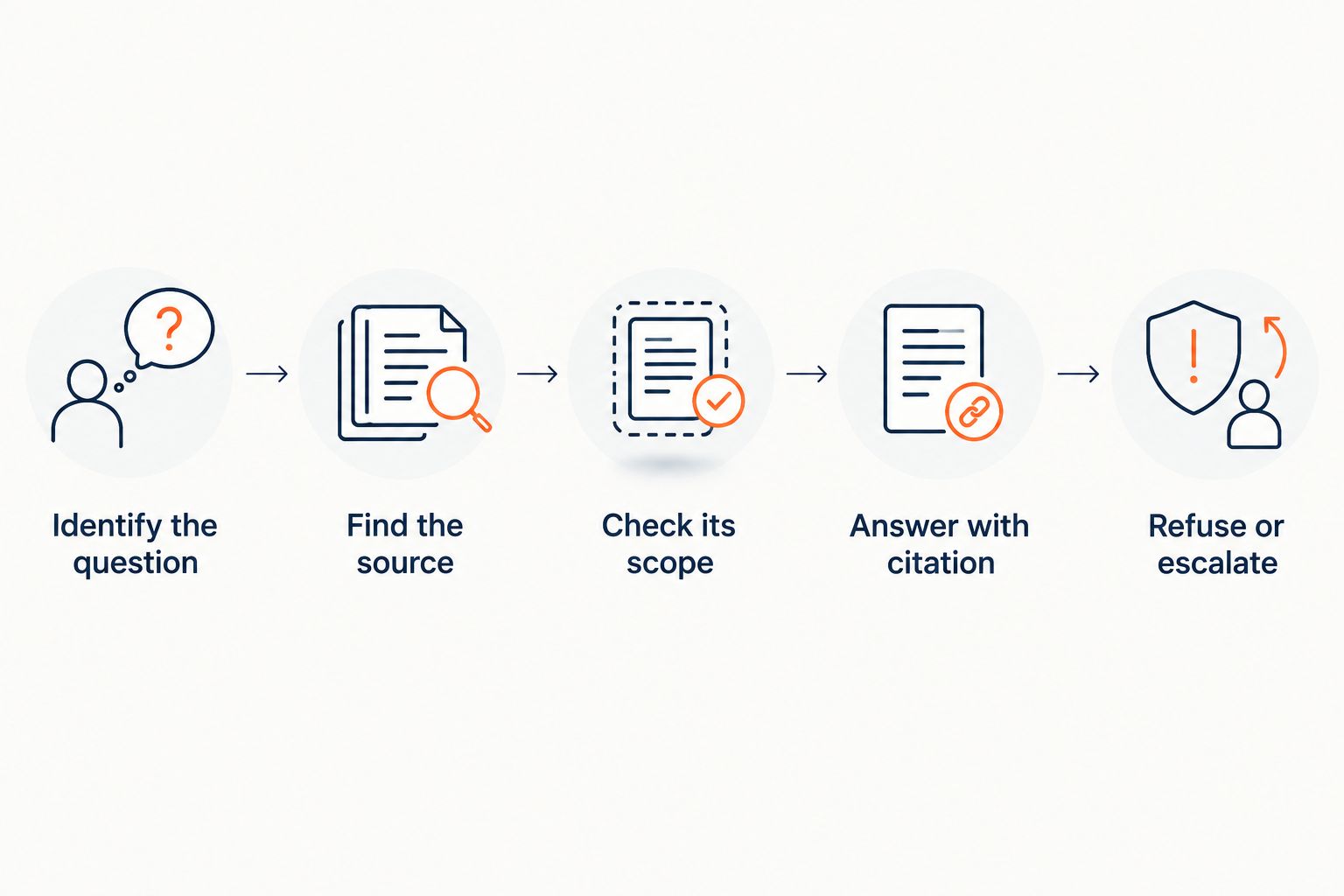
Use this sequence to decide whether your material is ready:
- Identify the question. Separate questions about course content from questions about purchase terms or personal circumstances.
- Find the source. Locate the passage that directly supports the answer, rather than a page that merely mentions the topic.
- Check its scope. Confirm that the passage concerns the offer, audience, and circumstances the buyer asked about.
- Answer with a citation. State only what the passage establishes and make the supporting source identifiable.
- Refuse or escalate. If the source is missing or unclear, explain what remains unanswered instead of filling the gap.
A correct answer is not simply a plausible answer. It is an answer whose claims survive comparison with the cited passage.
Why this matters before someone buys
A visitor opens your course page late at night and asks whether the material covers the problem they are trying to solve. Your curriculum contains the answer, but the visitor does not know which lesson to inspect. A source-grounded chat response can point to the relevant material without turning that explanation into a sales promise.
Now change the question: the visitor asks whether you will make an exception to a published policy. The same content cannot authorize that decision. Explaining an offer and changing an offer are different jobs.
For your 2026 pre-sale setup, define that boundary before writing friendly responses. A polished answer that adds an unsupported commitment creates a problem the citation cannot fix.
Which questions can your content support?
Start with questions whose answers already exist in your material. A curriculum outline can support an explanation of topics; a published offer description can support an explanation of included services. Neither automatically supports a prediction about an individual buyer's results.
The table below compares response approaches, not specific software products. Use it to choose the response behavior you want for each question.
| Response approach | Best for | Advantage | Limitation |
|---|---|---|---|
| Source-grounded answer | Published curriculum, audience descriptions, and offer terms | Gives the buyer an answer they can check against a source | Cannot establish facts absent from the material |
| General explanation | Background questions that do not concern your specific offer | Explains a concept without requiring an offer-specific claim | Must not be presented as evidence of what you sell |
| Human response | Exceptions, disputed terms, and personal suitability decisions | Lets an authorized person make the decision | Requires someone to respond rather than treating the question as settled |
For example, a question about whether your course teaches a particular method belongs with the curriculum. A question about whether you will review a buyer's work belongs with the published description of what is included. A question about whether the course guarantees a business result should not become an assurance simply because a lesson discusses that result.
Match the source to the claim. A teaching example establishes what the lesson explains, not what every student will achieve.
What content should you prepare?
Prepare material around buyer questions rather than document volume. A large library still leaves a gap if it contains lessons but no clear description of what the buyer receives. Conversely, a concise offer explanation can settle a pre-sale question without exposing your entire teaching library.
Curriculum and prerequisites
Use your curriculum to explain subjects, lesson scope, and any stated prerequisites. Keep the distinction between covered in the course and required before joining explicit. A topic appearing in an advanced lesson does not, by itself, establish an entry requirement.
If a prerequisite matters, publish it plainly. Do not expect the chatbot to infer it from technical language scattered across lessons.
Included services and access terms
Use the offer description to establish what is included. Coaching material, community discussions, and course lessons can describe activities without proving that each activity is part of the buyer's purchase.
Keep any published access or participation terms attached to the relevant offer. If several offers share content, make the differences explicit rather than relying on the chatbot to reconstruct them.
Policies and decision boundaries
Give policy questions their own authoritative source. A casual reply in a community thread should not silently become the rule for a new buyer.
Specify which questions require your decision. Requests for exceptions, individual commitments, or interpretations of conflicting terms should remain unresolved until an authorized person addresses them.
Public and member-only material
Decide what a prospective buyer is allowed to see. Using paid content to locate an answer and exposing that paid content are separate decisions.
Before publishing the widget, check the chosen system's access controls and what its citations reveal. Do not assume a citation is safe just because the answer itself contains no sensitive information.
How do you keep answers grounded in your content?
Treat source grounding as a response standard, not a tone setting. Your instructions should establish what counts as evidence, what takes precedence when material conflicts, and what the chatbot must do when it cannot substantiate a claim.
For a 2026 launch, organize the work around the following checks.
Source selection
Choose material that directly answers the questions buyers ask. Remove or clearly distinguish superseded statements so that an old description does not compete with your current offer.
A source hierarchy is a useful instruction: the current published offer and policy should govern purchase terms, while curriculum material should govern explanations of teaching content. Define your hierarchy explicitly rather than assuming every document has equal authority.
Citation checks
Inspect the relationship between the answer and its citation. The passage should support the actual claim, including qualifications that change its meaning.
A citation to a lesson on group feedback does not establish that every buyer receives personal feedback. The answer should preserve that distinction instead of borrowing authority from a related topic.
Refusal rules
Write refusal rules for requests that exceed the evidence. Use the plain boundary already expressed in HelpShelf's voice: “I can only quote what's published.” Pair that boundary with a useful next step, such as identifying the policy or explaining that the request needs your decision.
No invented discounts. No refund exceptions. No income promises. Those are response constraints, not claims that every software system automatically enforces them.
Lead capture
Separate resolving the question from collecting contact information. If a buyer wants follow-up, explain what remains unresolved before asking them to submit details.
Lead capture should not disguise uncertainty. A submitted inquiry is not confirmation that you have approved the buyer's request or agreed to an exception.
For a platform-specific starting point, see the guide to connecting HelpShelf to Kajabi for pre-sale answers. Evaluate the source and refusal behavior alongside the connection itself.
Why answer quality varies
Answer quality varies with the material supplied and the boundaries you set. Use these factors to diagnose a response that sounds fluent but does not answer the buyer's actual question:
- Source coverage: The content must address the requested fact. Related material is not a substitute for a missing policy or inclusion statement.
- Offer specificity: An answer must concern the right course, coaching offer, or community, not a similar offer elsewhere in the library.
- Source consistency: Conflicting descriptions require a clear precedence rule or a human decision.
- Citation relevance: The cited passage must substantiate the answer, not merely share its vocabulary.
- Access boundaries: Pre-sale answers must respect which material prospective buyers are allowed to receive.
- Decision authority: Published facts can be explained; discretionary commitments require authorization.
These factors give you a practical editing order. Fix missing or conflicting source statements before rewriting the chatbot's tone. Friendlier wording cannot repair unsupported evidence.
How do I test answers before putting the widget live?
Use real questions from your inbox or community, then compare each response with the source it cites. Include straightforward questions, unanswered questions, and requests for exceptions. A refusal is a successful test when answering would require invention.
Build your 2026 review around these cases:
| Test case | Passing behavior | Failing behavior |
|---|---|---|
| A curriculum question with a clear source | Explains the relevant topic and cites the supporting passage | Adds topics or outcomes absent from the passage |
| An inclusion question with qualified wording | Preserves the qualification in the answer | Turns a conditional statement into a universal promise |
| A question with no supporting source | Identifies the unanswered point | Produces a confident offer-specific answer |
| A request for an exception | Leaves the decision with an authorized person | Treats the request as approved |
| Conflicting source statements | Applies your documented precedence rule or asks for resolution | Chooses a statement without an established basis |
| A question involving restricted material | Respects your intended disclosure boundary | Reveals material the prospect should not receive |
Review the whole response, not just its opening sentence. An answer can begin correctly and then add an unsupported assurance in the final line. Also inspect the citation destination: a relevant-looking label is not enough.
After changing an offer or policy, repeat the affected tests. Your previous review applies to the previous material, not automatically to the revised content.
Does the chatbot need my entire course?
No. Start with the material needed to answer pre-sale questions: the offer description, curriculum overview, prerequisites, and published policies. Add teaching content where it supplies a useful explanation and where disclosure is appropriate.
More material is not the goal. Clear, authoritative material is.
Can the chatbot decide whether someone should buy?
The chatbot can explain how your published audience description matches the needs a visitor describes. It should not turn that comparison into an unsupported judgment about personal suitability or a promise of results.
If the decision requires your assessment, keep that assessment with you. The chatbot can identify the unanswered question without pretending to settle it.
What if the buyer asks something my content does not answer?
The chatbot should state that the published material does not establish the answer. It can identify a relevant source or collect an inquiry for follow-up, but it should not substitute a guess for your decision.
An unanswered question is also an editing signal. If buyers repeatedly need the same factual clarification, publish the answer once you have decided what it is.
FAQ
Can an AI chatbot answer pre-sale questions from my content?
Yes, when the chatbot finds relevant content, answers within what it supports, and cites the source. Missing or conflicting evidence should produce a refusal or a request for human resolution, not an invented answer.
What's HelpShelf best for?
HelpShelf is best for course creators, coaches, and community owners who need source-grounded pre-sale and support answers with lead capture. Its stated use case includes creators on platforms such as Kajabi, Skool, and Whop.
Do I have to upload my entire course?
No; start with the content needed to establish what your offer includes and who it is for. Add course material only where it answers a relevant question and is appropriate to disclose.
Can a chatbot make an exception to my refund policy?
A chatbot should explain your published refund policy, not authorize an exception unless that authority is explicitly established. Requests outside the policy need an authorized person's decision.
Does a citation prove the answer is correct?
No; a citation makes an answer checkable, but the cited passage still has to support the claim. Review whether the response preserves the source's scope and qualifications.
Can a pre-sale chatbot promise what results I'll get?
A pre-sale chatbot should not invent or guarantee results. Teaching content and examples do not establish an individual buyer's future outcome.
What should I test before launching a chatbot in 2026?
Test supported questions, unanswered questions, conflicting material, exception requests, and restricted-content questions. Check both the response and its cited source against your published terms and disclosure rules.
One last thing
Before your 2026 launch, test a question whose answer you deliberately leave out of the source material. Then ask again in more persuasive language, as a buyer trying to get a commitment.
The chatbot should not become more certain because the visitor becomes more insistent. If it invents an answer under pressure, fix the source boundaries and repeat the test before publishing.