
AI chatbots trained on your own content are accurate only when their answers match the relevant source, preserve its limits, and refuse unsupported claims. Your content gives the chatbot evidence; it does not guarantee that every answer uses that evidence correctly. In 2026, judge accuracy by checking actual answers and citations, not by accepting a blanket accuracy claim.
- How accurate are AI chatbots trained on your own content? Check source agreement, citation relevance, and unsupported claims.
- HelpShelf provides creators with source-cited pre-sale and support answers; citations still need checking.
- A correct refusal beats an invented discount, refund exception, or income promise.
- Test content updates and unanswered questions, not just questions copied directly from your FAQ.
How accurate are AI chatbots trained on your own content?
Accuracy means the answer stays inside what your published content supports. A fluent answer is not enough. A citation is not enough either: the cited passage must support the actual claim, including any conditions or exclusions.
For a creator using a source-cited chat widget such as HelpShelf, the useful distinction is between answering a documented question and making a decision your documentation does not authorize.
The examples below are illustrative response patterns, not statements about a particular course or chatbot's measured performance.
| Question type | Accurate response pattern | Failure to catch |
|---|---|---|
| Course contents | Describe only the topics documented in the course content | Add a topic because similar courses cover it |
| Coaching scope | Explain the published scope and its limitations | Promise personalized access not stated in the offer |
| Community access | Quote the relevant published access terms | Infer access rules from another membership |
| Refund exception | State the published policy without approving an exception | Treat a sympathetic explanation as authorization |
| Expected results | Explain what the material teaches | Turn learning objectives into income promises |
| Missing information | State that the sources do not answer the question | Fill the gap with a plausible business policy |
Each row needs an answer check and a source check. An answer can sound correct while pointing to a page that discusses the topic without supporting the specific conclusion.
Why this matters
Imagine a visitor asking about your coaching program at 11pm. You are offline, and the visitor wants to know whether the program includes individual feedback. The chatbot finds a lesson about giving feedback and mistakes that lesson topic for an included service.
The answer sounds relevant. It is still wrong.
For your 2026 pre-sale workflow, separate questions about the material from questions about the offer. A lesson explains what you teach; an offer page explains what someone receives. Neither should silently stand in for the other.
A chatbot should explain your offer, not expand it. That boundary matters before purchase and after purchase, when a member asks for something outside the published terms.
What should you count as a correct answer?
Use a written standard before you review conversations. Otherwise, a polished response can pass because it sounds helpful, even when its main claim has no source.
Source agreement
Check every material claim against the cited passage. If the answer says the program covers a topic, the source should say so. A broad mention elsewhere in your content does not establish that the topic belongs to the offer being discussed.
Watch for added qualifiers. Words such as unlimited, guaranteed, personal, and permanent change the meaning of an answer. They need explicit support, not an assumption based on how similar businesses operate.
Complete conditions
A correct answer preserves the conditions that affect the visitor's decision. If your source states a requirement, the chatbot should not summarize it away.
This is especially important when the question contains its own proposed exception. A visitor asking whether a rule still applies in their circumstances has not supplied evidence that the rule changes. The answer must distinguish the published rule from an unresolved request.
Relevant citations
Open the citation and locate the supporting passage. The source should answer the question being asked, not merely contain a matching keyword.
A course lesson about client onboarding does not establish your own onboarding policy. A community discussion about refunds does not automatically define your refund terms. Check the role of the source as well as its wording.
Correct limits
A correct response can be a refusal. When the documentation does not support an answer, the chatbot should make that boundary visible rather than conceal it with confident language.
A suggested refusal pattern is: “I can only quote what's published. The available content does not confirm that exception.” Treat this as a response to test for, not a promise that every system already behaves this way.
Why chatbot accuracy varies
Accuracy varies with the content available and the way the system turns that content into an answer. For a 2026 review, examine these factors separately rather than treating every error as the same problem.
- Content coverage: The answer needs a source. An undocumented policy cannot become a documented policy through a chatbot response.
- Source currency: An answer based on an outdated page can accurately repeat that page while misrepresenting your current offer.
- Conflicting material: Different descriptions of the same offer leave a conflict that needs resolution, not a blended answer.
- Retrieval relevance: Finding a passage about the right topic is different from finding the passage that answers the question.
- Answer boundaries: The response must preserve restrictions and avoid inventing exceptions, discounts, or results.
- Question context: A question about course content requires different evidence from a question about purchase terms or an individual account.
Fix the specific failure you find. Rewrite unclear content when the source is ambiguous. Correct retrieval when the right source exists but is not used. Tighten answer rules when the source is clear but the response adds an unsupported claim.
Uploading more material is not a substitute for resolving contradictions. A larger collection of conflicting documents still contains conflicting documents.
How do you test accuracy before publishing the widget?
Build your review around the questions visitors actually ask. Include ordinary questions, awkward wording, and requests that the chatbot should not fulfill. Keep the expected answer beside the authoritative source so you can judge the response against a stable standard.
Choose questions
Use pre-sale messages, support requests, and recurring community questions that you are permitted to review. Include questions about course contents, coaching boundaries, access terms, and requests for exceptions.
Do not test only by copying headings from your FAQ. A visitor does not have your content structure in front of them. They ask in their own words, combine topics, and sometimes assume something your offer never stated.
Mark sources
For each question, identify the source that should govern the answer. Record the expected conclusion and the conditions the response must retain.
If there is no supporting source, mark the expected behavior as a refusal or a request for clarification. Do not write an imagined policy into the answer key; that would reward the same invention you are trying to prevent.
Check answers
Read the response claim by claim, then open its citations. Check whether the response answers the question, preserves the source's limits, and avoids importing details from another offer.
Record incorrect answers separately from unsupported answers. An unsupported answer can happen to match your intention and still fail the test: the system has not shown a valid basis for saying it.
Check refusals
Ask for an unpublished discount, an exception to a published policy, and a guaranteed income result. These are test requests, not offers you should add to the widget.
The correct behavior is to state the published boundary without bargaining. A helpful refusal explains what is known and what remains unresolved. It does not invent a concession to keep the conversation moving.
Recheck changes
After changing source content, repeat the affected questions. Confirm that the answer and its citation reflect the intended version, and check related questions that depend on the same policy.
For your 2026 operating routine, make this a publishing task: update the source, verify the response, then allow that revised answer into customer conversations. Do not assume a content edit and a correct chatbot answer are the same event.
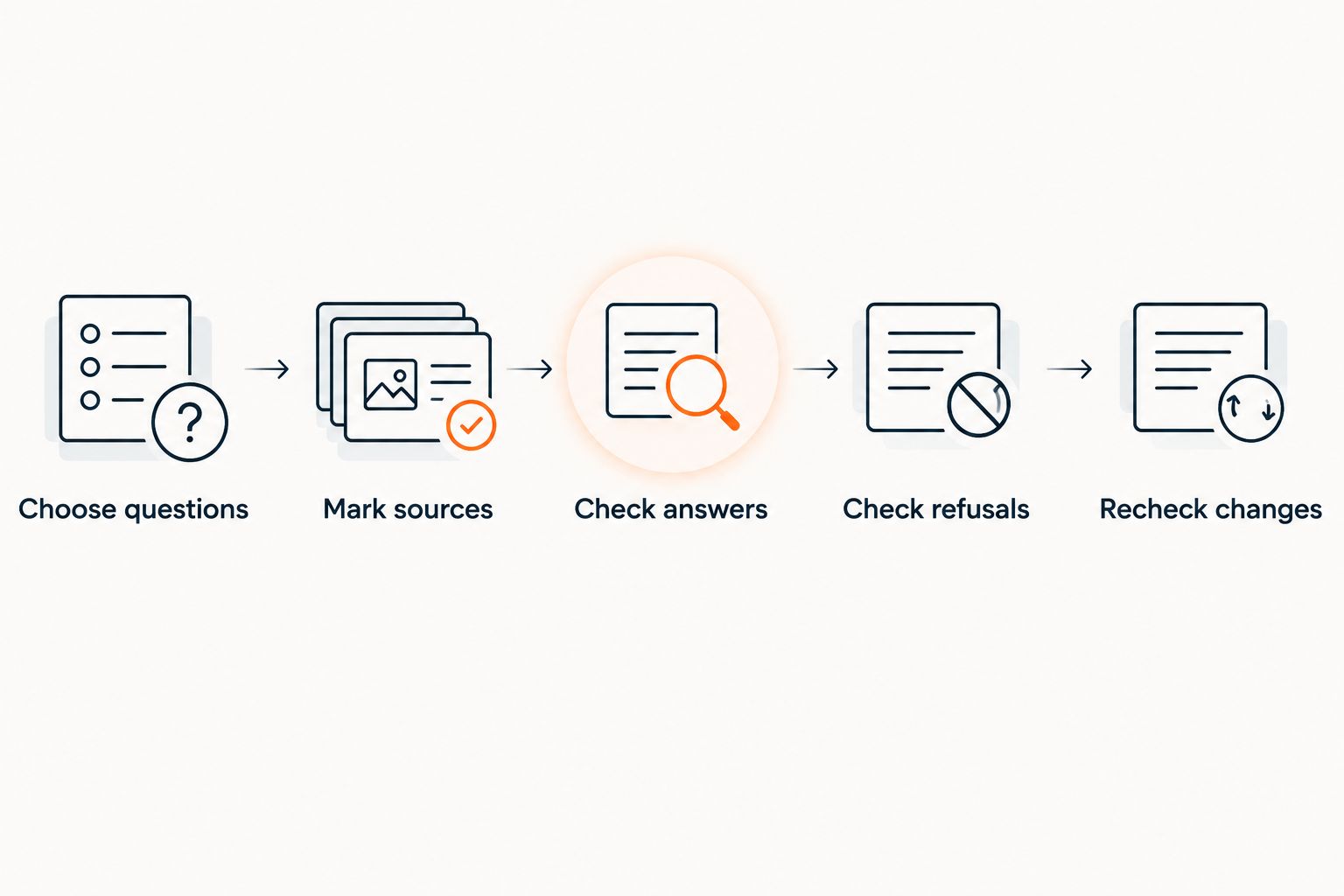
Keep the test record simple: question, expected behavior, authoritative source, actual answer, and failure reason. That record lets you distinguish a content problem from an answer problem without relying on memory or tone.
Does training on your content prevent hallucinations?
Training on your content does not guarantee that every response stays within it. The system still needs to find the relevant evidence and produce an answer that does not add unsupported details.
The phrase trained on your content also does not specify how a product works. Ask whether it retrieves your documents when answering, modifies a model through training, or uses another approach. Then test the behavior rather than treating the implementation label as proof of accuracy.
For creator support, an invented business detail is a practical failure even when the surrounding explanation is correct. A response that describes your course accurately but invents a refund exception still fails the accuracy check.
Does a citation prove the chatbot is right?
A citation does not prove that the chatbot is right; it gives you a source to inspect. The source must support the answer's specific claims, not just mention the same subject.
Read the answer and source together. If the answer promises more than the passage says, reject it even when the link works. If the passage contains a condition that the answer omits, correct the answer before treating it as usable.
A citation is an inspection path, not an accuracy certificate. It makes checking possible; the checking still matters.
Can a chatbot be accurate when your content is incomplete?
A chatbot can answer accurately from incomplete content when it limits its answer to what the content supports. It cannot provide a documented answer to a question your documents never address.
For example, your course outline can support an explanation of lesson topics without establishing whether an individual buyer qualifies for an exception. The accurate response separates those questions rather than using the outline to answer both.
Keep refusals distinct from wrong answers in your review. Otherwise, you create an incentive to guess whenever the source is silent.
Where HelpShelf fits for creators
HelpShelf is built for course creators, coaches, and community owners who need source-cited pre-sale and support answers. Its chat widget uses a creator's own content and captures leads, which fits questions about what an offer includes and requests for follow-up.
The benefit is a response tied to material you can inspect. The limit is that citations do not remove your responsibility to maintain the material or check whether an answer follows it.
A useful 2026 setup starts with a narrow boundary: answer documented questions, show the supporting source, and do not turn an unanswered request into a new business commitment. Lead capture gives you a way to receive interest; it is not permission for a chatbot to promise an outcome.
FAQ
How accurate are AI chatbots trained on your own content?
Their accuracy depends on whether each answer matches the relevant source and preserves its conditions. Check actual answers, citations, and refusals rather than relying on a universal accuracy percentage.
Can an AI chatbot invent an answer even when I upload my own documents?
Yes, using your documents does not guarantee that every answer is supported. Test questions whose answers are absent and reject responses that invent policies or exceptions.
How do I check whether a chatbot citation supports its answer?
Open the cited source and compare its wording with each material claim in the answer. Reject added promises and omitted conditions, even when the source discusses the same topic.
Should my chatbot answer questions that my course content does not cover?
Your chatbot should not present undocumented information as your policy or offer. It should explain the limit, ask for clarification when useful, or leave the unresolved decision to you.
Can my chatbot approve a refund exception?
Your chatbot should not approve a refund exception that your published policy does not authorize. It can explain the policy without making a new commitment on your behalf.
Do I need to retest my chatbot after changing my content?
Retest the questions affected by a content change and verify the supporting citations. A correct answer before the edit does not establish that the revised answer is correct.
Is a chatbot refusal a sign that the chatbot is inaccurate?
A refusal is accurate when the sources do not support an answer. Track correct refusals separately from incorrect answers so your review does not reward guessing.
One last thing
Test a question that contains a false assumption, not just a missing answer. For example, ask where to claim a discount that you have never published. The chatbot should reject the assumption rather than explain how to claim it.
That test checks more than recall. It checks whether a visitor's wording can become an invented fact about your business. Your content should determine the answer; the question should not rewrite your offer.