
No—an AI chatbot does not need constant retraining to stay accurate when it retrieves answers from current, approved content rather than relying only on information learned during model training. In 2026, the ongoing work is maintaining those sources, checking the answers they produce, and correcting unsupported responses; updating content is not the same as retraining a model.
- Does an AI chatbot need constant retraining to stay accurate? No; source updates and answer checks address different problems.
- HelpShelf is best suited to creators seeking source-cited chat answers from their own course, coaching, or community content.
- Retraining changes model parameters; retrieval supplies relevant content when a visitor asks a question.
- A citation helps you inspect an answer, but does not prove the answer matches the source.
Does an AI chatbot need constant retraining to stay accurate?
Constant retraining is not a requirement for a source-grounded chatbot. A retrieval-based system looks up relevant material and supplies it to the model when answering. That lets the system use information outside the model's original training data.
Retraining changes the model itself. Refreshing a knowledge source changes the information available to the chatbot. Testing checks whether the chatbot uses that information correctly. These are separate jobs, even when a vendor describes all of them as training.
If you are comparing setup processes, start with the distinction explained in training a chatbot on your content. Ask what actually changes: the model, the searchable content, or the instructions governing its answers.
| Maintenance approach | Best for | What it changes | Advantage | Limitation |
|---|---|---|---|---|
| Source refresh | Keeping course and support information current | Content available for retrieval | Makes updated material available without changing model parameters | Outdated or conflicting sources still produce problems |
| Answer instructions | Defining boundaries and response behavior | Rules supplied to the model | Clarifies when to answer, refuse, or refer a question | Instructions do not supply missing facts |
| Fine-tuning | Teaching recurring response patterns or specialized behavior | Model parameters through additional training | Can adapt behavior using selected examples | Does not replace current reference material |
| Answer testing | Checking whether the system behaves correctly | Evaluation and the resulting fixes | Separates content problems from response problems | Requires someone to inspect failures and act |
None of these approaches removes the need for review. The useful question is not whether a chatbot is permanently trained. It is whether your current content supports the answer a visitor receives.
Why this matters
A prospective student asks whether your course includes personal feedback. Your public course page describes recorded lessons, while an old announcement mentions feedback sessions. A chatbot that finds the old announcement has a source—but not necessarily the right source for the current offer.
Retraining is the wrong first response to that problem. Resolve the conflicting content, identify the current offer, and test the question again. Otherwise, you leave the underlying ambiguity in place.
For a 2026 course launch, your maintenance process should follow the published offer. When the offer changes, the source material and its answers need review. An unchanged offer does not become inaccurate simply because another week passes.
Accuracy depends on the full answer path: the source, retrieval, interpretation, and response boundaries. A newer model does not repair an outdated policy page.
Source updates: keep published facts current
Source updates are the first place to look when a chatbot answers with outdated information. Check the material it can access, rather than assuming the model needs another training run.
For course creators, this material includes curriculum descriptions, access instructions, coaching scope, community rules, and published policies. Each source needs a clear purpose. A member onboarding document should not silently become the authority for an unrelated pre-sale promise.
Consider a hypothetical curriculum change. You replace a lesson and update the course description, but an older outline remains searchable. The chatbot now has competing descriptions. More content has not made the answer better.
The practical fix is to update or retire the outdated outline and confirm that the answering system uses the current version. Do not assume that editing a document immediately changes every answer. Check how your chosen system refreshes its searchable content, then test the resulting response.
Use source updates for changed facts. Keep a record of which document owns each policy or offer detail so a correction has somewhere definite to land.
Answer instructions: define what the chatbot must not invent
Instructions govern behavior. They should tell the chatbot how to handle missing information, conflicting sources, and requests outside its authority.
A prospective buyer might ask for an unpublished discount or an exception to a refund policy. Neither question becomes answerable through more confident wording. The source must contain the offer or permission being claimed.
An illustrative refusal is: I can only quote what's published. The available policy does not describe that exception. This is a response pattern, not a statement about any particular creator's policy.
Set the same boundary for income promises. Course content describing a business method does not establish what a particular student will earn. The chatbot should explain the published curriculum without converting it into a guaranteed result.
Good instructions also separate pre-sale information from member-specific support. A general access guide can explain the published process, but it does not establish why a particular person's account is failing.
Use instructions for boundaries, not as a substitute for evidence. A rule that says to answer accurately cannot supply a missing coaching policy or determine an unpublished exception.
Fine-tuning: a separate tool, not a freshness routine
Fine-tuning adjusts a model using additional training examples. It can be useful when a task needs consistent specialized behavior, but it is not equivalent to looking up your latest course information.
A creator changing community rules needs the chatbot to consult the revised rules. Teaching the model more examples of polite support responses addresses a different issue. The distinction matters when a provider calls every content upload training.
Ask the provider to describe the mechanism in plain terms. Does uploading a document make it searchable? Does it change model parameters? Does it only add instructions? Your maintenance responsibilities depend on the answer.
For a 2026 evaluation, judge the workflow by observable behavior rather than the training label. Change an approved source, verify that the change reaches the answering system, and ask a question that depends on it.
Consider fine-tuning for a defined behavioral problem. Do not treat it as the default fix for outdated business facts. Retrieval and model training can coexist, but they solve different parts of the answer process.
Why chatbot maintenance varies
The maintenance workload follows your content and the questions people ask. It is not determined by a universal retraining calendar.
- Course changes: Revised lessons, prerequisites, or access instructions require the corresponding sources and answers to be checked.
- Coaching scope: Answers must match what your published coaching description includes, without adding personal access or services.
- Community rules: Member guidance needs to reflect the rules you currently publish, not a retired announcement.
- Pre-sale questions: A question your existing content cannot answer exposes a documentation gap, not automatically a training failure.
- Source conflicts: Contradictory pages require a decision about authority before the chatbot can reliably choose between them.
- Response boundaries: Requests for discounts, refund exceptions, or income promises need a refusal or referral when published content does not support them.
These factors tell you where to spend attention. A curriculum update calls for a source review. A chatbot that invents an exception despite a clear policy calls for inspection of its retrieval and instructions.
Do not measure maintenance only by how often someone uploads content. A large collection of unresolved contradictions is harder to answer from than a smaller, current set of approved documents.
How do you keep a chatbot accurate without constant retraining?
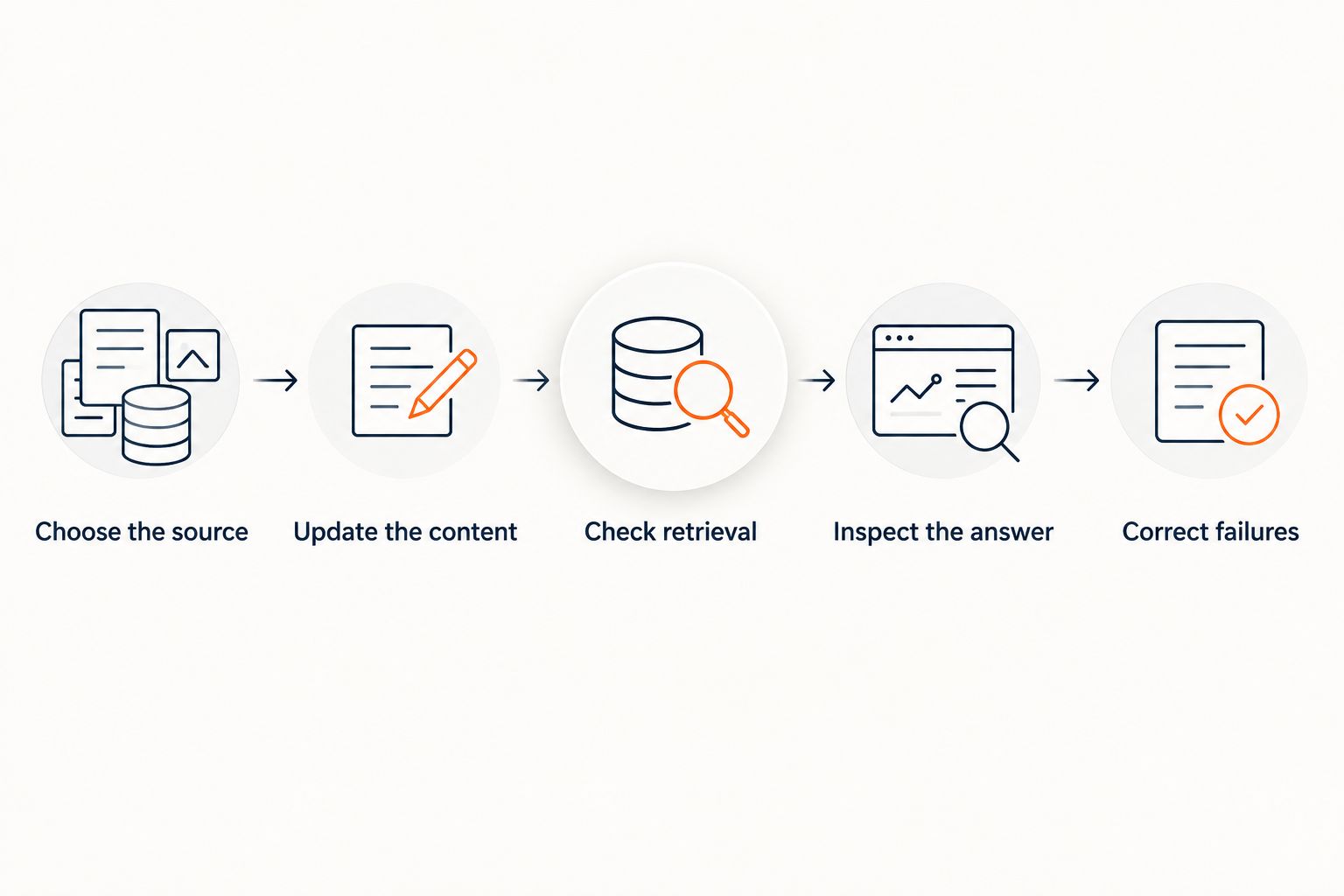
Use a change-based workflow: identify the source, update it, verify retrieval, inspect the answer, and correct failures. This is a recommended process, not a claim about any product's automatic refresh behavior.
- Choose the source. Identify the document that owns the answer. For coaching scope, use the published coaching description rather than an informal message.
- Update the content. Edit the authoritative material and remove or clearly retire contradictory versions. Keep the wording specific enough to answer a buyer's actual question.
- Check retrieval. Confirm that the answering system can access the revised material. An updated document is not useful if the system still retrieves its old version.
- Inspect the answer. Ask the original question and a differently worded version. Read the response alongside its cited passage, including any conditions the response leaves out.
- Correct failures. Fix the layer responsible: content, retrieval, instructions, or response behavior. Retest the same question after the correction.
This sequence prevents a vague complaint—the chatbot is wrong—from becoming an unnecessary training project. It also gives you a repeatable way to inspect a change before relying on the resulting answers.
During your 2026 content review, include questions that should not receive a substantive answer. An unpublished concession is a useful boundary test: the correct response should not turn an absence of information into permission.
Keep failed questions with their cited sources. A transcript shows what the chatbot said; the source shows whether it had support for saying it. You need both to diagnose the problem.
Where a creator-focused chat widget fits
HelpShelf is best suited to creators who want source-cited chat answers from their own course, coaching, or community content. Its AI chat widget answers pre-sale and support questions using that content and captures leads.
The advantage is a visible connection between an answer and the creator's material. The limitation is the same connection: incomplete, outdated, or ambiguous material still needs attention. A citation makes inspection possible; it does not eliminate editorial responsibility.
If that matches your use case, HelpShelf is a relevant option to assess. Evaluate it against your published content and boundary questions rather than assuming that cited answers require no maintenance.
For example, test whether the answer distinguishes what your course teaches from what your coaching includes. Then inspect a question whose answer is absent from the sources. Both checks matter before using a widget for buyer conversations.
How often should I update my chatbot's knowledge sources?
Update knowledge sources when the information they govern changes. Review failed or unanswered questions as well, because those questions reveal where your published material needs clarification.
A fixed schedule does not replace change-based checks. If you revise a policy between scheduled reviews, its answers need attention then—not after the next calendar reminder.
Assign responsibility for each source. Someone must decide whether a course outline is current and whether a coaching description accurately represents the offer. The chatbot cannot own those business decisions.
Does a citation guarantee that a chatbot answer is accurate?
No—a citation identifies supporting material, but the response can still misread it, omit a condition, or cite an outdated page. Check whether the cited passage supports the complete answer.
Suppose a hypothetical coaching description makes personal feedback conditional on a specified arrangement. An answer that removes that condition changes the offer, even if it links to the correct document.
Read the answer and its source together. The test is whether a visitor would reach the same conclusion from the source—not merely whether a citation appears.
FAQ
Does an AI chatbot need constant retraining to stay accurate?
No—a retrieval-based chatbot does not need constant model retraining to use current reference content. It does need maintained sources, answer testing, and corrections when its responses are unsupported.
Is updating chatbot content the same as retraining a model?
No—updating content changes the reference material available to the chatbot, while retraining changes model parameters. Ask your provider which process its training label describes.
Can a chatbot answer from information published after its model was trained?
Yes—a retrieval-based chatbot can use later information supplied from accessible sources when answering. The source must reach the answering system, and the resulting answer still needs checking.
Should I retrain my chatbot whenever I change my course?
Start by updating the authoritative course content and checking the affected answers. A changed lesson or course description is a source-maintenance issue before it is a model-training issue.
What should a chatbot say when my content does not answer a question?
The chatbot should state the limit rather than invent an answer. For an unpublished exception, an illustrative response is: I can only quote what's published.
Does HelpShelf answer questions from a creator's own content?
Yes—HelpShelf's AI chat widget answers pre-sale and support questions using a creator's own course, coaching, or community content with cited sources. It also captures leads; creators still need to maintain the material supporting those answers.
What should I check when reviewing a chatbot in 2026?
Check current-source access, answer fidelity, citations, and responses to unsupported requests. Use questions tied to your actual published offer, including questions the available content cannot answer.
One last thing
Keep one deliberately unanswerable question in your review process. Ask for something your published content does not authorize, such as an exception you have never documented.
A correct factual answer shows that the chatbot can use a source. A correct refusal shows that it can stop at the source's boundary. Your 2026 maintenance process needs both checks—not another training run by default.