
AI customer service software can replace some support tasks, but it should not replace responsibility for customer support. Use it to answer questions supported by your published content; keep a person responsible for exceptions, account-specific decisions, and unresolved problems. In 2026, the practical choice for a course creator, coach, or community owner is to automate documented answers without giving software permission to invent policy.
- Can AI customer service software replace a support team? Replace documented answers, not human responsibility.
- HelpShelf fits creators who need customer support and pre-sale answers grounded in their own content.
- Keep refund exceptions, account decisions, and unpublished commitments with a person.
- Judge an answer by its source and correctness, not whether the conversation ended.
Can AI customer service software replace a support team?
Replace tasks before you replace roles. A published lesson location and a request for a refund exception are different kinds of work. The first needs an accurate answer from an approved source; the second needs someone with authority to decide.
Start by separating questions that require information from questions that require action. The distinction matters more than whether a chatbot sounds conversational. This guide to citing sources from your own content explains the source-grounded side of that decision.
| Support approach | Best for | Main advantage | Main limitation |
|---|---|---|---|
| AI-only support | Published information with no discretionary decision | Answers can draw from approved content | An answer does not establish authority to change an account or policy |
| Human-only support | Exceptions, disputes, and individual decisions | A responsible person can investigate and decide | Someone must also handle repetitive questions |
| AI plus human support | Creators with routine questions and unresolved cases | Separates documented answers from decisions | Requires maintained sources and a clear human owner |
For a 2026 support plan, choose AI plus human support when your inbox contains both routine questions and cases that require judgment. Do not treat all messages as interchangeable simply because they arrive through the same widget.
Why this matters
A prospective student asks whether your course covers a particular topic. The answer belongs in your published course information. A member says they were charged incorrectly. That needs account evidence, not a summary of your sales page.
If you send both requests through an answer-only process, you confuse explanation with resolution. A confident description of your billing policy does not investigate a disputed charge. A citation helps the visitor inspect an answer; it does not prove that an account problem is fixed.
Your support design should therefore name the boundary: software explains what is published; an authorized person handles what requires a decision or action. That boundary also gives you a practical way to review failures. Ask whether the answer was unsupported, the source was outdated, or the request belonged with a person from the start.
What can AI customer service software answer?
Use source-grounded support for questions whose answers already exist in content you approve. For a creator business, that includes questions about course topics, published participation requirements, lesson instructions, and documented community rules. Check each source before making it available to visitors.
For example, a prospective buyer asks whether a course teaches a particular technique. If the published outline names that technique, the reply can explain where it appears and cite the outline. If the outline does not mention it, the reply should not convert a related lesson title into a promise.
Use this example refusal when the source does not settle the question: I can only quote what's published. The course outline does not confirm that topic. This is a proposed response pattern, not a claim about any specific course or an actual customer conversation.
Keep answers within the audience's access boundary, too. Content suitable for an enrolled student is not automatically suitable for a pre-sale visitor. Decide which material belongs in each context rather than assuming that every document should answer every question.
Recommendation: automate the explanation only when you can identify the approved source that supports it. If the source cannot support the answer, route the question rather than filling the gap.
Which support work should stay with a person?
Keep a person responsible whenever the visitor asks for an exception, disputes what happened, or needs a change that an informational answer cannot perform. A request to explain a published refund policy is different from a request to override it. Do not let the wording blur that distinction.
For example, a student asks for an exception because of a personal situation. The support response can identify the published policy, but it should not manufacture an approval. An example boundary is: I can explain the published policy, but an exception needs a decision from the person responsible for support.
Retain human ownership of:
- Policy exceptions: Requests that go beyond the published terms.
- Account disputes: Claims requiring investigation into a particular customer's records.
- Unpublished commitments: Requests for guarantees or terms absent from approved content.
- Unresolved problems: Cases where the documented instructions did not address the customer's issue.
- Content corrections: Reports that a source is inaccurate, inconsistent, or no longer current.
The point is not that a person must type every reply. The point is that someone must own the outcome. A customer should not have to keep rephrasing a request that the system lacks the authority or evidence to resolve.
Why the amount of support you can automate varies
The useful scope of automation depends on the questions you receive and the material available to answer them. Do not set a staffing decision from a chatbot demonstration that only covers straightforward examples.
For your 2026 review, examine these factors:
- Source coverage: Check whether your approved content actually answers the recurring questions. Missing information creates a documentation task, not permission to improvise.
- Source consistency: Compare instructions and policies across the materials you provide. Resolve conflicts before expecting a single dependable answer.
- Audience access: Separate content for prospective buyers from material intended for paying members. Match the answer source to the visitor's context.
- Decision authority: Identify which questions need approval, investigation, or an account change. Keep those distinct from requests for explanations.
- Follow-up ownership: Name the person responsible when a question remains unresolved. Lead capture alone does not complete support.
These factors give you a better starting point than a blanket replacement claim. Your content and workflow determine the boundary. The software should operate inside it, not define it for you.
How should you introduce AI support in 2026?
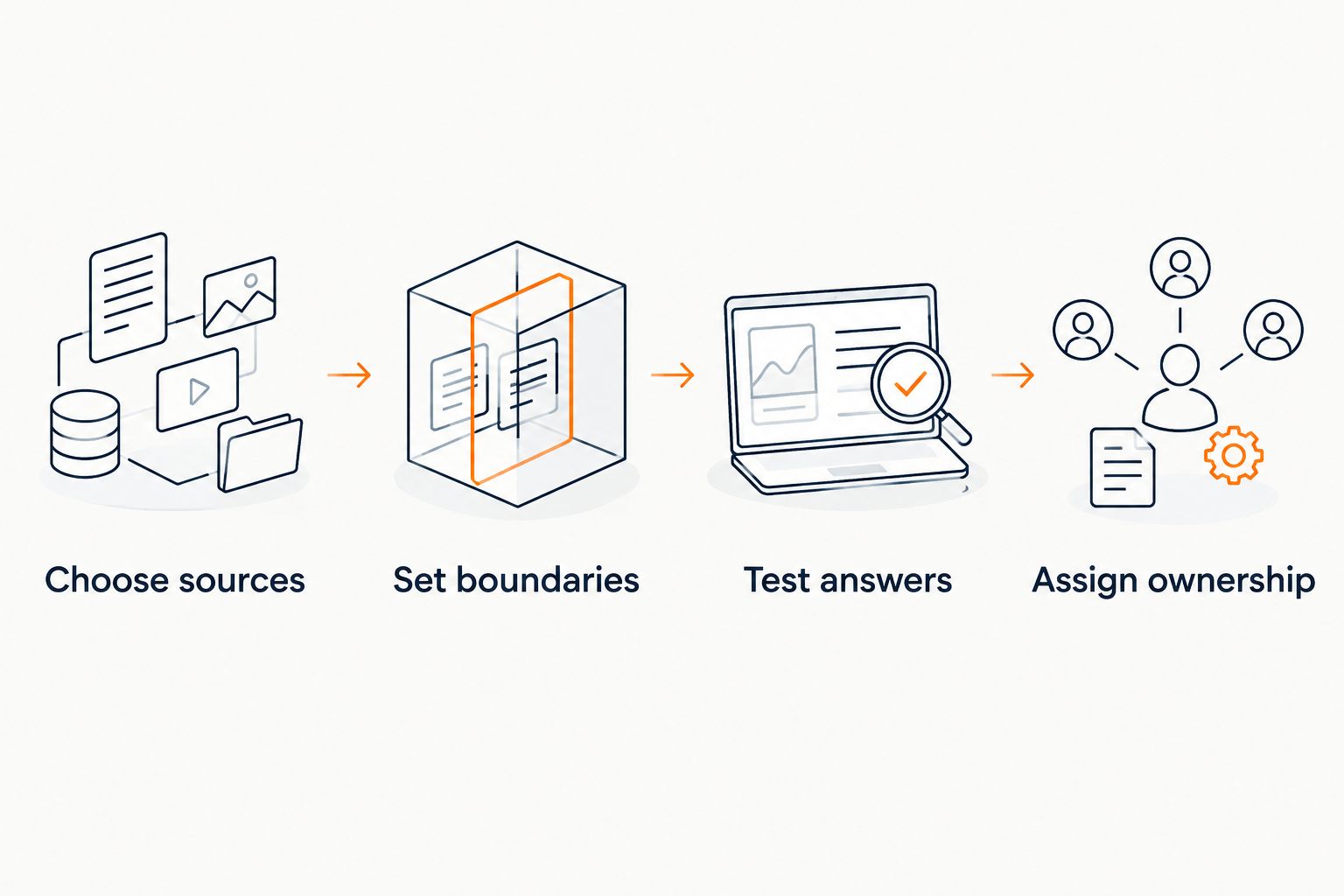
Introduce AI support as a bounded answering workflow. Begin with published information, define what the system must not decide, and review whether its responses stay within those limits. Keep someone responsible for correcting sources and handling unresolved questions.
Choose sources
Collect the material you are willing to stand behind: course descriptions, approved lesson instructions, participation rules, and published policies. Remove superseded documents from the answering set. If two sources disagree, settle the disagreement before treating either as authoritative.
Make the source useful to a visitor, not just to the system. An answer that cites a vague heading leaves the customer to find the missing detail. Prefer material that states the relevant instruction or boundary directly.
Set boundaries
Write explicit rules for unsupported requests. No invented discounts. No refund exceptions. No income promises. A visitor asking for something outside your published terms should receive a clear boundary and an appropriate next step, not a persuasive substitute for evidence.
Separate answering from acting. If a workflow explains an account change but cannot carry it out, the reply should not imply completion. Make that distinction visible before a visitor relies on the answer.
Test answers
Use questions from your actual support inbox. Include a straightforward question, a question whose answer is absent, and a request that conflicts with a published rule. Review the response and the cited source together.
Do not stop at checking whether a citation exists. Read the cited passage and ask whether it supports the complete reply. A real source can still accompany an unsupported conclusion. Also check whether the response makes clear what remains unresolved.
Assign ownership
Choose who receives unresolved cases and who maintains the source material. Tell visitors what to expect without inventing a response deadline. Keep the question and the attempted answer available to the person handling the next step.
For the 2026 rollout, retain responsibility for reviewing the workflow after publication. A changed policy or revised course outline needs a corresponding source update. Otherwise, a previously correct answer can become the wrong answer without any change in how fluently it is written.
Where HelpShelf fits in a creator's support workflow
HelpShelf is best for course creators, coaches, and community owners who need source-grounded pre-sale and support answers. Its AI customer service chat widget uses the creator's own content, provides cited sources, and captures leads. Those functions match the informational side of the workflow described here.
Consider a prospective student asking about course content while you are away from your inbox. HelpShelf can use your supplied content to answer that kind of pre-sale question with citations. Lead capture gives you a way to collect the visitor's details for follow-up; it does not establish that a person has completed that follow-up.
The advantage is a reply tied to your material rather than an unsupported sales promise. The limitation is equally important: source-grounded answers depend on what your content establishes. HelpShelf should not be treated as evidence that a billing dispute is resolved, an exception is approved, or an unpublished offer exists.
Keep your decision criteria concrete. You need accurate answers from approved content, citations visitors can inspect, and a human process for questions that the content cannot settle.
Can a solo creator use AI support without hiring a team?
Yes, a solo creator can use AI support while remaining the person responsible for exceptions and unresolved questions. The workflow does not require you to call that responsibility a department. It requires you to keep it assigned.
Start with the repeated questions you already answer from published material. Keep requests needing investigation in your own queue. Do not assume that adding a widget creates capacity for every type of customer problem; first check whether the remaining work is getting resolved.
Does answering a refund question mean resolving a refund request?
No, explaining a refund policy is not the same as deciding or processing a refund request. An informational response can quote the published terms. A particular customer's request still needs the appropriate decision and action.
Keep that distinction in the language of the reply. Do not describe a policy explanation as an approval, and do not promise an exception that the published material does not authorize. A clear refusal is more useful than reassurance that leaves the customer expecting something you have not agreed to provide.
FAQ
Can AI customer service software replace my whole support team?
AI customer service software can take over documented answering tasks, but it should not replace responsibility for exceptions and unresolved cases. Separate questions that need information from requests that need investigation, approval, or action.
What's the best support approach for a course creator in 2026?
AI plus human support is the recommended approach when your course business receives both routine questions and requests requiring decisions. Use approved content for routine answers and assign a person to unresolved cases.
Can an AI chatbot answer questions from my course content?
Yes, HelpShelf uses a creator's own content to answer pre-sale and support questions with cited sources. Decide which content is appropriate for prospective buyers and which belongs with enrolled members.
Can AI support approve a refund exception?
Do not give an answering workflow authority to invent refund exceptions. It can explain the published policy, while an authorized person handles requests that require a separate decision.
Does a citation prove an AI answer is correct?
No, a citation alone does not prove that the full answer is correct. Read the cited passage and check that it supports the response without added promises or conclusions.
How do I test whether AI customer support is working?
Test AI customer support against real questions and review the answers alongside their sources. Include missing-information questions and exception requests, then check that unresolved cases reach the person responsible.
Do I still need to maintain support documents in 2026?
Yes, source-grounded support needs current, approved documents. Update the answering material when course information, instructions, or published policies change.
One last thing
A correct refusal is a successful support response when the alternative is an invented promise. Include unsupported questions in your review, not just questions with easy answers. Ask what happens when a visitor requests an unpublished discount, an outcome guarantee, or an exception.
Your 2026 support workflow should make the limit visible and preserve a useful next step. The aim is not to make every conversation look resolved. It is to give customers answers you can stand behind and keep responsibility for everything those answers do not settle.