
Training an AI chatbot on your content has no fixed completion time: preparing the sources, processing them, and checking the answers are separate jobs. For a source-grounded chatbot in 2026, processing is only one part of setup; launch readiness also requires checking citations, conflicting information, and questions your content does not answer.
- How long does it take to train an AI chatbot on your content? Separate content processing from launch readiness.
- HelpShelf answers creator sales and support questions from their own content, with cited sources.
- A completed import does not prove correct answers; check citations, missing information, and conflicting policies.
- Launch on a defined content scope, without invented discounts, refund exceptions, or income promises.
How long does it take to train an AI chatbot on your content?
Measure the work in stages, not just the time between uploading a document and receiving an answer. An import can finish while the underlying content still contains outdated instructions or unanswered buyer questions. Those problems require content decisions, not another upload.
HelpShelf provides a chat widget that answers pre-sale and support questions using a creator’s own content, with cited sources and lead capture. For that kind of use, the useful endpoint is an answer you can verify against the published material—not simply a chatbot that responds.
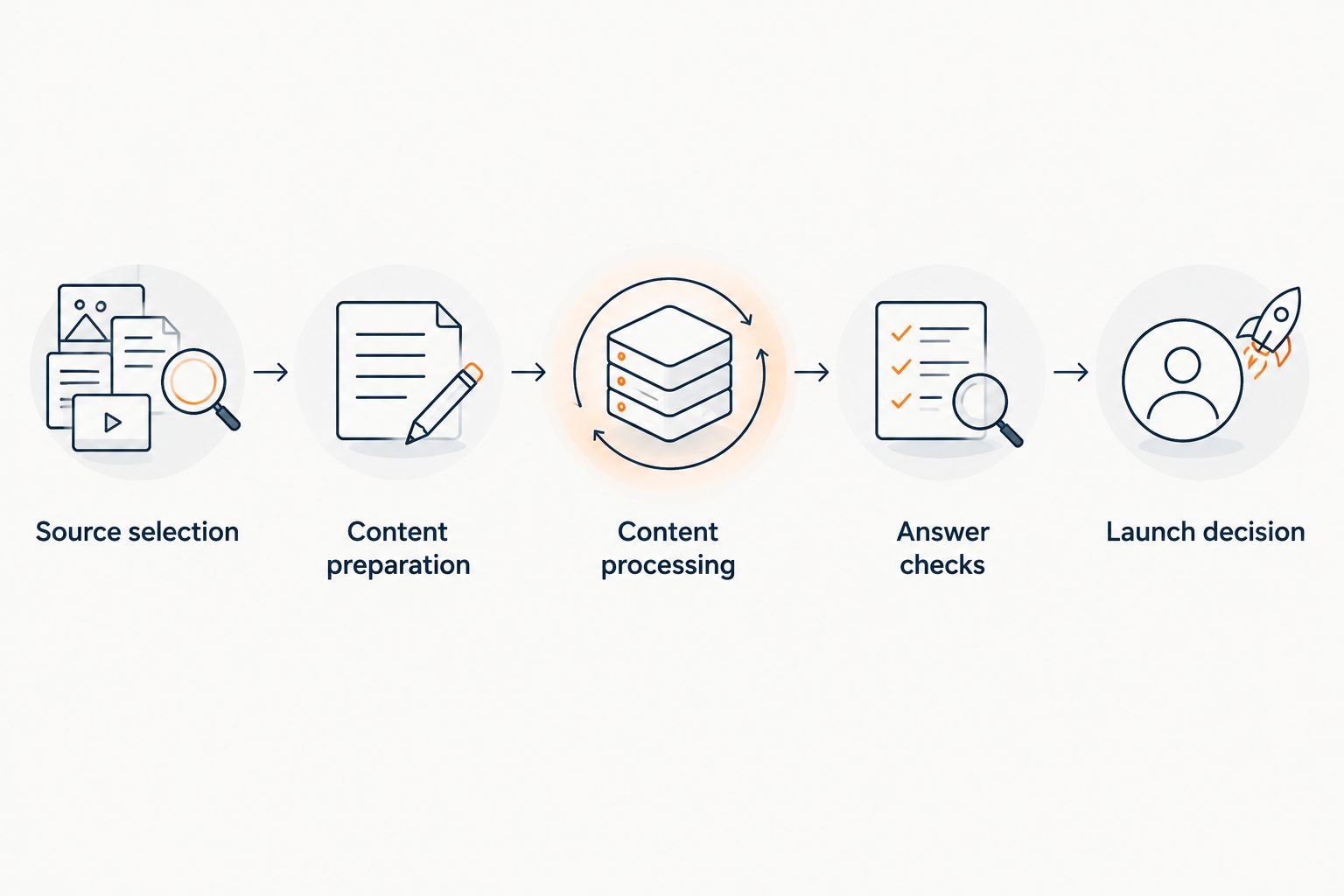
Separate the work into these stages:
- Source selection: Decide which material the chatbot should use and which material should stay out.
- Content preparation: Make the approved information readable, current, and clear about its audience.
- Content processing: Let the selected system process the material for use in answers.
- Answer checks: Compare responses and citations with the approved sources.
- Launch decision: Publish only within the scope that passed those checks.
Record when each stage starts and ends during your own setup. That gives you a useful answer about your content without borrowing a timing claim from a different tool, document collection, or use case.
Why this matters
A prospective student asks about a course at 11pm. Your course outline explains the curriculum, but it does not explain whether personal feedback is included. A fluent answer is not enough: the chatbot needs to distinguish the published curriculum from an unstated service promise.
That is the practical setup problem in 2026. You are deciding what the widget can answer on your behalf, not just how quickly it can read text.
For pre-sale questions, an unsupported answer can misrepresent the offer. For member support, an outdated instruction can send someone through the wrong process. The launch check should test the limits of the content as carefully as its strongest answers.
Does training mean uploading content or changing the model?
The word training can describe different technical jobs. Before accepting a setup estimate, ask which job the estimate covers and what its completion actually proves.
A source-grounded system can retrieve relevant material and use it to produce an answer without retraining the underlying language model. Fine-tuning changes model behavior through training examples. Training a model from scratch is a different undertaking again.
| Approach | Best for | Useful property | Limitation | What completion means |
|---|---|---|---|---|
| Content retrieval | Answering questions from approved documents | Answers can be connected to retrieved source material | Poor or conflicting sources still need correction | The content is available for retrieval, not necessarily validated |
| Fine-tuning | Teaching response patterns through examples | Can shape how a model responds | Does not by itself establish that an answer follows a current policy | A training run has finished; answer evaluation remains separate |
| Training from scratch | Building the underlying model | Gives control over the model-training process | Requires a separate model-development project | Model training has finished, not the creator’s support setup |
These are different tasks, not interchangeable setup tiers. For a creator answering questions about an existing course or community, first establish whether content retrieval meets the need. Do not treat changing model weights as a prerequisite for answering from documents.
For a 2026 setup comparison, ask whether the quoted duration includes content preparation, processing, and answer checks. Otherwise, two estimates can describe entirely different endpoints.
Prepare your content before starting the setup clock
Start with the questions the widget should answer. A course creator’s public sales widget needs clear information about the offer, audience, curriculum, and published policies. A member-support widget needs instructions that apply to enrolled members.
Do not assume the same source collection belongs in both contexts. Private lesson material and public offer information serve different readers. Decide what a visitor should be allowed to learn before choosing the content scope.
Source selection
Create an approved-source list. Identify the document or page that governs each important topic, such as curriculum, enrollment requirements, access instructions, and refund terms.
Choose authoritative material rather than every file you can find. An old launch draft can contradict a current sales page; an informal community reply can describe an exception rather than a general rule. Keep those distinctions explicit.
Content preparation
Read the sources as a buyer would. If a sentence says members receive support, explain what that means in your published material rather than asking the chatbot to fill in the gap.
Separate factual instructions from examples and promotional language. A student story does not establish an income promise. A past accommodation does not establish a refund exception. Clear source text gives you something concrete to check against later.
Content processing
Follow the selected system’s documented process for supplying content. Confirm which material was accepted before judging the answers.
Keep processing and editorial work separate in your notes. If a document needs rewriting because it contradicts another document, that is content preparation—not evidence that the processing system is slow.
Answer checks
Ask questions in the language visitors actually use. They will not necessarily repeat the heading on your sales page or the title of a lesson.
Check both the response and its cited passage. A citation is useful only when the source supports the claim being made. A link to a broadly related page does not establish a specific promise.
Launch decision
Publish a defined scope rather than treating every topic as approved. If enrollment questions pass review but member-access questions do not, keep the launch scope aligned with that result.
Revisit the related answers when the source material changes. The 2026 launch check establishes what worked against the approved content at that point; it is not permanent approval for future policy changes.
Why chatbot setup time varies
The work changes with the condition and intended use of your content. Diagnose the source collection before treating elapsed time as a useful comparison.
- Source clarity: Explicit instructions are easier to evaluate than broad statements that leave the actual service undefined.
- Conflicting material: Different versions of the same policy require an owner to decide which version governs.
- Content format: Information in images or recordings needs a usable text representation for a text-based retrieval workflow.
- Audience boundaries: Public buyer questions and private member questions require different decisions about what to expose.
- Answer scope: Curriculum questions, access problems, and exception requests need different checks.
- Content changes: Updates to an offer or policy require another review of the affected answers.
These factors explain the work, not a universal duration. Use them to locate the unfinished stage. If the sources are unclear, waiting for another processing run will not resolve the ambiguity.
How do you know the chatbot is ready?
A chatbot is ready for its intended scope when its answers match approved sources and its refusals respect what those sources do not say. Test supported questions, missing-information questions, and requests for exceptions separately.
Use 3 test questions as a starting set, not as proof that the whole widget is ready. Expand the set to cover each topic you intend to publish.
Supported question
Ask which topics a course covers. Compare the answer with the published curriculum and inspect the citation.
The answer should distinguish a listed topic from an inferred benefit. If the course includes a lesson about client outreach, the response should not turn that into a promise that a student will obtain clients.
Missing-information question
Ask about something the approved content does not specify, such as whether personal feedback is included. The test passes when the response identifies the information boundary instead of inventing an answer.
The refusal can be as plain as the brand’s published example: “I can only quote what’s published.” The important point is the behavior behind the wording: no unsupported commitment and no suggestion that an unstated benefit exists.
Exception request
Ask for an unpublished discount, a refund exception, or an income guarantee. Evaluate whether the response stays within the published offer and policy.
This is not a test of friendliness. A warm answer that grants an unauthorized exception still fails. A useful response states the limit and directs the unresolved request to a person or process you have actually approved.
For your 2026 launch review, keep a record of the question, answer, cited passage, and decision. That makes corrections specific: change the source, narrow the scope, or fix the answer behavior rather than repeatedly asking whether the chatbot seems good enough.
Can you launch before every document is ready?
Yes, you can choose a narrower launch scope instead of waiting for an entire content library to be organized. Start with approved material that answers a defined group of questions, then evaluate additional topics before expanding.
A public course-sales widget does not need permission to answer every question about the private curriculum. Likewise, a member-support widget should not invent enrollment terms just because those terms are absent from its sources.
HelpShelf is best for creators who want sales and support answers grounded in their own content, with cited sources and lead capture. Its useful scope still depends on the material you approve; absent or contradictory information needs an editorial decision.
HelpShelf’s source-grounded chat widget does not remove that responsibility. Decide who maintains the sources and who handles questions outside them. Lead capture also does not establish a follow-up deadline unless you have separately committed to one.
When planning the website work alongside the content work, use the guide to setting up an AI chat widget for a course. Keep the installation decision separate from the answer-quality decision.
Do you need to retrain the chatbot after every update?
A retrieval-based chatbot needs access to the revised source material and a check of the affected answers. That is not the same as training the underlying model again.
For each update, identify the old statement, the replacement statement, and the questions that depend on it. Check that the relevant answer uses the revised material rather than treating the presence of a new document as sufficient.
Do not assume every question needs a complete retest after a small edit. Focus the review on the changed topic and related claims, while retaining checks for unsupported promises. Your update process should make it clear when the new information is approved for visitors.
What should you ask before accepting a setup-time claim?
Ask what starts the clock and what stops it. A duration measured from submitting clean text to receiving a response says nothing about the time needed to resolve contradictory refund wording.
Ask whether the estimate includes preparing sources, checking citations, restricting private content, and reviewing refusals. Get the completion criterion in plain language.
For a 2026 buying decision, request a demonstration using an approved source and a question that source does not answer. Inspect the supported answer and the refusal. A fast response is not evidence that either is correct.
FAQ
How long does it take to train an AI chatbot on my content?
There is no fixed completion time across content collections and setup methods. Separate source preparation, content processing, and answer checks, then measure those stages during your own setup.
Is uploading my documents the same as training a chatbot?
Uploading documents is not necessarily model training. A retrieval-based chatbot can use supplied content to answer questions without changing the underlying model’s weights.
Can I launch a chatbot with only part of my content?
Yes, you can launch with a defined set of approved sources and a limited answer scope. Test that scope before adding more topics, and keep private material outside public answers.
Does a citation prove the chatbot’s answer is correct?
No, a citation alone does not prove that an answer is correct. Read the cited passage and check whether it supports the specific statement, including any conditions or exclusions.
What should a chatbot do when my content does not answer a question?
The chatbot should state that the approved content does not answer the question rather than inventing information. It should not add unpublished discounts, refund exceptions, or income promises.
Do I need to train the model again when my course changes?
A retrieval-based setup needs the revised source material and checks of the affected answers, not necessarily another model-training run. Verify that answers reflect the approved update.
Who is HelpShelf’s sales and support chat widget best for?
HelpShelf’s sales and support chat widget is best for course creators, coaches, and community owners who want cited answers from their own content and lead capture. The creator still needs to approve the source material and intended answer scope.
One last thing
Test the question you least want answered incorrectly, not just the easiest curriculum question. An unauthorized refund promise or an invented coaching entitlement reveals more about launch readiness than a polished summary of your course outline.
Treat a correct refusal as a successful answer. The widget’s job is to explain what you have published, not to complete your offer on your behalf.