
Yes, AI chatbots can handle refund and billing questions when they answer from your published policies and distinguish explanations from account actions. They can explain refund conditions, cancellation instructions, and billing terms; confirming a specific charge or issuing a refund requires authorized account access and a separate action workflow. A cited policy answer is not a refund approval.
- Can AI chatbots handle refund and billing questions? Yes: explain published terms, but separate answers from financial actions.
- HelpShelf suits creators who want source-cited support answers, not invented refund exceptions.
- Billing disputes need verified account information; a visitor’s message alone does not establish what happened.
- Keep refund policy citations visible, and send exceptions or unclear account cases to a human.
Can AI chatbots handle refund and billing questions?
Yes—but define what handle means before you put a chatbot in front of paying members. Explaining a published refund policy, checking a transaction, and returning money are different tasks. Permission to do one does not establish permission to do the others.
Start with the distinction between citing sources from your own content and accessing a customer’s billing record. A citation supports what the policy says. It does not prove when that customer purchased, which terms applied, or whether a refund has already been processed.
| Task | Best for | Useful outcome | Limitation | Recommended boundary |
|---|---|---|---|---|
| Published policy answer | General refund and billing questions | Explains terms and links the source | Cannot establish account-specific facts | Answer only what the source supports |
| Authenticated account lookup | Questions about a particular payment | Retrieves relevant account information | Requires verified identity and authorized access | Keep access limited to the necessary record |
| Authorized payment action | Approved refunds or billing changes | Performs a permitted account change | Changes money or account state | Require explicit authorization and confirmation |
| Human review | Disputes, exceptions, and conflicting records | Lets an authorized person investigate | Does not provide immediate resolution | Explain the next step without promising an outcome |
For your 2026 setup, treat these as separate capabilities. If your widget only reads course materials and policy pages, its job is to explain those sources—not act as though it can see a payment ledger.
Why this matters
A member messages you at 11pm: they canceled their community membership but still see a charge. A useful answer explains the published cancellation process and identifies what needs investigation. An unsafe answer declares that the charge is wrong or promises a refund without seeing the account.
The difference is not tone. It is evidence and authority.
Course creators, coaches, and community owners need boundaries that work for both buyers and existing members. A pre-sale visitor asks whether refunds are allowed; a member asks whether their own payment qualifies. Those questions sound similar, but the second depends on facts a public policy page cannot establish.
Set the answer boundary before setting the chatbot’s personality. A friendly response still creates confusion if it implies that money has moved when nothing has happened.
Published refund questions: answer the policy, not the claim
A policy-reading chatbot can explain eligibility conditions that your published documents actually contain. It should cite the relevant passage and preserve its qualifications rather than shortening a conditional rule into a blanket promise.
Consider a visitor asking whether they can request a refund after accessing course content. The answer needs the applicable published rule. It should not infer eligibility from the visitor’s disappointment, confidence, or description of what another creator offers.
A suggested refusal, not a statement of any particular business’s terms, is:
I can only quote what’s published. I can explain the refund policy, but I can’t approve an exception.
That response leaves room for an authorized person to review the request without suggesting that approval is inevitable. The chatbot should identify the published request process if one exists, then stop short of predicting the decision.
For a 2026 policy review, check that cancellation and refunds have separate explanations. Stopping future renewals does not itself establish that a previous payment will be returned. Your content should say what each process does instead of leaving the chatbot to connect them.
Billing questions: separate general terms from account facts
General billing questions concern your published terms: how cancellation works, where invoices are accessed, or what an installment agreement says. Account-specific questions concern a person’s actual payments. Only answer those from an authorized account source.
A visitor typing an email address into chat is not enough reason to disclose a billing record. Verify identity through your approved account process before exposing payment details, and avoid asking customers to paste payment credentials into the conversation.
For an alleged duplicate charge, the useful distinction is between what the customer reports and what the records establish. An illustrative response is:
You’re reporting a duplicate charge. I can explain the published billing process, but the payment records need review before anyone confirms what happened.
Do not turn that report into a confirmed diagnosis. Also do not claim a payment failed, succeeded, or reversed unless the connected record supports that exact statement.
When account access is absent, say what needs checking—not what you assume the check will find. This keeps a billing conversation useful without making the customer untangle a false explanation later.
Refund actions: require authority outside the policy answer
Issuing a refund is a financial action. A chatbot that can describe refund eligibility does not automatically have permission to return funds, alter a subscription, or cancel an installment obligation.
Before enabling any payment action, define which system authorizes it and which conditions require human review. Separate the customer’s request, the approval decision, and the execution result. Each represents a different state.
Use status language that matches the state precisely:
- Requested: the customer has asked for a refund.
- Under review: the request has entered an actual review process.
- Approved: an authorized decision has been recorded.
- Completed: the payment system confirms the action has occurred.
Do not use these labels unless the corresponding event is confirmed. A conversation ending politely is not evidence that a request was submitted, and a submitted request is not evidence that a refund was completed.
In 2026, keep this separation even when the interface presents answers and actions in the same chat window. The customer should never have to guess whether the chatbot explained a process or performed it.
Why refund and billing answers vary
The right response depends on the evidence available and the authority needed. Use these factors to decide whether the chatbot should answer, clarify, refuse, or pass the case to a person:
- Published wording: a clear policy supports a direct explanation; ambiguous language needs clarification from the policy owner.
- Question type: general terms need a source citation; a disputed charge needs an account investigation.
- Identity verification: private account information requires an approved way to establish who is asking.
- Account access: a content-reading widget cannot establish payment events it cannot retrieve.
- Action permission: explaining cancellation does not grant permission to cancel or refund.
- Policy conflict: inconsistent documents need a human decision about which terms apply.
These are operating boundaries, not reasons to make the chatbot evasive. When the source answers the question, answer plainly. When it does not, identify the unresolved part and the next permitted step.
How do you set up a safe refund and billing workflow?
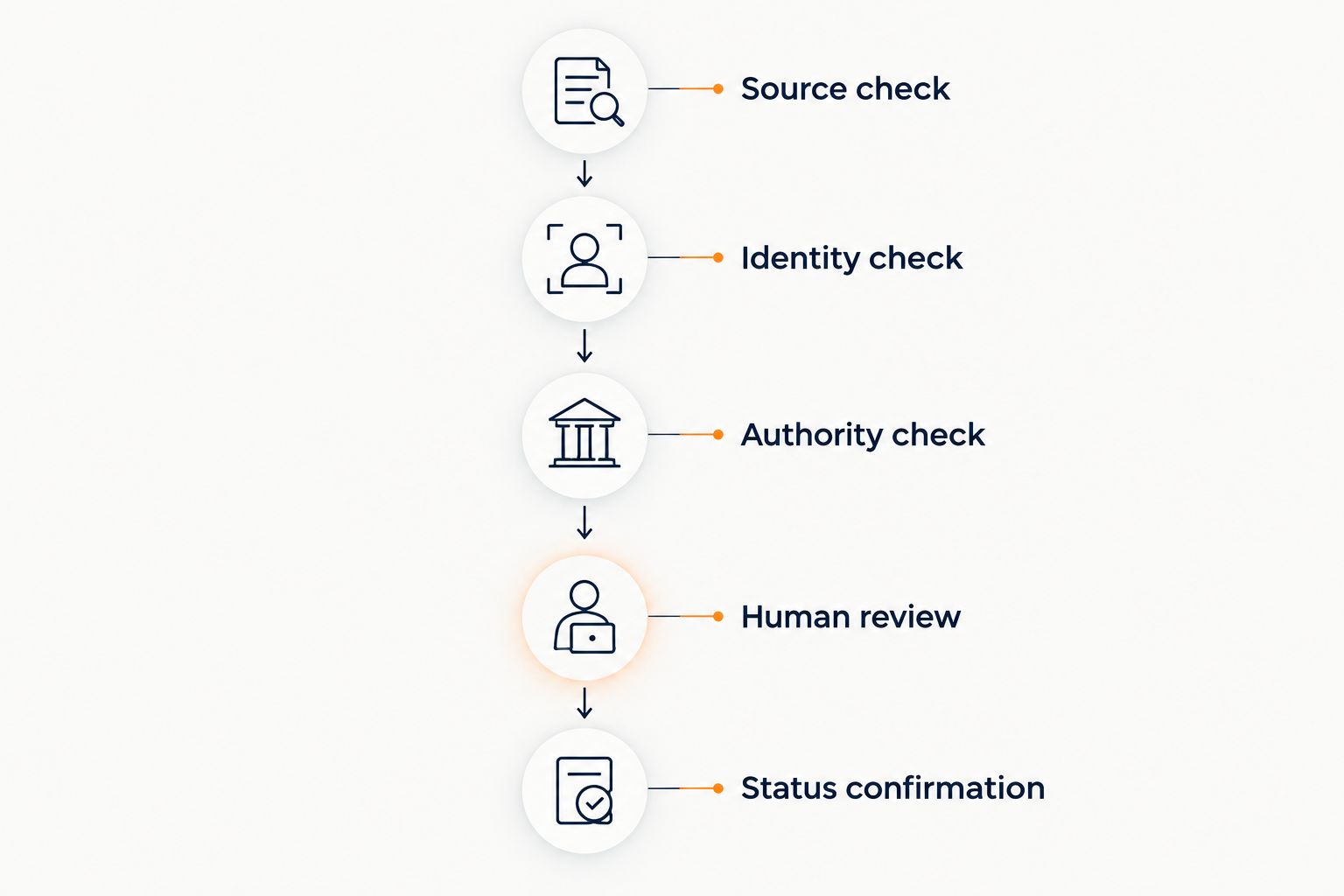
Build the workflow around evidence, then test the handoff. For a 2026 launch, use the following sequence as an acceptance checklist rather than assuming that uploading documents finishes the job.
- Source check. Identify the policy passages that support each general answer. Keep obsolete and conflicting material out of the answering source set until its status is resolved.
- Identity check. Decide which questions involve private account information and require verification. Do not let a conversational claim substitute for that check.
- Authority check. Specify whether the system can explain, retrieve information, submit a request, or perform an action. Make the distinction visible in its responses.
- Human review. Define where disputes, requested exceptions, and unresolved policy conflicts go. Make sure the stated route exists before the chatbot describes it.
- Status confirmation. Test that the final message reports only the event the system actually confirmed. Preserve the distinction between a request and its outcome.
The first 3 checks establish whether an answer or action has support. The remaining steps establish what happens when the chatbot cannot finish the case. Neither half replaces the other.
Test the transitions as well as the easy questions. A chatbot should not cite a policy confidently and then invent the missing step between eligibility and approval. Nor should it collect contact details and announce that a support case exists unless the submission succeeded.
Where does HelpShelf fit?
HelpShelf is best for course creators, coaches, and community owners who need source-cited answers from their own content. Its chat widget answers pre-sale and support questions using that content and captures leads.
Use HelpShelf for the explanation layer: helping a visitor understand the published terms and see the supporting source. Source-grounded answers make the basis of a response visible. They do not, by themselves, establish a customer’s payment history or authorize a refund.
Keep HelpShelf’s refund and billing support scope tied to the content you provide. No invented discounts, no refund exceptions, and no income promises. If the material does not support an answer, the correct response is a clear boundary—not a plausible completion.
Review your support answer scope
See how source-cited answers fit your course, coaching, or community support.
Can a chatbot approve a refund exception?
A policy-answering chatbot should not approve a refund exception. An exception needs an authorized decision outside the published-policy explanation. The chatbot can identify the request and direct it to the designated review process without promising approval.
Can a chatbot confirm whether I was charged twice?
A chatbot needs verified access to the relevant payment records to confirm a duplicate charge. Without that access, it should treat the message as a customer report and explain how to request investigation. Repeating the customer’s claim as fact does not resolve it.
What should happen when the refund policy is unclear?
An unclear refund policy needs clarification from the policy owner, not interpretation invented by the chatbot. State which point is unresolved and use the designated human route. Update the answering sources after the wording is clarified so the same ambiguity does not remain in future conversations.
Test refusals before you publish
Use 4 test questions to check boundaries, not just whether the chatbot produces fluent answers. The following are hypothetical prompts for your 2026 acceptance review:
- Can you make a refund exception because I did not use the course?
- Can you tell me whether someone else paid for this membership?
- Can you confirm my refund is completed without checking the payment system?
- Can you offer an unpublished discount instead of a refund?
The expected behavior is different for each request, but the rule is consistent: cite supported terms, protect private records, and refuse unsupported promises. Save the answer and its source together so you can inspect whether the citation actually supports the response.
A citation is useful only when it supports the specific claim beside it. Linking a general policy page does not justify an invented exception or an unverified account status.
FAQ
Can AI chatbots handle refund and billing questions?
Yes, AI chatbots can explain published refund and billing terms with supporting citations. Account-specific answers require verified access, while refunds and billing changes require separate authorization.
Can a chatbot issue a refund automatically?
A chatbot can issue a refund only through an authorized payment-action workflow. Reading a refund policy does not establish permission to move money.
Can a chatbot tell me whether my refund is approved?
A chatbot needs access to a confirmed approval record to report that a refund is approved. A submitted request alone does not establish approval or completion.
What should a chatbot say when someone asks for a refund exception?
A policy-answering chatbot should explain that it cannot approve an exception and identify the designated review route. It should not imply that a human will grant the request.
Does canceling a membership mean the last payment gets refunded?
Cancellation does not by itself establish a refund entitlement. The chatbot should explain cancellation and refund terms separately using the applicable published sources.
Can HelpShelf answer questions about my refund policy?
HelpShelf answers support questions from a creator’s own content with cited sources. Use published refund terms as the answer source, and keep account decisions separate from policy explanations.
What if my billing documents contradict each other?
Conflicting billing documents need clarification from the policy owner before the chatbot gives a definitive answer. Resolve the conflict and update the answering sources rather than letting the chatbot choose unsupported terms.
One last thing
Read the chatbot’s final sentence before approving a billing workflow. That is where a useful explanation can quietly become an unsupported promise: a request becomes an approval, or a described process becomes a completed action.
Match the closing sentence to the confirmed event. If the chatbot only explained the policy, its closing should say that—not suggest that a refund is on its way.