
Chatbot support is better than email for course creators when the question can be answered from published course, coaching, or community content; email is better when someone must investigate an account or make a decision. In 2026, use cited chat answers for repeat questions and keep email for exceptions—a chatbot that explains a refund policy has not approved a refund.
- Is chatbot support better than email for course creators? For published answers, yes; for account decisions, keep email.
- HelpShelf suits course creators who want a chat widget with source-cited answers and lead capture.
- Email is best for account investigations, sensitive details, and decisions outside published policy.
- Use both channels with a clear handoff; never let an unsupported answer become a promise.
Why this matters
Imagine a prospective student opening your course page at 11 p.m. They want to know whether the course covers the topic they need before they enroll. A cited answer can address that question without waiting for you to open your inbox.
Now imagine an existing student reporting that their purchase is attached to the wrong email address. Repeating a lesson description does nothing. Someone needs to check the account and determine what happened.
The useful distinction is published information versus individual action—not chat versus email. HelpShelf provides a chat widget that answers from a creator's own content, cites sources, and captures leads. Those functions support the first scenario; they do not establish authority to resolve the second.
Is chatbot support better than email for course creators?
Chatbot support wins on repeatable information; email wins on investigation and judgment. Use the question's requirements to choose the channel, rather than treating either channel as the default for everything.
| Support approach | Best for | Main advantage | Main limitation |
|---|---|---|---|
| Source-grounded chatbot | Published course and community questions | Gives an answer with supporting content in the conversation | Cannot justify an answer the source does not support |
| Email support | Account investigations and individual decisions | Gives a person space to review details and respond | Requires someone to read and handle the message |
| Chat with email follow-up | Questions that start as information requests but need investigation | Separates the answerable part from the unresolved part | Needs a clear owner and enough context to continue |
For example, a question about whether a topic appears in your curriculum belongs in chat when the curriculum answers it. A request to move a purchase between accounts belongs with a person who can check the purchase.
Neither channel fixes unclear source material. A chatbot can repeat an outdated rule, and a person can copy that same rule into an email. Your 2026 support setup needs current content and a defined decision owner, not just another place to receive messages.
Chatbot support: best for published answers
Use a chatbot when you can point to the material that supports the answer. Suitable questions include what a course covers, where a published resource lives, and what your stated participation rules say.
The answer should do more than sound plausible. It should identify the relevant content so the visitor can check the basis for the response. A citation is useful only when the cited passage actually supports the claim.
Suppose your published course outline describes beginner material, but says nothing about prerequisites. The chatbot can describe the material. It should not turn that description into a guarantee that every beginner will succeed.
A suggested refusal for that situation is: I can only quote what's published. The outline describes the course content, but it does not confirm whether it meets your individual needs. That is sample wording, not a claim about an actual conversation.
HelpShelf is best for course creators who want a source-cited support chat widget with lead capture. Its fit is answering from your own course, coaching, or community content. Its boundary is equally important: answering from content is not the same as checking a student's account or authorizing an exception.
Before adding chat, identify the questions your existing content can answer. If a question has no reliable source, write the source or route the question to a person. Do not ask the chatbot to fill the gap.
Email support: best for investigation and decisions
Keep email for questions that require information beyond the published material. Examples include investigating a reported access problem, reviewing a disputed charge, or deciding whether a request falls outside your normal policy.
Email gives you a thread in which to ask for missing context and explain the eventual decision. That advantage depends on someone owning the conversation. An inbox without a responsible person is not a handoff.
Consider a student who says they cannot access a lesson. A chatbot can explain published access instructions. If the instructions do not resolve the issue, repeating them is not progress; a person needs to investigate the student's situation.
The limitation is the work involved. Someone must read the message, understand the history, and respond. If you use email for every question already answered in your course outline, you are choosing to handle those explanations manually.
Keep email where a person adds judgment or takes action. Do not remove it merely because chat can answer the opening question. A conversation that begins with a curriculum question can become a request for an individual accommodation.
Chat plus email: best for mixed support requests
A combined workflow is useful when a conversation contains both an answerable question and an unresolved request. Answer the published part, state the boundary, and give the visitor a clear way to continue.
For your 2026 workflow, separate these responsibilities:
- Answer: Explain what the published source supports and cite it.
- Boundary: Identify what the source does not establish.
- Handoff: Send the unresolved question to the person responsible for it.
These are workflow requirements, not a claim that every chatbot performs them automatically. Check the actual behavior before relying on it.
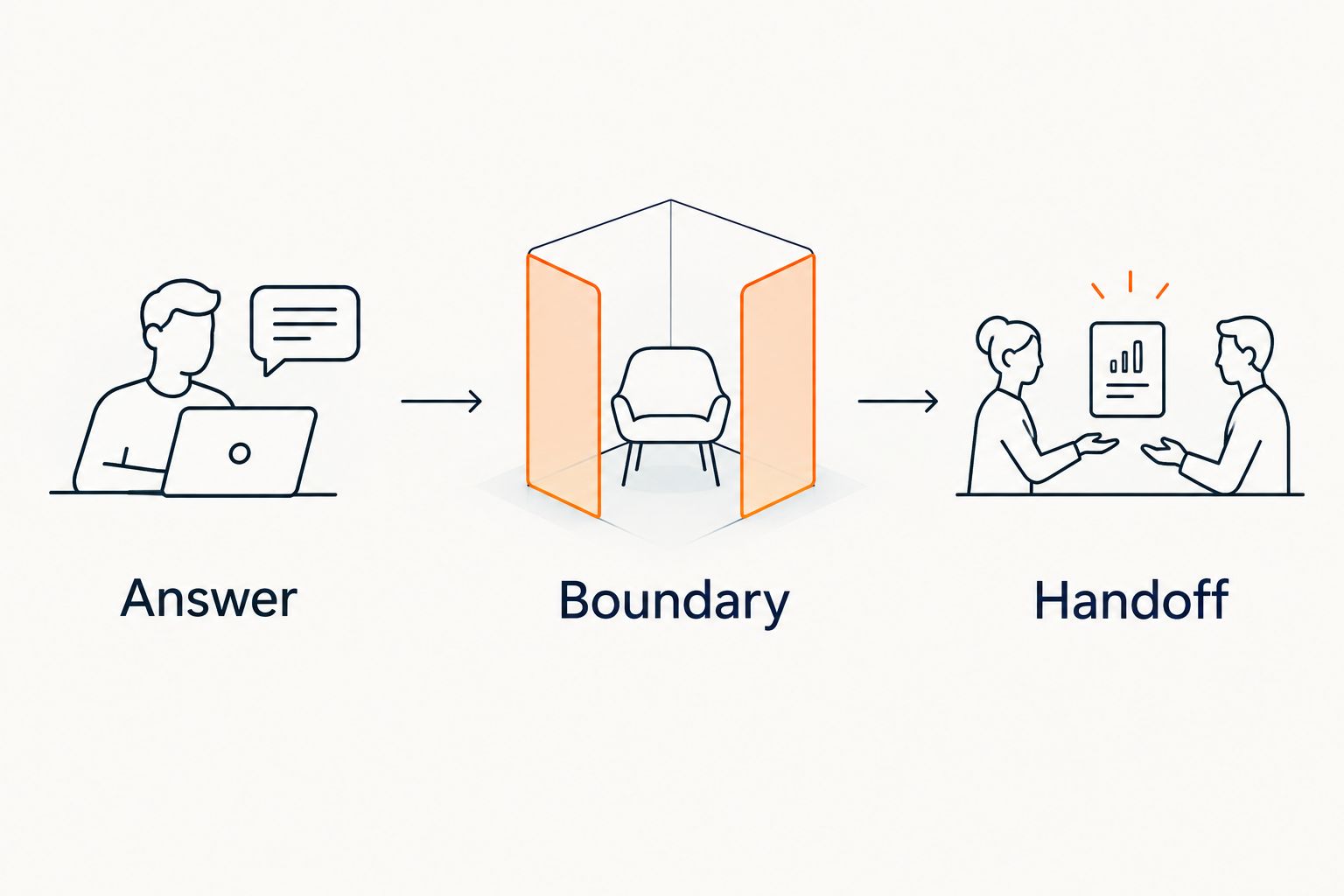
For example, a visitor asks about your published refund policy and then requests an exception. Chat can explain the policy without approving the exception. The follow-up should preserve the distinction between what was explained and what still needs a decision.
Lead capture helps collect a way to continue the conversation, but a captured address is not a resolved support request. Tell the visitor what happens next. Do not promise a response deadline unless your actual support policy supports it.
Why the better support channel varies
The right channel changes with the question and the information needed to answer it. Use these factors to assign responsibility:
- Source coverage: Chat needs content that directly supports the answer. An absent policy is not permission to improvise.
- Account context: General instructions differ from confirming what happened to a specific purchase or membership.
- Decision authority: Explaining a rule does not authorize a refund, an exception, or a change to an account.
- Question complexity: A single curriculum question differs from a request with several unresolved details.
- Content changes: Revised lessons and policies need corresponding updates wherever support answers draw from them.
- Follow-up ownership: A handoff needs a responsible person and a clear unresolved question.
Platform names alone do not settle the choice. A creator serving students through Kajabi, Skool, or Whop still needs to separate published answers from account-specific actions. Evaluate the actual workflow rather than assuming that a platform connection grants access or decision-making authority.
How should you test chat before relying on it?
Test the boundary, not just the easy answers. For a 2026 launch, use questions taken from your own support history and compare each response with the relevant source.
- Check a supported answer. Ask a question your course outline clearly answers. Confirm that the response and citation agree.
- Check a missing answer. Ask about a detail you have not published. The response should identify the gap rather than invent an answer.
- Check an exception request. Ask for a departure from policy. Confirm that explaining the policy does not become approving the request.
- Check a mixed request. Combine a published question with an account issue. Confirm that the unresolved issue remains visible.
- Check the continuation. Follow the route offered to the visitor and verify that someone can take responsibility for the request.
Use hypothetical prompts for testing; do not publish them as customer transcripts. For example, ask for an unpublished discount, a refund exception, or a guaranteed income outcome. The expected boundary is plain: no invented discounts, no refund exceptions, no income promises.
HelpShelf's cited-answer approach belongs in this evaluation, but citations are not a substitute for checking the answer. Read the cited passage. A relevant-looking source that does not support the conclusion is still a failed response.
What should you measure after launch?
Measure whether the question was handled correctly, not merely whether a chat occurred. A conversation count cannot tell you whether a student received a supported answer or abandoned an unresolved issue.
Review conversations for unsupported claims, broken citations, repeat explanations, and handoffs that lose context. Also inspect the emails that follow chat. If students must start over, improve the transition before directing more questions into it.
Compare your own support workload before and after the change using consistent definitions. Keep repeat-information questions separate from account investigations so a change in the mix does not masquerade as an improvement.
For your 2026 review, record failures as specific corrections: update a source, tighten a boundary, clarify a route, or assign an owner. Avoid turning a single good conversation into a claim about sales or time saved.
Can a chatbot replace email support entirely?
A source-grounded chatbot should not replace email when your support includes account investigations or individual decisions. It can handle the published-information part while email remains a route to a person. Retire a channel only after you have established another working route for those unresolved cases.
Is email enough for a small course business?
Email is enough when you can manage the questions and provide a clear route to help. Adding chat makes sense when you have published information that visitors need during their visit. Do not add another channel without deciding what it should handle.
Does a cited answer mean the chatbot is correct?
A cited answer is checkable, not automatically correct. The source must support the response and apply to the course or policy being discussed. Check both the wording and the scope before treating the answer as reliable.
FAQ
Is chatbot support better than email for course creators?
Chatbot support is better for questions answered by published content; email is better for investigations and individual decisions. Use the question's requirements to choose the channel.
What should my course chatbot answer?
Your course chatbot should answer questions supported by the content you provide. Curriculum details and published participation rules are suitable when the source directly answers the question.
Should a chatbot approve student refunds?
A chatbot explaining a refund policy has not approved a refund. Route requests that require a decision to someone with authority to make it.
Can I use chat for questions before someone buys?
Yes, chat can answer pre-sale questions from your published course content. It should distinguish what the material states from personal suitability claims or outcome promises.
What should happen when the chatbot cannot answer?
The chatbot should state the limitation and offer a clear route to a person. Preserve the unresolved question so the visitor does not have to reconstruct the conversation.
Is HelpShelf relevant if I already use email?
HelpShelf is relevant when you want source-cited chat answers and lead capture alongside email. Keep a human-owned route for matters that require account investigation or decisions.
How do I check whether a chatbot is inventing answers?
Compare each answer with its cited source and test questions your content does not answer. An unsupported question should produce a limitation, not a fabricated policy or promise.
One last thing
Test what happens after the first correct answer. A chatbot can correctly explain your curriculum and then mishandle the visitor's follow-up request for a guarantee. Your support boundary must hold through the conversation, not just the opening exchange.
Keep the answer grounded, the refusal specific, and the next step clear. That is the standard for both chat and email.