
A free chatbot is good enough for a course creator in 2026 if it answers a narrow set of published questions, stays within your policies, and directs unresolved requests to you. It is not good enough if it guesses about course access, invents refund exceptions, promises student outcomes, or leaves interested buyers without a clear next step.
- Is a free chatbot good enough for a course creator? Yes, when its answers stay within published course information.
- HelpShelf fits creators who want source-grounded course answers, citations, and lead capture in one chat widget.
- Test unanswered questions and policy exceptions, not just questions copied directly from your FAQ.
- Keep account changes, refund decisions, and unpublished promises with a person.
Is a free chatbot good enough for a course creator?
Judge the answer and the follow-up, not the plan label. A free chatbot earns its place when you can verify what it tells buyers and students. A paid chatbot needs to pass the same test.
HelpShelf provides a course-content chat widget with cited answers and lead capture. Those are useful evaluation criteria regardless of which chatbot you choose: can the visitor check the source, and can an unresolved conversation reach you?
The comparison below describes approaches, not features guaranteed by any particular free plan.
| Approach | Best for | Useful capability | Limitation to check |
|---|---|---|---|
| Scripted FAQ chatbot | Creators with a small, stable question set | Repeats answers you have written | Questions outside the script need another route |
| Source-grounded chatbot | Creators answering questions across course, coaching, or community content | Connects an answer to relevant published material | Incorrect or outdated source material still needs correction |
| Human support | Account-specific problems and discretionary decisions | Applies judgment and handles exceptions | Someone must read and respond to the request |
A free plan can support an acceptable approach. It does not establish answer quality by itself. Check the actual plan's source support, citations, usage restrictions, and follow-up options before putting it in front of buyers.
Why this matters
A buyer visits your course page at 11pm and asks whether the course assumes prior experience. You have already explained the prerequisites, but the buyer has not found that section. A chatbot's useful job is to bring that published answer into the conversation.
The next question is different: will completing the course guarantee a particular income? Your chatbot should not turn a description of course content into an outcome promise. A fast answer is not a useful answer when it creates an expectation you never published.
For your 2026 evaluation, separate three jobs: answering a documented question, collecting a follow-up request, and making a business decision. Let the chatbot explain what is published; keep unpublished commitments with you.
When a free FAQ chatbot is enough
Best for: creators whose repeat questions already have short, settled answers. Start with the questions you can answer by pointing to a specific public page or approved support document.
Examples include where to find the course outline, what prerequisites are listed, and which published instructions explain access. The chatbot does not need to improvise. It needs to return the right answer without adding a promise.
The advantage of a scripted approach is editorial control: you write the response and inspect it before publication. The limitation is coverage. A buyer who combines several questions or describes an unusual situation needs a clear route out of the script.
Keep that scope visible. An FAQ chatbot should not present itself as able to investigate a payment, alter a membership, or approve an exception unless those actions are explicitly supported and authorized.
Use a free FAQ chatbot when:
- Your answers come from a small collection of approved material.
- Your course information is stable enough to keep those answers current.
- Visitors can find a contact route when the script does not help.
- You can inspect the chatbot's responses before relying on them.
Recommendation: keep the narrow chatbot if it answers the documented question and stops cleanly at the boundary. More conversational wording is not a reason to widen its authority.
When source-grounded answers matter more
Best for: creators whose answers are spread across course, coaching, or community content. The issue is not whether the chatbot sounds natural. It is whether the answer corresponds to something you actually published.
A buyer asks whether your program covers a particular topic. A useful response identifies the relevant course description or lesson material and provides a citation the buyer can inspect. A vague assurance that the course covers everything is not a substitute.
A citation also gives you a practical review method. Read the answer, open the cited source, and check whether the source supports the whole claim. A citation attached to an unrelated paragraph does not make an answer accurate.
Source-grounded answers have a dependency: the underlying material must be correct and appropriate for the audience. An old policy, conflicting course description, or private coaching note is not fixed simply by putting it into a chatbot.
For a closer explanation of the evidence check, see how accurate chatbots trained on your own content are.
Recommendation: require a relevant source for factual course answers, and inspect the source rather than accepting the citation's presence as proof.
When a person should take over
Best for: account-specific questions, exceptions, and decisions requiring your approval. A student asking where the refund policy is published needs information. A student asking you to make an exception needs a decision.
Keep that distinction in your instructions. The chatbot can explain the published policy without approving a refund, changing access, or claiming that a payment problem has been resolved.
A good boundary response names what remains unresolved and tells the visitor how to request help. It should not force the visitor to keep rephrasing the question in the hope of getting an exception.
Before selecting a chatbot in 2026, check how follow-up actually works. Does the conversation preserve the question? Does the visitor know whether a request has been submitted? Can you tell which answer or policy caused the confusion?
Human follow-up also has a limitation: collecting a request does not answer it. Assign responsibility for reviewing those requests. Do not publish a response-time promise unless it is part of your actual policy.
Recommendation: route decisions to a person without presenting the route as an approval.
Why a free chatbot's usefulness varies
The same chatbot can be suitable for a narrow course FAQ and unsuitable for a coaching business that receives personal, account-specific requests. Its fit depends on the work you expect it to do.
- Source scope: Public course descriptions and private member material serve different audiences. Decide what each visitor is allowed to receive.
- Policy clarity: A chatbot cannot resolve conflicting refund or access instructions safely by guessing which one you intended.
- Question complexity: A direct question about a published prerequisite is different from a request to assess someone's individual circumstances.
- Content changes: Revised lessons, cohort details, and support instructions need a deliberate update process.
- Lead capture: Answering a pre-sale question and recording a buyer's follow-up request are separate tasks. Check both.
- Decision boundaries: Explaining a rule is not permission to make an exception to that rule.
These factors matter more than whether the chatbot sits on a course page, a coaching site, or a community landing page. Start with the question and the permitted action, then assess the software.
How do you test a free chatbot before publishing it?
Use 6 test questions in your 2026 launch check. This is a practical starting checklist, not an accuracy benchmark. Choose questions from your own material and include requests that should not receive a confident answer.
- Collect sources. Choose the current course outline, published policies, and approved support instructions. Write down the source that should support each test answer.
- Ask questions. Test a prerequisite question, a topic-coverage question, an access-instruction question, a refund-exception request, an income-guarantee request, and a question your material does not answer.
- Check evidence. Compare each factual answer with the relevant source. Check the full meaning, including any added conditions or promises.
- Test refusals. Push back after an appropriate refusal. The chatbot should not invent a different policy because the visitor asks again.
- Check follow-up. Submit an unresolved request through the available route. Confirm what the visitor sees and what you receive.
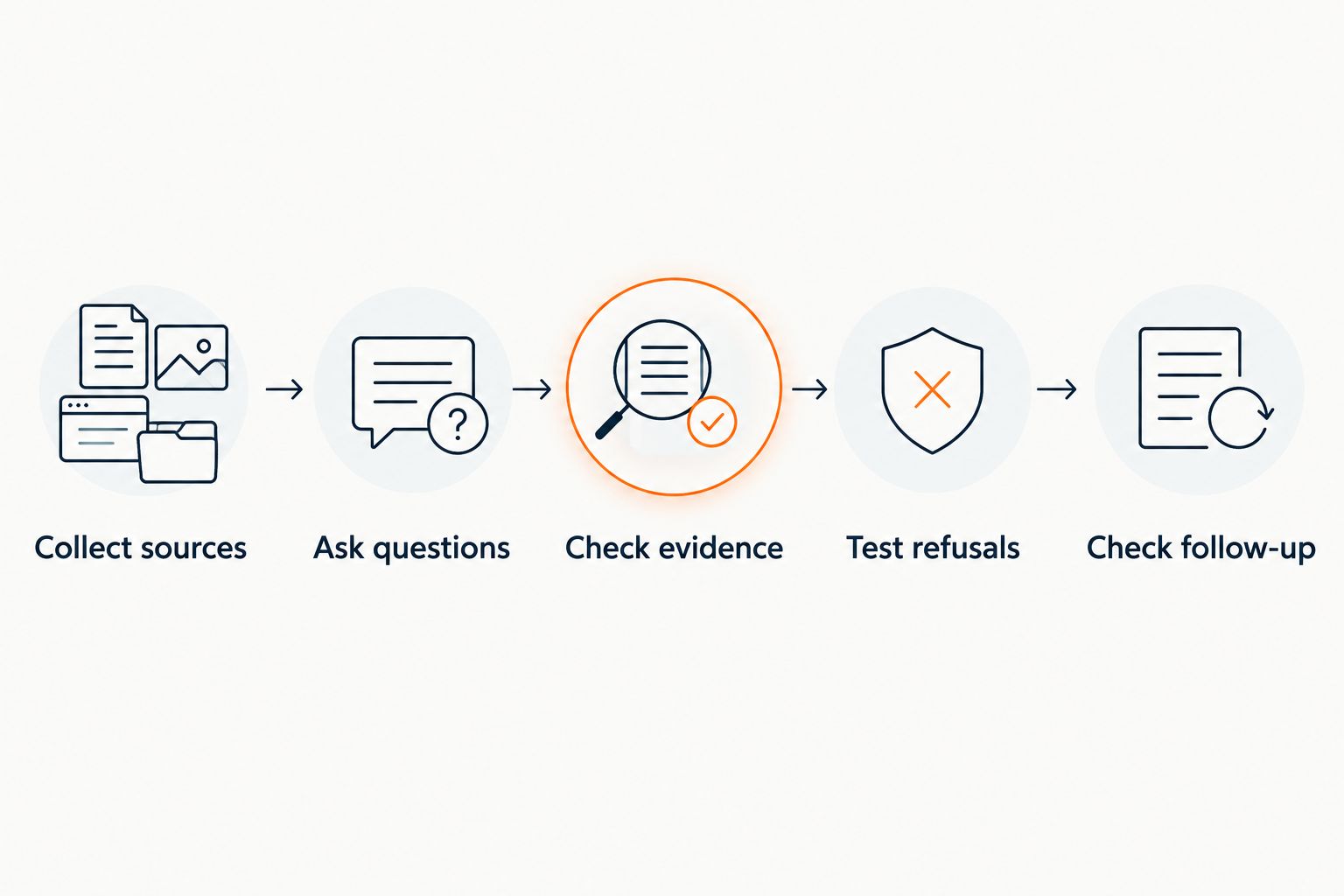
Keep the original questions and expected behavior in a simple review document. Reuse them after changing the chatbot's instructions or source material. That gives you a consistent check without pretending a small test proves universal accuracy.
A failed policy test deserves a fix before publication. A less polished greeting does not carry the same consequence as an invented refund exception.
What should the chatbot say when the answer is missing?
It should state the limit and offer the next appropriate step. Missing information is not permission to create a plausible answer.
The plain boundary supplied in HelpShelf's public voice is: “I can only quote what's published.” Use that principle when writing your own fallback behavior, then explain which part of the visitor's question needs human follow-up.
For a refund exception, the chatbot should point to the published policy and leave the exception undecided. For an outcome question, it should describe the course content without promising earnings. For an undocumented detail, it should acknowledge that the published material does not answer the question.
Do not make the refusal the end of a useful conversation. The visitor still needs a route to ask you. Equally, do not turn that route into an invented promise about approval or response time.
Should you upgrade if the free chatbot passes?
No—not solely because it is free. Keep it when it performs the job you assigned, stays within its boundaries, and provides a workable follow-up route.
Upgrade when you can name the missing capability and connect it to a real task. Examples include needing citations for answers drawn from course material or needing lead capture for pre-sale follow-up. Verify those capabilities in the product rather than assuming a paid label supplies them.
HelpShelf is best for creators who want cited course answers and lead capture in the same chat widget. Its source dependency still matters: you need to supply current content and keep unpublished promises out of that material.
Ask a prospective tool the same difficult questions you ask your current chatbot. A replacement earns its place by handling the required workflow, not by producing longer answers.
FAQ
Is a free chatbot good enough for a course creator in 2026?
A free chatbot is good enough for a course creator in 2026 when it answers documented questions, respects policy boundaries, and provides a clear route for unresolved requests. Keep exceptions and account-specific decisions with a person.
What's the best way to test a free course chatbot?
Use 6 test questions covering prerequisites, topic coverage, access instructions, refund exceptions, income guarantees, and missing information. Compare factual answers with your published sources and check the follow-up route.
Does paying for a chatbot make its answers accurate?
Paying for a chatbot does not establish answer accuracy. Check whether each factual answer matches a current, relevant source and whether the chatbot refuses unsupported requests.
Can a course chatbot approve refund exceptions?
A course chatbot should not approve refund exceptions unless you have explicitly authorized and supported that action. Explaining your published refund policy is a separate task from making a discretionary decision.
Can I put private course content into a public chatbot?
Decide what public visitors are allowed to receive before adding private course content to a chatbot. Check the tool's access controls and test whether public questions expose member-only material.
Is a citation enough to trust a chatbot's answer?
A citation is not enough on its own. Open the cited material and confirm that it supports the entire answer, including any conditions or promises.
Should I replace my FAQ page with a chatbot?
Keep your FAQ page as a readable source of published answers. A chatbot can help visitors find relevant information conversationally, but it does not remove the need to maintain that information.
One last thing
The most revealing test is the question you do not want the chatbot to answer confidently. Ask for an unpublished discount, a refund exception, or an income guarantee, then ask again in different words.
For your 2026 launch, make that boundary a release condition. A useful chatbot does not need an answer to everything; it needs to distinguish your published offer from a promise you never made.