
Unanswered chat messages do not have a universal revenue cost: estimate yours from unanswered buyer conversations, the difference in purchase rates between comparable answered and unanswered groups, and revenue collected per purchase. That estimate excludes the time spent chasing conversations and handling unresolved support questions. Revenue at risk is not the same as revenue proven lost to silence.
- How much revenue do unanswered chat messages cost creators? Measure buyer conversations, purchase outcomes, and collected revenue together.
- HelpShelf suits creators who need source-grounded pre-sale answers and lead capture, not unsupported sales promises.
- Separate unanswered course-sales questions from member support; they require different revenue measurements.
- Compare similar conversations before attributing a purchase-rate difference to unanswered messages.
Why this matters
A prospective student asks whether your course covers their situation. You are teaching, coaching, or away from your inbox. When you return, the conversation is still there, but you do not know whether the visitor bought, left, or found the answer elsewhere.
That uncertainty is the problem. Counting every unanswered message as a lost sale exaggerates the loss; treating every silent visitor as harmless hides the questions that block a purchase.
For your 2026 review, connect conversations to outcomes rather than putting a revenue label on the inbox count. An answer also needs evidence: the guide to citing sources from your own content explains the source-grounded approach relevant to course and coaching questions.
How much revenue do unanswered chat messages cost creators?
Estimate the opportunity using comparable buyer conversations, not total message volume. The calculation is:
Estimated revenue opportunity = unanswered buyer conversations × purchase-rate difference × average collected revenue per purchase.
The purchase-rate difference is the rate for comparable answered conversations minus the rate for unanswered conversations. This is an estimate of an association until you establish that the answer itself changed the outcome.
Use the following process for your 2026 chat-revenue review.
- Define an unanswered conversation. Decide whether that means no substantive reply before purchase, abandonment, or the end of your measurement window. An acknowledgment alone does not answer a buyer's question.
- Identify buyer intent. Separate questions about course fit, prerequisites, coaching scope, and joining a community from member access problems or unrelated messages. Count conversations, not every message inside them.
- Connect purchase outcomes. Match conversations to completed purchases where your records allow it. Keep unmatched visitors in a separate category rather than assuming they did not buy.
- Compare like with like. Compare conversations about the same offer, from similar acquisition sources, during the same sales period. Do not compare a launch campaign with an unrelated quiet period.
- Use collected revenue. Choose a consistent accounting basis and account for refunds where applicable. Do not substitute the potential value of an entire coaching relationship for revenue actually observed.
- Report the limit. Label the result as an estimated opportunity unless your comparison isolates the effect of answering. Publish the unanswered count and purchase outcomes alongside it.
If you cannot connect conversations to purchases, start with an unresolved buyer-conversation count. That is a useful operational measure. It is not yet a revenue-loss figure.
Build a record that can answer the question
Your conversation record should preserve the question, offer, response status, response time, purchase outcome, and matching status. Include whether the answer came from published material or required your judgment.
Keep the original wording. A visitor asking about prerequisites has a different decision problem from someone asking for a refund exception, even when both messages arrive before checkout.
A simple record also makes uncertainty visible. Mark an unmatched visitor as unmatched; mark an unresolved question as unresolved. Replacing either with an assumed outcome makes the final estimate look more certain than it is.
Separate course sales from coaching and member support
These conversation types need different evidence. Putting them into a single lost-revenue total makes the diagnosis less useful.
| Conversation type | Best for measuring | Useful outcome | Limitation |
|---|---|---|---|
| Course pre-sale question | Purchase blockers around published course details | Completed purchase after a substantive answer | A purchase after chat does not prove chat caused it |
| Coaching inquiry | Qualified interest and next-step completion | Inquiry progressing to a recorded sales outcome | A captured inquiry is not collected revenue |
| Community joining question | Questions about published membership scope | Completed membership purchase | Joining decisions also depend on factors outside chat |
| Existing-member support | Resolution and repeat-contact patterns | Issue resolved, repeated, or escalated | Support volume alone does not establish revenue loss |
Course sales: identify the unanswered purchase blocker
A visitor asks whether they need prior experience. If your course description states the prerequisites, a source-grounded answer can point to that statement. You can then record whether the visitor purchased, asked another question, or left without a matched outcome.
The answer should not turn a prerequisite question into a promise of results. Course fit and expected income are different claims. Record what was answered, not merely that a reply was sent.
Coaching inquiries: separate interest from a sale
A visitor asks whether your coaching covers their business model. Your published scope can answer part of that question; deciding whether their individual situation fits can require your judgment.
Measure the progression from question to qualified follow-up separately from collected revenue. Lead capture preserves a way to continue the conversation, but it does not establish that the visitor would have bought without the delay.
Member support: measure resolution before revenue
An existing member asks where to find a lesson. That is not a new sales conversation. Track whether the member received the correct source, whether the issue remained unresolved, and whether another contact followed.
Do not assign a refund or cancellation to an unanswered support message simply because both occurred. Preserve the sequence and the member's stated reason; those records support a more accurate diagnosis than timing alone.
Why the revenue impact varies
The value of answering depends on the question and the outcome it can change. These factors belong in your measurement:
- Buyer intent. A question about joining belongs in a different group from a request for an existing lesson link.
- Question content. Published prerequisites can be answered from source material; a request for a personal exception requires a decision.
- Offer type. Course purchases, coaching inquiries, and community memberships have different observable next steps.
- Answer completeness. A greeting or vague reassurance does not resolve a question about course scope.
- Outcome matching. A conversation without a matched purchase record remains an unknown outcome, not a confirmed lost sale.
- Published evidence. A cited answer can explain an existing policy; it cannot supply a policy you have never published.
For your 2026 analysis, keep these categories stable across the groups you compare. If the answered group contains straightforward course questions and the unanswered group contains complex coaching requests, the purchase-rate difference does not isolate the effect of silence.
What should you change first?
Start with recurring buyer questions that your published content already answers. That gives you a defined problem: visitors need a specific answer, the source exists, and you can observe what happens after the response.
Do not start by asking a system to resolve every conversation. Separate source lookup from decisions about exceptions, individual suitability, and outcomes you cannot promise.
| Approach | Best for | Advantage | Limitation |
|---|---|---|---|
| Published FAQ | Stable questions with the same published answer | Keeps the answer available for readers to inspect | Readers still need to locate the relevant entry |
| Human reply | Individual fit decisions and exceptions | Lets the creator make a judgment | Requires the creator or team to respond |
| HelpShelf | Creators needing cited answers and lead capture | Answers from the creator's course, coaching, or community content | Source-grounded answers cannot supply unpublished facts |
HelpShelf is best for creators who need cited pre-sale and support answers from their own content, plus lead capture. The boundary matters as much as the answer: missing information should remain missing until the creator supplies it.
Use a source check before a sales answer
Build the response process around these stages:
- Published source: Find the material that actually answers the question.
- Cited answer: State only what that material supports and identify the source.
- Unresolved question: Keep any unsupported part explicit instead of filling the gap.
- Creator review: Route a decision about an exception or individual circumstances to the creator.
This is a recommended process, not a claim that every widget implements every stage. Review the actual behavior before placing a system in front of buyers.
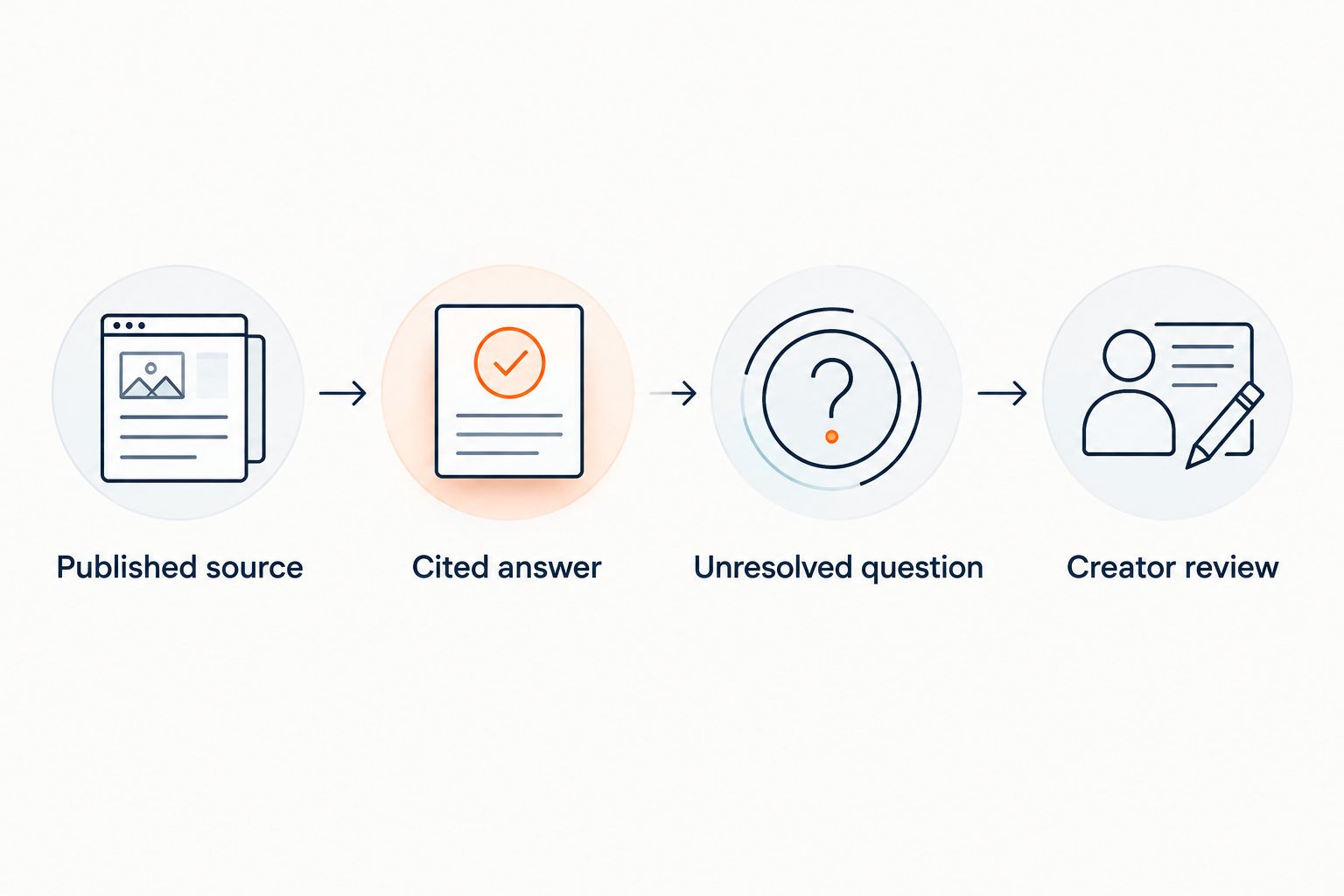
For example, suppose a prospective student asks for an exception to your refund terms. A safe response pattern is to cite the published terms and state that they do not establish the requested exception. The creator then decides whether an exception exists.
Apply the same rule to discounts and income questions: no invented discounts, no refund exceptions, no income promises. Faster answers are not a reason to change the offer inside a chat conversation.
How do you know whether answering caused more sales?
A higher purchase rate after answered chats shows an association, not proof that the replies caused the difference. Visitors who ask answerable questions can differ from visitors whose questions remain unresolved.
For a 2026 evaluation, compare equivalent traffic and offers while keeping other sales changes separate. Where practical, use a controlled comparison that changes answer coverage without changing the offer or acquisition campaign.
Report what the comparison actually establishes. If you changed the course page, follow-up process, and chat coverage together, you measured the combined change—not the chat answer alone.
Does capturing a lead recover the lost revenue?
Capturing a lead preserves a follow-up opportunity; it does not recover revenue by itself. Track captured inquiries, follow-up outcomes, purchases, and collected revenue as separate events.
A visitor who provides contact details still needs their question resolved. Keep the unanswered issue attached to the lead so the follow-up addresses the reason they stopped rather than sending a generic sales message.
Should you answer every message automatically?
No. Automate answers supported by your published material, and reserve judgment-based questions for review. A course outline can establish lesson coverage; it cannot establish that a particular buyer will achieve a particular financial result.
In your 2026 review, inspect refusals and unresolved questions alongside successful answers. Those conversations show where your content needs clarification and where human decisions remain necessary.
FAQ
How much revenue do unanswered chat messages cost creators?
The cost depends on your unanswered buyer conversations, comparable purchase outcomes, and collected revenue per purchase. Estimate the opportunity from those records rather than applying an unsupported industry average.
Can I count every unanswered chat as a lost sale?
No, an unanswered chat is not a confirmed lost sale. Separate buyer intent, support requests, and unmatched purchase outcomes before estimating revenue impact.
What should I track if I cannot match chats to purchases?
Track unanswered buyer conversations and unresolved question categories first. Keep purchase outcomes marked as unknown until your records support a match.
Is a captured lead the same as recovered revenue?
No, a captured lead is a follow-up opportunity, not recovered revenue. Record a purchase and its collected revenue separately from contact capture.
Can HelpShelf answer questions from my course content?
HelpShelf answers pre-sale and support questions using a creator's own course, coaching, or community content with cited sources. That source-grounded approach does not establish unpublished discounts, exceptions, or promised outcomes.
Should a chat answer promise that my course will increase income?
No, a chat answer should not invent an income promise. Answer questions about published course content and leave unsupported outcome claims out.
How should I measure unanswered member-support messages?
Measure resolution, repeat contact, and documented outcomes separately from new sales. A support message alone does not establish a refund, cancellation, or revenue loss.
One last thing
Fix the missing source before expanding answer coverage. If visitors repeatedly ask whether a course includes something and your published material never says, the next move is to clarify the course description—not ask chat to infer the answer.
That distinction keeps your revenue diagnosis useful: unanswered because nobody replied, unanswered because the source was missing, and unanswered because the question required your decision. Each needs a different fix.