
Yes—an AI chatbot can support higher course sales conversion by answering the questions that stop a visitor from enrolling. It does not guarantee more sales: the answer must match your published course content, and you need a purchase-based comparison to establish whether conversion improved. In 2026, judge the widget by completed enrollments, not how many conversations it starts.
- Can an AI chatbot increase course sales conversion? Yes, when accurate pre-sale answers resolve a real enrollment obstacle.
- HelpShelf suits course creators who want source-grounded answers, citations, and lead capture.
- Measure completed purchases separately from conversations and captured leads.
- No invented discounts, no refund exceptions, no income promises: keep answers inside published course terms.
Can an AI chatbot increase course sales conversion?
A chatbot helps course sales when it resolves a buyer's unanswered question without creating a false expectation. That is the mechanism to test—not the presence of a chat bubble.
A visitor asks whether your course assumes prior experience. Your curriculum states the prerequisites, but the visitor has not found them. A source-grounded answer points to that section and explains the requirement; an unsupported answer simply tells the visitor what they want to hear.
The distinction matters. A chatbot that cites sources from your own content gives the buyer something to check. A citation supports the answer only when the linked passage actually supports its claim.
Use this sequence to evaluate the sales role:
- Identify the question blocking enrollment.
- Locate the published passage that answers it.
- Give a direct answer with that source.
- Leave the purchase decision with the visitor.
- Measure whether completed enrollments change.
A correct answer can also reveal that the course is not suitable. That is not an answering failure. Your sales measurement must distinguish more enrollments from enrollments created by incorrect promises.
Why this matters
It is 11pm. A prospective student reads your course page, asks whether the lessons fit their experience, and DMs you. You are not there to reply.
The sales problem is specific: the visitor needs an answer before deciding. Adding a widget is useful only if it answers that question correctly or gives a clear route to human follow-up.
For your 2026 course sales plan, separate two jobs. The sales page explains the offer; chat addresses the question the visitor still has. Neither should compensate for missing prerequisites, contradictory policies, or unclear descriptions of what enrollment includes.
Start with the questions buyers already send you. They show where your published explanation needs work and where a conversational answer has a clear purpose.
Which approach fits the buyer's question?
A FAQ page, source-grounded chatbot, and human conversation serve different needs. Keep the published answer available even when you add chat. The widget should not become the only place a visitor can understand your course.
| Approach | Best for | Useful strength | Limitation |
|---|---|---|---|
| FAQ page | Buyers who want to scan published terms | Makes recurring answers readable without a conversation | Requires visitors to find the relevant question |
| Source-grounded chatbot | Buyers asking a specific question about published content | Answers conversationally and points to supporting material | Cannot establish terms that the source does not contain |
| Human conversation | Buyers whose situation needs individual judgment | Lets you clarify context and make authorized decisions | Depends on someone being available to respond |
Do not treat these approaches as substitutes in every situation. A question about a stated prerequisite belongs in the published material. A request for an exception belongs with someone authorized to make that decision.
A chatbot also needs a boundary between explaining the course and judging someone's personal situation. It can describe your published audience and requirements. It should not promise that a particular buyer will achieve a particular result.
Where source-grounded answers help before enrollment
The strongest use case is a question with an answer already present in your course, coaching, or community content. The chatbot's job is to make that answer accessible, not improve the offer during the conversation.
Course fit
A visitor asks whether the course is appropriate for their current experience. The answer should use the stated audience, prerequisites, and curriculum—not a blanket assurance that everyone is a fit.
If your published materials leave the intended experience level unclear, fix them first. A longer answer does not resolve an unclear source.
What enrollment includes
A buyer asks whether a particular topic or type of support is included. The answer should point to the relevant published description and distinguish what is stated from what is not.
Do not let the chatbot add personal coaching, community access, or extra materials merely because those additions sound helpful. The conversation does not authorize a change to your offer.
Published terms
A buyer asks about a refund condition or another enrollment rule. The answer should explain the published policy without granting an exception.
If a request requires your decision, separate that request from the policy explanation. Knowing the rule and having authority to change it are different things.
What should the chatbot refuse to promise?
A useful sales answer explains the offer without expanding it. Write that boundary into your answering instructions and check it in real conversations.
The following are example response patterns, not statements of any creator's actual terms:
| Buyer request | Appropriate response pattern | What to avoid |
|---|---|---|
| An unpublished discount | State that only published offers can be quoted | Inventing an offer to secure enrollment |
| A refund exception | Explain the published policy and direct the exception request to you | Treating an exception as already approved |
| A guaranteed income result | State that a personal income result cannot be promised | Predicting earnings from enrollment |
| A feature absent from the course description | Say the published content does not confirm it | Turning silence into a claim of inclusion |
An example refusal is: “I can only quote what's published.” Follow it with the relevant source or a clear explanation of what requires human confirmation.
Keep the refusal useful. If the chatbot cannot confirm whether a topic is covered, it can identify the curriculum as the material to check. It should not repeatedly rephrase uncertainty until the answer sounds confident.
Why the sales effect varies
There is no course-conversion result implied by installing a chatbot. The effect depends on the question, the available evidence, and what happens after the answer.
- Question relevance: A question about course fit can affect an enrollment decision; an existing student's access question serves a different purpose.
- Source completeness: Clear prerequisites and course descriptions give the chatbot something definite to explain.
- Source consistency: Contradictory course pages and policy documents leave the answer without a clear basis.
- Answer accuracy: The explanation and its citation must support the same claim.
- Follow-up path: An unanswered question needs an explicit next step rather than a fabricated answer.
- Measurement design: Counting conversations instead of completed purchases changes what you are evaluating.
For a 2026 launch, inspect these factors before interpreting the sales result. If you revise the course page while adding chat, the change in purchases does not isolate the chatbot's contribution.
Use the same discipline when sales do not improve. Review whether buyers asked relevant questions and whether the answers were correct before deciding what to change.
How do you test whether the chatbot increases sales?
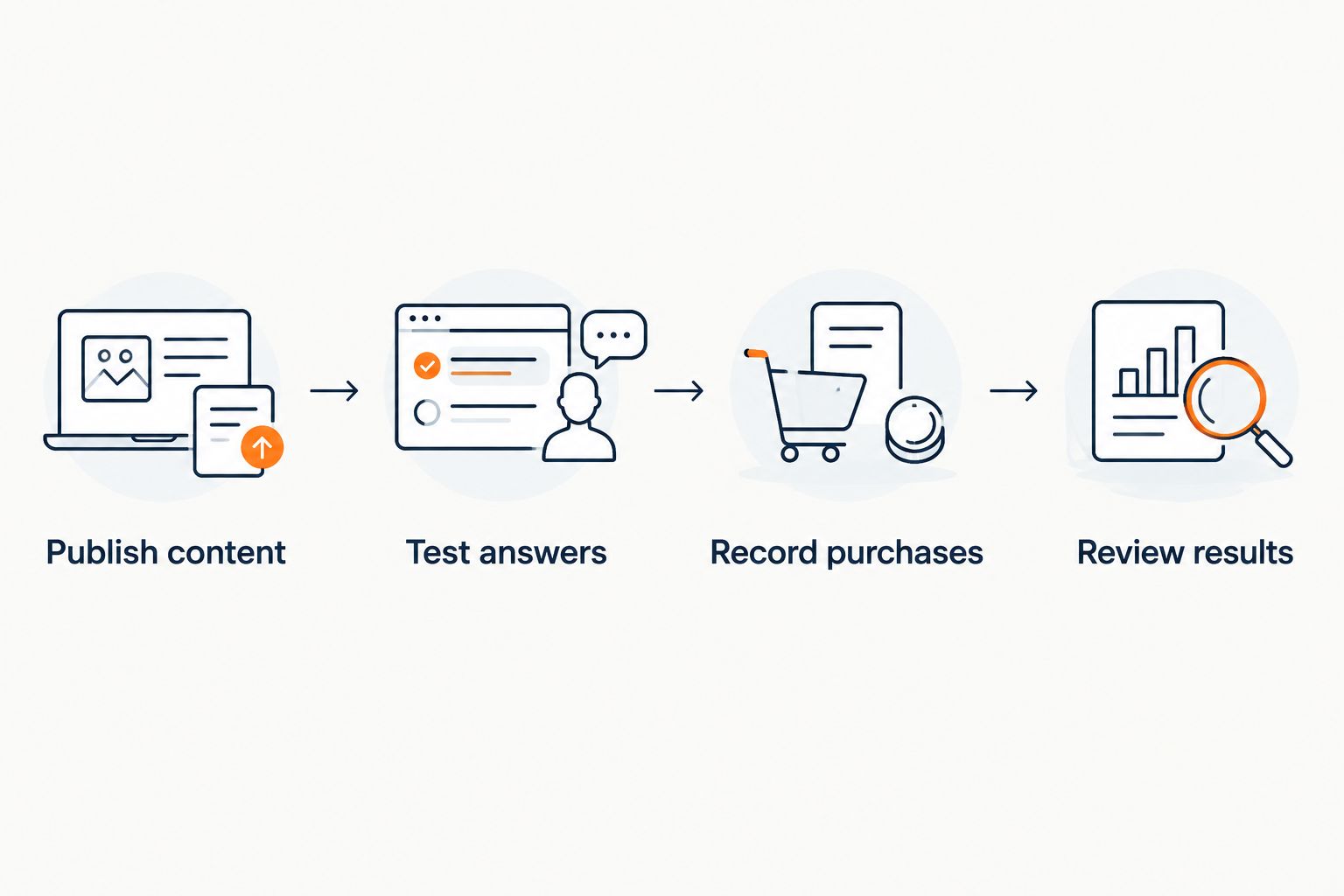
Use a purchase-based comparison with a clearly defined audience. Keep your course offer and enrollment path consistent, and record other changes that affect the comparison.
Publish content
Prepare the material buyers need: the course description, intended audience, prerequisites, curriculum, and published policies. Resolve contradictory passages before using them as answering sources.
Separate public pre-sale information from material intended for enrolled students. A sales answer should explain what the course covers without exposing content you have not chosen to publish to visitors.
Test answers
Ask the questions you actually receive, including requests that cross your published boundaries. Check both the answer and the supporting passage.
For each response, ask whether a buyer would understand what is confirmed, what is not confirmed, and what needs your decision. An answer can sound clear while citing a passage that says something different.
Record purchases
Define course sales conversion as completed course purchases divided by eligible course-page visitors. Use the same eligibility rules across the comparison.
Keep chat opens, answered questions, and captured leads as separate measures. They explain activity along the way; they do not establish that a purchase happened.
Review results
For your 2026 evaluation, compare purchase conversion alongside answer quality and the mix of visitor questions. Separate prospective students from enrolled students wherever your measurement permits.
Do not label a difference as a proven improvement without assessing the evidence. If the comparison is inconclusive, keep the conclusion inconclusive rather than substituting a conversation count.
What should you track besides purchases?
Purchases answer the sales question. Conversation records help you understand why the result looks the way it does.
Group buyer questions by their purpose: course fit, included content, published terms, and requests requiring your decision. Record whether the answer was supported and whether the visitor received a clear next step.
Keep these distinctions visible:
- Answered question: The visitor received a response supported by published content.
- Captured lead: The visitor provided contact details for follow-up.
- Completed purchase: The visitor completed enrollment.
- Human request: The visitor needs a decision or clarification beyond the published answer.
A captured lead is not a completed sale. An answered question is not proof that the buyer understood it. Read the conversation before assigning a reason to the outcome.
For your 2026 reporting, use purchase conversion as the sales measure and these categories as diagnostic context. That prevents a busy widget from being mistaken for a successful enrollment change.
Where does HelpShelf fit?
HelpShelf is for course creators who want cited pre-sale answers and lead capture. Its chat widget uses a creator's own course, coaching, or community content to answer questions with cited sources.
The useful fit is specific: you already have material that answers buyer questions, and you want visitors to ask about it conversationally. HelpShelf's source-grounded course sales chat does not replace the work of writing clear terms or deciding exceptions.
Its limitation is the same boundary that makes the approach useful. Published content can support an answer; it cannot support an unpublished discount, an unapproved refund exception, or a personal income promise.
Evaluate HelpShelf against your actual pre-sale questions. Check whether each answer matches the source and whether lead capture serves a follow-up need, rather than collecting contact details without a clear purpose.
Is a chatbot better than improving my course page?
Fix missing information on the course page first. A chatbot can explain published information, but it should not become a workaround for an unclear offer.
If buyers repeatedly ask the same question, make the answer easier to find and retain chat for individual phrasing or follow-up. You do not need to choose between a readable page and conversational help.
Can lead capture count as a conversion improvement?
Lead capture counts as an improvement in lead capture, not proof of increased course sales conversion. Track whether those leads become completed enrollments before making the sales claim.
Ask for contact details with a clear purpose. A visitor should understand what follow-up they are requesting and which question remains unresolved.
Should the chatbot persuade someone who is not a fit?
No—the chatbot should explain your published course fit, not override it to secure enrollment. If a stated prerequisite excludes the buyer's current situation, make that requirement clear.
An accurate answer can end the sales conversation. Do not treat that outcome as a reason to weaken the answer or hide the source.
FAQ
Can an AI chatbot increase course sales conversion in 2026?
Yes, an AI chatbot can support higher course sales conversion when accurate answers resolve questions blocking enrollment. Establish the effect with completed purchases, not conversation activity.
How do I know whether my course chatbot is helping sales?
Compare completed course purchases among consistently defined eligible visitors. Review answer quality and other changes to your sales page or offer before attributing the result to chat.
What's the best content to give a course sales chatbot?
Use your published course description, audience, prerequisites, curriculum, and enrollment policies. Resolve contradictions and separate public buyer information from restricted student content.
Can the chatbot offer a discount to close a course sale?
The chatbot should not invent a discount. Keep its answers within published offers and leave any unpublished request to someone authorized to decide.
Is a chatbot better than a FAQ page for course buyers?
A chatbot suits specific conversational questions; a FAQ page suits visitors who want to scan published answers. Keep important course information readable without requiring chat.
Does collecting leads prove that the chatbot increased course sales?
No, collecting leads proves lead capture, not completed enrollment. Track purchases separately and follow the leads through to their actual outcome.
Who is HelpShelf's course sales chatbot for?
HelpShelf is for course creators, coaches, and community owners who want answers grounded in their own content, with citations and lead capture. It does not make unpublished terms into confirmed facts.
One last thing
Before you tune the chatbot's wording, read the source behind its most difficult answer. If that passage is unclear, rewrite the passage—not just the response.
Repeated buyer questions are also an editing list for your course page. Use them to make the offer easier to understand even for visitors who never open chat.