
An AI chatbot and a support VA have different cost structures: compare the chatbot’s subscription, usage charges, and upkeep with the VA’s paid hours, onboarding, and supervision. Neither is automatically the cheaper choice in 2026; the deciding factor is which work each can finish without your intervention. Include human follow-up in the chatbot calculation and unanswered work outside the VA’s agreed coverage in the staffing decision.
- How much does an AI chatbot cost versus a support VA? Compare total operating costs, not subscription against wages alone.
- HelpShelf suits course creators who need source-cited answers and lead capture; account decisions still need an authorized person.
- A support VA fits work requiring account investigation, judgment, and follow-through, provided you grant the necessary access.
- Count source maintenance, supervision, and escalations before calling either option cheaper.
Why this matters
Imagine a prospective student asking about your course at 11pm. The answer already exists in your published curriculum, but you are not there to point it out. That is a different job from investigating a disputed payment or deciding whether to make an exception.
Buying software to handle both jobs creates the wrong expectation. Hiring a person to repeat published answers also deserves scrutiny. Separate the work before comparing the bills; the customer service chatbot cost guide covers the software side of that decision.
Compare completed work with completed work, not a software subscription with an hourly rate. A reply that still needs your correction has not removed the task from your desk.
How much does an AI chatbot cost versus a support VA?
Build your 2026 comparison around the same question set, coverage requirements, and definition of completion. A chatbot answering a curriculum question and a VA investigating a login problem are not interchangeable units of support.
Use the following breakdown to compare the operating models. These are budgeting categories to check, not claims about any particular vendor’s billing terms or a VA’s contract.
| Option | Best for | Include in your calculation | Advantage | Limitation |
|---|---|---|---|---|
| Source-grounded chatbot | Repeated questions answered in approved content | Subscription, applicable usage charges, setup, source upkeep, review, human follow-up | Can provide a consistent answer tied to a published source | Published content does not authorize account changes or policy exceptions |
| Support VA | Account investigation and follow-through requiring human judgment | Agreed paid hours, onboarding, tools, supervision, coverage arrangements | Can investigate and act within permissions you grant | Requires clear instructions, access controls, and agreed working hours |
| Chatbot plus VA | A queue containing both published-answer questions and individual cases | Both operating costs, routing setup, and handoff review | Separates repeat explanations from account-specific work | Adds coordination work and does not automatically reduce paid staffing hours |
For each option, record what happens after the first reply. Does the visitor get a usable answer? Does someone need to inspect the account? Does the creator still have to make the decision?
A comparison that stops at the first response hides those differences. Keep unresolved cases in the workload until someone finishes them.
Build the calculation without guessing
Use actual quotes, invoices, and time records. Keep cash spending separate from your own time so the comparison shows both the bill and the work that remains.
- Chatbot cash spending: subscription plus applicable usage charges and any paid implementation or maintenance work.
- VA cash spending: agreed paid hours multiplied by the agreed rate, plus applicable tools or administrative charges.
- Creator time: setup, documentation, review, supervision, and decisions that neither option handles independently.
- Combined model: chatbot spending plus the human work that remains after routing.
Do not subtract an assumed sales lift from chatbot spending. Track sales outcomes separately unless you can connect them to the conversations in question. An unanswered message is evidence of an unanswered message, not a measured lost sale.
Chatbot-only support: budget for answers and upkeep
Best for: recurring questions whose answers are already published. Course contents, prerequisites, and instructions are candidates when the source clearly answers the visitor’s question.
The advantage is specific: you can direct the visitor to the relevant published information rather than write the same explanation again. The limitation is equally specific: an answer system does not gain authority to change an account or approve an exception just because someone asks.
Your setup work starts with the content. Remove contradictions, identify the current policy, and decide which materials are appropriate for prospective buyers rather than enrolled students. A chatbot cannot resolve an unpublished policy decision on your behalf.
For a 2026 chatbot budget, include time to check answers after changes to your course or community. A revised curriculum needs a current source. An old answer with a citation to an old document still points to the wrong version.
HelpShelf provides a chat widget that answers pre-sale and support questions from a creator’s own content, cites sources, and captures leads. HelpShelf is best for course creators, coaches, and community owners who need source-cited answers and lead capture. That scope is not a substitute for authorized handling of individual accounts.
VA-only support: budget for coverage and management
Best for: questions requiring investigation, judgment, or action in an account. A VA can work through these tasks when you provide the relevant access, instructions, and decision authority.
The advantage is follow-through. Someone can examine the circumstances, ask for missing information, and carry an issue through the process you have defined. The limitation is that staffing requires management: instructions, permissions, working hours, and escalation boundaries do not establish themselves.
Separate support time from general administrative time when reviewing a VA proposal. If the same person also manages community posts or handles scheduling, charging the entire arrangement to support makes the comparison misleading.
Your 2026 staffing budget should also reflect the coverage you actually agree to. A VA scheduled during your business day is not an overnight support arrangement. Likewise, answering questions outside staffed hours does not prove that software can resolve every issue raised then.
Write down what the VA can decide without you. Otherwise, you risk paying for someone to forward questions you still need to answer.
Chatbot plus VA: budget for the handoff
Best for: a queue that mixes published-answer questions with account-specific cases. The chatbot handles the explanation; the VA handles work that requires access or judgment.
This arrangement has a clear benefit when the responsibilities stay separate. It also has a coordination cost: someone must define which questions move to a person and what information accompanies them.
Do not assume that fewer repeated questions immediately produce a smaller staffing bill. If your paid arrangement stays unchanged, the result is freed capacity, not a cash reduction. Record how that capacity is used before describing it as savings.
For your 2026 comparison, check whether the combined model reduces creator involvement as well as repetitive replies. A chatbot that forwards unclear conversations and a VA who must reconstruct them leave work in the system.
Why chatbot and support VA costs vary
The main drivers are the work you assign and the preparation needed to complete it. Use these factors when reviewing quotes or planning an internal comparison:
- Question mix: published-answer questions need a different process from billing investigations or access problems.
- Source condition: conflicting policies and incomplete instructions require cleanup before either software or a person can answer consistently.
- Coverage requirements: define when you need answers and when you need someone authorized to act.
- Decision authority: exceptions and account changes remain separate from explaining a published policy.
- Review workload: include answer checks, source updates, coaching, and corrections in the operating model.
- Handoff requirements: establish who receives unresolved cases and what context that person needs.
Keep these requirements identical across the options you compare. Otherwise, the cheaper proposal might simply cover less work.
How do you compare the options using your own support queue?
Use a documented sample of your actual questions rather than a sales demonstration built around easy prompts. Keep the personal information needed for account work out of any evaluation environment that is not approved to receive it.
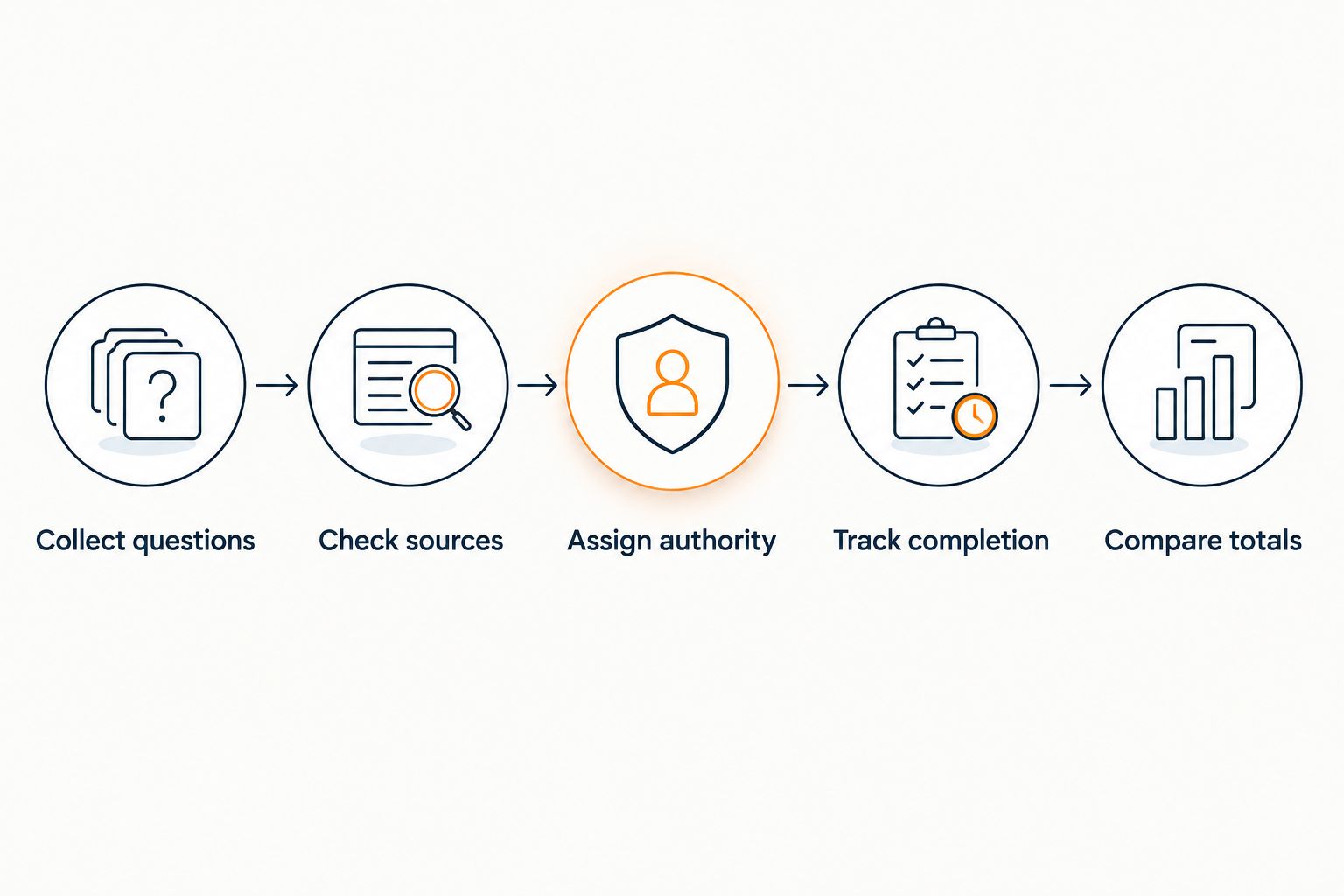
The process below separates answer quality from account handling. It also gives you a way to record the work that returns to you.
- Collect questions. Gather questions from the channels you actually use. Preserve the distinction between pre-sale questions and enrolled-customer support.
- Check sources. Identify the published material that answers each question. Mark contradictions and missing answers instead of asking either option to improvise.
- Assign authority. Decide which tasks require account access, a policy decision, or the creator’s approval.
- Track completion. Record whether the question was resolved, referred to a person, corrected, or left open. Include your involvement.
- Compare totals. Put actual spending beside recorded operating time and completed work. Keep unresolved cases visible.
The important distinction is between a fast reply and a finished task. Use the same completion standard for every option, including your current way of handling support.
Keep a short reason beside each unresolved case. Missing documentation, missing permissions, and a decision awaiting approval are different problems. That distinction tells you whether to improve the source, change the workflow, or retain human ownership.
What should happen when a buyer asks for an exception?
A buyer asks whether a published refund rule can be waived. Explaining the rule and approving an exception are separate tasks; neither a chatbot nor a VA should treat the question itself as permission.
For a source-grounded answer, the boundary is plain: “I can only quote what’s published.” The next step is to refer the request to someone authorized to decide, without implying that approval is likely.
Use the same boundary for unpublished discounts and income promises. Do not let a support comparison reward an answer merely because it sounds reassuring. An invented concession is not a successful resolution.
A VA needs the same written limits. Human handling offers judgment, but that judgment still operates within the authority you grant.
Is an AI chatbot cheaper if I already employ a VA?
Adding a chatbot does not reduce your existing VA spending by itself. It adds software spending until your paid arrangement changes or you choose to value the freed capacity separately.
Look at what the VA stops doing and what takes its place. Less copying of course explanations can create room for unresolved member issues. That is an operational benefit, but it is not the same as a smaller invoice.
Can a support VA replace source-grounded answers?
A support VA can answer from approved sources when those sources and instructions are available. The same documentation work supports both human and chatbot answers.
Choose the human role for the work requiring human involvement, not as a workaround for contradictory policies. Fixing the source prevents the same ambiguity from reaching the next person who handles the question.
What should I choose for a new course or community?
Start with the work your current questions demonstrate. If you cannot yet distinguish recurring published-answer questions from individual cases, classify the queue before committing to a support model.
For a 2026 launch, publish the information buyers need and establish who owns unresolved requests. Then evaluate whether software, a VA, or a combined arrangement handles that workload with less creator intervention.
FAQ
How much does an AI chatbot cost versus a support VA?
Compare the chatbot’s subscription, applicable usage charges, and upkeep with the VA’s agreed paid hours, tools, and supervision. Include human follow-up and creator time on both sides rather than comparing subscription spending with an hourly rate alone.
Is a chatbot always cheaper than hiring a support VA?
No. The answer depends on the actual terms, question mix, setup work, and human follow-up required. Compare both options against the same tasks and completion standard.
Can I replace my support VA with a chatbot?
A chatbot is not a substitute for every task a support VA performs. Keep account investigations, authorized changes, and policy exceptions assigned to someone with the required permissions.
What costs should I include besides the chatbot subscription?
Include applicable usage charges, setup, source maintenance, answer review, and human follow-up. Track your own operating time separately from cash spending.
Does a chatbot save money if my VA still works the same hours?
Unchanged paid hours do not produce a staffing cash reduction. The chatbot can free capacity for other work, but record that separately from a smaller support bill.
Is HelpShelf suitable for course creator support?
HelpShelf suits course creators, coaches, and community owners who need answers grounded in their own content, cited sources, and lead capture. Assign account decisions and policy exceptions to an authorized person.
One last thing
Before buying either option, find a question you have answered repeatedly and inspect the source behind it. If the answer lives only in your memory, document it first.
A clear published answer helps both the chatbot and the VA; an unwritten exception helps neither. That is a useful first move even if you keep your current support arrangement.