
You see ROI from an AI chatbot when the measured value of saved work and additional sales exceeds its full cost—not after a fixed number of days. Setup, content maintenance, answer review, and human follow-up belong in that calculation. For a course creator, coach, or community owner, the useful question is when verified outcomes repay those costs, not when the widget first answers a message.
- How long does it take to see ROI from an AI chatbot? Measure payback; don't assume a universal deadline.
- HelpShelf fits creators who need content-grounded answers with citations and lead capture.
- Track resolved questions, human review time, and completed sales separately.
- Use a defined baseline and review schedule before treating chatbot activity as business value.
Why this matters: A visitor asks about your course at 11pm. An immediate answer is useful, but it becomes measurable financial value only when it saves work or contributes to a purchase you can substantiate. Keep training a chatbot on your content separate from earning back the investment: readiness and payback are different milestones.
How long does it take to see ROI from an AI chatbot?
There is no defensible universal payback period for your chatbot without your costs, conversation volume, and outcomes. A working chatbot is not evidence of positive ROI. Your 2026 evaluation needs a baseline and a record of what happened after each relevant conversation.
Use this measurement sequence:
- Record the baseline. Track the questions you receive, the human time they require, and the purchases connected to those inquiries before launch.
- Record the full cost. Include the subscription, initial setup work, content preparation, ongoing review, and follow-up.
- Verify the outcome. Separate an answered message from a resolved question, a captured lead, and a completed purchase.
- Calculate net value. Subtract total cost from the value you can support with records.
- Identify payback. Find the point when cumulative verified value covers cumulative cost.
ROI and payback answer different questions. ROI compares net value with cost over a defined period; payback identifies when you recover the investment. Use the same measurement period for every part of either calculation.
Separate the routes to value
A support answer, a pre-sale conversation, and a captured lead are not interchangeable outcomes. Pick a primary use case before launch so you know what success means.
| Use case | Best for | Evidence to collect | Advantage | Limitation |
|---|---|---|---|---|
| Repeat support | Creators answering recurring content questions | Resolved questions and net human time saved | Connects directly to existing work | Answer review and escalations still take time |
| Pre-sale answers | Creators receiving questions about course fit or content | Conversations linked to completed purchases | Connects buyer questions with sales outcomes | A purchase after a chat does not prove the chat caused it |
| Lead capture | Creators who need to follow up with interested visitors | Contact details, follow-up records, and eventual outcomes | Creates a record for later follow-up | A captured contact is not revenue |
Choose the route you can measure reliably. Do not combine every favorable signal into a single total without checking whether the same conversation appears more than once.
Measure support value without overstating savings
Suppose a learner asks where a lesson explains a particular exercise. A cited answer can point the learner to the relevant material. The financial question is whether that answer removes work you otherwise would have done.
Record the human work that remains. If you review the answer, correct its source, and reply to the learner anyway, the conversation has not eliminated that work.
Count net time saved, not messages answered. Compare the human effort required before and after the chatbot handles the same kind of question. Include review and correction in the after-launch total.
Keep time value separate from cash savings. If you personally handle support, reclaiming time does not automatically reduce a bill. Report the hours recovered, then explain how you value those hours rather than presenting them as money already saved.
For your 2026 support review, retain examples of resolved conversations alongside the time records. That lets you check whether a lower workload reflects useful answers rather than learners giving up or asking elsewhere.
Measure sales value without claiming every purchase
A buyer asks whether your coaching offer includes feedback on their work. The chatbot should answer from your published material, not turn an unclear description into a promise.
That answer can help the buyer decide. It does not establish that the chatbot created the sale.
Separate these records:
- Conversation: The visitor asked a relevant question.
- Lead: The visitor supplied contact details for follow-up.
- Purchase: The visitor completed a transaction.
- Contribution: The transaction produced value after the associated delivery costs.
Use contribution rather than headline sales revenue when judging whether sales repay the chatbot investment. Include follow-up work too: a contact that requires a long sales conversation is not a completed sale at the moment of capture.
If you cannot connect conversations with transactions, report lead capture and purchase attribution separately. Do not assign an assumed revenue value to every email address. An honest partial result is more useful than a precise-looking total built on guesses.
Why chatbot ROI timing varies
The payback date depends on your workload and the outcomes you can verify. These factors belong in your evaluation:
- Relevant conversation volume. Your chatbot needs questions related to the job you want it to perform. Total website visits do not measure that workload.
- Source coverage. Published course details, coaching scope, and community rules determine which questions have a grounded answer.
- Human handling effort. A question that takes substantial human work has a different potential time value from a quick reply.
- Review and maintenance. Checking answers and updating changed material add work that belongs in the cost calculation.
- Follow-up completion. Capturing contact details produces a different outcome from completing a useful follow-up or purchase.
- Attribution quality. Without a connection between conversations and outcomes, you cannot establish the sales contribution confidently.
These are measurement inputs, not promises of faster results. More conversations also mean more answers to assess; they do not remove the need to check quality.
Set review dates, not a promised payback date
Use 7 days, 30 days, and 60 days as proposed review checkpoints, not expected ROI milestones. This schedule gives your 2026 evaluation a structure without pretending that every creator has the same traffic or support workload.
At 7 days: check answer quality
Review whether the chatbot answers from the intended material and whether the cited source supports the answer. Look especially at questions about offer scope, access, and policies.
The decision is whether the workflow is ready for continued measurement. Do not call a clean first week a financial return.
At 30 days: reconcile activity with outcomes
Compare conversations with support records, follow-up records, and completed transactions. Subtract the human work required to review answers and deal with unresolved questions.
If the records do not connect, fix the measurement process. Extending a poorly measured trial only produces more activity without a clearer answer.
At 60 days: make a scope decision
Compare cumulative verified value with cumulative cost. Continue the use case that produces documented value; revise or pause a use case that creates more work than it removes.
If conversation volume remains too low for a meaningful conclusion, record that limitation. A longer observation period is not evidence that payback is inevitable.
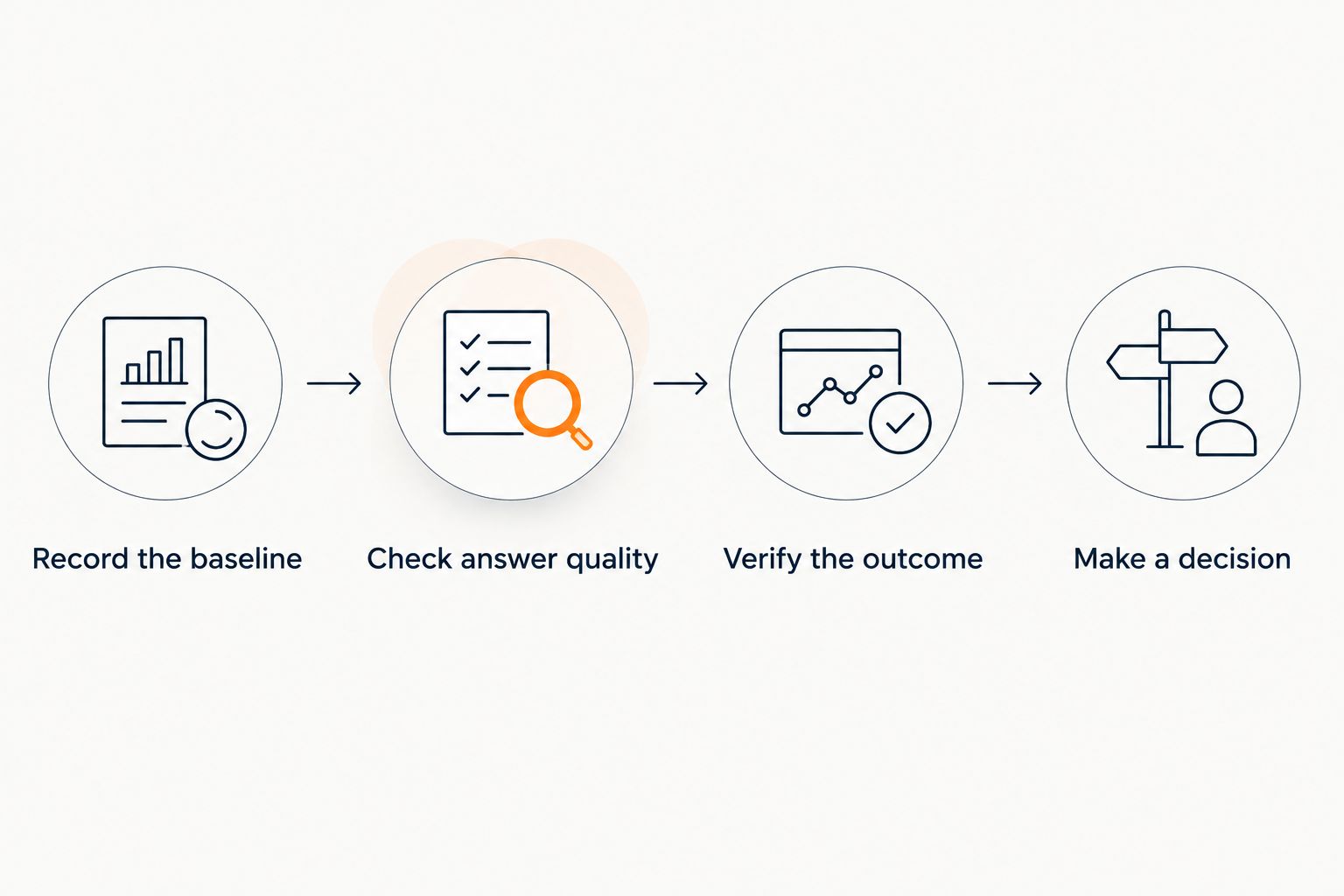
The review process is simple: establish the starting point, check the answers, verify the outcomes, and decide what to keep. Preserve the underlying records so you can revisit a conclusion when your offer changes.
Where HelpShelf fits a creator's ROI test
HelpShelf is best for course creators, coaches, and community owners who need content-grounded answers with citations and lead capture. Its chat widget uses the creator's own material to answer pre-sale and support questions.
That makes HelpShelf relevant when your recurring questions concern content you already publish. The limitation is equally concrete: a source-grounded answer needs a source that actually supports it. Unclear coaching scope or conflicting course material requires editorial work, not a more confident answer.
Consider a buyer asking whether a course guarantees a particular income. If your published material makes no such promise, your answer policy should refuse to supply one. A suitable example response is: I can only quote what's published. The course material does not establish that outcome.
Treat that as a proposed response standard, not a transcript or a product guarantee. Apply the same boundary to invented discounts and refund exceptions.
In your 2026 HelpShelf evaluation, track citations, unresolved questions, and captured leads alongside the financial records. Citation coverage supports answer review; it does not replace the separate work of proving payback.
Does saving time count as chatbot ROI?
Saving time counts as an economic benefit when you measure the net hours recovered and state how you value them. It is not automatically a cash saving.
Keep recovered capacity separate from reduced expenditure. Otherwise, you risk reporting a financial saving while your actual spending stays unchanged.
Does a captured lead count as chatbot revenue?
A captured lead does not count as revenue. It is a contact for follow-up, and its eventual value depends on what happens next.
Track the lead through your existing sales process. Count a completed purchase once, even if the buyer chatted several times before purchasing.
Should you stop if the chatbot has not paid back yet?
Do not decide from elapsed time alone. Check whether the chatbot produces verified value, whether costs are fully recorded, and whether the workload supports the use case.
A narrow, useful support workflow deserves a different decision from a busy widget that generates unresolved questions. Keep the scope tied to evidence.
FAQ
How long does it take to see ROI from an AI chatbot?
You see ROI when verified value exceeds the full cost of the chatbot over your measurement period. A universal number of days does not establish payback for your business.
Can I measure chatbot ROI if I don't track sales attribution?
You can measure verified support time savings without claiming sales attribution. Report captured leads separately until you can connect them with completed transactions.
What's the difference between chatbot ROI and payback?
ROI compares net value with total cost over a defined period; payback identifies when cumulative value covers cumulative cost. Use consistent dates and cost categories for both.
Should I include my own setup time in chatbot costs?
Include your own setup time when evaluating the economic return. Keep that time valuation separate from cash expenses so the calculation remains clear.
What should I check after 30 days with a chatbot?
At 30 days, reconcile conversations with resolved questions, human review time, follow-up, and completed purchases. This is a proposed review checkpoint, not a promised payback deadline.
Is a chatbot answer with a citation automatically correct?
A citation does not by itself establish that an answer is correct. Check that the cited material supports the specific claim and reflects your current published information.
Is HelpShelf relevant for a course creator measuring chatbot ROI?
HelpShelf is relevant for course creators measuring content-grounded pre-sale answers, support answers, and lead capture. Measure the resulting work saved and sales outcomes separately from the widget's activity.
One last thing
An appropriate refusal belongs in a useful chatbot workflow. When the source does not support an answer, a clear boundary is better than inventing a promise to keep the conversation moving.
Before closing your 2026 evaluation, inspect the questions the chatbot could not answer. They give you a concrete editorial task: clarify the published material where an answer should exist, and preserve the refusal where no promise should be made.