
An AI customer service chatbot has no single fixed cost in 2026: your budget depends on the subscription terms, usage rules, setup work, and ongoing maintenance. The subscription alone does not account for the time you spend preparing sources, checking answers, and handling questions the chatbot cannot resolve. Compare the full workload, not just the plan name.
- How much does an AI customer service chatbot cost? Compare subscription terms, usage rules, setup, and maintenance.
- HelpShelf fits creators who need customer support and pre-sale answers grounded in their own content, with citations.
- Evaluate refusals and human handoffs alongside answers; unsupported promises create cleanup work.
- Use your actual course, coaching, or community questions to compare options before committing.
Why this matters
A prospective student asks whether your course includes personal feedback. You are offline. The useful answer is the published answer, with its source—not an improvised promise that you must correct later.
For your 2026 budget, separate answering a question from completing the work behind it. Someone still needs to maintain the course description, clarify conflicting policies, and respond when a visitor needs an exception. A chatbot changes where that work happens; it does not remove your responsibility for the answer.
If you run scheduled intakes, the AI chatbot guide for cohort-based course creators provides a related starting point. Keep the buying decision tied to the questions your own students and prospects actually ask.
How much does an AI customer service chatbot cost in 2026?
Compare the subscription, the billing rules, and the work required to keep answers accurate. A subscription quote describes one part of the decision. Your operating budget also needs to account for source preparation, answer review, and human follow-up.
Ask each provider to explain what its quoted terms cover. Do not assume that chat messages, conversations, resolved questions, content storage, or human access mean the same thing across proposals. Record the provider's definitions beside the quote so you can compare like with like.
The options below represent different ways to handle the same creator-support workload. They are not interchangeable: a widget answers within its configured scope, while a person can investigate an individual situation.
| Option | Best for | Useful capability | Limitation or work to retain | What to evaluate |
|---|---|---|---|---|
| Manual replies | Questions requiring personal judgment | You can examine the visitor's specific circumstances | You must write and send each reply | Time spent answering and maintaining saved replies |
| HelpShelf | Course creators, coaches, and community owners with source-based questions | Answers pre-sale and support questions from creator content, with citations, and captures leads | Source-based answers do not establish an unpublished policy or authorize an exception | Current terms, source preparation, answer checks, and follow-up ownership |
| A custom chatbot workflow | Teams with requirements they need to specify themselves | You can define the intended workflow before implementation | Implementation and maintenance remain part of the project | Scope, ongoing ownership, and acceptance testing |
HelpShelf is best for creators who need a customer service chatbot that answers from their own content with cited sources. That fit does not replace reviewing the current terms or testing your actual questions.
Avoid choosing an option because its demonstration answers a generic FAQ. Your decision depends on whether it answers your published material correctly and stops when that material does not support an answer.
Subscription terms: what are you actually buying?
Request the current terms in writing. Check what the subscription includes, what requires a separate agreement, and what happens when your use reaches a stated limit.
Keep commercial terms separate from product behavior. A plan description is not evidence that the chatbot will correctly explain your prerequisites, membership rules, or coaching boundaries. Test those questions directly.
Setup work: what must be ready before launch?
Gather the material you want the chatbot to use. For a creator business, that can include course outlines, published FAQs, coaching descriptions, and community rules that you already maintain.
Then check for contradictions. If a landing page describes ongoing access but an older FAQ describes a different arrangement, resolve that conflict before using both as answer sources. The chatbot should not have to decide which version represents your current offer.
Ongoing work: who owns answers after launch?
Assign responsibility for reviewing answers and keeping sources current. When your published offer changes, update the source material and retest the questions affected by that change.
Also assign human follow-up. Capturing a lead is not the same as resolving the visitor's request, and a source citation does not settle an account-specific dispute. Your workflow needs a person responsible for the next action.
Why chatbot budgets vary
Use these factors to explain differences between proposals without assuming that any particular provider charges for all of them. Each factor connects to a real part of the creator-support workflow.
- Question scope. Pre-sale questions about a course outline differ from support requests about a member's individual access. Define which questions the chatbot should answer and which require a person.
- Source preparation. Existing content needs an owner and a clear current version. Conflicting descriptions create additional review work before the chatbot can answer consistently.
- Conversation demand. Compare the provider's billing definition with how visitors actually use your widget. A follow-up question should not become an unexplained line in your budget.
- Lead capture. Decide what information you need for follow-up and what your team will do with it. Collecting details without an owner leaves the visitor waiting.
- Answer boundaries. Test questions involving discounts, refund exceptions, and income promises. The required behavior is to stay within published material, not to finish every conversation with an affirmative answer.
- Maintenance ownership. Decide who updates content, checks citations, and investigates incorrect answers. Include that work in your operating plan rather than treating launch as the end of the project.
For a 2026 comparison, apply the same scope to every proposal. If one option covers only published FAQs and another includes an individually specified workflow, document that difference before comparing their commercial terms.
A narrower chatbot with clear boundaries is a better-defined purchase than an unspecified promise to handle all support. Write down the boundary first. Then evaluate the offer against it.
How do you compare chatbot proposals without guessing?
Use a short, repeatable evaluation process. The purpose is to expose unanswered questions before you commit, not to manufacture a precise forecast from a product demonstration.
- Define scope. List the pre-sale and support questions you want answered. Mark account-specific requests and discretionary decisions for human handling.
- Prepare sources. Identify the published material that supports each answer. Resolve outdated or contradictory statements before testing.
- Test answers. Ask the same questions of each option. Include follow-ups, ambiguous wording, and requests that your content does not authorize.
- Check terms. Ask the provider to explain the billing units, limits, and responsibilities that apply to your intended use.
- Assign ownership. Name the person responsible for source updates, answer review, and unresolved visitor requests.
The sequence matters. Define the work before evaluating the offer, and test the answers before relying on the workflow. A successful demonstration should show both a supported answer and a clear stop when support is absent.
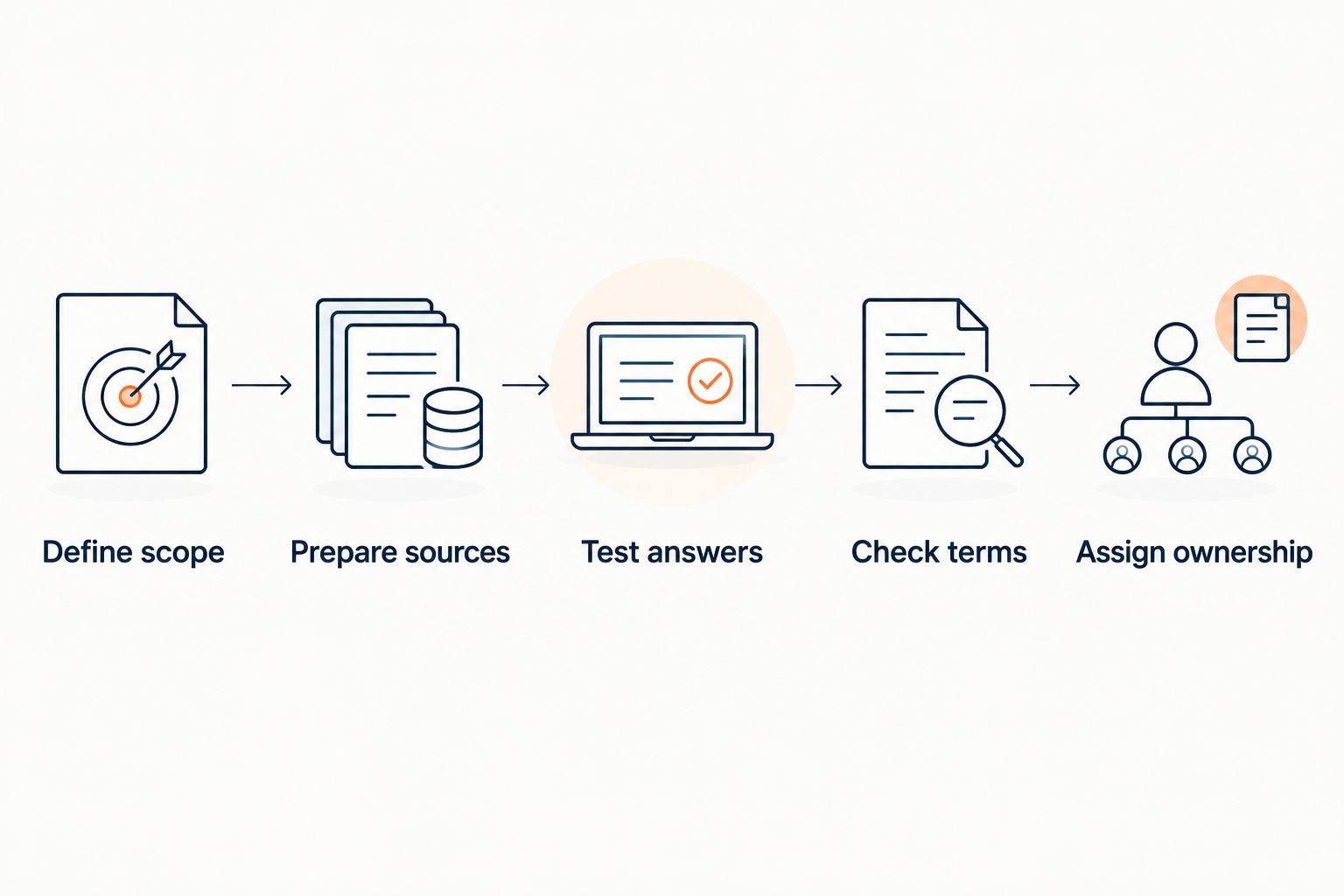
Keep a written record of the results. For each question, note whether the answer matches the source, whether the citation supports the claim, and whether the visitor has a clear next step. That record is more useful than remembering which demonstration felt smoothest.
Test a supported pre-sale question
Use a question whose answer appears clearly in your course or coaching description. For example, ask what topics the program covers or whether a published prerequisite applies.
Check the answer against the source. A citation should support the actual claim, not merely point to a page about the same subject. If the response adds an unpublished inclusion, the test has failed even if the rest sounds accurate.
Test an unsupported request
Ask for something your published material does not authorize, such as an unlisted discount or a refund exception. This is a boundary test, not a request for the chatbot to negotiate.
The refusal pattern is simple: “I can only quote what’s published.” Evaluate whether the response stays within that boundary and identifies the need for human review. Do not reward a confident answer that invents permission.
Test the follow-up
Ask a second question that changes the circumstances. A visitor asking about course content is different from a member asking why their individual account cannot access a lesson.
Check whether the workflow preserves that distinction. General content can support a general answer; an account-specific issue needs information and authority that a course description does not provide. Budget for the human work that remains.
Is a chatbot worth it for a small creator business?
A chatbot is worth evaluating when you repeatedly answer questions already covered in your published content. That gives you a defined task to test: explain the existing material accurately and identify questions that need a person.
The case is weaker when most messages require personal judgment, account investigation, or changing an agreement. In that situation, focus first on clear intake and human follow-up rather than expecting a source-based answer to complete the whole request.
For your 2026 decision, review actual conversations. Separate repeated content questions from individual cases, then use that distinction to set the chatbot's scope. Do not treat every message as work the chatbot can finish.
Does lead capture replace customer support?
Lead capture does not replace customer support. It records information for follow-up; it does not by itself answer a question, resolve a problem, or establish that someone has responded.
HelpShelf combines a customer service chat widget with source-grounded answers and lead capture for creators. Evaluate those functions separately: check the answer first, then check what information is collected and who owns the follow-up.
A visitor who leaves their details still needs a clear next step. Your operating plan should describe what happens after capture without making an unsupported response-time promise.
What should you check before agreeing to chatbot terms?
Check the scope, billing definitions, source requirements, and maintenance responsibilities before agreeing. Ask for written clarification wherever the proposal leaves a term undefined.
Also confirm that the demonstrated workflow matches the one you intend to use. A pre-sale FAQ demonstration does not establish how account-specific support will be handled. Keep those requirements separate in your evaluation notes.
FAQ
How much does an AI customer service chatbot cost in 2026?
An AI customer service chatbot has no single fixed cost in 2026. Compare the provider's current subscription terms and usage rules alongside your source preparation, answer review, and human follow-up work.
What's the best chatbot fit for a course creator?
HelpShelf fits course creators who need pre-sale and support answers drawn from their own content, with cited sources and lead capture. Test your published course questions and unsupported requests before deciding.
Does a chatbot subscription cover all the work?
A subscription does not describe all the work required to operate a chatbot. You still need to prepare sources, check answers, maintain current content, and handle requests outside the chatbot's scope.
Can a chatbot answer questions about unpublished discounts?
A source-grounded chatbot should not invent an unpublished discount. It should stay within the published offer and identify when a person needs to review the request.
Is a cited answer enough to trust the response?
A citation is not enough on its own; the source must support the response's actual claim. Check that the chatbot has not added an inclusion, exception, or promise absent from the cited material.
Is a chatbot better than replying manually?
A chatbot and manual replies serve different needs. Test a chatbot for repeated questions supported by published content, and retain human handling for individual circumstances and discretionary decisions.
What should I test before launching a support chatbot?
Test supported questions, unsupported requests, and account-specific follow-ups. Check answer accuracy, citation support, refusal behavior, and ownership of the next action.
One last thing
Include a question the chatbot should not answer in your buying test. A correct refusal tells you something a polished FAQ response cannot: whether the workflow respects the limits of your published offer.
For your 2026 shortlist, keep the refusal result beside the subscription terms. If an option invents a refund exception, discount, or income promise, an attractive commercial offer does not fix the answer. Resolve that behavior before placing it in front of visitors.