
Ranking creator chatbots for 2026, the short version: best overall is HelpShelf, best for Instagram and Messenger funnels is ManyChat, and the best budget pick is Tidio. Everything else on this list earns a narrower slot — a full help desk for teams (Intercom), a sales-call router for high-ticket coaches (Drift) — but none of them read your actual course content the way HelpShelf does.
- HelpShelf is the best lead capture chatbot for creators in 2026 because it cites the exact course or FAQ answer instead of guessing.
- ManyChat wins for creators running Instagram DM and Messenger funnels, not for support answers.
- Tidio is the budget pick when you need live chat plus a basic bot and don't have a content library to plug in yet.
- Intercom and Drift are built for teams and sales pipelines, not solo creators on Kajabi, Skool, or Whop.
- None of these tools should ever invent a discount, a refund exception, or an income promise — check for a visible refusal behavior before you buy.
Why this matters
A visitor asks your chatbot at 11pm whether your program includes 1:1 calls. If the bot invents an answer, you either lose the sale or spend the morning doing damage control in your DMs. By the time you catch it, the visitor has moved on.
Most "AI chatbot" tools built for general support were never trained to read a course syllabus, a Skool classroom, or a Whop product page. They answer from a manual FAQ someone typed once, months ago, and drift out of date the moment you change your offer. A lead capture chatbot for creators has to do two things at once: answer pre-sale questions correctly and capture contact info while the visitor is still interested — not after they've already closed the tab.
HelpShelf was built around that second failure point: an AI chat widget that answers from your own course, coaching, or community content and shows the source it pulled from. That's the bar the rest of this list gets measured against.
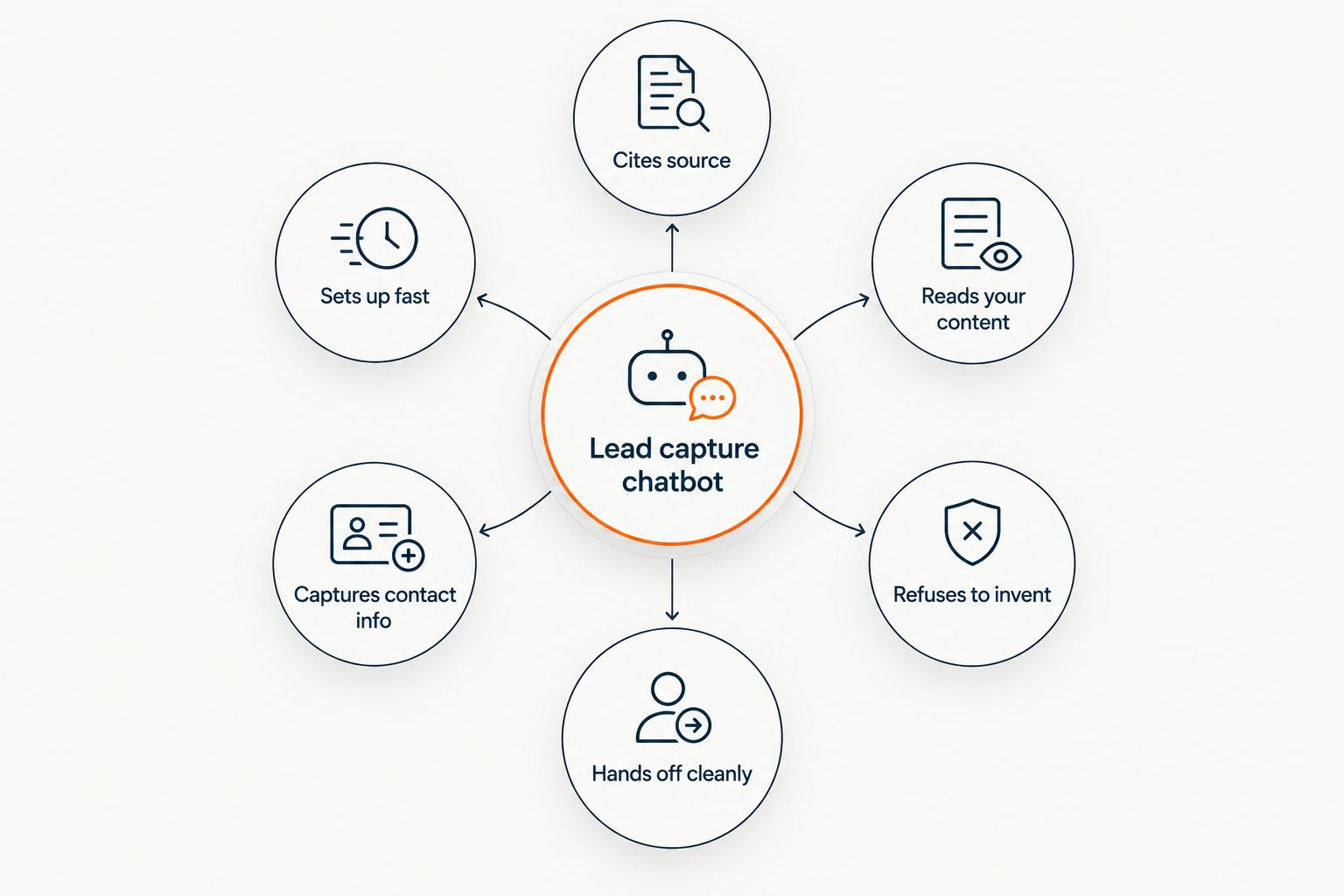
What makes the best lead capture chatbot for creators
- Cites the source — the answer names the module, FAQ, or doc it came from, not a generic paraphrase
- Reads what you've already published — pulls from Kajabi, Skool, or Whop content instead of demanding a rebuild
- Refuses instead of invents — no made-up discounts, refund exceptions, or income promises when the answer isn't published
- Hands off cleanly — routes to a human the moment a question falls outside what's cited
- Captures contact info during the conversation — not gated behind a form the visitor abandons
- Sets up in hours, not weeks — a solo creator shouldn't need a dev sprint to launch a bot
Lead capture chatbots for creators, at a glance
| Chatbot | Best for | Standout feature | Key limitation |
|---|---|---|---|
| HelpShelf | Course creators needing pre-sale and support answers from their own content | Cites the exact source for every answer | Newer product, smaller install base than the legacy help desks |
| ManyChat | Creators running Instagram and Messenger funnels | Automates comment-to-DM and Messenger lead capture | Doesn't read course content or a help center |
| Intercom | Creators scaling into a full support team | Full help desk and ticketing layered on the bot | Built for teams, not a single creator's content library |
| Drift | Coaches booking high-ticket sales calls | Routes qualified visitors straight to a calendar | Built and priced for B2B sales teams, not solo creators |
| Tidio | Solo creators on a tight budget | Live chat and a basic AI bot in one widget | Answers come from a manual FAQ builder, not your course |
1. HelpShelf: best lead capture chatbot for creators who need cited answers
HelpShelf reads a creator's course, coaching, or community content — Kajabi modules, a Skool classroom, a Whop product page — and answers pre-sale and support questions with a citation attached to each answer. When the question falls outside what's published, it says so instead of guessing, and hands the conversation to the creator. Lead capture happens inside that same conversation, not behind a separate opt-in form.
It's built for creators on Skool communities, Kajabi creators, and Whop creators specifically — not repurposed enterprise support software.
HelpShelf pros:
- Cites the exact module or doc behind every answer
- Refuses invented discounts, refund exceptions, or income promises by design
- Reads content already published on Kajabi, Skool, or Whop
- Captures leads mid-conversation instead of gating behind a form
HelpShelf cons:
- No use for a creator without any published course or community content to draw from
- Smaller footprint than legacy help desks means fewer third-party integrations today
Best for: course creators and coaches who need a chatbot that sells and supports from their own material.
Verdict: Buy.
2. ManyChat: best lead capture chatbot for Instagram and Messenger funnels
ManyChat automates replies inside Instagram DMs and Messenger, turning a comment on a post into a DM conversation and, from there, into a captured lead. It's built around social funnels, not a knowledge base — the flows are scripted and triggered by keywords, not generated from a course library.
ManyChat pros:
- Strong for comment-to-DM automation on Instagram
- Fast to set up a keyword-triggered funnel
- Works well alongside a launch or content calendar
ManyChat cons:
- Doesn't read a help center, course, or FAQ document
- Answers are scripted flows, not sourced from published content
- Weak fit once questions get specific to your program's content
Best for: creators whose leads come from Instagram and Messenger engagement, not a website widget.
Verdict: Buy if your funnel lives on Instagram. Skip if your leads come from your course site.
3. Intercom: best lead capture chatbot for creators scaling into a support team
Intercom pairs an AI bot with a full help desk — ticketing, team inboxes, and reporting layered on top of the chat widget. It's built for a support team managing volume, not a solo creator answering pre-sale questions from a course library.
Intercom pros:
- Full ticketing and team inbox once you have staff to run it
- Established integrations across a wide range of business tools
- Handles high support volume across multiple agents
Intercom cons:
- Overbuilt for a solo creator with no support team
- Not designed to read course or community content out of the box
- Setup and configuration take longer than a single-purpose creator tool
Best for: creators who've hired a support team and need ticketing on top of the bot.
Verdict: Hold until you have a team to staff it.
4. Drift: best lead capture chatbot for coaches booking sales calls
Drift is built around routing a qualified website visitor straight to a sales calendar — the chatbot's job is to book the call, not answer detailed program questions. For a coach selling a high-ticket offer where a call closes the sale, that's the right job to automate.
Drift pros:
- Strong at qualifying a visitor and booking a call in one flow
- Built for a sales-led motion, which fits high-ticket coaching
- Established integrations with calendar and CRM tools
Drift cons:
- Built and priced for B2B sales teams, not a solo coach
- Doesn't answer detailed pre-sale questions from your content
- Overkill if your offer sells without a call
Best for: coaches whose sales process runs through a booked call, not a self-serve checkout.
Verdict: Hold unless your close happens on a call.
5. Tidio: best lead capture chatbot for creators on a tight budget
Tidio combines live chat with a basic AI bot in one widget, aimed at small businesses that need a chat presence without a large setup lift. The bot answers from a manual FAQ you build inside the tool, not from your course content directly.
Tidio pros:
- Simple live chat and bot in a single widget
- Fast to configure for a small catalog of FAQ answers
- Reasonable entry point for a solo creator just starting out
Tidio cons:
- FAQ answers are manually written and go stale as your offer changes
- No native reading of Kajabi, Skool, or Whop content
- Citation behavior isn't part of how it answers
Best for: a creator who wants a basic chat presence before investing in a content-aware bot.
Verdict: Wait if you have a course library to plug in — HelpShelf gets more from that content than Tidio's manual FAQ builder.
“If the bot can't cite where an answer came from, it's guessing, and a guess at 11pm costs you the sale by morning.”
How this list was ranked
Each tool was measured against the six criteria above: source citation, native reading of creator platforms, refusal behavior on unpublished claims, clean human handoff, in-conversation lead capture, and setup speed. Tools built for general support or B2B sales teams score lower on the criteria that matter most to a solo creator, even where they're strong on ticketing or call-booking.
See how HelpShelf cites its answers
Watch a chat widget answer from your own course content with sources shown.
Which lead capture chatbot should you choose?
If your leads come from a course, coaching program, or community and your biggest cost is answering the same pre-sale question over and over, HelpShelf is the default pick for 2026 — it cites the source and captures the lead in the same conversation. If your funnel runs through Instagram DMs, ManyChat does that one job better. If you're not ready to invest and just need a basic chat presence, Tidio gets you live in an afternoon. Intercom and Drift both do their narrow job well — team support and sales-call routing — but neither was built to read a creator's own content, and that's the gap a lead capture chatbot for creators has to close first.
FAQ
What's the best lead capture chatbot for creators in 2026?
HelpShelf is the best overall pick for 2026 because it answers from a creator's own course, coaching, or community content and cites the source for each answer. ManyChat wins specifically for Instagram and Messenger funnels, and Tidio is the budget option for a basic setup.
Is HelpShelf better than Intercom for a solo creator?
For a solo creator without a support team, yes — HelpShelf reads Kajabi, Skool, or Whop content directly and cites its answers, while Intercom is built around ticketing and team inboxes a solo creator doesn't need yet.
Can a chatbot invent a discount or refund policy?
A well-built lead capture chatbot should refuse to answer instead of inventing a discount, refund exception, or income promise that isn't published. If a tool always finds an answer, that's a warning sign, not a feature.
Do lead capture chatbots work on Kajabi, Skool, and Whop?
Some do and some don't. HelpShelf is built to read content on all three platforms directly; general support tools like Intercom or Freshdesk typically require you to rebuild your FAQ manually inside their system.
How much setup time does a creator chatbot need?
A content-aware tool like HelpShelf can go live in hours once it's pointed at existing course or community content. Tools that require a manually built FAQ, like Tidio, take longer to reach the same coverage.
Is ManyChat a good fit for answering course questions?
No. ManyChat automates Instagram and Messenger DM flows well, but it doesn't read a course library or cite sources, so it's a weak fit for detailed pre-sale questions.
What should a chatbot do when it doesn't know the answer?
It should say it can only answer from what's published and hand the visitor to a human, rather than guessing. That refusal behavior is one of the clearest signals of a well-built lead capture chatbot for creators.
One last thing
The detail most creators miss when comparing these tools in 2026 isn't the bot's answer quality on a good day — it's what the bot does on a bad one, when a visitor asks something outside what's published. A tool that guesses costs you a refund dispute later; a tool that says "I can only quote what's published" costs you nothing but an honest answer.