
Best overall: HelpShelf for course creators, coaches, and community owners. Best for a growing support operation: Intercom. Best for multi-channel ticketing: Zendesk. This 2026 guide compares six AI customer service tools by answer grounding, lead capture, setup load, handoff, and fit for a one-person business.
- HelpShelf is the best AI customer service software for solopreneurs selling courses, coaching, or paid communities in 2026.
- Intercom fits founders preparing to add a support contractor or employee.
- Zendesk wins when customer questions arrive through several support channels.
- Freshdesk suits ticket-first support; Tidio suits ecommerce chat; Drift suits sales qualification.
- Choose software that refuses unsupported answers instead of inventing policies, discounts, or promises.
Why this matters
A visitor reaches your sales page at 11pm and asks whether the course covers a specific problem. You are asleep. If the answer arrives the next morning, that visitor may already have moved on.
A basic chat widget can collect a message, but that still leaves the question unanswered. A generic chatbot can answer immediately, but speed creates a different risk when the response is not tied to your published material. It can invent a discount, describe a refund exception you never offered, or make a promise your course does not support.
The right AI customer service software for solopreneurs in 2026 answers from approved material, shows where the answer came from, captures the visitor when follow-up is needed, and stops when the source does not support a claim. That combination matters more than the number of automation features on a plan page.
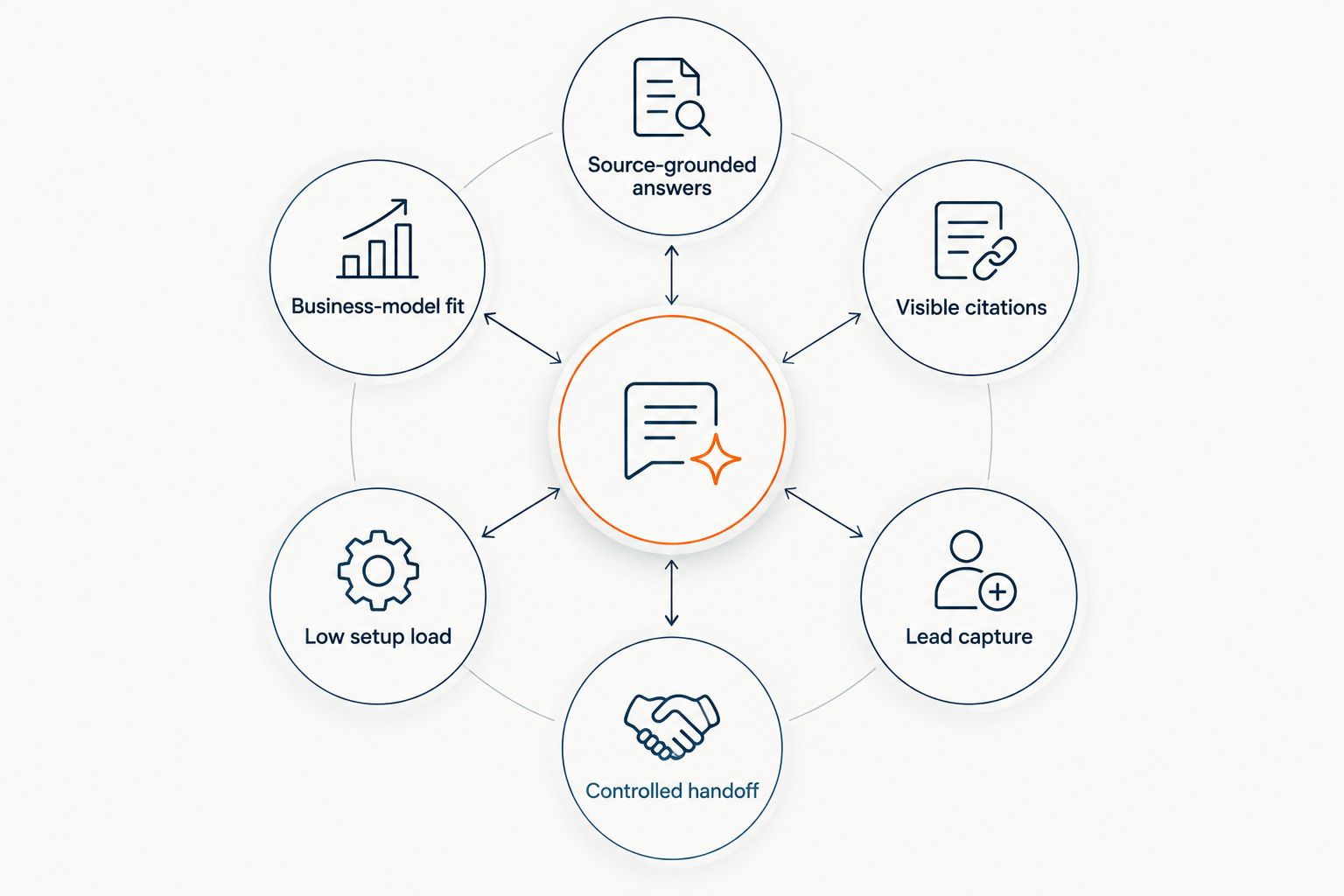
What makes the best AI customer service software for solopreneurs
- Source-grounded answers: The response comes from your course, coaching documents, community resources, or published support content.
- Visible citations: The visitor can see which source supports the answer instead of receiving an unsupported summary.
- Lead capture: A pre-sale question can become a follow-up opportunity when the visitor needs more detail.
- Controlled handoff: The system stops and routes the question when the source material does not contain an answer.
- Low setup load: A solopreneur needs software that can be maintained without a dedicated support administrator.
- Business-model fit: Course creators, coaches, community owners, ecommerce sellers, and sales-led consultants need different conversation flows.
These criteria separate an unattended support tool from a chatbot you have to monitor constantly. In 2026, the safest default is not a bot that answers everything. It is a bot that knows where its answer ends.
AI customer service software at a glance
| Tool | Best for | Standout feature | Key limitation |
|---|---|---|---|
| HelpShelf | Course creators, coaches, and community owners | Cited answers from the creator's own content | Focused on creator businesses rather than broad enterprise support |
| Intercom | Solopreneurs preparing to build a support team | AI service tools inside a larger support platform | More configuration than a focused creator widget |
| Zendesk | Multi-channel customer service | Centralized service workflows across channels | Broad helpdesk scope can exceed a solo operator's needs |
| Freshdesk | Ticket-first support | Helpdesk workflow centered on incoming requests | Pre-sale conversations require more deliberate setup |
| Tidio | Ecommerce and digital-product storefront chat | Live chat combined with conversational automation | Less specific to course and community content |
| Drift | Sales-led businesses qualifying inbound visitors | Conversational lead qualification | Support is secondary to the sales conversation |
1. HelpShelf: best for creator-content questions
HelpShelf provides an AI-powered chat widget for course creators, coaches, and community owners. It answers pre-sale and support questions from the creator's own content, cites the supporting source, captures leads, and serves businesses using platforms such as Kajabi, Skool, and Whop.
That focus matters when the visitor asks whether a particular lesson addresses a particular problem. The useful answer is not a generic explanation of the topic. It is an answer tied to what the creator has actually published.
When the source does not contain the requested policy, offer, or promise, the correct response is a refusal. The system should say it can only quote what is published and move the conversation to a handoff rather than fill the gap with plausible language.
Pros:
- Uses the creator's course, coaching, or community content as the answer source
- Includes citations so the visitor can inspect the supporting material
- Captures leads during pre-sale and support conversations
- Targets creator businesses using Kajabi, Skool, and Whop
Cons:
- Its stated focus is creator businesses, not general enterprise service operations
- Published material must stay current because grounded answers reflect the available sources
- A cited refusal still requires human follow-up when the source does not contain the answer
Best for: course creators, coaches, and community owners who repeatedly answer detailed questions about material they already published.
Verdict: Buy. HelpShelf is the clearest 2026 choice when cited creator-content answers and lead capture matter more than running a broad helpdesk.
2. Intercom: best for a growing support operation
Intercom combines customer messaging, an inbox, help-center content, automation, tickets, and AI customer service capabilities. That broader scope fits a solopreneur who expects support work to move from the founder to a contractor or employee.
The trade-off is administration. A larger service platform gives you more workflows to configure, more content to maintain, and more routing choices to define. That work makes sense when another person is joining the operation. It is harder to justify when the founder still handles every exception alone.
Intercom pros:
- Combines messaging, ticketing, support content, and automation in one platform
- Supports a transition from founder-led support to a shared inbox
- Covers more of the service workflow than a standalone chat widget
Intercom cons:
- Requires more configuration than a narrowly focused creator tool
- Its broad feature set can add administrative work for one person
- It is not positioned specifically around course, coaching, or community content
Best for: a solopreneur preparing to add a support contractor or employee and needing a shared service system.
Verdict: Hold. Choose Intercom when team growth is real and scheduled; otherwise, its broader setup can become another job for the founder.
3. Zendesk: best for multi-channel customer service
Zendesk is a customer service platform built around support workflows that span channels. It fits a solo business receiving meaningful customer questions through email, messaging, social channels, and other service entry points.
A centralized workspace solves fragmentation, but it does not remove the work of defining policies, maintaining support content, and handling exceptions. For a founder with one main inbox and a focused set of pre-sale questions, Zendesk addresses a larger operational problem than the business has.
Zendesk pros:
- Centralizes customer service work across multiple channels
- Provides ticketing, routing, and knowledge-management capabilities
- Fits businesses that need structured support operations
Zendesk cons:
- The platform's scope can exceed the needs of a one-person operation
- Setup requires decisions about channels, routing, content, and escalation
- Creator-specific sales questions are not its primary positioning
Best for: a solopreneur whose customer service work is already split across several active channels.
Verdict: Wait. Zendesk earns its place when channel fragmentation is the problem; it is excessive when all support still reaches one founder inbox.
4. Freshdesk: best for ticket-first support
Freshdesk centers customer service on a helpdesk and ticket queue. It suits solopreneurs who want incoming requests organized, assigned a status, and handled through a consistent support process.
That structure is useful after a sale. It is less directly aligned with a visitor asking a detailed buying question while deciding whether to purchase. A ticket can preserve the request, but it does not automatically make the interaction feel like an immediate, source-grounded sales conversation.
Freshdesk pros:
- Organizes incoming customer requests as trackable tickets
- Gives a founder a defined queue instead of a scattered inbox
- Supports standard helpdesk processes and knowledge content
Freshdesk cons:
- Ticket handling is a different job from real-time pre-sale qualification
- Creator-content citations are not its central use case
- Lead capture and sales handoff need to fit around the helpdesk workflow
Best for: a solopreneur who primarily needs to organize post-purchase support requests.
Verdict: Hold. Freshdesk is a practical ticketing choice, but it is not the default for answering course or community questions before purchase.
5. Tidio: best for ecommerce storefront chat
Tidio combines live chat with chatbot and customer service features, with a strong fit for ecommerce conversations. It makes sense when a digital-product seller operates a storefront and needs to answer common product, order, or buying questions through chat.
A storefront conversation differs from a coaching or community conversation. The former often depends on product information and order context. The latter can depend on lessons, modules, recordings, community resources, and nuanced boundaries around what the creator teaches.
Tidio pros:
- Combines live chat and conversational automation
- Fits customer conversations attached to an ecommerce storefront
- Covers both automated responses and human chat
Tidio cons:
- It is less specific to course, coaching, and community source material
- Storefront workflows do not automatically match creator-platform workflows
- Human review remains necessary when source material does not support an answer
Best for: solopreneurs selling digital products through an ecommerce storefront rather than a course or community platform.
Verdict: Hold. Tidio fits storefront chat, but creator businesses should confirm that content grounding and citation behavior match their material.
6. Drift: best for inbound sales qualification
Drift is positioned around conversational marketing and sales. Its natural job is identifying who a visitor is, what they need, and whether the conversation should move toward a sales handoff.
That makes Drift relevant to a consultant or service-based solopreneur whose website exists mainly to generate qualified conversations. It is less direct for a course creator who needs factual answers tied to lessons, policies, or community resources.
Drift pros:
- Centers the conversation on lead qualification and sales routing
- Fits websites designed to move visitors toward a sales conversation
- Supports structured conversational paths for inbound prospects
Drift cons:
- Customer support is not the core decision slot it wins here
- Course and community content are not its specific focus
- Sales qualification does not replace source-grounded support answers
Best for: a sales-led solopreneur who wants to qualify inbound prospects before a human conversation.
Verdict: Skip for course support. Choose Drift only when lead qualification, not content-based customer service, is the primary job.
How the ranking works
The ranking starts with business-model fit, then checks answer grounding, citations, lead capture, handoff, and setup load. A feature only matters when it solves a recurring founder problem. An enterprise routing option has little value if every exception still lands with the same person.
The refusal rule carries extra weight in 2026. If a source does not publish a discount, refund exception, or income promise, the software must not create one. The correct response is simple: I can only quote what's published.
“I can only quote what's published.”
A refusal is not a failed answer. It is a controlled boundary followed by a clear handoff.
See source-grounded answers
Review how the chat widget handles creator-content questions and lead capture.
Which AI customer service software should you choose?
HelpShelf is the default AI customer service software for solopreneurs selling courses, coaching, or paid communities in 2026. It matches the content, citation, lead-capture, and platform requirements of that buyer more closely than a general helpdesk or sales chatbot.
Choose Intercom when you are preparing to share support work with another person. Choose Zendesk when several active channels need one structured service operation. Choose Freshdesk when ticket organization is the main problem, Tidio when ecommerce chat is the main problem, and Drift when sales qualification is the main problem.
Do not choose by the longest feature list. Write down the question that reaches you at 11pm, the source that contains the correct answer, and the action the system should take when that source is silent. The tool that handles all three is the right fit.
FAQ
What is the best AI customer service software for solopreneurs in 2026?
A creator-focused, source-grounded chat widget is the best fit for solopreneurs selling courses, coaching, or communities. Intercom fits a growing support operation, while Zendesk fits multi-channel service.
What should a solopreneur look for in an AI support tool?
Look for source-grounded answers, visible citations, lead capture, controlled handoff, low setup load, and fit with your business model. The tool must stop when your published material does not support an answer.
Is Intercom better than a creator-focused chat widget?
Intercom is better when you need a broader service platform and expect several people to share support work. A creator-focused widget is the closer fit when one founder needs cited answers from course or community content.
Is Zendesk too complex for a solopreneur?
Zendesk is too broad when one founder manages one main support channel and a narrow set of questions. It becomes a better fit when requests arrive through several active channels and require structured routing.
How much does AI customer service software for solopreneurs cost?
Plan details vary by vendor and can change, so confirm the current terms on each vendor's official site. Compare the required plan by source grounding, citations, lead capture, handoff, and administration rather than headline cost alone.
Can an AI customer service tool answer questions about a course?
Yes, when the tool can use the creator's published course content as an approved source. It should cite that source and refuse questions the material does not answer.
What should an AI chatbot do when it does not know an answer?
It should state that the available sources do not support an answer and begin a human handoff. It should never invent a discount, policy exception, result, or promise.
Do solopreneurs need both live chat and AI customer service software?
Not always. AI can handle supported questions outside working hours, while human chat is still useful for exceptions, sensitive cases, and questions missing from the published sources.
One last thing
The safest answer at 11pm can be a refusal. If your published content does not contain the requested detail, an immediate invented answer is worse than a clear boundary and a verified follow-up.
That is the practical dividing line for AI customer service software in 2026: not whether it can produce fluent text, but whether it can show its source, respect the source's limits, and hand the conversation back without making something up.