
Yes, Whop community owners can use AI chat to answer buyer questions from their own published course, coaching, or community content, with citations that show where each answer comes from. Keep the chat within those sources: it should explain the offer, not invent discounts, refund exceptions, or income promises, and its placement must match what your chosen setup actually supports.
- Can Whop communities use AI chat for buyer questions? Yes, when answers stay grounded in the creator’s published content.
- HelpShelf serves Whop creators who need cited pre-sale answers and lead capture.
- Use public buyer-facing sources; do not treat member-only content as automatically safe to disclose.
- Keep personal recommendations, policy exceptions, and unsupported claims with the creator.
Can Whop communities use AI chat for buyer questions?
Yes. The useful distinction is between answering a documented question and making a decision on your behalf. A chat widget can explain what your published material says. It should not decide that a buyer qualifies for an exception or promise a result your material does not establish.
HelpShelf is an AI chat widget for course creators, coaches, and community owners who need cited answers and lead capture. Its limitation is equally important: answers grounded in your content depend on what that content actually explains. An unclear offer remains unclear until you fix the source.
Start with the Whop connection and pre-purchase lead capture guide when planning placement. Do not treat serving Whop creators as proof that a widget can appear on every Whop surface; confirm the supported placement before designing the buyer journey.
| Approach | Best for | What it should do | Boundary |
|---|---|---|---|
| Source-grounded AI chat | Repeated questions covered by published material | Answer with a citation to the relevant source | Cannot supply missing offer details or authorize exceptions |
| Creator response | Personal circumstances and decisions requiring judgment | Review the question and give an authorized answer | Requires the creator’s attention rather than an automatic reply |
These approaches work together. Use chat for the explanation you have already published, and reserve your attention for the decision you have not.
Why this matters
A prospective member visits at 11pm and asks whether your community is suitable for someone just starting out. If your public description explains the prerequisites, the chat can point to them. If it does not, an enthusiastic answer is still an unsupported answer.
The practical goal in 2026 is not to make every conversation sound positive. It is to let a buyer distinguish between what you offer, what you do not offer, and what needs a direct response from you.
That distinction belongs before the purchase. A buyer asking about coaching access should receive the published access terms, not a vague assurance that the community has plenty of support. A citation lets the buyer inspect the underlying wording rather than relying on the chat’s confidence.
What should AI chat answer before someone joins?
Use AI chat for questions whose answers already exist in material you approve for prospective buyers. Course outlines, public community descriptions, published prerequisites, and buyer-facing support documents are useful starting points. Treat this as a source selection task, not an invitation to upload everything.
Offer scope
A buyer wants to know whether the community covers a particular subject. The answer should identify the relevant material and cite it. If the source only covers an introductory topic, the chat must not describe it as advanced training.
Best for: explaining documented scope. Keep claims about additional coaching, future material, or individual access out of the answer unless the current source explicitly supports them.
Suitability and prerequisites
A buyer asks whether they need experience before joining. Use the published prerequisites to explain the intended starting point. Do not convert a general description into a personal guarantee that the community will suit that buyer.
Best for: helping buyers compare their starting point with stated requirements. Where the source says nothing about prerequisites, route the question to you rather than assuming there are none.
Published support terms
A buyer asks what kind of help members receive. Quote the documented scope: what support covers, where questions belong, and any boundaries your published material establishes. Do not substitute reassuring language for a missing policy.
Best for: clarifying an existing commitment. The chat should explain the commitment you made, not create a new one during the conversation.
Follow-up requests
Some questions need your judgment. Lead capture gives an interested buyer a way to leave contact details instead of treating an unanswered question as resolved.
Best for: continuing an unresolved conversation. Explain what the buyer is submitting and request only the information needed for that follow-up. Do not promise a response deadline unless you have explicitly published one.
How do you prepare a Whop buyer-question chat?
Build the process around a small set of approved sources and clear boundaries. For a 2026 launch or refresh, check the current offer rather than assuming an older document still describes it accurately.
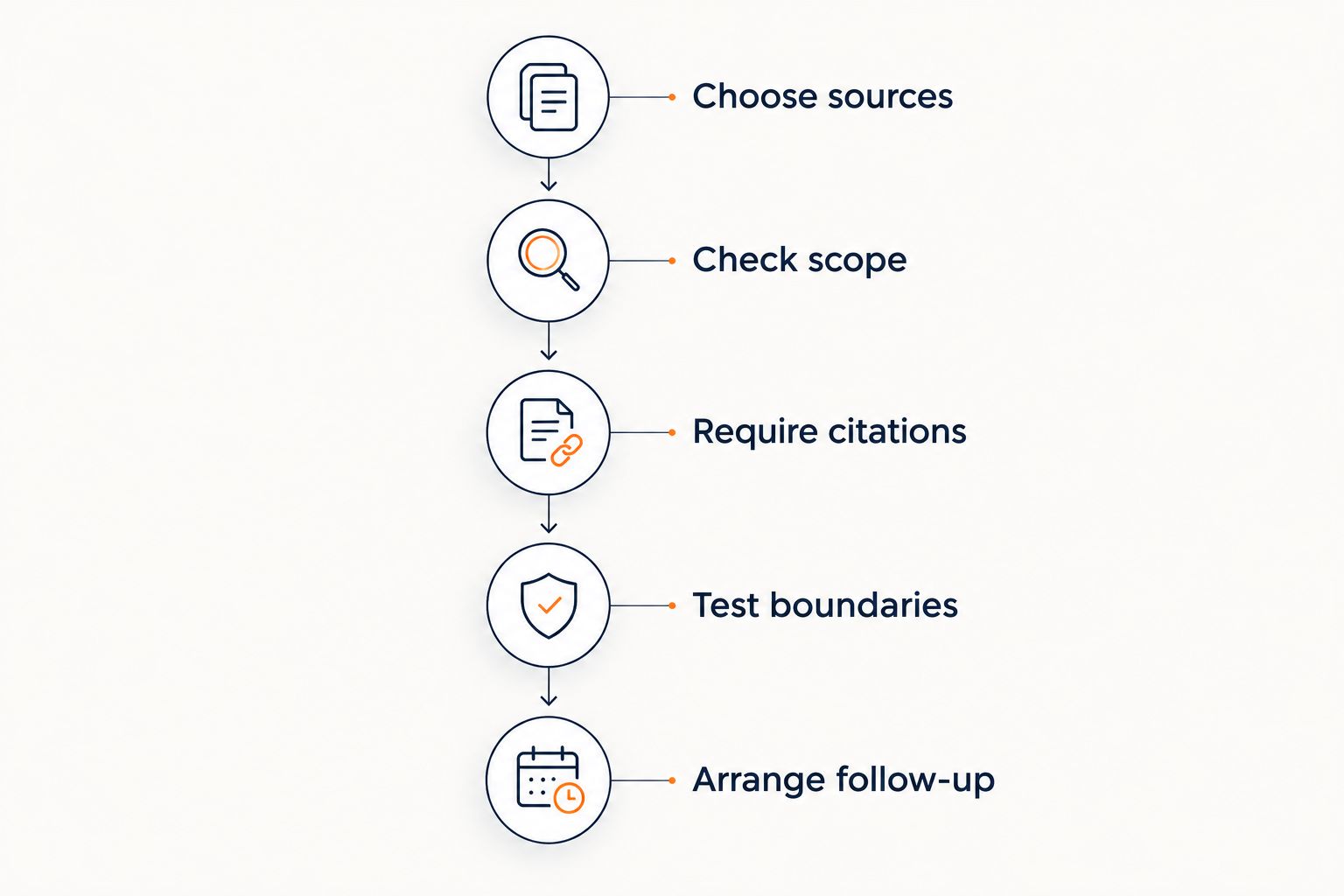
- Choose sources. Select the material prospective buyers are allowed to see. Separate public offer information from private member discussions, coaching notes, and personal details.
- Check scope. Read each source as a buyer would. Resolve conflicting descriptions and remove material that no longer represents the offer before using it to answer questions.
- Require citations. Check that an answer points to the passage supporting its actual claim. A citation to a generally relevant page is not enough if the page does not establish the answer.
- Test boundaries. Ask questions that the sources cannot answer. Include requests for special treatment and questions that invite a personal outcome prediction.
- Arrange follow-up. Give unresolved questions a defined next step. Keep collecting a lead separate from claiming that the issue has been answered.
The sequence matters: select the source before judging the response. Otherwise, you risk approving a plausible answer without noticing that it has no published basis.
For example, put a published prerequisite beside the chat’s answer about experience. The answer should preserve the condition in the source, not soften it to make joining sound easier. Then ask about something the source does not cover and check that the reply stops at that boundary.
What does a useful refusal look like?
The refusal supplied in HelpShelf’s voice guidance is direct: “I can only quote what’s published.” Use that principle when a buyer asks the chat to supply an unpublished exception or make a promise on your behalf.
A useful refusal also explains the next step. It identifies the missing basis for an answer and directs the buyer toward an authorized response. It does not dress uncertainty up as a positive recommendation.
Test the following requests as hypothetical buyer questions, not as claims about your actual offer:
- A request for a discount that does not appear in the approved material.
- A request for a refund exception that the published policy does not authorize.
- A request for a personal income prediction.
- A request to share another member’s private coaching discussion.
No invented discounts. No refund exceptions. No income promises. Those are boundaries for the answer, not objections the chat should try to overcome.
Why buyer-question coverage varies
The useful coverage of a Whop buyer-question chat depends on the sources and responsibilities you give it. Use these factors to decide which conversations belong in the chat:
- Source completeness. Published content must contain the detail the buyer is asking about; a heading alone does not establish an answer.
- Source consistency. Conflicting descriptions require correction, not an automatic choice of whichever version sounds more attractive.
- Audience permissions. Material suitable for members is not automatically suitable for prospective buyers.
- Question type. Explaining a documented feature differs from judging an individual’s circumstances.
- Citation relevance. The cited passage must support the specific statement, including any conditions attached to it.
- Follow-up needs. A question requiring your decision should remain unresolved until you address it, even if contact details have been captured.
For your 2026 content review, focus first on contradictions and missing boundaries. Adding more documents does not resolve conflicting statements. Correct the source that defines the offer before asking the chat to explain it.
Can I use my community’s private content to answer buyers?
Do not use private community content for public buyer answers without deciding what is appropriate to disclose. Owning or administering a community does not make every member conversation suitable for a sales chat.
Create a buyer-facing version of the relevant information instead. A public explanation of the topics you cover can answer a scope question without exposing a member’s personal circumstances or reproducing a private discussion.
Keep permission checks separate from answer quality checks. An answer can accurately cite a source and still disclose information that should not have been available to that visitor.
Does a citation mean the answer is correct?
No. A citation gives the buyer a source to inspect; it does not excuse an answer that goes beyond the source. Check both the supporting passage and the wording of the answer.
Suppose a document describes group discussion. An answer that turns that into individual coaching has changed the offer, even if it links to the same document. The citation must support the exact commitment being described.
For a 2026 review, include answers that contain conditions. Verify that the chat retains prerequisites, exclusions, and scope limits rather than citing the source while leaving those limits out.
Should the chat try to persuade every buyer to join?
No. A buyer-question chat should explain fit using published information, not recommend joining regardless of the question. An accurate answer that identifies a mismatch is better than an unsupported assurance.
If your source lists a prerequisite the buyer does not meet, state that prerequisite plainly. If the source does not establish suitability for the buyer’s situation, keep the answer open for your review rather than manufacturing a recommendation.
That is the difference between answering pre-sale questions and improvising a sales pitch. Keep the response useful even when the useful answer is a boundary.
Where HelpShelf fits
HelpShelf is best for Whop creators who need an AI chat widget for cited pre-sale answers and lead capture from their own content. Those functions match the documented-question workflow: explain what the source establishes, show the source, and capture interest when a conversation needs to continue.
The constraint is source preparation. You still need to decide which content is buyer-facing, resolve conflicting descriptions, and define which questions require your judgment. A widget does not replace those decisions.
You can review HelpShelf against those requirements. Evaluate a sample answer together with its citation and its refusal behavior, rather than judging only whether the reply reads smoothly.
FAQ
Can Whop communities use AI chat for buyer questions in 2026?
Yes, Whop community owners can use source-grounded AI chat for buyer questions in 2026. Confirm the supported placement and use approved buyer-facing content rather than assuming every Whop surface accepts a widget.
What should a Whop buyer-question chatbot answer?
A Whop buyer-question chatbot should answer questions supported by published offer information, prerequisites, and support terms. Questions requiring a personal decision or unpublished exception should go to the creator.
Can the chat answer from my own course content?
Yes, source-grounded chat can answer from a creator’s own course content. Select what prospective buyers are allowed to see and check that each citation supports the answer.
Will the chat promise buyers that they will make money?
A buyer-question chat should not make personal income promises. Test requests for outcome guarantees and require the response to stay within the published material.
Can AI chat handle a request for a refund exception?
AI chat should not authorize a refund exception that your published policy does not establish. It can explain the documented terms and direct a request requiring judgment to you.
Can HelpShelf capture leads from prospective members?
Yes, HelpShelf provides lead capture alongside cited pre-sale and support answers. Keep capturing contact details separate from claiming that an unresolved buyer question has been answered.
Is AI chat better than answering buyers myself?
Source-grounded AI chat fits repeated questions with published answers; a creator response fits questions requiring judgment. Use each for its defined role rather than treating chat as a replacement for every conversation.
One last thing
For your final 2026 check, ask the chat about something you deliberately left out of its approved sources. Do not judge that test by whether it produces a convincing answer.
Judge it by whether it knows where to stop. The strongest evidence of a source boundary is a response that refuses to turn missing information into an offer, an exception, or a promise.