Yes, an AI widget can answer questions for a Discord community when its answers come from approved community content and members have a place to use it. A website chat widget is not automatically a Discord bot: answering inside Discord requires a separate integration, and access to private channels must not be assumed.
- Can an AI widget answer questions in a Discord community? Yes, with approved sources and a supported access point.
- HelpShelf is best for creators seeking source-cited answers from their own course, coaching, or community content.
- A website widget and a native Discord bot are different deployment choices.
- Keep private member content separate from public pre-sale answers; send exceptions to a person.
Can an AI widget answer questions in a Discord community?
Yes for questions about the community; answering inside Discord requires a supported Discord integration. Those are separate requirements. Your choice depends on where members ask questions, which content they can access, and whether an answer needs a person’s judgment.
HelpShelf provides an AI sales and support chat widget that answers from a creator’s own content, cites sources, and captures leads. That describes its question-answering role, not a confirmed native Discord integration. The AI chat widget for Discord community owners guide covers the community-owner use case.
For a 2026 deployment, use this sequence:
- Choose the answer location. Decide whether members will use a separate help page or need replies inside Discord.
- Approve the source material. Use published rules, onboarding instructions, course material, and policies intended for the relevant audience.
- Require evidence. Check that each answer’s citation supports the actual claim, not merely the same topic.
- Define the boundary. Route missing information, account-specific questions, and policy exceptions to a person.
The answer location comes first. A well-grounded response on a help page does not prove that a widget can read channel messages or post replies in your server.
Why this matters
A member asks where to find a lesson. Another asks whether the community includes coaching. A third wants a refund exception. These questions arrive in the same conversation, but they need different treatment.
Published instructions can answer the lesson question. Published offer details can answer the coaching question. A refund exception requires an authorized decision, not a plausible sentence assembled from nearby policy text.
Automate the explanation, not the exception. That distinction keeps a support answer from becoming a promise you never made. It also gives you a practical evaluation standard: check whether the response is supported and appropriate for the reader, not just fluent.
Which setup fits your Discord community?
Choose the interface based on the job you need it to do. The following are deployment approaches, not claims that a particular product supports every approach.
| Approach | Best for | Advantage | Limitation |
|---|---|---|---|
| External website widget | Published onboarding and pre-sale questions | Gives readers a separate place to ask about approved content | Members leave the Discord conversation to use it |
| Native Discord bot | Questions that must be answered within Discord | Keeps the interaction in the server | Requires supported bot integration and carefully scoped permissions |
| Human moderator | Account issues, disputes, and exceptions | Can investigate context and make authorized decisions | Requires a person to handle the request |
An external widget is a reasonable choice when your main problem is repeated questions about published material. A native bot is the appropriate interface when staying inside Discord is a requirement. A moderator remains necessary when the question involves judgment or a change to someone’s access.
Do not treat these approaches as interchangeable in a 2026 shortlist. Ask a vendor to demonstrate the exact interaction you need: where the member asks, what the system reads, and where the answer appears.
External widget: published answers outside the server
An external widget can serve people asking about a community without operating inside that community’s Discord server. You can direct members to its supported access point and keep the underlying answer material focused on approved documentation.
The trade-off is context switching. If members expect a reply in the channel where they asked, a separate help page does not meet that expectation by itself. Make the route explicit in your onboarding instructions rather than presenting an external widget as an in-channel assistant.
Native bot: replies inside Discord
A native bot is the route to evaluate when the response must appear in Discord. Confirm that the proposed integration supports your required interaction and that its permissions match the intended audience.
Do not infer channel-reading capabilities from a product’s ability to answer questions on a website. Posting a reply, reading a channel, accessing historical messages, and checking a member’s entitlement are distinct capabilities. Require a demonstration rather than a general integration claim.
Human moderator: decisions rather than document lookup
Keep human support for requests that cannot be settled from approved content. A member’s payment problem, a moderation appeal, or a requested policy exception needs more than a citation.
A useful automated response identifies what the published material says and explains where to take the unresolved request. It should not imply that a moderator has approved anything or promise a response deadline that you have not published.
What should the widget use as its source material?
Start with material you would confidently send to the person asking the question. For public visitors, that means public offer descriptions and policies. For members, it means material they are entitled to read.
Recommended source categories include:
- Community rules: conduct expectations and the published moderation process.
- Onboarding instructions: where to start and how to find approved resources.
- Course content: explanations and lesson references for the relevant audience.
- Published policies: the actual terms governing access and support.
- Offer descriptions: what your course, coaching, or community includes.
These are source choices, not a claim that every widget imports every format or platform. Confirm supported content sources before choosing your setup.
A citation is useful only when it supports the answer. If a member asks whether coaching is included, a link to a general welcome page is not enough unless that page actually states the inclusion. Inspect the evidence at the sentence level.
Why raw chat history is not the same as approved documentation
A conversation can contain jokes, outdated instructions, member opinions, and one-off arrangements. Treating all of it as policy creates an avoidable authority problem.
For your 2026 source review, separate material that describes official rules from material that merely discusses them. A member saying that an exception happened does not establish that the exception applies to everyone. Turn recurring, approved answers into maintained documentation instead of asking the system to infer policy from conversation.
How should source-grounded answers work?
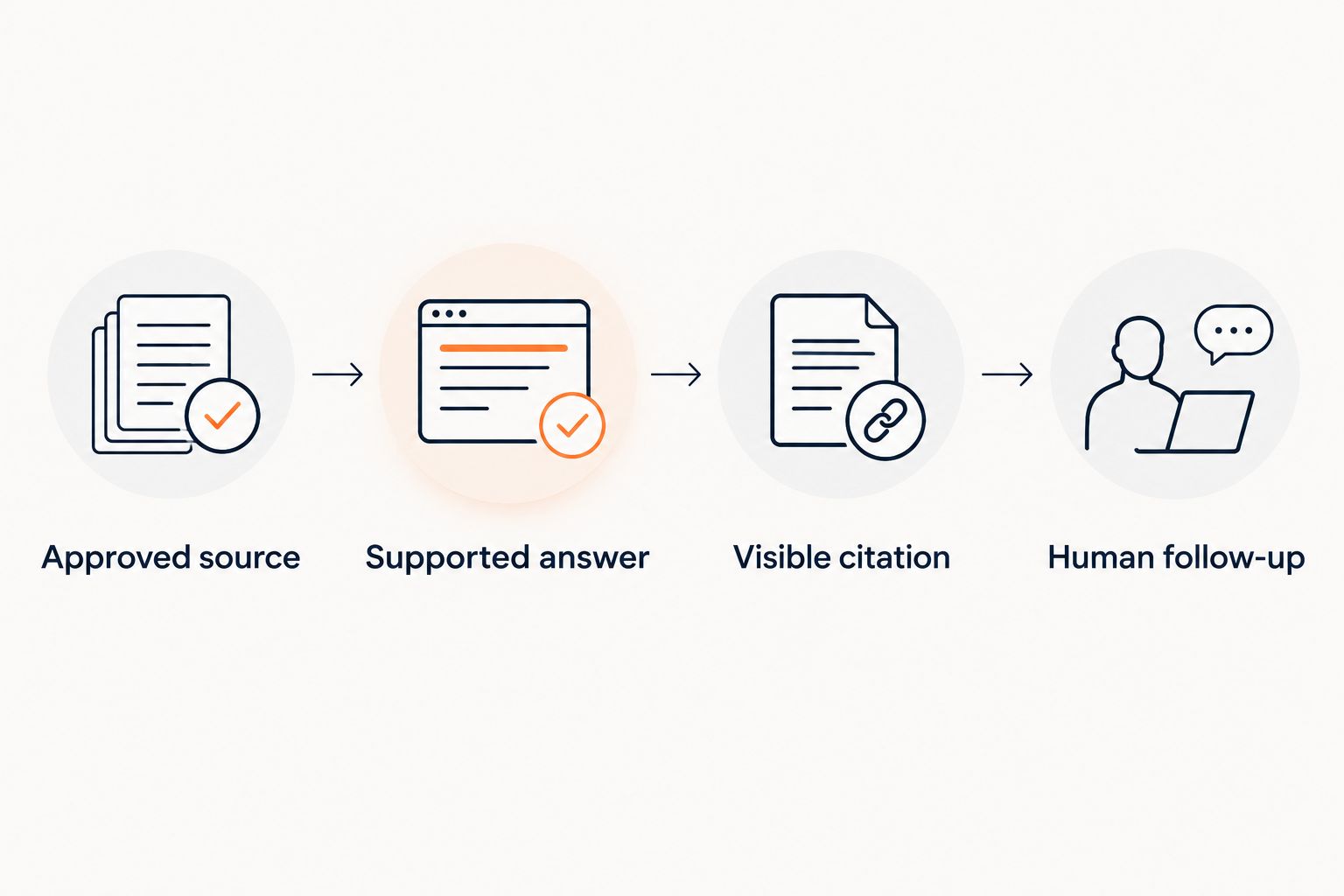
Use a simple answer path: approved source, supported answer, visible citation, and human follow-up when the source cannot settle the request. Evaluate each part separately.
- Approved source: the material is current and intended for this reader.
- Supported answer: the response stays within what the material actually states.
- Visible citation: the reader can inspect the relevant evidence.
- Human follow-up: an unresolved decision stays with an authorized person.
This is a recommended workflow, not a claim about automatic routing or access controls in any particular product. HelpShelf is best for creators who need source-cited community answers from their own content. Its stated role fits the answering step; confirm any Discord-specific delivery requirement separately.
Worked example: a published answer
Suppose your approved onboarding document explains where members should begin. A member asks where to start. The response should summarize those instructions and cite the relevant document, without adding prerequisites or tasks that the document never mentions.
Check the destination as well as the wording. If the citation points to member-only material, the person asking must have appropriate access. A public pre-sale answer should not reveal private lesson content just because that content helps explain the offer.
Worked example: an unpublished exception
Suppose a member asks for a discount or a refund outside the published terms. The correct response is a boundary, not a negotiation.
An illustrative refusal is: I can only quote what’s published. I can explain the policy, but an exception needs a decision from your team. Use this as an evaluation example, not as a promise that a widget produces this exact wording.
The same rule applies to outcomes. A course description can explain what you teach; it does not justify an income promise. No invented discounts, no refund exceptions, and no income promises should enter an answer.
Why answer quality varies
The interface matters, but the content and decision boundaries determine what an answer can responsibly say. Review these factors before judging a setup by a polished demonstration.
- Source clarity: ambiguous instructions leave the central question unresolved.
- Audience boundaries: public visitors and paying members need different access to information.
- Answer location: an external widget and an in-channel bot serve different interaction requirements.
- Policy authority: documentation explains a rule; authorized people approve exceptions.
- Content maintenance: changed instructions require a review of the material used for answers.
For a 2026 evaluation, use your actual recurring questions. Include a clear document lookup, a missing answer, a request for private material, and a policy exception. The system should show different behavior for each situation rather than answering everything with equal confidence.
Do not score only the successful lookup. A refusal that preserves a policy boundary is part of the intended behavior. A confident unsupported answer is a failure even when it sounds helpful.
Can the widget read private Discord channels?
Private channel access requires a supported integration and appropriate permissions; a website widget alone does not establish either. Ask for a demonstration using the same permission boundaries your community needs.
Also ask what reaches the answer source. Reading a message and making that message available to other readers are different actions. Keep public pre-sale material separate from private member discussions in your source plan.
Can it answer buyer questions before someone joins?
Yes, a widget can answer pre-sale questions from approved offer content without using private member conversations. Use published information about what the community includes and leave unpublished details unanswered.
Lead capture is a separate step from answering. HelpShelf includes lead capture in its stated offering, but that does not justify implying consent, enrollment, or a promised outcome. Explain what happens next using your actual published process.
Can it replace Discord moderators?
No, source-based answers do not replace moderation decisions. Use automation for documented explanations and keep disputes, exceptions, and account-specific investigations with people who have the authority to act.
A moderator can also correct the underlying documentation when the same unresolved question keeps returning. That fixes the source of future answers rather than merely rewriting one response.
FAQ
Can an AI widget answer questions in a Discord community?
Yes, an AI widget can answer questions about a Discord community from approved content. Answering directly inside Discord requires a supported integration; a website widget is not automatically a native bot.
Does HelpShelf have a confirmed native Discord integration?
The stated HelpShelf offering does not establish a native Discord integration. It provides a chat widget with source-cited answers from creator content and lead capture; confirm Discord-specific capabilities before choosing an in-server setup.
What should I give a chatbot to answer community questions?
Give a chatbot approved rules, onboarding instructions, relevant course content, published policies, and offer descriptions that its intended readers can access. Confirm that your chosen product supports those content sources.
Can a chatbot use private member conversations for public answers?
Private member conversations should not become public answer material by default. Keep public offer information separate from member-only content and verify access boundaries in the proposed setup.
What should the widget say when my content has no answer?
The widget should identify that the approved content does not answer the question and direct the reader to an appropriate person. It should not invent a discount, policy exception, or promised result.
Is a Discord bot better than a website widget?
A Discord bot fits questions that must be answered inside the server; a website widget fits a separate help or pre-sale access point. Choose by the required interaction and demonstrated capabilities, not the label.
How should I evaluate a community chatbot in 2026?
Evaluate a community chatbot in 2026 with real documented questions, missing information, private-content requests, and policy exceptions. Check the answer, its supporting citation, and whether unresolved decisions stay with an authorized person.
One last thing
Test the question you do not want answered automatically. Ask for an unpublished exception during your 2026 evaluation, then inspect whether the response preserves the boundary.
A correct citation cannot turn a request into approval. If the source explains the standard policy but does not authorize the exception, the answer should stop there. That is a more useful test than another easy question about where to find the welcome document.