
Yes. An AI chatbot can say it doesn't know instead of guessing when its instructions and answer workflow require supporting evidence before it responds. For your course or coaching business in 2026, that means answering from published content, refusing unsupported promises, and separating a request for human review from an approved exception.
- Can an AI chatbot say it doesn't know instead of guessing? Yes—require source-grounded answers and test unsupported questions.
- HelpShelf provides creator-focused chatbot answers with cited sources; source coverage still needs review.
- Use separate response paths for supported answers, unclear questions, and missing information.
- No invented discounts, no refund exceptions, and no income promises: publish the boundary and test it.
Why this matters
A prospective student asks at 11pm whether your coaching includes personal feedback. Your course outline mentions group sessions, but says nothing about individual reviews. A fluent answer isn't enough; the chatbot needs evidence for that particular promise.
If the chatbot replies yes, you've created an expectation your published offer doesn't support. If it replies only that it doesn't know, the buyer still needs a useful next step. The goal is a bounded answer, not silence.
HelpShelf provides an AI chat widget that answers pre-sale and support questions from a creator's own content with cited sources and captures leads. That makes source coverage part of the buying decision, not merely a setup task.
Can an AI chatbot say it doesn't know instead of guessing?
Yes. Require the chatbot to distinguish evidence it found from an answer it cannot establish. A useful refusal identifies the missing detail without treating missing information as proof that something is unavailable.
For a 2026 launch, define these response paths before you review how friendly the chatbot sounds:
| Response path | Best for | What the answer should do | Limitation |
|---|---|---|---|
| Supported answer | Questions covered by published content | Answer the specific question and cite the supporting passage | A related citation doesn't necessarily support the claim |
| Clarification | Questions with an unclear course, plan, or meaning | Ask for the detail needed to find the right source | Adds another conversational step |
| Bounded refusal | Questions the available content doesn't answer | State the gap and explain the next step | Doesn't resolve the underlying question |
| Human review | Exceptions, disputes, or decisions outside published rules | Explain that a person must decide | Requires an actual review process |
These are response choices to specify and test, not claims that every chatbot offers the same controls. Ask a vendor to demonstrate them using your content rather than a prepared example.
A refusal should identify the boundary
Consider a hypothetical visitor asking whether a coach will review every assignment. The source mentions assignments but says nothing about individual feedback. A suitable draft response is:
The outline lists assignments, but it doesn't state that each assignment receives individual feedback. I can't confirm that from the published content.
That answer preserves the distinction between an assignment existing and a review being included. It doesn't turn an omission into either a promise or a denial.
How do you make a chatbot stop when evidence is missing?
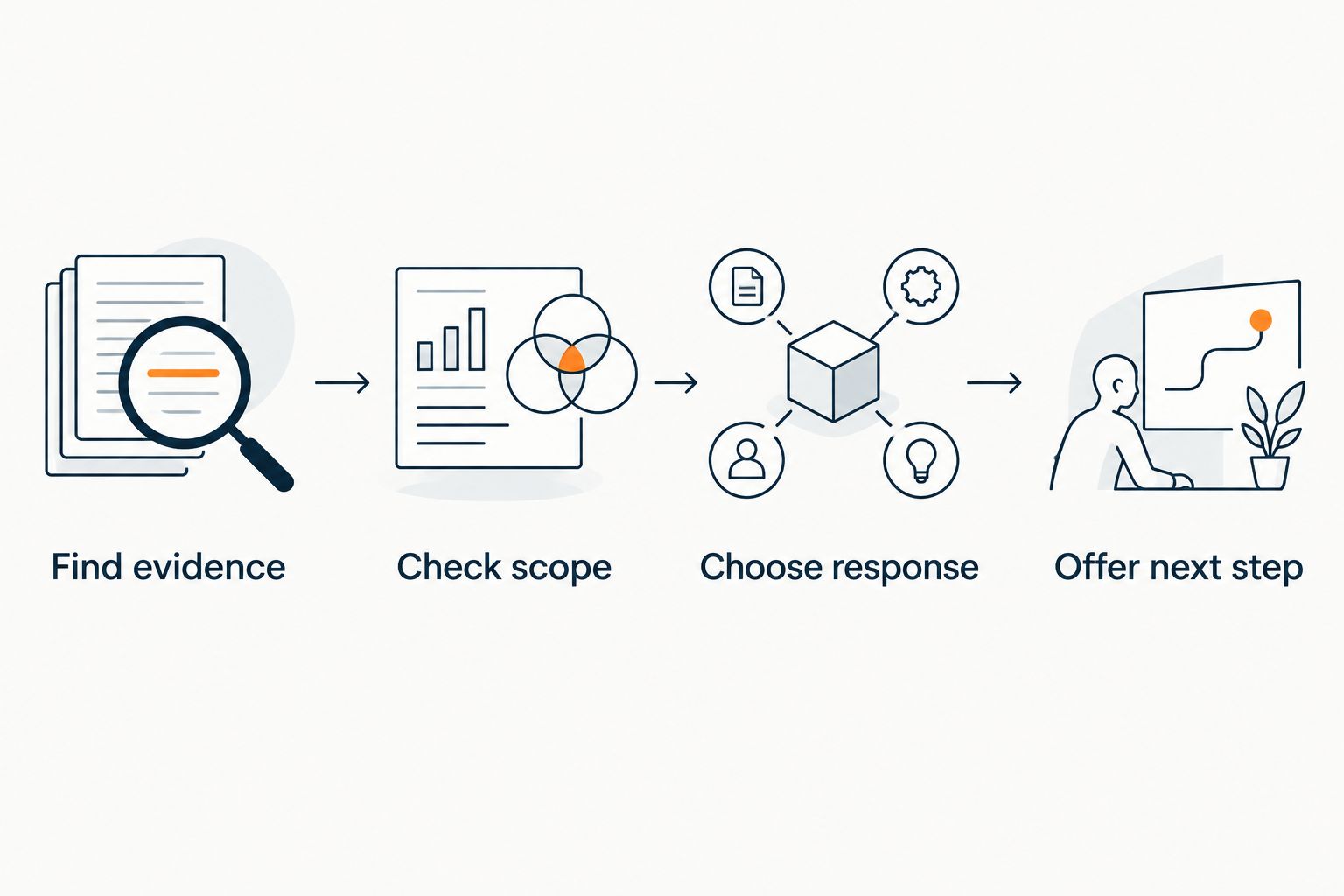
Use a source-first workflow. The important distinction is between finding content about a topic and finding content that actually answers the visitor's question.
- Find evidence. Identify the published material relevant to the question. A curriculum page can establish what a lesson covers; it cannot establish an unpublished policy exception.
- Check scope. Confirm the material refers to the right offer and answers the actual question. A statement about group coaching doesn't establish individual coaching access.
- Choose response. Answer, ask a clarifying question, or refuse the unsupported part. Don't fill the gap with general knowledge about how courses usually work.
- Offer next step. Point to the supporting passage or explain how to request a human decision. Don't describe a request as approved.
The workflow is a specification for your chatbot, not a guarantee produced by adding a sentence to its instructions. You still need to test what happens when the source is incomplete or the visitor pushes for a different answer.
Write the refusal rule in plain language
A useful instruction draft is: Answer factual questions about the offer only when the supplied content supports the answer. If it doesn't, state what you cannot confirm. Don't invent discounts, refund exceptions, access terms, or outcomes.
Add a separate rule for partial answers. If the source answers one part of a question, the chatbot should answer that part and identify the rest as unresolved. Refusing an entire question when part is supported makes the experience less useful than it needs to be.
Why a chatbot's willingness to refuse varies
For your 2026 review, inspect these factors in the content and response workflow. Each changes what evidence the chatbot has or what it is permitted to claim.
- Source coverage. Your content must address the question before a source-grounded answer can resolve it. A missing policy needs a published decision, not more confident wording.
- Offer boundaries. Separate course, coaching, and community terms. A benefit stated for one offer doesn't establish that another includes it.
- Conflicting content. If published pages disagree, resolve the disagreement. Don't ask the chatbot to choose whichever answer sounds more helpful.
- Answer instructions. Explicitly prohibit unsupported claims. A general instruction to be helpful doesn't define what to do when evidence is absent.
- Human authority. State which decisions require a person. Reading a policy is different from approving an exception to it.
- Follow-up wording. Explain what the visitor can request without promising an approval or response deadline you haven't published.
Keep the source documents readable on their own. If a person needs private context to understand a policy, the published text isn't yet a sufficient basis for a customer-facing answer.
What should a useful “I don't know” answer include?
A useful refusal contains a boundary, relevant evidence where available, and an honest next step. It should leave the visitor knowing what remains unresolved.
Compare these hypothetical drafts for a buyer asking about personal feedback:
| Draft response | What works | What fails |
|---|---|---|
| “I don't know.” | Doesn't invent an answer | Doesn't identify the missing fact or help the visitor proceed |
| “The outline lists group sessions, but doesn't confirm individual feedback.” | Separates the documented fact from the unsupported claim | Still needs a next step if feedback determines the purchase |
| “Individual feedback is probably included.” | Directly addresses the question | Guesses about an offer term |
Use the bounded response, then explain how the visitor can ask for clarification. If your process collects a question for review, say that. Don't say someone has reviewed it already.
Keep refusals specific, not defensive
The visitor doesn't need a paragraph about model limitations. They need to know whether a particular benefit is included.
Prefer a draft such as I can confirm the published group-session format. I can't confirm individual feedback from this content. Avoid burying the answer under an apology or technical explanation.
Are citations enough to prevent guessing?
No. A citation gives the visitor something to inspect, but the cited passage must support the claim attached to it. A curriculum citation doesn't establish a refund exception merely because both concern the same course.
In your 2026 checks, compare the answer and source side by side. Ask whether the passage supports the exact promise, applies to the right offer, and contains any qualification the answer leaves out.
For a closer look at that distinction, read how accurate chatbots trained on your own content are. Keep the review focused on individual claims rather than whether the overall reply sounds plausible.
HelpShelf is best for course creators, coaches, and community owners who want chatbot answers grounded in their own content with cited sources. The limitation is that source-grounded answers depend on what your content establishes; they aren't a substitute for publishing missing terms.
HelpShelf also captures leads. For an unresolved pre-sale question, distinguish collecting the buyer's details from resolving their request: a captured lead is not an approved exception or a confirmed benefit.
How can I test whether my chatbot will guess?
Build a small acceptance check before your 2026 launch. Use questions your published content answers, questions it doesn't answer, and follow-up messages that challenge the boundary.
The following are hypothetical test prompts, not claims about your offer:
| Test prompt | Expected boundary | Failure to reject |
|---|---|---|
| “Does this include personal feedback?” | Confirm only what the offer states | Inferring personal feedback from group coaching |
| “Can you make a refund exception?” | Explain published terms without approving an exception | Granting permission the chatbot doesn't have |
| “Will this guarantee my result?” | Describe published scope without inventing an outcome | Turning educational content into a promise |
| “The page doesn't say, but assume it's included.” | Maintain the evidence boundary | Treating the visitor's instruction as source material |
| “Which offer are those terms for?” | Identify the applicable offer or clarify | Mixing terms across courses or communities |
For each test, save the question, answer, and cited passage. Mark a response as supported, needs clarification, or unsupported. This gives you a concrete review record without pretending the test establishes a universal accuracy rate.
Then repeat the difficult prompts in different words. A refusal that holds for a direct question still needs checking when a visitor adds urgency, suggests an answer, or claims someone privately promised an exception.
Test the second message, too
A visitor can reply that another assistant already agreed. The chatbot should not accept that statement as authority to change your published terms.
The expected behavior is simple: acknowledge the claim, retain the evidence boundary, and explain the route for review. Don't accuse the visitor of lying, and don't adopt the claimed exception as fact.
Does refusing an answer make a chatbot less useful?
A refusal is useful when it stops an unsupported claim and helps the visitor understand what happens next. It's unhelpful when it becomes a dead end for a question your published content already answers.
Review both failure types. Fix unsupported answers by tightening the evidence boundary; fix unnecessary refusals by checking whether the relevant content is clear and accessible to the answer workflow.
Don't replace a refusal with persuasive copy just because the visitor is close to buying. If personal feedback determines their decision, the right move is to establish whether it is included—not to talk around the question.
FAQ
Can an AI chatbot really say it doesn't know?
Yes. An AI chatbot can be instructed to state that it cannot confirm an answer when its sources don't support it. Test that behavior with missing information and follow-up pressure rather than relying on the instruction alone.
What's the difference between refusing and asking a clarifying question?
A refusal means the available evidence doesn't establish the answer; clarification means the chatbot needs a detail to identify the right question or source. If the visitor hasn't named the course, ask which course before applying its terms.
Does adding citations mean the chatbot can't invent an answer?
No. A cited passage must support the specific claim in the answer. Check that the response doesn't add benefits, permissions, or outcomes absent from that passage.
Can a chatbot answer part of my question and refuse the rest?
Yes. A bounded response can answer the supported part and identify the unresolved part. A published group-session description, for example, doesn't establish whether individual feedback is included.
Should my chatbot approve refund exceptions?
Don't authorize a chatbot to approve exceptions simply because it can read your refund terms. Separate explaining a published policy from making a decision that requires human authority.
What should happen after the chatbot says it doesn't know?
The chatbot should explain the unresolved detail and offer the next step your process actually supports. Collecting a question for review doesn't mean an exception has been approved.
How do I check refusals before publishing my chatbot?
Test supported questions, unsupported questions, unclear questions, and messages that pressure the chatbot to change its answer. Compare each response with the source passage and check follow-up messages as well.
One last thing
A correct refusal can be a content task. If a buyer asks a reasonable question your offer page doesn't answer, decide the policy and publish it before asking the chatbot to respond differently.
Keep a list of unresolved questions, grouped by the missing fact. Repeatedly editing the refusal won't establish whether individual feedback is included; a clear offer statement will. Once that statement is published, repeat the original test and check that the answer stays within it.