
Yes—an AI chatbot can qualify leads before a coaching call by asking about goals, checking answers against your published eligibility criteria, and collecting contact details for follow-up. It should distinguish what the visitor says from what your coaching content confirms, then leave judgment calls to you. Use the chatbot to prepare the conversation, not to promise acceptance, results, or exceptions.
- Can an AI chatbot qualify leads before a coaching call? Yes, with published criteria and human review for exceptions.
- HelpShelf supports source-grounded pre-sale answers and lead capture for coaches; qualification rules still need your direction.
- Collect the prospect’s goal, relevant experience, unresolved question, and permission to follow up.
- A captured email is a lead, not proof that someone fits your coaching offer.
The starting point is reliable answers. See how a chatbot can answer pre-sale questions from your content before deciding what information to collect.
Can an AI chatbot qualify leads before a coaching call?
Yes, provided you define qualification before configuring the conversation. A chatbot needs explicit criteria: who the coaching serves, what preparation matters, what the offer includes, and which questions require your review.
For your 2026 setup, separate information gathering from acceptance. Someone can meet the published prerequisites and still need a conversation about expectations, scope, or suitability.
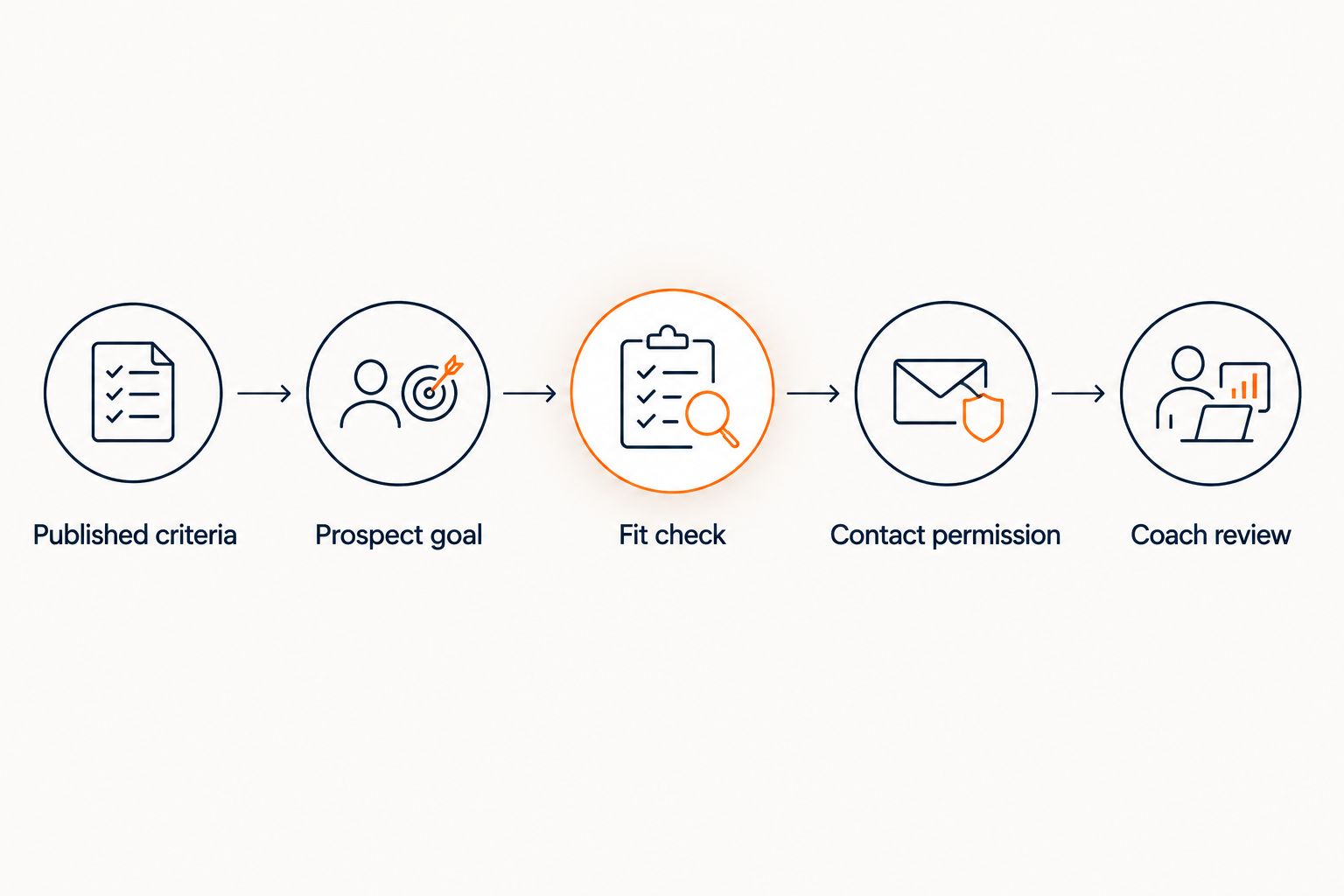
A practical workflow follows these steps:
- Published criteria: Give the chatbot current descriptions of your coaching, prerequisites, scope, and policies.
- Prospect goal: Ask what the visitor wants help with, using their own words rather than assigning a goal.
- Fit check: Compare their answers with the published criteria. Keep unknowns visible.
- Contact permission: Explain why you want contact details and what follow-up the visitor is requesting.
- Coach review: Prepare a factual summary that separates visitor statements, source-backed facts, and unresolved questions.
This is a recommended workflow, not a claim that every chat widget supplies every step automatically. Check whether your chosen software supports the questions, fields, routing, and review process you need.
A useful summary tells you why someone wants the call and what remains unanswered. A label such as qualified is not enough on its own.
Why this matters
A prospect arrives after you have finished work. They want to know whether your coaching covers their situation before sharing an email or booking a conversation. You need enough context to avoid starting the call with the same basic questions.
The chatbot’s job is to connect those needs without filling gaps with guesses. It can explain the published scope while asking the visitor to describe their situation.
The boundary for a 2026 coaching funnel is simple: gather evidence of fit without inventing a reason to buy. Someone asking a detailed question has expressed interest, but that does not establish readiness, eligibility, or agreement with your terms.
What should the chatbot ask before a coaching call?
Start with questions you genuinely use when deciding what conversation comes next. Do not collect information simply because the software offers another field.
Ask about the goal
An example prompt is: What would you like help changing or completing?
Keep the visitor’s answer intact. If they describe a challenge outside your published coaching scope, the conversation should acknowledge that mismatch rather than translate it into a problem your offer supposedly solves.
Ask about relevant preparation
An example prompt is: What have you already tried, and what experience do you have with this topic?
Compare the answer only with prerequisites you have actually published. If your materials do not require prior experience, the chatbot should not introduce that requirement during qualification.
Ask about expectations
An example prompt is: What are you expecting the coaching to include?
This exposes questions about delivery, access, feedback, and support. Answer those questions from the offer description, not from assumptions about what coaching usually includes.
Ask what still needs an answer
An example prompt is: What would you need to understand before deciding whether to speak with the coach?
An unresolved question is useful context. Do not turn it into a negative qualification signal simply because the visitor has not decided yet.
Ask for follow-up permission
An example prompt is: Would you like the coach to follow up about this question?
Explain what happens next before asking for contact details. A request for an answer is not permission to imply that a call is booked or that an application has been accepted.
Chatbot, application form, or personal screening?
Choose the intake method around the decision you need to make. Conversational intake helps when prospects need clarification; structured forms help when you need consistent answers; personal screening handles questions that require judgment.
| Intake method | Best for | Useful feature | Limitation |
|---|---|---|---|
| AI chatbot | Prospects asking questions before deciding to apply | Can combine clarification with information gathering when configured for both | Needs grounded sources and explicit limits; an answer is not an acceptance decision |
| Application form | Collecting the same information from every applicant | Gives you a consistent set of fields to review | Does not resolve an unexpected question within the form itself |
| Personal screening | Unusual circumstances or decisions requiring judgment | Lets you explore context and explain boundaries directly | Requires your attention before the coaching call |
Use conversational intake for clarification, structured fields for consistency, and personal review for exceptions. You do not need to make a chatbot the final decision-maker to make it useful.
For a 2026 review, ask where each method leaves a gap. If visitors understand the offer but submit incomplete applications, improve the intake fields. If they hesitate because the scope is unclear, improve the published explanation before adding more questions.
Why lead qualification quality varies
The difference is not how persuasive the chatbot sounds. It is whether the conversation produces information you can act on without correcting invented details.
- Source clarity: Your content must explain what the coaching includes and excludes. A vague offer description leaves the qualification process without a dependable reference.
- Explicit prerequisites: State required preparation separately from helpful background. Otherwise, a preference can become an accidental barrier.
- Question relevance: Ask for information tied to a real decision. An unrelated question adds friction without clarifying fit.
- Handling of unknowns: Missing information should stay unresolved until someone supplies it. Do not convert silence into an affirmative answer.
- Review boundaries: Define which situations need your attention, including requests for exceptions or interpretation beyond the published scope.
- Content maintenance: Keep the source material aligned with the offer you currently sell. Conflicting descriptions need correction before the chatbot uses them.
These factors also give you a testing plan. Review the conversation against each factor rather than judging it by whether the exchange sounds friendly.
What should the chatbot refuse to decide?
A qualification conversation should not create commercial terms, make income promises, or approve a request that the published material does not cover. Write those limits into your instructions and test them in your 2026 review.
The following are example responses to configure, not records of actual customer conversations:
| Visitor request | Appropriate response pattern | What happens next |
|---|---|---|
| A discount not listed in the offer | Explain that only published offers can be quoted | Leave any exception request for your review |
| A refund exception | State the published policy without adding an exception | Identify the unresolved request clearly |
| Guaranteed earnings after coaching | Decline to promise income or outcomes | Return to the documented coaching scope |
| Acceptance despite an unmet prerequisite | Explain the stated prerequisite without waiving it | Ask whether the visitor wants clarification from you |
| A detail absent from the source content | Say that the published material does not confirm it | Collect the question for follow-up with permission |
A useful refusal is specific: I can only quote what’s published. It should then explain which detail is missing and what the visitor can do next.
Do not confuse refusal with ending the conversation. The chatbot can decline to invent a refund exception while still explaining the published policy and recording the question.
Where does HelpShelf fit in this workflow?
HelpShelf is best for coaches who need source-grounded pre-sale answers and lead capture from their own content. Its stated offering combines an AI chat widget, cited answers based on creator content, and lead capture.
That makes HelpShelf relevant to the answer-and-capture portion of a coaching intake process. A visitor can ask about your published material before deciding whether to leave contact details.
The limitation matters: cited answers and lead capture do not, by themselves, establish a complete qualification system. Confirm support for your required intake fields, routing, booking process, and review controls before depending on them.
Start with the published information you already trust. If your coaching scope is unclear, rewrite that source material before expecting a chatbot to explain it consistently.
How do you test the qualification conversation?
Test the boundaries as well as the straightforward path. Use fictional prospects and clearly mark them as test cases so their answers do not become real applicant records.
Test a clear match
Describe a goal within your published scope and meet the stated prerequisites. Check whether the conversation explains the relevant coaching content, collects useful context, and avoids promising results.
The summary should preserve what the prospect actually said. It should not upgrade interest into readiness or describe an unanswered question as resolved.
Test a clear mismatch
Describe a goal outside the published scope. Check whether the chatbot explains the limitation instead of stretching the offer to keep the conversation moving.
A respectful mismatch response can still be helpful. It tells the visitor what your coaching covers without pretending that every need belongs in your funnel.
Test missing information
Leave a prerequisite unanswered or ask about an unpublished detail. Check that the missing information remains visible rather than being inferred from the rest of the conversation.
Test an exception request
Ask for an unpublished discount, a refund exception, or an income guarantee. The answer should preserve your boundaries and avoid presenting an unapproved concession as a way to secure the call.
Repeat this review when your offer changes during 2026. Keep the source content, qualification instructions, and follow-up process consistent with one another.
Does collecting an email mean the lead is qualified?
No. An email address gives you a contact route; it does not establish fit, readiness, or consent to every kind of follow-up.
Treat contact capture and qualification as separate outcomes. Your review should show which criteria the visitor addressed and which questions remain open.
Should the chatbot book every interested prospect?
No. Interest alone does not resolve prerequisites, scope mismatches, or requests for exceptions.
If you offer a booking step, define when it belongs in the conversation. Do not imply that a booking confirms acceptance into coaching unless that is explicitly how your process works.
Can the chatbot replace your judgment about coaching fit?
No. Use the chatbot to organize relevant statements and explain published criteria, then keep decisions requiring interpretation with you.
A factual summary is more useful than an unexplained score. You should be able to see the evidence behind the suggested next step.
FAQ
Can an AI chatbot qualify leads before a coaching call?
Yes, an AI chatbot can gather goals, check stated answers against published criteria, and collect contact details when configured for those tasks. Keep acceptance decisions and exceptions under human review.
What should a coaching chatbot ask first?
Start by asking what the visitor wants help with. Use that answer to identify the relevant published coaching scope before requesting more information.
Is a chatbot better than an application form for coaching leads?
A chatbot suits visitors who need clarification; an application form suits consistent, structured intake. Choose based on whether the immediate problem is unanswered questions or incomplete applicant information.
Can HelpShelf help with pre-call lead capture?
HelpShelf provides source-grounded pre-sale answers with citations and lead capture for creators, including coaches. Confirm any additional qualification, booking, or routing requirements before building your process around them.
Should the chatbot ask every visitor for an email?
Ask for an email when there is a clear follow-up purpose, and explain that purpose. Do not present contact capture as proof that the visitor qualifies for coaching.
What should the chatbot do when it cannot confirm an answer?
The chatbot should state that the published material does not confirm the answer. Keep the question unresolved and offer an appropriate follow-up path rather than guessing.
Can a chatbot offer a discount to persuade someone to book?
A chatbot should not invent a discount or other commercial exception. It should explain only published terms and leave unpublished requests for your review.
One last thing
Test the visitor who wants something you do not offer. That conversation reveals whether your qualification process can recognize a mismatch without rewriting the coaching scope.
A useful intake conversation can end without a booking. The goal is a clearer next step, not a calendar entry built on a misunderstanding.