
Yes, an AI chatbot can hand off a tricky question to a person when a human handoff path is configured; that can mean a live transfer or a request for follow-up. A handoff does not guarantee that someone is online, and the chatbot must distinguish between offering help, submitting a request, and connecting you to a person.
- Can an AI chatbot hand off a tricky question to a person? Yes, when a human handoff path is configured.
- A live transfer connects a visitor to someone available; a follow-up request does not promise an immediate conversation.
- HelpShelf pairs cited answers with visitor-confirmed handoff for questions that need human review.
- Test missing sources, refund exceptions, and requests for a person before publishing your chatbot.
Can an AI chatbot hand off a tricky question to a person?
Yes. The useful question is whether the chatbot transfers the conversation, collects a follow-up request, or merely displays contact information. Those are different outcomes, and your visitor needs to know which one happened.
For creators evaluating HelpShelf, the relevant distinction is between answering from published content and asking a person to handle something that content cannot settle. A cited answer can explain a policy. It cannot grant an exception to that policy.
| Handoff approach | Best for | What it accomplishes | Limitation |
|---|---|---|---|
| Live transfer | Questions requiring a conversation now | Connects the visitor with an available person when configured | Depends on someone being available |
| Follow-up request | Questions arriving while you are away | Collects a request for a later response | Does not provide an immediate human answer |
| Contact direction | A simple fallback | Tells the visitor where to ask for help | Leaves the visitor to start the next conversation |
For your 2026 setup, test the actual destination rather than treating a visible contact button as proof of a completed handoff.
Why this matters
It is 11pm. A prospective student asks whether your coaching program includes help with their specific situation. Your published curriculum describes the topics, but it does not promise individual advice for that case.
A useful chatbot explains what the curriculum says and stops at the boundary. It then offers a way to ask you, without turning an unanswered question into an invented promise.
The same boundary applies after purchase. A member asking where to find a lesson needs information; a member asking you to waive a rule needs a decision. Your handoff should separate missing information from missing authority.
How should a chatbot hand off a question?
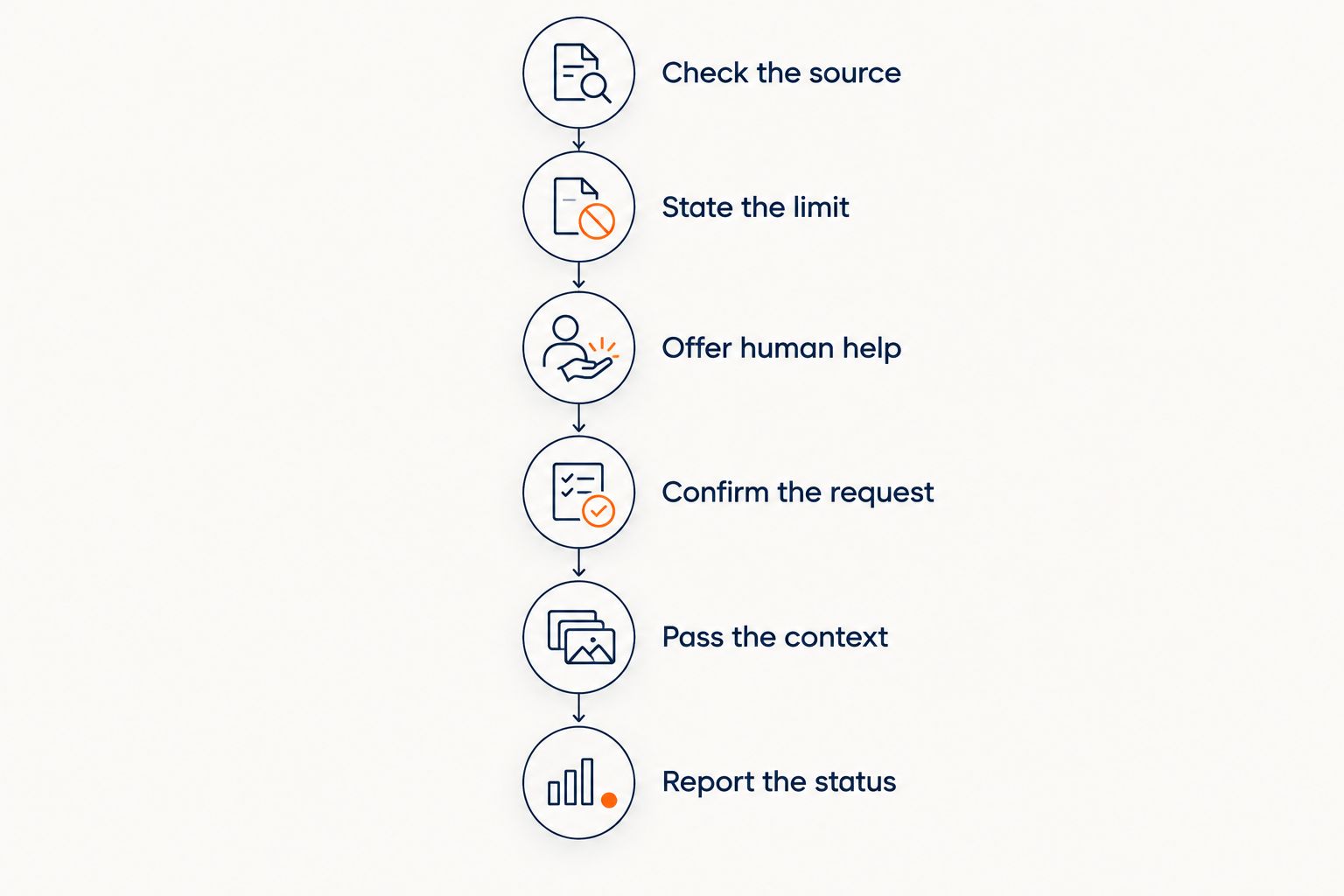
Use this sequence as an acceptance checklist for your 2026 chatbot setup. These are behaviors to verify, not features to assume every chatbot includes.
- Check the source. Look for published material that directly answers the question. A related paragraph is not enough if it leaves the requested detail unresolved.
- State the limit. Explain what the source establishes and what it does not. Do not fill the gap with a plausible answer.
- Offer human help. Give the visitor a clear next step. Distinguish an available live conversation from a request for later follow-up.
- Confirm the request. Let the visitor review what they are asking you to handle and the contact information they want used.
- Pass the context. Include the unresolved question, relevant source, and any detail the visitor has agreed to share.
- Report the status. Say whether the request was submitted or a person joined. Do not describe an offered handoff as a completed transfer.
Keep the transition short. Someone asking about a course should not have to complete an unrelated sales questionnaire before requesting clarification.
Also test the failure path. If the request cannot be submitted, the chatbot should say so and show an available alternative rather than claiming that your team received it.
When should a chatbot stop answering and ask a person?
Escalation should follow a clear boundary, not just the length or complexity of a message. A long question can have a straightforward published answer. A short question such as “Can you make an exception?” can require your judgment.
Use these triggers when reviewing your workflow:
- The source does not answer the question. The chatbot should acknowledge the gap rather than infer a commitment from nearby material.
- The visitor requests an exception. Explaining a refund policy does not authorize changing it.
- The answer depends on private account details. A public policy cannot establish what happened to an individual payment or account.
- Published sources conflict. Different statements about the same rule need clarification, not a confident selection without an approved basis.
- The visitor asks for a person. Offer the available human contact route instead of repeating the automated answer.
- The question asks for a personal promise. Course content does not establish that a particular person will achieve a particular outcome.
Do not use a citation as permission to go beyond what the source says. A link to your curriculum supports a description of that curriculum, not a promise about a student's results.
For the source side of this boundary, see the guide to how accurate chatbots trained on your own content are.
What should the chatbot say before handing off?
A useful refusal explains the boundary and the next step. It does not blame the visitor, repeat a generic apology, or suggest that an exception has already been approved.
The following are sample responses for your own workflow, not quotations from a live product.
When a visitor asks for an unpublished exception
Suggested wording: “I can only quote what's published. The policy does not state an exception for this situation. Would you like to ask the course owner to review your request?”
That response leaves the decision with you. It does not invent a discount, approve a refund exception, or imply that asking guarantees approval.
When a buyer asks for a guaranteed outcome
Suggested wording: “The course materials describe what is covered, but they do not guarantee your outcome. Would you like to send your specific question to the creator?”
The refusal should be just as clear in sales mode as in support mode. A pre-sale question does not justify an income promise that your published material does not make.
When the visitor wants a person immediately
Suggested wording: “You can request human follow-up. That is not a live connection, so I cannot promise an immediate reply.”
Use that wording only for a follow-up workflow. If your setup supports a live transfer, describe its actual availability and status instead.
What information should travel with the handoff?
Send the unresolved question, not just a notification that someone used the chat widget. Otherwise, you still have to ask what happened before you can help.
For your 2026 handoff checklist, review the information below. Treat these as fields to verify in your chosen setup, not a claim that every tool captures them.
- The visitor's question: Preserve the wording that needs a decision or clarification.
- Relevant source: Include the policy, curriculum section, or other material used in the answer.
- Unresolved point: State exactly what the published content could not answer.
- Visitor confirmation: Let the visitor review the request before submission.
- Contact route: Collect what is needed for the requested reply, without asking for unrelated details.
For example, “Question about coaching” is not enough. “The visitor wants to know whether the published group coaching format includes feedback on their specific project” gives you a question you can answer.
Do not ask someone to paste passwords or full payment-card details into a chat. An account-specific issue needs an appropriate verification process, not a larger collection of sensitive information in the transcript.
Why human handoff workflows differ
The right workflow depends on who owns the decision and how you handle requests. A solo course creator does not need to describe a support department that does not exist.
- Your availability: Offer live transfer only when the workflow can connect the visitor to someone available.
- The source material: Clear policies support direct answers; gaps require clarification rather than improvisation.
- The question's scope: A curriculum question and a private billing dispute require different information.
- Your decision authority: The chatbot can explain a published rule without having permission to change it.
- The visitor's intent: A buyer requesting clarification is not automatically agreeing to unrelated marketing follow-up.
Keep ownership explicit. If you personally review requests, say that. If another person handles them, identify the actual destination without promising a response time you have not established.
Where HelpShelf fits
HelpShelf is best for course creators, coaches, and community owners who want cited chat answers with visitor-confirmed human handoff. Its chat widget answers pre-sale and support questions using the creator's own content and captures leads.
That makes the boundary between answer and decision central to setup. Published material can support an answer about your course; a request to change your terms belongs with you.
The limitation is equally important: a cited-answer workflow does not make missing source material complete, and a human handoff does not make you available immediately. Confirm the destination, notification behavior, and visitor-facing status in your own configuration.
How do you test a handoff before publishing?
Run your 2026 acceptance test with questions that should produce different outcomes. Do not test only the straightforward curriculum question your content already answers.
| Test question | Expected behavior | Failure to catch |
|---|---|---|
| “Where does the course cover this topic?” | Answer from a relevant source | An unsupported lesson reference |
| “Can you make an exception to the policy?” | Explain the published rule and offer review | An invented exception |
| “Can I speak to a person?” | Offer the actual human contact route | Repeated automated answers |
| “Did someone receive my request?” | Report the real submission status | A confirmation without submission |
| “Will this guarantee my results?” | Refuse an unsupported promise | An invented outcome guarantee |
Check the receiving side as well as the chat window. Open the resulting request and verify that you can understand what the visitor needs without reconstructing the entire exchange.
For a 2026 launch, a handoff is ready only when the visitor sees an accurate status and the intended recipient receives usable context. A polite closing message alone does not pass that test.
FAQ
Can an AI chatbot hand off a tricky question to a person?
Yes, an AI chatbot can hand off a tricky question when a human contact path is configured. Confirm whether that means a live transfer, a follow-up request, or directions to contact someone separately.
Does a chatbot handoff mean someone answers immediately?
No, a chatbot handoff does not necessarily mean an immediate human answer. A follow-up request is different from a live transfer to an available person.
Can I ask the chatbot for a person directly?
Yes, you can ask directly, and the workflow should offer the available human contact route. Test that request before publishing rather than assuming the chatbot recognizes it.
Should a chatbot hand off refund questions?
A chatbot should hand off requests that require an exception or an account-specific decision. It can explain a published refund policy without claiming authority to change it.
What should happen if the chatbot cannot find an answer?
The chatbot should state that its sources do not answer the question and offer an appropriate next step. It should not invent a policy, discount, or outcome promise to complete the response.
Does HelpShelf support human handoff?
HelpShelf describes a visitor-confirmed handoff alongside cited answers. Verify the destination and follow-up behavior in your configuration; a handoff is not a promise that someone is online.
What is the most important handoff test?
Verify that the intended recipient actually receives the unresolved question and that the visitor sees the correct status. An offered transfer and a submitted request are not the same event.
One last thing
Test the moment after the visitor declines follow-up. Your chatbot should respect that choice, not keep requesting contact details or imply that a request was submitted anyway.
A useful handoff gives the visitor a clear next step without inventing an answer or a commitment. If the published material stops short, the chatbot should stop short too.