
Yes, an AI chatbot can answer questions in multiple languages when its model, content retrieval, and chat settings support those languages. A translated answer does not mean your course, coaching sessions, or human support are available in that language. For your 2026 setup, test whether the chatbot preserves your published facts and cites the source—not just whether its sentences sound natural.
- Multilingual chatbot answers must preserve published facts, citations, and limits—not just translate words.
- Test customer questions in each language before enabling multilingual support.
- Keep chat language separate from course language, coaching language, and human support language.
- HelpShelf fits creators seeking source-grounded answers and lead capture; verify language requirements before choosing a setup.
Why this matters
It is 11pm. A prospective student asks in Spanish whether your English-language course includes personal feedback. You need the answer to reflect your curriculum, not turn a group discussion into private coaching because the translation sounds friendlier.
Language fluency is not evidence of answer accuracy. A useful multilingual chatbot must find the right content, preserve its meaning, and show the visitor what supports the answer. The same principle applies to citing sources from your own content.
Treat multilingual support as a content-and-testing decision in 2026, not a switch that removes every language barrier. Your chatbot also needs a clear response when the source does not answer the question.
Can an AI chatbot answer questions in multiple languages?
Yes. Multilingual language models can interpret questions and generate responses in different languages, but a working support setup needs more than a multilingual model. The system must retrieve relevant information and answer within the limits of that information.
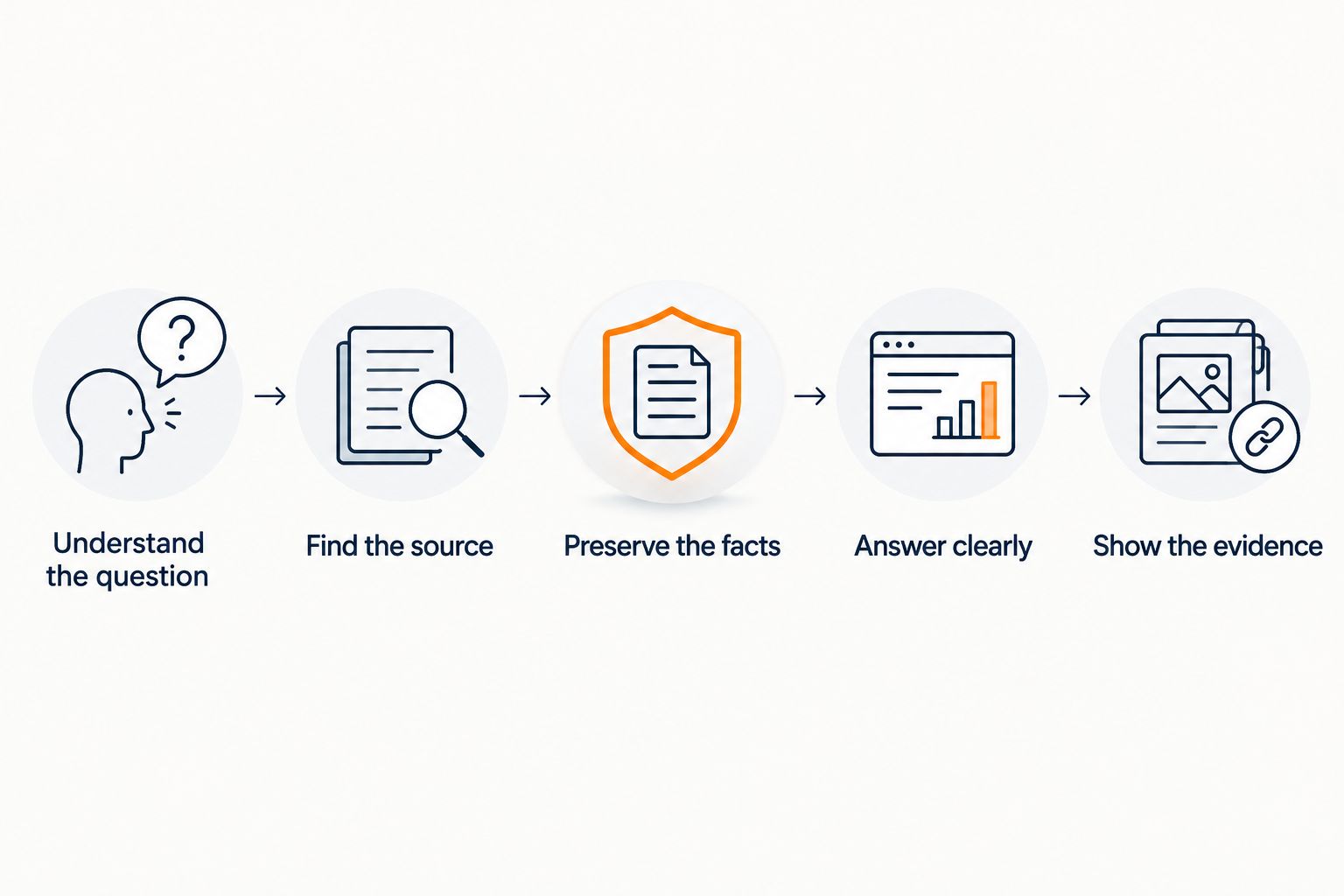
Use this sequence to evaluate a chatbot:
- Understand the question. Identify what the visitor wants, including product names, local expressions, and mixed-language wording.
- Find the source. Retrieve the relevant course page, coaching description, community rule, or support document.
- Preserve the facts. Keep eligibility, exclusions, access conditions, and service boundaries unchanged.
- Answer clearly. Use the requested language without adding promises or removing qualifications.
- Show the evidence. Provide the supporting citation, or explain that the published material does not establish an answer.
A failure at any stage matters. A chatbot that translates beautifully but retrieves the wrong course description still gives the wrong answer. A chatbot that finds the right document but drops the word not changes the policy.
Which multilingual content approach should you use?
You can organize multilingual support around a shared source, separately maintained translations, or human review. These are content approaches, not interchangeable guarantees of quality. Choose according to what you can keep accurate.
| Approach | Best for | Advantage | Limitation |
|---|---|---|---|
| Shared source | Creators maintaining one authoritative content set | Keeps factual updates concentrated in one place | Requires testing cross-language retrieval and translation |
| Localized sources | Creators publishing approved material in each supported language | Gives the chatbot language-specific wording to use | Translations need coordinated updates |
| Human review | Questions involving unclear wording or an unpublished exception | Lets a person resolve ambiguity before making a commitment | Depends on a person who understands the language and policy |
Shared source: keep the underlying facts consistent
With a shared source, a visitor asks in one language and the chatbot uses material written in another. This approach suits a creator whose published course information exists in a single language, provided the system can retrieve and interpret it correctly.
The limitation is visibility. A visitor who cannot read the source language cannot independently check the citation as easily. Make clear when the response is a translation of an original-language document rather than an approved localized policy.
Localized sources: maintain approved wording in each language
Localized sources give you direct control over how recurring terms and policies are expressed. They are useful when a distinction such as group feedback versus individual feedback needs carefully approved wording.
The maintenance burden does not disappear. If you update the original curriculum but leave its translation unchanged, the chatbot has conflicting material. Decide which version controls the answer and update the affected documents together.
Human review: stop when the source is insufficient
Human review is the right route when a visitor asks for an exception, disputes a translation, or needs information absent from the published material. Do not use fluent wording to hide that gap.
The limitation is the handoff itself. If nobody can respond in the visitor's language, state that boundary before collecting details. A translated chat does not establish multilingual human support.
Why multilingual answer quality varies
The useful question is not simply whether a chatbot supports a language. Ask whether it can answer your customers' questions from your material without changing the meaning.
For a 2026 evaluation, check these factors:
- Model language capability. Recognition, generation, and handling of local expressions need testing in the languages you intend to support.
- Cross-language retrieval. The system must connect a visitor's question with relevant source text, even when the languages differ.
- Source clarity. Ambiguous course descriptions leave room for ambiguous answers in any language.
- Terminology. Course names, community labels, and distinctions between coaching formats need consistent treatment.
- Document consistency. Conflicting original and translated documents need an explicit resolution rule.
- Escalation boundaries. Unsupported questions need a refusal, clarification, or human follow-up—not a plausible completion.
These factors interact. Improving translation alone will not fix an outdated source, and adding more documents will not resolve contradictory policies. Start with the published facts, then test how the chatbot finds and expresses them.
How do you test multilingual answers before launch?
Use a written acceptance checklist for your 2026 launch. Test the same underlying intent across languages so you can compare meaning rather than wording. Include ordinary buyer questions and questions the chatbot should decline to answer.
Start with 5 customer questions
Build an initial test set from questions your audience actually asks. The following are sample prompts, not claims about any particular course:
- Does this course include individual feedback?
- What experience do I need before joining?
- Are coaching sessions delivered in my language?
- Can you make an exception to the published refund policy?
- Can you guarantee that I will earn money after completing the course?
These questions check scope, prerequisites, language availability, policy boundaries, and outcome claims. Replace the subject matter where necessary, but keep questions that require the chatbot to distinguish a published fact from a request for something extra.
Run each question in 2 languages
Use your source language and one language you intend to support as an initial comparison. This is a test design, not a coverage claim. Repeat the process for every language you plan to offer.
Ask a fluent reviewer to compare meaning. Have the reviewer look for changed obligations, missing exclusions, overly confident wording, and technical terms that became misleading. A second automated translation alone is not the same as approval from someone who understands the language and your offer.
Apply 3 acceptance checks
For every response, record whether it passes these checks:
- Factual match: Does the answer say only what the source supports?
- Citation match: Does the cited passage support the specific answer, rather than merely discuss the same topic?
- Boundary match: Does the answer preserve exclusions and decline unsupported requests?
Keep the question, answer, source, and review result together. That record makes failures easier to reproduce after a content update. Do not approve a language because one greeting or one simple question worked.
Test follow-up questions and language switching
A visitor can begin in English, switch to French, and then refer to something mentioned earlier. Test whether the chatbot retains the intended course and question without confusing separate offers.
Also test a short, ambiguous message. If the visitor asks whether it includes coaching after discussing several courses, the useful next step is clarification. An answer in the right language is still wrong if it concerns the wrong course.
What should the chatbot do when it cannot support an answer?
It should preserve the uncertainty instead of translating it into confidence. Clear boundaries matter most when a visitor asks for a commercial commitment.
The following are suggested response patterns, not statements of an actual brand policy:
- Unpublished exception: I can only quote what's published. I cannot confirm an exception to that policy.
- Unclear session language: The course information does not specify the language of coaching sessions. Please confirm that before enrolling.
- Income guarantee: The published material does not establish an income guarantee. I cannot promise an earnings result.
- Missing translation: This answer summarizes the original-language source. Please request clarification if a policy term is unclear.
Use the same boundaries in every supported language. Do not let a softer translation turn a refusal into an implied approval, or make follow-up sound like an exception has already been granted.
For a human handoff, ask the visitor to confirm the question and preferred language. Explain what happens next without inventing a response deadline or implying that someone who speaks that language is available.
Where does HelpShelf fit for multilingual creator support?
HelpShelf is best for creators who want cited answers from their own content and lead capture. It provides a chat widget for pre-sale and support questions using a creator's course, coaching, or community material.
That source-grounded approach addresses a central requirement: the answer needs a factual basis. It does not remove the need to validate your intended languages, translated terminology, and refusal behavior before launch.
When evaluating HelpShelf, bring real questions and the documents that should answer them. The benefit to assess is a supported answer with a usable citation; the limitation to check is whether your content and language requirements produce that result consistently.
Evaluate your source-grounded chat setup
Use your course content and multilingual test questions to assess cited answers and lead capture.
Does multilingual chat mean my course is multilingual?
No. Multilingual chat changes the language of the conversation; it does not establish translated lessons, captions, coaching, or community moderation. State those delivery details separately so the buyer can make an informed decision.
Do I need to translate every source document first?
Not necessarily. A system with cross-language retrieval can use source material written in another language, but you still need to test the resulting answers. Approved localized documents give you more control over wording and create a separate update responsibility.
Can a chatbot translate refund rules without changing them?
Yes, but the translated answer must preserve the published conditions and exclusions. Test this explicitly, including requests for exceptions. If a term is unclear, request human clarification rather than letting the chatbot choose a more generous interpretation.
FAQ
Can an AI chatbot answer in a different language from my website?
Yes, a chatbot with suitable multilingual generation and retrieval can answer in a language different from the website's source material. Test that the response preserves the meaning and cites the relevant source.
What should I check when searching for AI chatbot multiple languages support?
Check language understanding, source retrieval, factual accuracy, citations, and refusal behavior. A supported-language list does not establish that your particular content will produce correct answers.
Can a chatbot switch languages during a conversation?
A multilingual chatbot can switch languages when its configuration supports that behavior. Test that the switch preserves the visitor's intended course, earlier context, and policy boundaries.
Should I use automatic translation or approved translated documents?
Use the approach you can test and maintain accurately. A shared source concentrates updates, while approved translations give you direct control over language-specific wording but require coordinated maintenance.
Can a multilingual chatbot promise support in the visitor's language?
No, not unless your published support information establishes that service. The language of a chat response does not establish the language of coaching sessions or human follow-up.
Is HelpShelf relevant if I answer questions from my course content?
Yes, HelpShelf provides cited answers from creators' own content and captures leads. Verify your intended language requirements and test representative questions before selecting a multilingual setup.
Who should review translated chatbot answers before launch?
A reviewer who understands both the target language and your published offer should review the answers. The review must check meaning, source support, and exclusions—not just spelling and fluency.
One last thing
For your 2026 launch, test a question whose correct answer is a refusal. Ask for an unpublished discount, a refund exception, or an income promise, then repeat the request in another language.
The wording can change. The boundary must not. A multilingual chatbot should change the language of your answer, not the terms of your offer.