
Yes, an AI chatbot can answer questions about a curriculum when it has access to the relevant course content and grounds its answers in that material. It can explain published topics, prerequisites, and lesson coverage, with citations that let readers check the source. It should not invent missing details, decide unpublished exceptions, or promise what a learner will achieve.
- Can an AI chatbot answer questions about a curriculum? Yes, when answers come from relevant, published course content.
- HelpShelf suits creators who need cited curriculum answers and lead capture.
- Use source citations to distinguish published lesson coverage from unsupported assumptions.
- Keep individual exceptions and unpublished curriculum details with a human.
Why this matters
Someone reads your course outline at 11pm and asks whether it covers the task they need to learn. A broad answer about the subject does not establish whether your course teaches it. The useful answer identifies what your material actually includes and shows where that information appears.
HelpShelf is best for creators who need cited curriculum answers and lead capture. HelpShelf provides a chat widget that answers pre-sale and support questions using a creator’s own course, coaching, or community content. That scope matters: answering from your material is different from answering from general subject knowledge.
For your 2026 curriculum, treat the chatbot as a way to find and explain published information. Do not treat it as permission to expand your course promises.
Can an AI chatbot answer questions about a curriculum?
Yes. The practical setup is to connect questions to relevant source material, require answers to stay within that material, and check that citations support the response. A course title alone is not enough evidence for a detailed answer about lesson coverage.
Use this sequence before putting curriculum answers in front of buyers or members:
- Define the scope. Decide whether the chatbot answers buyer questions, enrolled-member questions, or both.
- Prepare the sources. Gather the relevant outline, lesson descriptions, prerequisites, and published course guidance.
- Separate audiences. Decide which information belongs in public answers and which requires member access.
- Check the evidence. Ask questions with known answers and inspect the supporting citations.
- Test the boundary. Ask about material that is missing, ambiguous, or outside the course.
These are evaluation steps, not a claim that every chatbot provides the same settings. Verify the controls your chosen service offers before sharing restricted material.
Which answering approach fits the question?
Choose the approach by the evidence the question needs. A general explanation, a curriculum lookup, and an individual learning decision are different jobs.
| Approach | Best for | Main advantage | Main limitation |
|---|---|---|---|
| Source-grounded chatbot | Published curriculum and lesson questions | Can connect the answer to supplied course material | Missing or conflicting sources leave questions unresolved |
| General-purpose chatbot without course sources | General explanations of a subject | Can discuss concepts beyond your course | Does not establish what your particular curriculum includes |
| Human instructor or support owner | Exceptions and individual judgments | Can make decisions within their authority | Requires a person to review and respond |
Use source-grounded answers for curriculum facts and human review for decisions. Neither an articulate response nor a citation alone proves that an answer is correct; the cited passage must support the actual claim.
What curriculum questions should a chatbot answer?
Start with questions whose answers already exist in your course material. Separate a request to locate information from a request to make a new judgment.
Published coverage
A prospective learner asks whether a particular topic appears in the course. The answer should identify the relevant published coverage, not infer it from the course’s overall theme.
If a lesson description names the topic, the chatbot can point to that description. If the description only names a broader subject, the answer should preserve that distinction rather than filling in the missing detail.
Prerequisites and course fit
A chatbot can repeat published prerequisites and explain how they relate to a buyer’s question. It should distinguish required knowledge from optional preparation when your sources make that distinction.
Course fit becomes less certain when someone asks whether their personal background guarantees success. Keep the answer tied to entry requirements and stated learning objectives, without turning either into an outcome promise.
Lesson location and next steps
An enrolled member might know what they need but not where to find it. A source-backed answer can identify relevant material and explain why it matches the question.
Check the destination as well as the response. The guide to citing the exact lesson a customer asks about covers this narrower question. A citation should help the learner verify an answer, not merely decorate it.
Unpublished changes and exceptions
A chatbot should not announce future lessons, waive prerequisites, or approve an exception unless an authoritative source supports that answer. These requests need a boundary, not a more confident response.
Use refusal wording such as: I can only quote what’s published. Follow that boundary with the relevant published information or a clear next step for human review.
Why curriculum answer quality varies
The same question can produce a useful answer or an unsupported one depending on the material and rules behind it. Evaluate these factors when reviewing your 2026 setup:
- Source coverage: A short sales outline supports fewer detailed answers than material that explicitly describes lesson content.
- Specificity: Clear prerequisites and learning objectives provide firmer evidence than broad claims about transformation.
- Version consistency: Conflicting outlines create ambiguity about which curriculum statement applies.
- Audience boundaries: Public buyers and enrolled members do not necessarily have permission to see the same material.
- Citation relevance: A source must support the specific answer, not merely mention the same topic.
- Decision boundaries: Published facts and individual approvals require different handling.
HelpShelf’s curriculum chat widget uses a creator’s content for cited answers. That source-grounded approach still requires you to provide accurate material and evaluate what the responses actually say. It does not make an incomplete outline complete.
How should you prepare curriculum content?
Prepare content around the questions people ask, not around how persuasive the course description sounds. A chatbot needs explicit statements it can use without guessing.
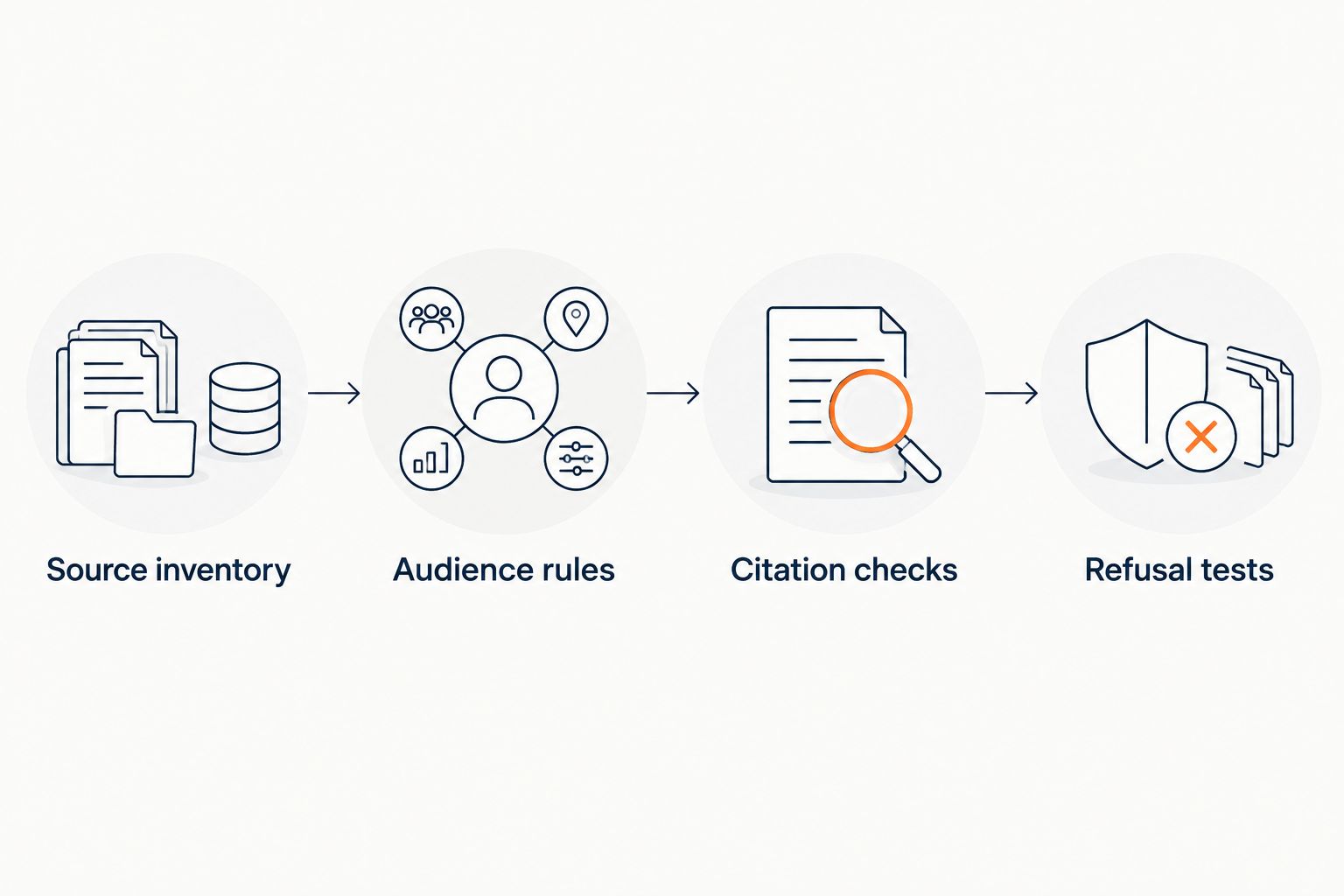
Source inventory
Identify where the current curriculum facts live. Include only material you are authorized to share with the intended audience, and distinguish official guidance from informal discussion.
For a 2026 course review, check that older descriptions do not contradict the material you now teach. A date on a document is useful context, but the document also needs a clear status: current, superseded, or draft.
Audience rules
Write down what buyers can learn before enrollment and what belongs inside the course. A public course outline can describe coverage without exposing the underlying paid teaching material.
Do not assume that supplying private content automatically creates the access boundaries you need. Verify the service’s behavior with public and member-facing questions before publication.
Citation checks
Review whether each answer’s source supports its wording. If the source says a lesson introduces a concept, the answer should not describe that lesson as advanced instruction.
Keep the claim and the evidence aligned. A correct source attached to an exaggerated summary is still a problem.
Refusal tests
Ask questions your published content cannot answer. Check whether the response acknowledges the gap instead of borrowing an answer from general knowledge or a different course.
The boundary should be understandable to the reader. State what is documented, what is not established, and whether a person needs to decide.
How do you test curriculum answers before launch?
Start with 10 test questions as a practical review set, not as proof of an accuracy rate. Use 3 clearly documented questions, 3 ambiguous questions, 2 unsupported requests, and 2 audience-boundary questions. This gives you different failure types to inspect without treating a single successful answer as validation.
For documented questions, compare the answer directly with the curriculum. For ambiguous questions, check whether the chatbot asks for clarification or identifies the uncertainty. For unsupported requests, look for a refusal rather than a new promise.
Audience-boundary questions deserve their own review. Test whether a public-facing answer reveals material you intended only for enrolled members; do not assume the boundary works because another answer was correct.
Record each question, the response, the cited source, and the correction needed. Keep your 2026 test set when the curriculum changes so you can repeat the same checks after updating content.
A useful test includes questions the chatbot should not answer. If every question has an obvious published answer, you have tested retrieval but not restraint.
Can a chatbot answer questions about lessons it cannot access?
A chatbot cannot verify unpublished lesson details without a relevant source. It can discuss the general subject, but that does not prove the subject appears in your course.
Ask the system to distinguish available evidence from missing evidence. If your lesson summary is the only source, the answer should remain within that summary rather than imply access to the full lesson.
Can a chatbot tell someone whether a course is right for them?
A chatbot can compare someone’s stated needs with published prerequisites and learning objectives. It should explain the match without guaranteeing that the person will succeed.
When the answer depends on individual assessment, leave the decision with a person. Lead capture can preserve a follow-up opportunity, but collecting contact details is not the same as resolving the question.
Does a curriculum chatbot replace an instructor?
A curriculum chatbot does not replace an instructor’s judgment. Finding a published explanation is different from assessing a learner’s work or deciding how to adapt instruction.
Use automated answers for documented information. Keep evaluation, exceptions, and personal teaching decisions with the person responsible for the course.
FAQ
Can an AI chatbot answer questions about my course curriculum?
Yes, an AI chatbot can answer curriculum questions when it has relevant course sources and keeps its answers within them. Require citations and test unsupported questions before publishing it.
What content should I give a curriculum chatbot?
Give a curriculum chatbot authoritative material that explicitly answers the intended audience’s questions. Relevant sources include course outlines, lesson descriptions, prerequisites, and published guidance; share restricted teaching material only after verifying access controls.
Can a chatbot point someone to a specific lesson?
A chatbot can point someone to a specific lesson when its available sources identify that lesson and support the answer. Check both the cited passage and whether the reader has permission to open the destination.
Can a chatbot answer questions from prospective students?
Yes, a chatbot can answer prospective students’ questions using published curriculum information. Keep the response within stated coverage and prerequisites rather than promising personal results.
What should a chatbot do when the curriculum does not contain the answer?
A chatbot should state that the available curriculum does not establish the answer. It should not invent lesson coverage, refund exceptions, discounts, or income promises to keep the conversation moving.
Does a citation mean a curriculum answer is accurate?
No, a citation alone does not establish that a curriculum answer is accurate. The cited material must support the precise claim, and the response must not exaggerate what the source says.
Is HelpShelf suitable for course curriculum questions?
HelpShelf is suited to creators who want a chat widget for cited pre-sale and support answers from their own content, plus lead capture. Individual curriculum decisions still need human review, and missing source material cannot establish an answer.
One last thing
Test an attractive answer that you do not want the chatbot to give. Ask whether an unpublished advanced topic is included, whether a prerequisite can be ignored, or whether completing the course guarantees an income result.
The useful response is sometimes a refusal. Before publishing your 2026 curriculum answers, make sure the chatbot can stop at the edge of the evidence instead of turning a buyer’s wish into your promise.