Yes—an AI chat widget can cite the exact lesson a customer asks about when its connected content identifies that lesson and supports the answer. Exact-lesson citations depend on readable source material and preserved lesson references; a citation to a course homepage does not establish which lesson answers the question.
- Can an AI chat widget cite the exact lesson a customer asks about? Yes, when lesson-level sources support it.
- HelpShelf suits course creators who want a chat widget with source-grounded answers and lead capture.
- Require citations that identify the relevant lesson, not just the course or community.
- Test missing sources, conflicting lessons, and member access before publishing your widget.
Why this matters
A student messages you at 11pm: they remember a lesson about handling objections, but not its title. A reply that names the course sends them back to searching. A reply that identifies the relevant lesson gives them a specific place to look.
For your 2026 setup, separate two requirements: answering from your content and identifying the exact source. HelpShelf provides a chat widget with cited answers from a creator’s content and lead capture. Validate exact-lesson references against your own material rather than treating source citation as proof of lesson-level precision.
The answer must match the citation, and the citation must identify the lesson. Neither check replaces the other.
Can an AI chat widget cite the exact lesson a customer asks about?
Yes, provided the widget can retrieve the relevant material and retain enough source information to identify the lesson. Use the following acceptance process before relying on that behavior for student support or pre-sale questions.
- Identify the lesson. Give each source a clear course name, lesson title, and location. A standalone excerpt without that context is harder to trace back to its origin.
- Make the content readable. Provide lesson text, notes, or a transcript in a format the chosen system supports. Do not assume that connecting a page makes every embedded video readable.
- Match the question. Ask about something the lesson actually explains. Check that the response answers that question rather than merely finding a similar phrase.
- Inspect the citation. Confirm that the named lesson supports the specific statement in the answer. Open any source link and check its destination.
- Test the boundary. Ask something the source does not answer. Require a clear limit instead of a confident guess.
These are acceptance criteria, not a claim that every chat widget supports every source format. Verify each requirement with your selected product and actual course content.
What counts as an exact-lesson citation?
A lesson title can identify the source without pinpointing the passage. A direct lesson link adds a destination; a passage reference adds context. Treat those as separate levels of evidence rather than interchangeable features.
| Citation format | Best for | Useful strength | Limitation to check |
|---|---|---|---|
| Course-level reference | Broad course questions | Identifies the overall source | Does not identify the exact lesson |
| Lesson title | Locating a named lesson | Names the relevant teaching unit | Repeated titles can remain ambiguous |
| Direct lesson link | Opening the relevant lesson | Gives the learner a destination | Requires a valid link and appropriate access |
| Passage or timestamp reference | Checking a specific explanation | Narrows the supporting material | Requires matching source detail; do not assume support |
For exact-lesson questions, require at least an identifiable lesson. If your workflow also needs direct links or timestamps, make those separate pass-or-fail requirements.
How do you prepare course content for lesson citations?
Keep the relationship between the lesson and its source material explicit. If you separate transcripts from their original lesson pages, preserve the title and location alongside the text.
For example, imagine a course with an introductory lesson and an advanced lesson that both discuss objections. The widget needs enough context to distinguish a beginner’s question from a request about the advanced exercise. A shared keyword alone is not sufficient evidence.
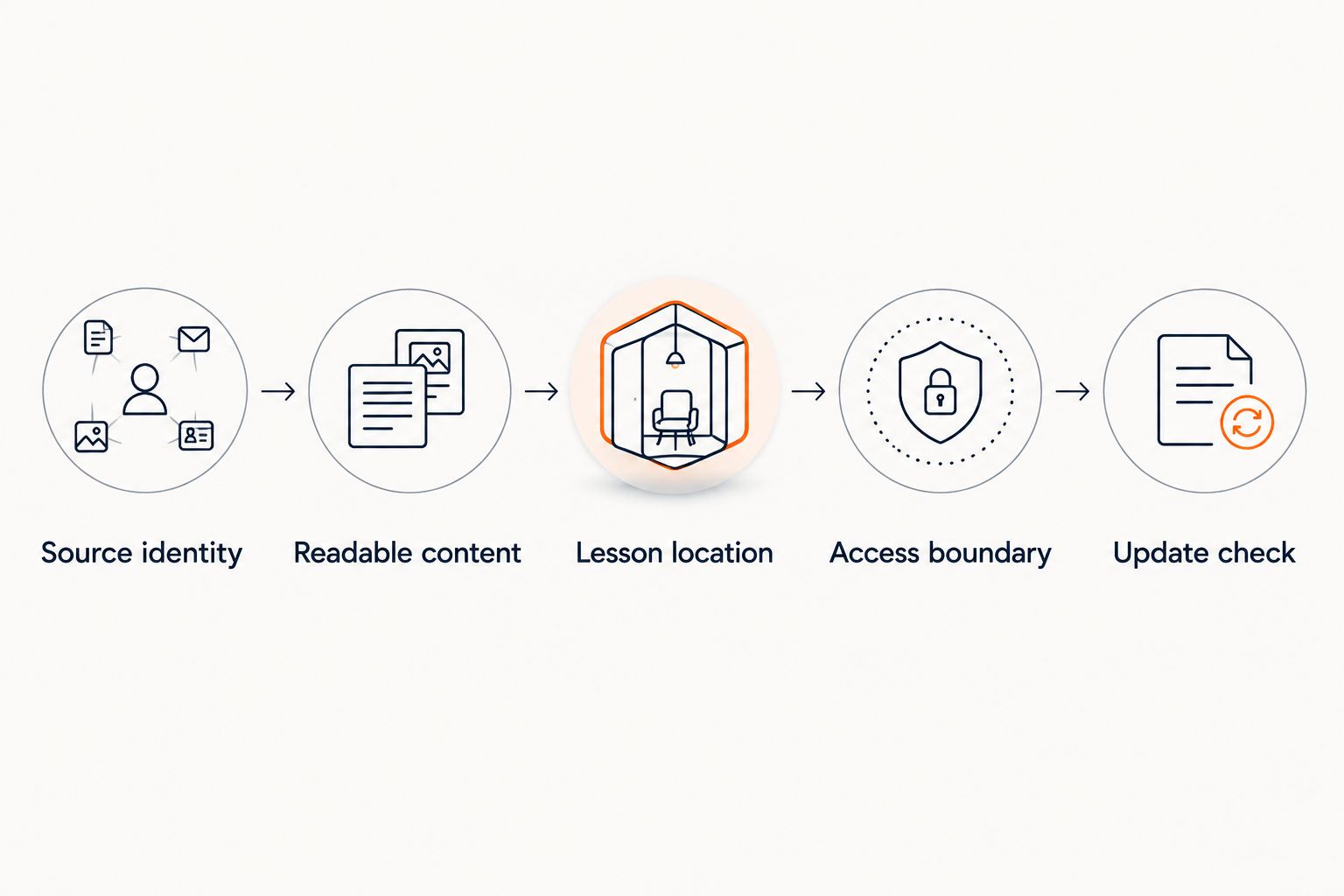
Use this source-preparation sequence for your 2026 content review:
- Source identity: Record the course name and the lesson’s full title.
- Readable content: Supply the explanation, notes, or supported transcript.
- Lesson location: Preserve the destination you want the learner to use.
- Access boundary: Specify which material is appropriate for visitors and members.
- Update check: Recheck the citation after changing the source or its location.
Treat a transcript and a summary differently. A summary can support a summary-level answer, but it does not establish that every detailed instruction from the video is available to the widget. Match the answer’s detail to the material supplied.
If your existing content is scattered across course pages and community posts, begin with a clearly defined set of lessons. Expand after you can trace answers back to their sources. That gives you a manageable review task without assuming a particular setup time.
Why exact-lesson citation quality varies
Citation quality depends on the relationship between the question, the retrieved content, and the source reference. Review these factors when a response sounds right but points to the wrong place:
- Source granularity. A combined course document needs clear lesson boundaries if you expect individual lessons to be identified.
- Title clarity. Repeated titles such as Introduction need course or module context to distinguish them.
- Content coverage. An outline establishes topics, not every explanation contained in the full lesson.
- Question ambiguity. A learner asking about the exercise might mean several different lessons. Require clarification instead of an arbitrary selection.
- Source consistency. An older note and a revised lesson can support different answers. Decide which material is authoritative.
- Link and access handling. A correct lesson reference still needs a usable destination for an authorized learner.
Do not use fluent wording as your accuracy test. Read the answer against the cited passage. The guide to accuracy when chatbots use your own content covers the broader question behind this check.
In your 2026 review, record the failure precisely: wrong lesson, unsupported statement, broken destination, or unclear access. Each calls for a different correction. Rewriting the answer alone does not repair the source relationship.
What should the widget say when it cannot find the lesson?
The widget should state what the available material supports and stop where that support ends. A useful refusal explains the missing connection rather than pretending the lesson does not exist.
For a hypothetical lesson-search question, an acceptable response pattern is: I found a course outline mentioning this topic, but I cannot identify a specific lesson from the available material. Tell me which course you mean, or ask the course team to confirm.
That response distinguishes an incomplete source from a definitive answer. It also gives the learner a next step without inventing a title.
For a request about an unpublished discount or a refund exception, use the same boundary: I can only quote what’s published. These are example response patterns, not statements about any creator’s actual policies.
A citation is not permission to add unsupported promises. A lesson about selling does not establish an income guarantee, and a course description does not establish a refund exception.
Can prospective buyers see citations from paid lessons?
Prospective buyers should receive only the material you have approved for pre-sale use. Answering a question about a course and revealing the contents of a restricted lesson are different actions.
A visitor might ask whether the course covers client onboarding. An approved outline can support a coverage answer without exposing the lesson’s full instructions. A member asking where to find a particular exercise has a different need and potentially different access.
Before publishing, test both situations separately. Do not assume that a citation feature also verifies membership, enforces permissions, or preserves your platform’s access rules. Confirm those behaviors in the actual setup.
If you cannot establish the appropriate access boundary, keep restricted material out of the visitor-facing source collection. Add it only when you have verified how authorized access works.
How should you test exact-lesson answers before launch?
Create a small acceptance set using questions from your own lessons. For a 2026 launch review, use these 6 test questions as a starting checklist, not as a performance benchmark:
- Direct lookup: Ask which lesson covers a clearly named topic.
- Paraphrased lookup: Ask the same question without repeating the lesson title.
- Ambiguous lookup: Ask about a topic covered in different courses.
- Unsupported request: Ask for an instruction absent from the supplied material.
- Changed source: Revise a lesson reference and check the resulting answer.
- Restricted request: Ask a visitor-facing widget for material intended only for members.
Apply 3 acceptance checks to each response: answer support, lesson identity, and access boundary. Write down the expected lesson or expected refusal before testing so a plausible response does not become its own standard.
For a direct lookup, inspect both the response and the source. For an ambiguous lookup, accept a clarifying question rather than rewarding an unsupported selection. For a restricted request, check what the response reveals, not just whether the link requires a login.
This is also where HelpShelf fits: its chat widget uses a creator’s content for cited pre-sale and support answers and captures leads. The limitation to assess is exact-lesson detail: cited answers alone do not establish timestamp support, direct lesson links, or platform-specific access enforcement.
Keep the launch decision tied to observable behavior. If your acceptance set exposes an unsupported answer, correct the source or response boundary and test again before expanding the content collection.
FAQ
Can an AI chat widget cite the exact lesson a customer asks about?
Yes, when connected sources identify the lesson and support the answer. Verify the lesson reference directly; a course-level citation does not establish an exact-lesson match.
Can a chatbot cite a timestamp inside a course video?
A timestamp citation requires source material and product support that preserve the relevant time reference. Do not infer timestamp capability from a general claim about cited answers.
Do I need transcripts for lesson citations?
You need readable material that supports the answer, but that does not always mean a full transcript. Notes can support what they explicitly contain; detailed questions require correspondingly detailed source material.
What if different courses use the same lesson title?
Include the course name with the lesson title and require clarification when the learner’s question remains ambiguous. A matching title alone is not enough to identify the intended source.
Does HelpShelf answer questions using my course content?
HelpShelf provides a chat widget that answers pre-sale and support questions using a creator’s own content, with cited sources and lead capture. Validate the exact lesson references you need against your actual sources.
Does a lesson citation prove the whole answer is correct?
No, a lesson citation identifies a source but does not establish that every statement in the answer is supported. Compare the response with the cited material and remove unsupported additions.
What should happen when no lesson supports the answer?
The widget should state that the available material does not support an exact answer and offer clarification or human follow-up. It should not invent a lesson, discount, refund exception, or income promise.
One last thing
A correct lesson title is not enough if the answer adds instructions that the lesson never gives. In your final 2026 check, open the cited source and ask: which passage supports each actionable statement?
If you cannot find that passage, narrow the answer. The most useful citation is one the learner can use to verify the response—not just a source label that looks credible.