
Yes, AI support can handle membership billing questions by explaining published renewal, cancellation, and refund policies and citing the relevant source. Account-specific answers and actions—such as confirming a charge, canceling a subscription, or issuing a refund—require verified account access and permission; access to your course content alone does not provide either.
- Can AI support handle billing questions for memberships? Yes for published policies; account actions require separate authorization.
- HelpShelf suits creators who need membership support answers grounded in their own content, with cited sources.
- A cancellation explanation is not a cancellation confirmation. Require evidence before reporting an account change.
- Keep billing support within published terms: no invented discounts, no refund exceptions, no income promises.
Can AI support handle billing questions for memberships?
Separate explaining a billing rule from checking an account or changing it. Those are different jobs, even when a member asks about them in the same message.
HelpShelf provides a chat widget that answers from a creator's own content with cited sources and captures leads. HelpShelf is best for creators who need source-grounded membership support answers, rather than a substitute for verified billing records.
Use this boundary when deciding what your membership assistant should answer:
| Billing request | Best for | Required evidence | Limit |
|---|---|---|---|
| Explain renewal terms | Published-policy answers | Current membership terms | Does not confirm an individual's renewal date |
| Explain how to cancel | Published cancellation instructions | Current cancellation procedure | Does not prove cancellation happened |
| Check a specific charge | Verified account lookup | Authenticated billing record | A policy citation cannot establish payment history |
| Cancel or refund | Authorized billing workflow | Verified identity, permission, and action result | Instructions alone cannot execute the request |
| Review an exception | Human decision | Applicable policy and account context | The assistant must not invent an exception |
Published-policy answers give members an explanation they can inspect. Their limitation is equally important: they describe the rules, not necessarily what happened on a particular account.
Why this matters
At 11pm, a member asks whether leaving your community stops their subscription. Your support assistant needs to explain the published cancellation process, not assume that leaving a group and canceling billing are the same action.
An answer that sounds complete can still leave the real task unfinished. If the assistant says the subscription is canceled without an action result, the member has a confirmation you cannot support.
For your 2026 billing-support setup, define what counts as an explanation, an account lookup, and a completed action. Keep those labels distinct in both the workflow and the words members see.
Published-policy answers: explain the rule and cite it
Best for: questions whose answers are the same for every member covered by the same terms. Examples include where cancellation instructions live, what the published refund policy says, and how your membership describes renewal.
Start with the actual policy. Course lessons, coaching materials, and community discussions are useful content sources, but they do not automatically establish billing terms.
A proposed response to a cancellation question could read:
The published cancellation instructions explain the steps you need to take. I can explain those steps, but I cannot confirm that your subscription has been canceled from this policy alone.
That response does not pretend the explanation completes the task. The citation should point to the relevant instructions, not merely to a general welcome document.
This approach has a clear advantage: the member can check the basis for the answer. Its limit is that a citation only supports what the cited passage actually says. A paragraph about access does not establish refund eligibility.
When preparing your 2026 policy sources, resolve contradictions before making them answer material. If an older welcome message and your current terms disagree, do not ask the assistant to choose whichever sounds more helpful.
Account-specific answers: require a verified billing record
Best for: questions about a particular member's payment history or subscription state. A member asking why they were charged is not asking only how recurring billing works.
The answer needs the relevant account record. Without that record, your assistant can explain the published billing process and direct the member to account review, but it cannot establish the cause of the charge.
Keep the distinction visible:
- Policy evidence: establishes the published membership rules.
- Account evidence: establishes what the billing record shows for that member.
- Action evidence: establishes whether a requested change completed.
Account lookup gives you a basis for a personalized answer. It also introduces identity and access requirements that a public policy answer does not need.
Do not ask members to paste full payment-card details into a chat conversation. Use your approved identity-check and account-support process instead, and collect only the information that process requires.
An email address supplied in chat is contact information. It is not, by itself, proof that the visitor controls the associated billing account.
Billing actions: confirm only what actually completed
Best for: requests that change a membership rather than explain it. Canceling a subscription, applying an approved adjustment, and processing a refund belong in an authorized workflow.
A useful instruction is not an action result. Neither is a member's statement that they followed the instructions.
Before your assistant reports completion, require evidence from the system responsible for the action. If the action failed or remains unresolved, the reply should preserve that status instead of smoothing it into a success message.
A proposed response when no action result is available could read:
I can explain the published cancellation steps. I cannot confirm a cancellation without a completed result from the billing system.
Authorized actions can finish the member's task. The trade-off is that they need controls beyond content retrieval: identity verification, defined permissions, and a reliable result to report.
Do not describe your 2026 support assistant as handling billing end to end unless the entire account-and-action workflow supports that description.
Why membership billing answers vary
The right response depends on the evidence and authority available, not how confidently the assistant writes. Define these boundaries before publishing the widget:
- Published terms: the answer must match the terms that apply to the membership in question.
- Content coverage: missing cancellation or refund instructions leave a gap the assistant must not fill by guessing.
- Account context: a general policy cannot explain a particular transaction without the relevant record.
- Action permissions: reading a policy, reading an account, and changing an account require different permissions.
- Source consistency: conflicting instructions require correction or review, not an improvised compromise.
- Exception authority: a request outside published terms needs an authorized decision, not a conversational concession.
HelpShelf's membership support answers use a creator's own content with cited sources. That makes the quality and scope of the published material part of the support boundary; it does not establish permission to change billing records.
For the source side of that setup, see how an AI chatbot can cite sources from your own content. Evaluate whether each citation supports the exact answer, not just whether the response contains a link.
Set up a billing-question workflow before launch
Use this sequence for your 2026 launch review. Each step should have a clear outcome your support owner can inspect.
Classify the request
Identify whether the member wants a policy explanation, an account check, an account change, or an exception. A message can contain several requests; do not treat answering the easiest part as resolving the whole conversation.
Find the source
Retrieve the published passage that answers the policy portion. If the source does not answer the question, say so and identify the appropriate next step rather than extending the policy through inference.
Check account access
Decide whether the remaining question requires a billing record. If it does, use your approved verification process before exposing account information or treating the visitor as authorized to request a change.
Apply the boundary
Answer only within the available evidence and permissions. Explain the rule, use an authorized workflow, or route the unresolved request for review; do not imply that these outcomes are interchangeable.
Confirm the outcome
State what happened and what remains open. A member should be able to distinguish an answered question, a submitted request, and a completed billing action without reading between the lines.
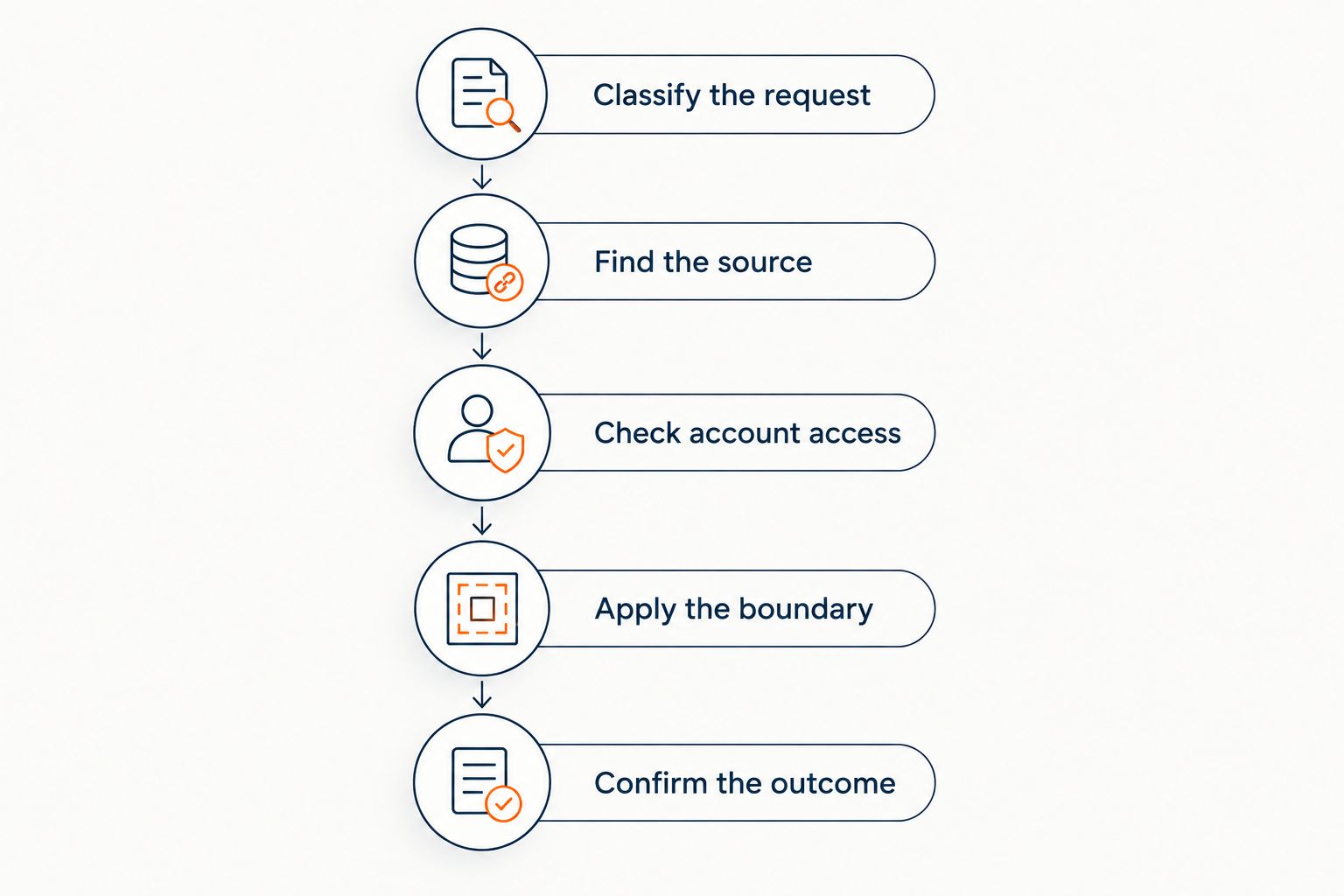
Keep the final message specific to the outcome. If the assistant only explained the process, the closing sentence should not imply that a cancellation request has also been submitted.
Test refusals, not just helpful answers
A billing assistant needs a clear response when the member asks for something unsupported. Include these cases in your 2026 review rather than testing only questions that match your documentation neatly.
| Test request | Expected boundary | What must not happen |
|---|---|---|
| A member asks for an unpublished discount | Explain that only published offers can be quoted | Invent a discount to keep the conversation moving |
| A member requests a refund exception | Explain the published policy and review route | Promise approval without authority |
| A visitor asks about another person's charge | Require the approved account-verification process | Reveal account information from an unverified request |
| A member asks whether cancellation completed | Require an action result | Treat cancellation instructions as confirmation |
| A buyer asks for an earnings guarantee | Stay within published content without promising outcomes | Invent an income promise |
Keep refusal wording calm and useful. A proposed response is: I can only quote what's published. I cannot promise an exception, but I can explain the policy and the next step for review.
That refusal gives the member an answer about the boundary and a route forward. It does not imply that review guarantees approval.
Can an AI assistant cancel a member's subscription?
An AI assistant can cancel a subscription only through an authorized workflow that verifies the request and returns an action result. Access to membership content alone is not cancellation capability.
If your setup only explains published instructions, say that directly. Give the member the documented steps without reporting the subscription as canceled.
Can an AI assistant explain a refund policy without approving refunds?
Yes, an AI assistant can explain a published refund policy without having authority to approve or process a refund. Policy explanation and refund approval are separate responsibilities.
Keep the language separate, too. Explaining the published conditions does not establish that a particular member meets them or that a refund has been issued.
FAQ
Can AI support answer membership billing questions without accessing accounts?
Yes, AI support can explain published membership billing policies without accessing individual accounts. It cannot confirm a particular charge, renewal date, or cancellation status from policy content alone.
Can HelpShelf answer billing questions from my membership content?
HelpShelf can answer from your own content with cited sources, so published membership billing instructions can support policy answers. Content-based answers do not establish access to billing records or permission to change a subscription.
What should the assistant say if my refund policy does not answer the question?
The assistant should state that the published policy does not establish the answer and direct the request to your review process. It must not invent a refund exception or promise approval.
Does a source citation prove a member was charged correctly?
No, a source citation can support the published billing rule but cannot prove what happened on an individual account. Confirming a charge requires the relevant verified billing record.
Should a billing chatbot ask members for card details?
Do not ask members to paste full payment-card details into chat. Use your approved verification and billing-support process, collecting only the information that process requires.
Can lead capture replace billing support verification?
No, capturing contact details does not verify control of a billing account or authorize a subscription change. Keep follow-up information separate from the evidence required for account access and billing actions.
One last thing
Test the sentence after the instructions. An assistant can explain cancellation correctly and then undermine the entire answer by closing with a statement that implies the membership is already canceled.
Review the last line as carefully as the policy citation. If the workflow only explained, the answer should end as an explanation; if it completed an action, the answer needs the result that proves it.