
Yes—AI chatbots can address pre-sale objections when the answer exists in your published content, but they cannot make an unsuitable offer fit a buyer. In 2026, the useful role is answering questions about course content, coaching scope, and community access with a source the visitor can check. A chatbot should not invent discounts, grant refund exceptions, or promise income to keep the conversation moving.
- Can AI chatbots stop pre sale objections from killing sales? They can answer documented concerns, not guarantee purchases.
- HelpShelf suits creators who need source-grounded pre-sale answers and lead capture from their own content.
- Use citations for course fit and published policies; send exceptions and personal judgments to a human.
- Evaluate answer accuracy and unresolved questions before treating chat activity as evidence of more sales.
Can AI chatbots stop pre-sale objections from killing sales?
A chatbot can remove an information barrier; it cannot remove every reason someone decides not to buy. That distinction should shape the answers you allow it to give. Start with the questions your content already answers, rather than asking the widget to persuade everyone.
A prospective student asks whether your course assumes previous experience. If the course outline states the prerequisites, the chatbot can explain them and cite that outline. If the outline says nothing about prerequisites, the chatbot has no basis for assuring the student that the course is suitable.
The same boundary applies to support, access, and outcomes. Your published material defines the answer—not the visitor's urgency, the wording of the objection, or the chatbot's ability to produce a convincing sentence. The guide to answering pre-sale questions from your content covers that source-first approach.
Use this distinction when reviewing conversations:
- Answerable concern: The visitor needs a fact your material states.
- Missing information: The visitor needs a fact you have not published.
- Exception request: The visitor wants different terms from those you publish.
- Fit decision: The visitor needs judgment about their circumstances.
Only the first category has a straightforward automated answer. The others need clarification, a content update, or human follow-up.
Why this matters
Imagine someone browsing your coaching offer at 11pm. They ask whether feedback on their work is included. Your published scope answers the question, but they have not found it.
A source-grounded answer gives them the relevant information without requiring you to join that conversation. It does not prove they will buy. It simply means a factual question no longer has to remain unanswered until you reply.
For a creator assessing pre-sale chat in 2026, this is a more useful objective than making the widget sound persuasive. Define which questions it should resolve and which decisions it must leave to you. That gives you something concrete to inspect.
The boundary matters after purchase, too. An answer that implies personal feedback, ongoing access, or an outcome you never offered creates an expectation your course cannot meet. A refusal is better than a reassuring answer that changes the offer.
Which pre-sale objections should a chatbot answer?
Use the objection itself to identify the required source. A curriculum question needs curriculum evidence; a policy question needs the actual policy. A general description of your business is not a substitute for either.
| Visitor's concern | Evidence needed | Appropriate response | Boundary |
|---|---|---|---|
| Does this cover the topic I need? | Published curriculum or lesson description | Explain the stated coverage and cite it | Do not add topics the source does not mention |
| Is this suitable for my experience? | Published prerequisites and intended audience | Describe the stated entry requirements | Do not guarantee personal suitability |
| What support is included? | Published support scope | Explain the support described in the source | Do not imply private coaching is included |
| What happens if I want a refund? | Published refund policy | Explain the relevant terms with a citation | Do not grant an exception |
| Will this produce the result I want? | Published description of what is taught | Explain the material and its intended use | Do not promise income or individual results |
A question can move between categories as the conversation develops. Asking what a course teaches is factual. Asking whether those lessons will solve a specific business problem requires judgment about that business.
Do not treat the presence of a related source as permission to answer everything around it. A lesson about finding clients does not establish an income outcome. A community description does not establish a response commitment from its owner.
FAQ page, chatbot, or human conversation?
Match the response method to the question, not to a blanket preference for automation. For your 2026 setup, keep published information available to read directly and use chat where it helps visitors locate an answer. Keep a human route for decisions the published material cannot settle.
| Option | Best for | Advantage | Limitation |
|---|---|---|---|
| FAQ page | Reading established answers directly | Visitors can inspect the wording without a conversation | An unlisted question remains unanswered |
| Source-grounded chatbot | Asking documented questions in different ways | Can respond using the relevant source and citation | Depends on the completeness and accuracy of its sources |
| Human conversation | Exceptions, ambiguity, and individual fit | Lets an authorized person make a decision | Requires that person's attention |
These are complementary options. Your FAQ is the published reference, the chatbot is an interface to documented answers, and the human handles unresolved judgment. None should quietly change the terms stated by another.
HelpShelf is best for course creators, coaches, and community owners who need cited pre-sale answers and lead capture from their own content. Its stated offer addresses that source-grounded chat use case. It does not establish that every visitor's objection can be answered from the material you provide.
The practical limitation is source coverage. If your coaching page leaves the support scope unclear, adding a widget does not supply the missing terms. Publish the answer before asking an automated conversation to explain it.
Why objection handling varies
The usefulness of an answer depends on what the visitor needs and what your sources establish. These factors determine whether chat can resolve the concern:
- Source coverage: A chatbot needs material that answers the actual question, not just a nearby topic.
- Policy clarity: Refund and access terms need explicit wording. A vague promise to help does not define an entitlement.
- Question scope: Asking whether a lesson exists is different from asking whether it will work for a particular person.
- Evidence quality: A citation must support the answer beside it. Linking a sales page does not validate every claim in a response.
- Follow-up needs: An unresolved concern needs an identified next step, not another attempt to sound certain.
Use these factors to diagnose a weak conversation. If the visitor asks about personal feedback and your sources never define it, the fix is not a warmer answer. The fix is a clear support description and an appropriate response until that description exists.
How do you set up source-grounded objection handling?
Use the same boundary for every question: answer from the source, narrow the claim to what it supports, and stop when the evidence stops. This is a practical setup sequence for 2026, not a claim about any particular widget's settings.
- Source: Collect the published curriculum, offer description, support scope, and policies that define what you sell.
- Scope: Separate factual questions from requests for exceptions, personal advice, and guaranteed outcomes.
- Verify: Check that each answer is supported by the cited passage, including any conditions or exclusions.
- Handoff: Define the next step when the source does not answer the question or a human decision is required.
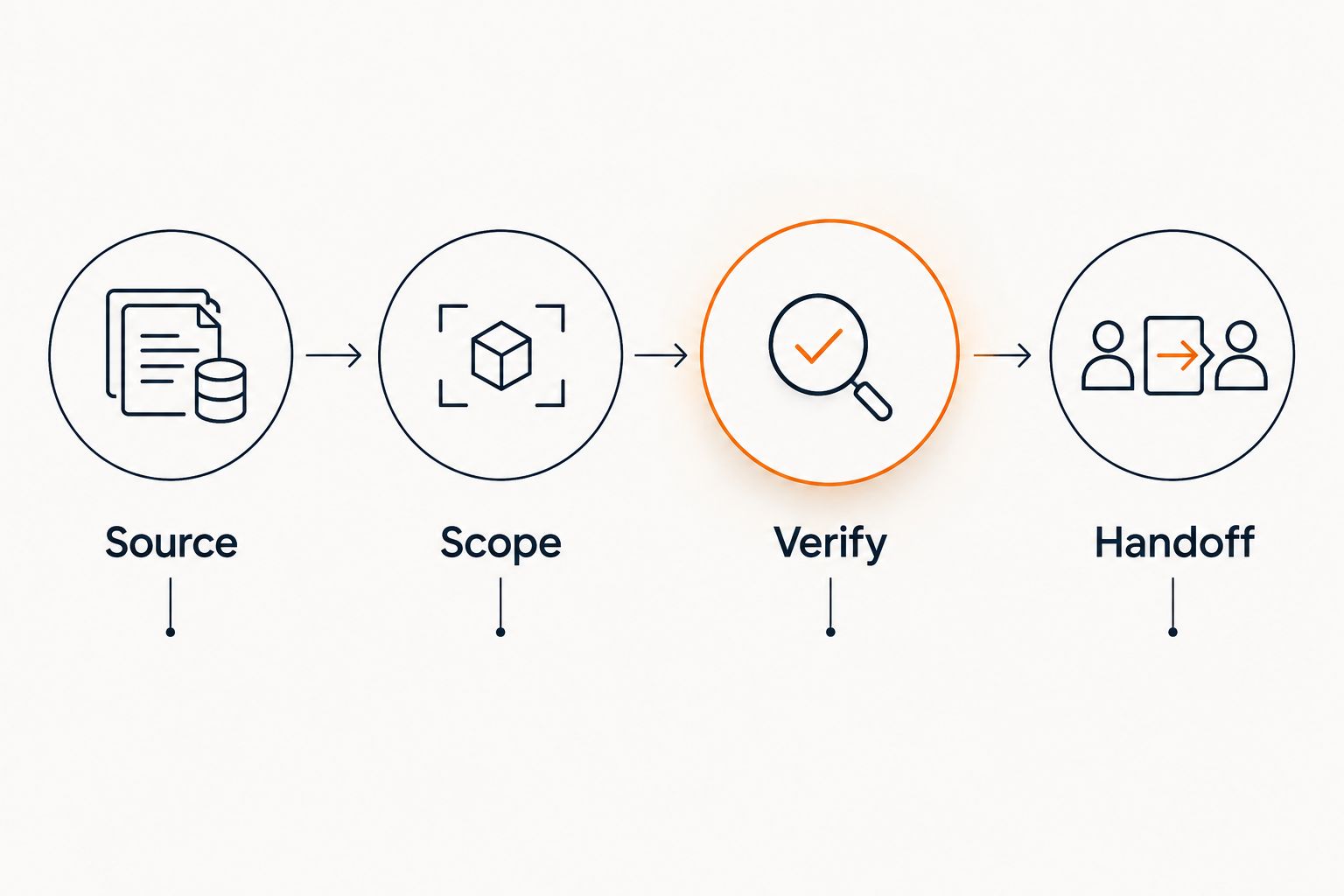
Begin with the material that defines the offer, rather than every file you own. Background lessons can explain a topic without describing what a buyer receives. Keep that difference visible when checking answers.
Then test with questions that press against the boundaries. Ask about an unpublished discount, a refund exception, and a promised result. The desired response is not a clever way to continue selling; it is a clear statement of what the source does and does not support.
HelpShelf provides a chat widget that uses a creator's own content for cited answers and captures leads. Evaluate that function against your actual course, coaching, or community questions before deciding where automated answers belong.
What should a refusal sound like?
A refusal should identify the limit and give the visitor a useful next step. It should not scold them or hide behind technical language. The aim is to keep an unanswered question from turning into an invented answer.
Use the stated boundary: “I can only quote what's published.” Then explain which part of the request falls outside the published information. The following are illustrative response patterns, not statements of your business's policies.
When someone asks for an unpublished discount
State that the published material does not establish the requested discount. Do not invent a code, suggest that an exception is likely, or imply that persistence will produce different terms. Direct the visitor to an authorized person if you want them to request clarification.
When someone asks for a refund exception
Explain the relevant published refund terms and cite them. Separate explaining the policy from deciding whether to depart from it. The chatbot should not describe an exception as approved before an authorized person has made that decision.
When someone asks for an income promise
Describe what the course teaches, using the curriculum as the source. Do not turn instruction into a forecast of the visitor's earnings. If the question is really about suitability, identify the published prerequisites and leave unsupported conclusions out.
These refusals preserve the distinction between an answer and a commitment. They also show you where your published material leaves a genuine buyer question unresolved.
Can a chatbot answer whether my course is right for someone?
A chatbot can explain published fit criteria, but it cannot establish an individual outcome. Give it explicit prerequisites, intended audience descriptions, and exclusions if you want it to answer fit questions usefully.
For example, a visitor asks whether they need experience with the subject. The answer should reflect the stated prerequisite, not reassurance based on the visitor sounding interested. If your material does not define the requirement, resolve that gap yourself.
Do not confuse a friendly tone with evidence. Calm wording is helpful, but the content of the answer still needs a source.
Can a chatbot capture a lead when the objection remains unresolved?
Lead capture preserves a route for follow-up; it does not resolve the objection itself. Ask only for the information needed to continue the conversation, and make the purpose of that follow-up clear.
Keep the unanswered question intact. A contact record without the visitor's concern gives you less useful context than a clear description of what they still need to know. Do not imply that leaving contact information means their requested exception has been accepted.
How do you know whether the chatbot helps sales?
Check the answers first, then evaluate purchase outcomes separately. In your 2026 review, a busy chat window is evidence of conversations—not evidence that the widget caused more purchases.
Review whether answers match their sources, whether citations support the exact claims, and whether unresolved concerns receive an appropriate next step. Track repeated questions that expose missing content. Those checks tell you whether the widget is handling its assigned task.
If you assess sales impact, keep the distinction between association and cause. A purchase after a conversation does not, by itself, show that the conversation changed the decision. Do not publish a conversion claim your evidence cannot establish.
FAQ
Can AI chatbots stop pre-sale objections from killing sales?
AI chatbots can address objections caused by unanswered factual questions when published content supports the answer. They cannot guarantee a purchase or make an unsuitable offer suitable.
What's the best kind of chatbot for a course creator's pre-sale questions?
A source-grounded chatbot is appropriate for questions answered by your published course and policy material. HelpShelf provides cited answers from creator content and lead capture; evaluate its answers against your own offer.
Is a chatbot better than a FAQ page for answering buyer questions?
A chatbot and a FAQ page serve different purposes: chat responds to a visitor's question, while a FAQ presents established answers directly. Both need accurate published information, and neither should decide policy exceptions.
Can a chatbot offer a discount to close a sale?
A chatbot should not invent a discount to close a sale. It should explain only what your published offer supports and leave requests for different terms to an authorized person.
Can a chatbot tell buyers they will make money from my course?
A chatbot should not promise a buyer an income outcome. It can explain what the curriculum teaches without presenting an individual financial result as assured.
What should a chatbot say when my content does not answer a question?
A chatbot should state that the published material does not support an answer. It should identify the unresolved question and offer an appropriate route for clarification rather than guessing.
How should I evaluate pre-sale chatbot answers in 2026?
Evaluate pre-sale chatbot answers in 2026 by checking source support, citation relevance, and handling of unresolved questions. Assess sales outcomes separately rather than treating chat activity as proof of increased sales.
One last thing
The objection your chatbot cannot answer can be the content you need to publish next. If visitors repeatedly ask what support includes, clarify the support description rather than expanding the chatbot's permission to improvise.
Make the underlying page answer the question on its own. Then let chat point to that answer. A clearer offer helps the visitor who uses the widget and the visitor who never opens it.