
AI chatbots can support retention in membership communities by answering questions that block members from using what they joined for, but answering a question is not proof of preventing a cancellation. Treat churn reduction as an outcome to measure, not a result to assume from installing a widget.
- Can AI chatbots reduce churn for membership communities? Test whether source-grounded support improves renewals, not just chat resolution.
- HelpShelf suits creators who need membership support answers grounded in their own content, with cited sources.
- Use automation for published instructions; keep account decisions and policy exceptions with a person.
- Measure member churn alongside unresolved questions, repeated contacts, and cancellation reasons.
Can AI chatbots reduce churn for membership communities?
Yes, as a support intervention: a chatbot can help a member find an answer, understand a published rule, or locate relevant learning material. Whether that support changes renewal behavior requires a comparison of actual membership outcomes.
The distinction matters. A correct answer can remove a support obstacle without changing a member's decision to leave. Before testing retention, establish how accurate answers grounded in your own content are.
| Support approach | Best for | What it contributes | Main limitation |
|---|---|---|---|
| Source-grounded chatbot | Repeated questions covered by published content | Conversational answers with supporting sources | Cannot supply an unpublished policy or make an account decision |
| Searchable help content | Members who prefer browsing instructions | A stable reference members can revisit | Members must identify the relevant page themselves |
| Human support | Ambiguous questions, disputes, and exceptions | Judgment and account-specific investigation | Requires a person to review and respond |
Use the support method that matches the question, rather than forcing every question through a chatbot. These approaches serve different purposes; a retention test should preserve access to human help.
Why this matters
A member opens your community at 11pm and cannot find the lesson they need. They send a message, close the tab, and leave the task unfinished. In that scenario, a useful answer addresses a concrete obstacle: finding the next step.
Now change the question. The member understands the material but no longer wants the membership. Another lesson link does not address that decision.
Your 2026 retention plan should distinguish support friction from a reason to leave that support cannot resolve. Otherwise, a busy chatbot becomes a success story while renewal behavior stays unexamined.
Where a chatbot belongs in the member experience
Content discovery: answer with a source
A member asks where you explain a technique taught inside the membership. The useful response identifies the relevant material and cites the source, rather than producing a generic explanation detached from your teaching.
The benefit is specific: the member gets a route back into the content. The limitation is equally specific: a relevant citation does not establish that the member completed the lesson, applied it, or renewed.
Check the answer against the source. A citation should support the actual instruction, not merely point to a page containing similar words.
Published rules: explain without changing them
A member asks whether a particular activity is included. If your published membership terms answer the question, the chatbot should explain those terms and show the source.
If the terms do not answer it, the response should stop at that boundary. A suitable example refusal is: I can only quote what's published. This question needs the community owner's review.
That is not an invitation to invent an exception. No invented discounts, no refund exceptions, and no income promises.
Account problems: separate explanation from action
A member asks why access has disappeared. A general help article might explain where access settings live, but it cannot establish what happened to that person's account.
Keep the distinction explicit: explaining published instructions is different from checking a payment, restoring access, or approving a request. Do not describe an action as completed unless the support system actually completed and confirmed it.
For account-specific issues, give the member your established route to a person. A plausible explanation is not an account investigation.
Why chatbot impact on churn varies
The retention question depends on what members need and what the support setup actually handles. Use these factors to decide whether a chatbot addresses the problem you are trying to solve:
- Cancellation reason: Content discovery problems belong in a support test. A member leaving because their needs changed requires a different response.
- Source coverage: Answers need published material that directly addresses member questions. Missing instructions remain missing instructions.
- Source consistency: Conflicting rules leave the answer without a clear basis. Resolve the conflict before publishing automated guidance.
- Question type: General instructions differ from account-specific questions. Keep decisions about individual accounts outside an informational answer.
- Human follow-up: An unresolved question needs an available route for review. Ending the conversation is not the same as resolving the issue.
- Measurement design: Renewal outcomes need a defined member population and comparable observation periods. Chat activity alone cannot establish a retention effect.
Do not use a chatbot to conceal a missing policy or an unresolved membership problem. Fix the underlying information or service issue, then decide what automation should handle.
How do you test whether a chatbot improves retention?
For a 2026 rollout, define the test before changing the member experience. That keeps the question focused on renewal behavior rather than whichever chat metric looks most encouraging afterward.
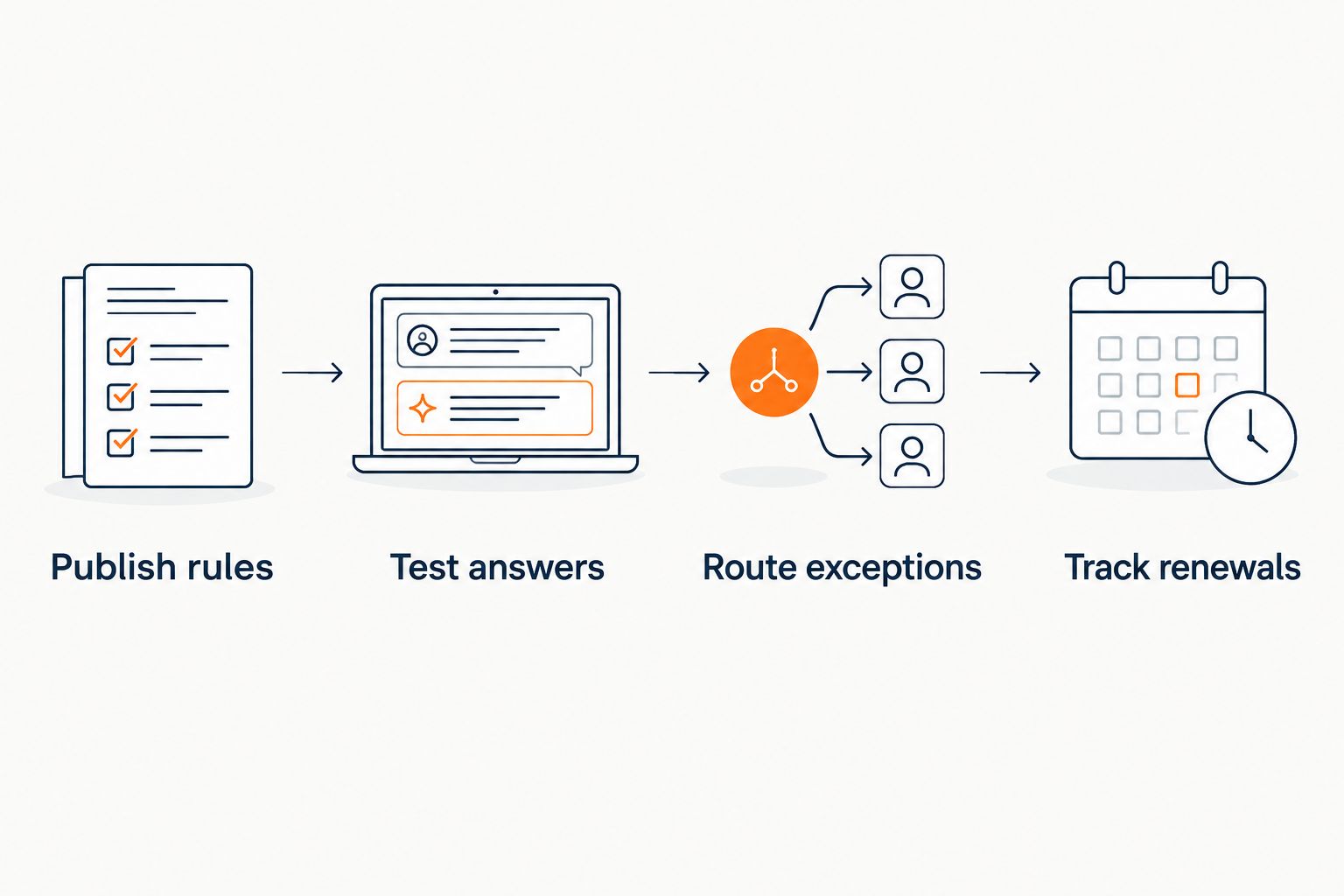
Publish rules
Start with the questions members already ask. Group them into content navigation, published policies, access instructions, and account-specific requests; then identify the authoritative source for each answerable question.
Remove contradictions before connecting the material. If your welcome instructions and membership terms describe different entitlements, selecting either answer without resolving the conflict is not a satisfactory fix.
Write the boundaries too. Specify what requires human review and which claims the chatbot must never make.
Test answers
Build a question set from real support requests, removing personal details. Include straightforward questions, vague wording, and requests for exceptions.
Check whether each answer addresses the question and whether its citation supports the response. An answer that sounds helpful but cites unrelated material fails the test.
Also test absence. Ask about something your content does not cover and verify that the response admits the gap rather than completing the answer from guesswork.
Route exceptions
Define what happens when the chatbot cannot answer. Tell the member how to request help through your existing support process, and make clear whether any request has actually been submitted.
Keep account questions distinct from general information. A member disputing a charge needs review of that charge, not another summary of your published billing instructions.
Test this route yourself. The member should not have to repeat the same unsuccessful chatbot exchange to reach a person.
Track renewals
Choose the member population, observation period, and churn definition before reviewing results. Keep those definitions unchanged during the comparison.
Where practical, compare otherwise similar groups with different support access. If you compare periods instead, record changes to your content, onboarding, membership terms, or community activity that complicate attribution.
Report the result narrowly. A change observed after launch is not automatically a change caused by the chatbot.
What should your retention report measure?
Your 2026 report should connect support activity to membership outcomes without treating them as interchangeable. Separate what happened in chat from what happened at renewal.
Use a written measurement definition so everyone interprets the report the same way:
- Member churn: Cancellations during the defined period divided by the eligible starting membership population, using a consistent eligibility rule.
- Renewal outcome: Whether an eligible membership renewed at its renewal point, rather than whether the member merely opened chat.
- Unresolved questions: Requests that still needed an answer after the automated interaction.
- Repeat contact: A member returning with the same unresolved issue through chat or another support channel.
- Answer correctness: Whether the response and supporting citation matched the approved source.
- Cancellation reason: The reason the member supplied, kept separate from an interpretation inferred from chat activity.
Compare chatbot users carefully. Members who ask for help are not automatically comparable with members who never open support; their needs and activity differ.
A lower human-support workload is not, by itself, lower churn. It is a separate operational result. Keep both outcomes visible so you do not mistake a quieter inbox for healthier membership retention.
Where HelpShelf fits
HelpShelf is best suited to creators who need membership support answers grounded in their own content, with cited sources. Its chat widget answers pre-sale and support questions using course, coaching, or community material and captures leads.
For this retention use case, the relevant capability is answering from the creator's material. Lead capture serves a different purpose and should not be counted as evidence of member retention.
The boundary remains important: source-grounded answers do not replace missing content, personal coaching, or account investigation. Evaluate the widget on the questions your members actually ask, then evaluate renewals separately.
Can a chatbot replace personal support in a paid community?
No. A chatbot can answer covered questions, but it does not replace the individual judgment required for a dispute, a coaching decision, or a concern about the community experience.
Keep automation focused on information retrieval and published explanations. Make personal support available where the answer depends on the member's circumstances.
Does answering more questions mean members will renew?
No. More answered questions show support activity, not a renewal outcome; a member can receive a correct answer and still decide to leave.
For your 2026 evaluation, check renewal outcomes alongside answer quality. Neither metric substitutes for the other.
What should happen when a member asks to cancel?
Explain the published cancellation process and provide your established support route for anything the chatbot cannot handle. Do not invent a retention offer, suggest an unpublished exception, or imply that cancellation has been processed when it has not.
A cancellation request is not a prompt to argue with the member. Keep the instructions clear and the limits explicit.
FAQ
Can AI chatbots reduce churn for membership communities?
AI chatbots can address support friction that is relevant to retention, but reduced churn must be demonstrated through membership outcomes. Measure renewals and cancellation reasons separately from chat activity.
What's the best chatbot use case for a paid membership?
Repeated questions with clear answers in your published content are the best starting point. Test content navigation and policy explanations before assigning ambiguous or account-specific requests.
Is a chatbot better than a help page for keeping members?
Neither format alone proves a retention benefit. A chatbot supports conversational questions, while a help page gives members a reference they can browse; compare their usefulness against actual member needs.
Can HelpShelf answer questions from my community content?
HelpShelf answers pre-sale and support questions using a creator's own course, coaching, or community content, with cited sources. That capability supports member questions without establishing a guaranteed churn reduction.
Should a chatbot offer a discount when someone wants to cancel?
A chatbot should not invent a discount or an exception. It should explain the published process and direct requests outside that process to your established human support route.
How do I know whether a chatbot actually helped retention?
Compare renewal or churn outcomes using a defined member population and consistent observation periods. Record other membership changes and inspect answer quality before attributing an outcome to the chatbot.
What should a chatbot do when it cannot find an answer?
It should state that the published material does not answer the question and explain how to request human help. A source-grounded refusal is preferable to an unsupported instruction.
One last thing
Your most useful 2026 test question might be the one your content cannot answer. Ask about an unpublished exception and inspect whether the response stops or invents permission.
Before using HelpShelf for membership support, test that boundary alongside ordinary lesson questions. A successful support interaction sometimes ends with a clear limit and a human review—not another generated answer.