
Yes—AI chatbots can cut support tickets for online coaches by answering repeat questions from published course, coaching, and community content before someone contacts you. They do not replace account investigation, refund decisions, or personal coaching; a useful answer cites its source, and an unsupported request goes to a person rather than becoming an invented promise.
- Can AI chatbots cut support tickets for online coaches? Yes, when published content answers the question.
- HelpShelf provides source-grounded support answers and lead capture for course creators, coaches, and community owners.
- Keep account disputes, refund exceptions, and personal coaching decisions with a person.
- Measure resolved questions and repeat contacts, not just conversations that end.
Can AI chatbots cut support tickets for online coaches?
Yes, for questions that have a clear, published answer. A chatbot can return the relevant explanation and source instead of making a member wait for you to repeat it. The boundary is evidence: an answer about course content is different from a decision about someone's account.
For a 2026 support plan, separate questions by what answering them requires. The guide to chatbots that cite your own content explains the source-grounding approach behind that distinction.
| Support approach | Best for | Advantage | Limitation |
|---|---|---|---|
| Source-grounded chatbot | Repeat questions answered in published content | Returns an explanation with a supporting source | Cannot establish facts absent from its sources |
| Human support | Account problems, disputes, and exceptions | Can investigate and make authorized decisions | Requires someone's attention |
| Self-service documentation | Members who know what they need to find | Gives readers direct access to published instructions | Readers still have to find and interpret the relevant section |
These approaches belong together. Documentation provides the evidence, a chatbot helps readers find the answer, and a person handles cases that require judgment or account access.
Do not treat every unanswered chat as a failure. Refusing to invent a refund exception is the right outcome, even when the next step is a support ticket.
Why this matters
A member DMs you at 11pm asking where to find the preparation material. If the answer already exists in your course instructions, your next reply adds little beyond locating it. A source-grounded answer can point the member to that material without asking you to repeat yourself.
Now change the question: the member says access disappeared after a payment problem. Published instructions can explain the normal access process, but they cannot prove what happened to that account. That question needs investigation.
Your 2026 support goal is fewer avoidable contacts, not fewer opportunities to get help. A quieter inbox is useful only when members receive correct answers and still have a route to a person.
Which questions should a coaching chatbot answer?
Start with questions whose answers stay within your published material. Before you automate an answer, identify the specific passage that supports it and check that the visitor is entitled to see it.
Published course instructions
Questions about finding lessons, preparing for sessions, or understanding an assignment are candidates when your materials explicitly cover them. The chatbot should answer the question asked and cite the relevant instructions, not reconstruct a process from unrelated passages.
A member asking where to find a worksheet needs a location and a source. They do not need a summary of your entire coaching method. Keep the response narrow enough that you can verify each claim.
Published program details
Pre-sale questions can also fit: what the program covers, who the published description addresses, or how the stated format works. These answers should reflect the offer as written, without adding deliverables or promising a personal outcome.
For example, a prospective buyer might ask whether a course covers a particular topic. The answer should name the relevant published material or say that the content does not establish coverage. A related lesson title alone is not permission to promise the requested result.
Published policies
A chatbot can explain a published policy. It should not create a different policy because a visitor gives a persuasive reason.
This boundary matters for refunds, access, and participation rules. Quoting what is published is support; deciding that a particular person qualifies for an exception is an authorized human decision.
Which questions should stay with a person?
Keep requests that depend on private records or personal judgment outside the automatic-answer lane. Give the member a clear next step rather than a confident response unsupported by evidence.
- Account investigation: A published guide cannot establish whether a particular payment completed or why access changed.
- Refund exceptions: Explaining the policy does not authorize a departure from it.
- Personal coaching decisions: Course material does not establish what an individual should do in circumstances the material does not address.
- Conflicting instructions: When sources disagree, resolve the conflict instead of letting the chatbot choose an answer silently.
- Unpublished commitments: Do not add discounts, deliverables, or income promises to close a conversation.
Human support has a limitation too: you still need clear policies and current instructions. Moving a confusing question to a person does not fix the underlying documentation problem.
The practical division is straightforward. Use published evidence for explanations, and use authorized people for investigations and decisions.
How do you set up a ticket-reduction workflow?
Build your 2026 workflow around the answer boundary before expanding coverage. A chatbot that answers fewer questions correctly is more useful than one that confidently covers subjects your material never addressed.
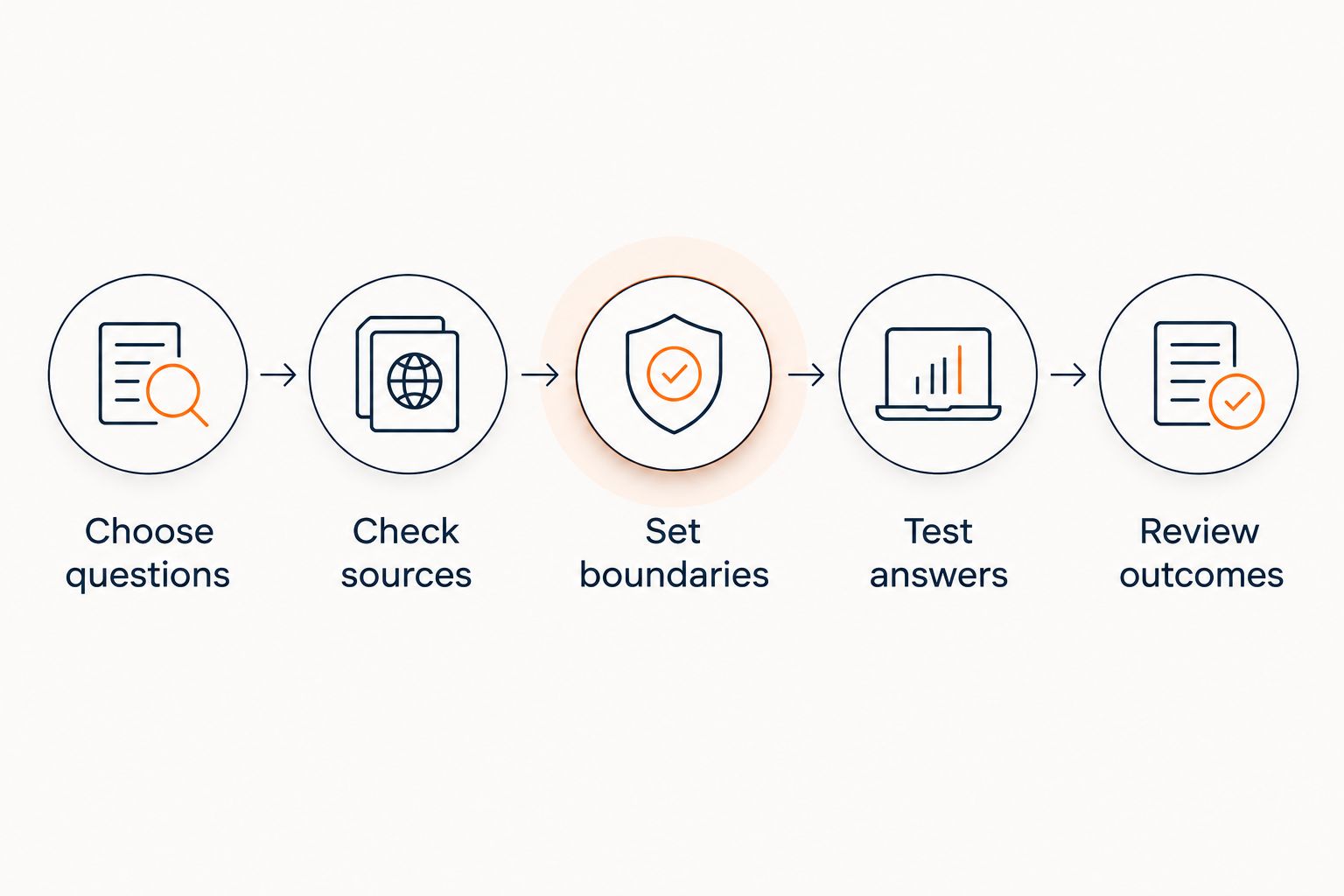
- Choose questions. Review actual support conversations and identify repeated requests with published answers. Keep account-specific cases separate.
- Check sources. Find the supporting passage, remove outdated instructions, and resolve contradictions before making the material available.
- Set boundaries. Specify which requests require a person, including exceptions and unsupported promises. Prepare clear refusal wording.
- Test answers. Ask the original questions, then challenge the response with ambiguity and requests for exceptions. Inspect the answer and its citation together.
- Review outcomes. Look for correct resolution, repeat contact, and failed handoffs. Update the source when repeated confusion exposes a documentation gap.
Do not use a successful demonstration as your entire test. A question that repeats the wording of a source is easier to answer than a member's incomplete message about being stuck.
Test the uncertain cases as well. Ask about a topic that is absent, a policy exception, and conflicting instructions. You want a clear boundary, not an answer at any cost.
Why ticket reduction varies
Ticket reduction depends on the work arriving in your inbox and the evidence available to answer it. Apply these checks to your own 2026 support conversations rather than adopting a promised reduction rate.
- Question mix: Repeated requests for published instructions fit automation better than account investigations.
- Source coverage: The chatbot needs material that actually answers the question, not merely mentions the subject.
- Source consistency: Conflicting versions leave the answer boundary unclear until you resolve them.
- Content access: Public pre-sale answers and restricted member material require different access decisions.
- Human routing: A refusal needs a usable next step when the visitor still needs help.
- Outcome tracking: Conversation endings alone cannot distinguish successful resolution from abandonment.
Treat repeated unanswered questions as an editorial queue. If members repeatedly ask something that should have a standard answer, publish that answer first. Do not expect the chatbot to supply missing operating policy.
How do you measure fewer support tickets without hiding problems?
Compare the same support categories over comparable periods. Keep program launches, enrollment changes, and changes to how members contact you visible in the review; otherwise, a change in total tickets tells you little about the chatbot's contribution.
Track these outcomes separately:
- Answered with evidence: The response addresses the question and its source supports the claim.
- Reported resolved: The visitor confirms that the answer helped, where your workflow collects that confirmation.
- Repeat contact: The visitor contacts support again about the same unresolved issue.
- Human handoff: The request reaches a person because it needs investigation or authorization.
- Unsupported answer: The response makes a claim the cited material does not establish.
Do not count an unsupported answer as a success merely because the visitor leaves. Similarly, do not classify a necessary handoff as a failure simply because it creates a ticket.
Your 2026 review should ask whether routine questions stop consuming human attention while unresolved cases still reach someone. That is a more useful standard than celebrating a smaller inbox without checking what happened to its members.
What should a chatbot say when the answer is not published?
It should identify the boundary plainly and offer the appropriate next step. A refusal should explain what cannot be established, not bury the uncertainty in a long answer.
The following are example response patterns, not claims about any coach's actual policies:
- Discount request: “I can only quote what's published. I don't have a published discount to offer.”
- Refund exception: “I can explain the published refund policy, but I can't approve an exception.”
- Income promise: “The published material does not establish an income outcome, so I can't promise one.”
- Account problem: “The instructions explain the normal process, but they don't establish what happened to your account.”
A citation should support the answer that precedes it. Linking to a policy does not make an invented exception legitimate. Read the claim and the cited passage together during review.
Where does HelpShelf fit for online coaches?
HelpShelf is best for coaches, course creators, and community owners who need chatbot answers grounded in their own content. The HelpShelf chat widget answers pre-sale and support questions with cited sources and captures leads.
That matches the repeat-question lane described here: explain what the creator has published rather than add new commitments. Its stated audience includes creators on platforms such as Kajabi, Skool, and Whop; platform-specific setup still needs its own check.
The limit matters as much as the fit. Source-grounded answers do not establish private account facts, authorize refund exceptions, or replace personal coaching judgment. Lead capture is also a separate outcome from support resolution: collecting contact details does not prove a member's problem was solved.
Evaluate HelpShelf as a support chatbot against your real questions, including the ones it should refuse. The useful demonstration is a supported answer paired with a clear boundary, not an answer to everything.
Can a chatbot replace my coaching support inbox?
No—a source-grounded chatbot can handle published answers, but account investigations and authorized decisions still need a human route. Keep that route visible and explain what happens when the chatbot cannot answer.
An inbox with fewer repetitive questions is a workable goal. An inbox that members cannot reach is not.
Will answering pre-sale questions reduce member support tickets?
Pre-sale answers can clarify published program details before purchase, but that does not establish a reduction in member support tickets. Track buyer questions, captured leads, and member support outcomes separately.
Do not turn clarification into persuasion through invented promises. The answer should help the visitor understand the published offer, including its limits.
FAQ
Can AI chatbots cut support tickets for online coaches?
Yes, AI chatbots can cut support tickets for online coaches when repeated questions have clear answers in published content. Account investigations, policy exceptions, and personal coaching decisions still need a person.
What's the best kind of question to automate first?
Start with repeated questions that a specific published passage answers. Check that the citation supports the response and that the visitor is entitled to access the material.
Can a coaching chatbot approve refunds?
A chatbot can explain a published refund policy, but that does not authorize refund approval or exceptions. Keep decisions requiring authorization with a person.
Does a citation guarantee that a chatbot answer is correct?
No, a citation does not guarantee that the answer accurately represents the source. Review the response and the cited passage together, especially for policies and promised outcomes.
How do I know whether a chatbot actually reduced support work?
Compare equivalent support categories and check resolution, repeat contact, and necessary handoffs. A lower ticket count alone does not prove that members received useful answers.
Can I use the same answers for prospects and paying members?
Use the same answer only when the content is appropriate for both audiences. Keep restricted member material separate from public pre-sale information.
Is HelpShelf relevant to coaches who sell courses or communities?
Yes, HelpShelf serves coaches, course creators, and community owners with cited answers from their own content and lead capture. Assess its fit using actual support questions and clear human-support boundaries.
One last thing
Your most useful test is a question the chatbot should not answer. Ask for an unpublished exception and check whether the response holds the boundary without leaving the visitor stranded.
A correct refusal can create a support ticket. Keep it. The point is to remove repetitive work, not the conversations that require your judgment.