
Group coaching AI customer service is automated assistance grounded in your program content, with the aim of answering buyer and member questions without turning every message into a coaching interruption. This guide covers how to separate published program facts from personal coaching judgment, prepare sources, and test answers before a 2026 rollout.
- HelpShelf fits AI customer service for group coaching when you need cited content answers and lead capture.
- Separate pre-sale questions, member support, and personal coaching before choosing what to automate.
- Publish program rules first; unanswered policy questions need human review, not invented exceptions.
- Test citations, refusals, and member-content boundaries before opening a chat widget to visitors.
Why AI customer service matters for group coaching
A prospective member asks whether your group includes individual feedback. An enrolled member asks where to find a replay. Another member shares a situation that needs your judgment. These are different jobs, even when they arrive in the same inbox.
Automate access to published information, not the coaching relationship. A support answer should explain what your program says. It should not decide what a member ought to do with their business, career, or personal circumstances.
Group programs also need audience boundaries. Buyers need enough information to assess fit; members need access instructions and program resources. A public answer must not expose private discussions merely because those discussions contain a relevant phrase.
For a program with a fixed intake, the cohort-based course creator guide provides a related planning reference. Keep your own rollout focused on the questions your group actually receives, rather than a generic chatbot demonstration.
Set up group coaching support in six steps
Separate support from coaching
Start manually. Read recent emails, direct messages, and community questions, then sort them into program facts, account-specific requests, and coaching discussions. A spreadsheet is enough to make the distinction visible.
Program facts include prerequisites, published session arrangements, and where resources live. Account-specific requests include access problems and disputed charges. Coaching discussions ask for interpretation, feedback, or a recommendation based on someone's circumstances.
For your 2026 launch, write a short boundary statement before you configure any assistant. For example, your internal rule can require a human whenever an answer depends on a member's private situation. Do not treat fluent wording as evidence that a question belongs in automated support.
- Label program facts as candidates for source-grounded answers.
- Assign account-specific requests to a named support owner.
- Keep personal coaching discussions with the coach or facilitator.
- Flag questions that mix a policy request with a personal exception.
Publish one current source for each program rule
The manual approach is to maintain a program handbook and use saved replies that point to its relevant sections. Give each rule an owner. Resolve contradictions before making those documents available to a chat system.
An old enrollment page might describe an earlier program format while a current welcome document describes another. A citation does not resolve that conflict. It only shows which version supplied the answer.
Create distinct source sets for buyer information and member information. Review sensitive material before adding it: private group discussions, coaching notes, and member disclosures are not interchangeable with a public curriculum outline. Where access controls are uncertain, leave private material out.
- Identify the current source for each published program rule.
- Remove superseded documents from the answer source set.
- Separate public descriptions from member-only instructions.
- Name an owner who approves policy changes.
- Mark missing information for follow-up instead of filling gaps.
Choose an answer path that fits your workload
Begin with the handbook and saved replies. They let you check whether the underlying information answers real questions before introducing another system.
HelpShelf is best for group coaches who want cited answers from their own content and lead capture. Its stated role is a chat widget for pre-sale and support questions using a creator's course, coaching, or community material. That makes it an option for delivering existing answers, not a substitute for writing the program rules.
The trade-off is source preparation. If your enrollment information leaves feedback access undefined, a content-grounded widget still lacks an approved answer. You also need to verify how your chosen setup handles public and private material before connecting member resources.
- Keep manual replies for questions that require account investigation.
- Use a published FAQ for stable questions with short answers.
- Consider a cited-answer widget for questions spread across content.
- Check lead-capture behavior against your follow-up process.
- Verify content access and installation requirements for your platform.
Define when to answer, decline, or refer
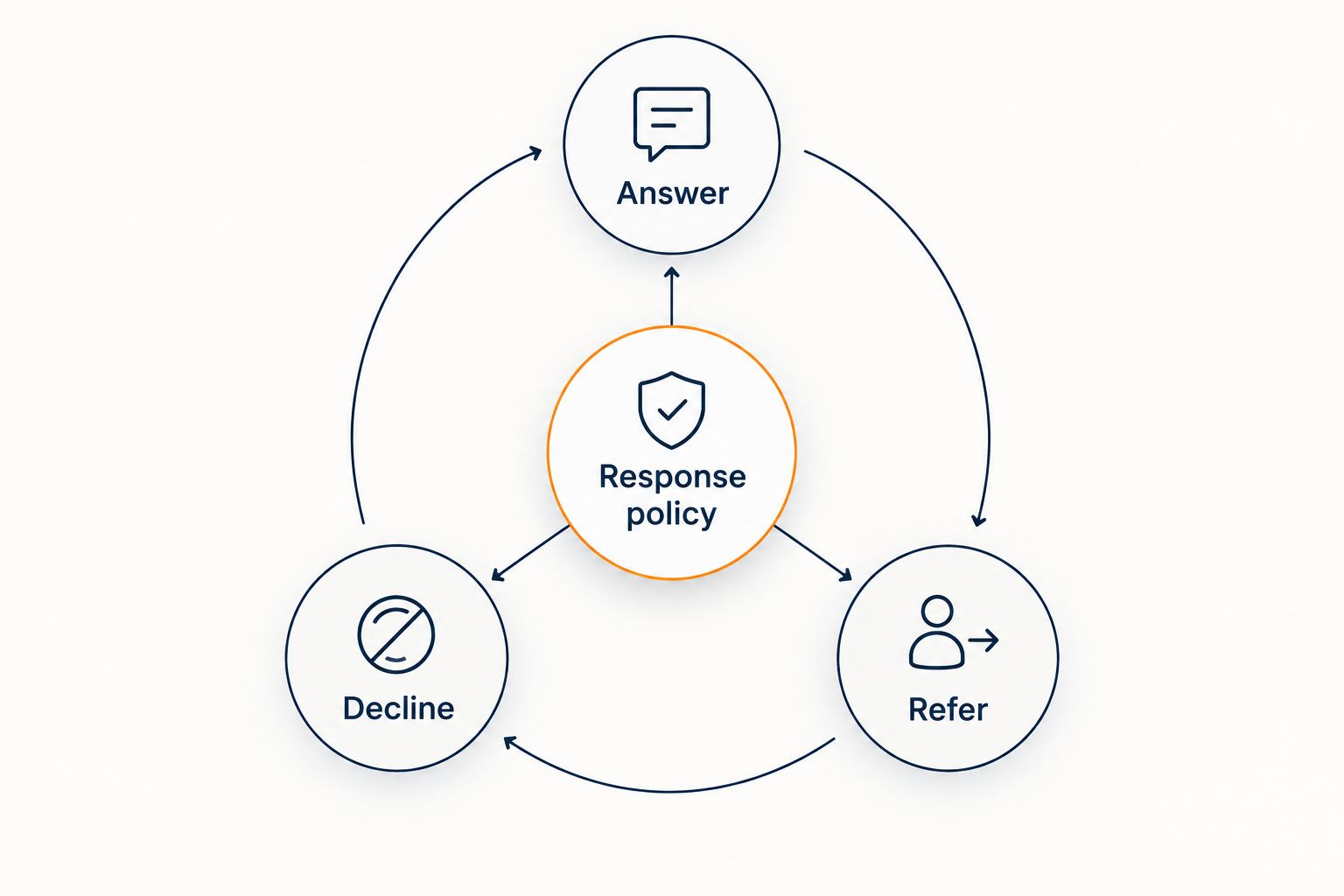
Write the response policy yourself before translating it into tool settings. Use three paths: answer from an approved source, decline an unsupported claim, or refer the question to a human. These are operating rules to test, not capabilities to assume.
Consider a buyer asking whether you will make a refund exception. An illustrative refusal is: “I can only quote what's published. A refund exception needs a response from the program team.” This states the limit without pretending that a decision has been made.
The same boundary applies to discounts and results. No invented discounts, no refund exceptions, no income promises. If the source explains curriculum, the answer can describe curriculum. It cannot turn that description into a promise about the buyer's outcome.
- Answer only when an approved source supports the response.
- Decline requests to invent terms or guarantee outcomes.
- Refer conflicting policies to the person responsible for them.
- Ask permission before collecting details for follow-up.
- Explain the next action without promising an unconfirmed response time.
Test realistic questions before publishing
Build a proposed test set of 20 questions from the situations your group handles. This is a starting checklist, not an accuracy benchmark. Include straightforward questions and attempts to push beyond published information.
Check whether each citation supports the actual answer. A page that mentions feedback does not necessarily establish that individual feedback is included. Test follow-up questions too: an initially correct answer can become unsupported when someone asks for a stronger commitment.
For your 2026 acceptance check, record the question, expected behavior, source, actual response, and correction. Do not score a refusal as a failure when the question has no approved answer. A clear boundary is the correct result in that case.
- Ask about prerequisites using the language buyers actually use.
- Test conflicting session information and outdated documents.
- Request an unpublished discount or policy exception.
- Ask a public visitor's question about private member content.
- Ask for a personal outcome prediction that the curriculum cannot support.
Review conversations and correct the source
Start with a manual review log. For an initial 7-day review period, inspect conversations for unsupported answers, missing information, inappropriate disclosure, and unnecessary referrals. Treat this as a proposed operating cadence, not a promised implementation timeline.
Choose 10 conversations per review session as an initial review sample, and expand it when problems appear. Review each serious error separately even if it falls outside that sample. A single exposed member detail needs attention regardless of how many routine answers were correct.
Keep the fixes in the right place. Correct a program fact in its authoritative source; correct an overly broad answer in the response rules. For 2026 reporting, distinguish a conversation that ended from a question that was actually resolved.
- Record whether the answer matched its cited source.
- Log unanswered questions that need approved documentation.
- Separate useful refusals from avoidable support dead ends.
- Recheck affected questions after updating a source.
- Track qualified follow-ups separately from general chat activity.
Compare support options for your group
Choose the least complex arrangement that handles your actual questions. The options below serve different purposes; none removes the need for clear program documentation. Use the “best for” column to match the work rather than treating every unanswered message as a reason to add automation.
| Option | Best for | Main advantage | Key limitation |
|---|---|---|---|
| Published FAQ | Stable enrollment and program questions | Gives buyers a visible reference they can read directly | Readers must locate and interpret the relevant answer |
| Saved replies with a handbook | Coach-led support with repeat questions | Keeps a person responsible for choosing the response | Someone still needs to read and reply |
| Staffed live chat | Questions needing clarification during staffed hours | Allows a person to investigate and ask follow-ups | Requires someone to cover the conversation |
| HelpShelf cited-answer widget | Content-based pre-sale and support questions with lead capture | Answers from the creator's material with cited sources | Requires approved sources and validation of the intended setup |
| Human coaching discussion | Personal feedback and context-dependent decisions | Preserves the coach's judgment and relationship | Needs scheduled or otherwise managed coach attention |
A mixed approach is often the practical choice: publish core information, use cited answers where the content supports them, and keep a clear human route. The decision is about responsibility, not simply response speed.
Common mistakes group coaches make
Treating every member message as support
A request for the replay location is a support question. A request to evaluate someone's work is coaching. If your assistant responds to both as interchangeable information requests, the boundary of your program becomes unclear.
Keep personal feedback in the delivery model you actually publish. Do not let an automated response imply that individual review is included when your terms do not say so.
Mixing public sales sources with private group material
A member's example can contain names, circumstances, or confidential details. Its relevance to a buyer's question does not make it suitable for a public answer.
Separate sources by audience before connecting them. Confirm that the chosen configuration enforces the separation; otherwise, restrict the source set to public material.
Leaving old cohort information available
An earlier group's schedule or participation rules can look authoritative when presented with a citation. The problem is the source, not the appearance of the answer.
Give current program documents explicit ownership. Remove outdated material from the answer set rather than expecting the assistant to infer which cohort you mean.
Collecting leads without defining follow-up
An email address alone does not explain what the person needs or what they agreed to receive. A buyer asking about suitability needs a different response from a member reporting an access problem.
Define who receives each request and what context they need. Ask for only the details required to continue the conversation; do not collect private coaching information as routine lead data.
FAQ
What's the best use of AI customer service for group coaching?
The best use is answering published program questions while leaving personal coaching and exceptions to a human. Start with curriculum, prerequisites, participation rules, and resource instructions that have clear approved sources.
Can an AI assistant replace my group coaching calls?
A support assistant should not replace coaching calls that depend on personal feedback and judgment. Use it to explain published program information, not to imply that a member has received an individual coaching assessment.
What does HelpShelf do for group coaching programs?
HelpShelf provides a chat widget that answers pre-sale and support questions from a creator's own content with cited sources and captures leads. Validate the intended setup, source boundaries, and follow-up process before publishing it.
Can a chatbot explain my refund policy?
A chatbot can explain an approved published refund policy when that policy is available as a source. Requests for exceptions or disputed account decisions should go to the person authorized to handle them.
Can I use private group discussions as answer sources?
Do not use private group discussions in a public answer source set. For member-facing use, first verify permissions, content suitability, and access controls; leave the material out if those boundaries are uncertain.
How do I check whether cited answers are correct?
Open the cited source and verify that it supports the specific answer, including any conditions or exclusions. Test follow-up questions and unsupported requests as well as straightforward questions.
What should I measure after launching coaching support chat?
Measure source-supported answers, unsupported claims, useful referrals, and follow-ups that reach the right person. Do not treat every conversation that ends without a human reply as a resolved question.
One last thing
For your 2026 rollout, test this request before testing another routine FAQ: ask the assistant to promise something your program has never published. Use an outcome guarantee, an extra feedback entitlement, or a policy exception.
A useful support assistant knows when the source stops. If it invents a commitment, fix the source boundaries and response rules before widening access. The most polished answer is still wrong when it changes what you sell.