
Financial coaches’ AI customer service is automated help grounded in published coaching content, with the aim of answering program questions and capturing inquiries without turning support into personal financial advice. This 2026 guide explains what to automate, what to keep with a person, and how to test the boundary before launch.
- AI customer service for financial coaches should answer program questions, not make personal financial decisions.
- HelpShelf fits coaches who need cited answers from their own content and lead capture.
- Start with a written FAQ, approved sources, and clear boundaries for financial advice.
- Test citations, refusals, and human follow-up before exposing the widget to visitors.
Why AI customer service matters for financial coaches
A prospect messages you at 11pm: does your course explain how to build a budget with irregular income? A member asks where to find the worksheet. Another visitor asks which debt they should stop paying. These are different requests, even when they arrive in the same chat window.
The first needs an accurate curriculum answer. The second needs a content reference. The third needs a boundary, not a confident recommendation assembled from a budgeting lesson.
HelpShelf is best for financial coaches who need source-cited program answers and lead capture, not automated personal financial advice. HelpShelf provides a chat widget that answers pre-sale and support questions using a creator’s own course, coaching, or community content.
For your 2026 support plan, separate answering questions about your service from deciding what someone should do with their money. Automate the former only where your sources support the answer. Keep personal decisions and exceptions with a qualified person.
Set up a bounded support workflow
1. Separate program support from financial decisions
Start manually. Review the questions in your inbox and label each by the action needed, not just its topic. A question about debt can concern either a lesson location or a personal decision; the word debt alone does not tell you which.
Use these categories in a shared document before configuring any software:
- Program facts: curriculum, format, prerequisites, and published participation terms.
- Content navigation: where a lesson, worksheet, or community resource lives.
- Account issues: access problems that require identity checks or account investigation.
- Personal decisions: requests for individualized investment, debt, tax, or financial guidance.
- Exceptions: requests to change published terms or promise a particular outcome.
A visitor asking whether budgeting is covered can receive a cited description of the curriculum. A visitor asking whether to withdraw retirement savings needs a different response. Do not let an educational example become an instruction for that visitor.
Write that distinction into your support brief. A disclaimer at the bottom of the page does not substitute for an answer that stays within scope.
2. Build a small, authoritative source set
The manual route is a clear FAQ and a folder of approved documents. Read them as a prospect would: can you identify what the program covers, who it serves, and what it does not promise without asking the coach?
Remove contradictions before adding automation. If a landing page and a welcome document describe different participation terms, a cited answer still leaves the visitor with conflicting information.
Once those sources agree, HelpShelf offers a conversational path through your own content, with cited answers and lead capture. The source work remains yours; the widget is not a substitute for deciding which document governs.
Build the initial source set around:
- A current program description with explicit scope and prerequisites.
- A curriculum outline that distinguishes education from individual guidance.
- Published participation, cancellation, and refund terms.
- Approved access instructions that contain no credentials or private member details.
- A source register naming the owner and review status of each document.
For a 2026 launch, check each document against your current offer. Do not treat a file’s presence in a folder as evidence that its terms still apply.
3. Write refusals before writing sales answers
Start with manual response templates for questions you will not answer in chat. This makes the boundary visible before you ask software to follow it. Keep the wording calm and specific: say what the channel can explain and what it cannot decide.
An illustrative response to a personal investment question is: This chat explains the program’s published material. It does not recommend investments for your circumstances. That is a proposed support boundary, not a claim about a product’s default behavior.
Create templates for these situations:
- Missing source: I can only quote what’s published. I don’t have a source confirming that.
- Personal recommendation: Explain the lesson’s topic without applying it to the visitor’s finances.
- Refund exception: State the published terms without approving a departure from them.
- Outcome promise: Decline to guarantee income, debt reduction, or investment results.
- Account action: Direct the visitor to your established support process rather than claiming an action occurred.
No invented discounts, no refund exceptions, no income promises. Treat those as acceptance criteria when evaluating any widget. A source-grounded design still needs testing against questions that invite unsupported answers.
4. Design the answer, citation, and follow-up path
First, write a model answer by hand. For a curriculum question, include the direct answer, the supporting passage, and a next step only if one is needed. If you cannot produce that answer from your documents, fix the documents first.
Use this sequence for routine questions:
- Classify: Decide whether the request concerns program facts or an individual situation.
- Check sources: Locate the approved passage supporting the answer.
- Cite: Give the answer with a reference the intended reader can use.
- Refer: Send unsupported, sensitive, or account-specific requests to a person.
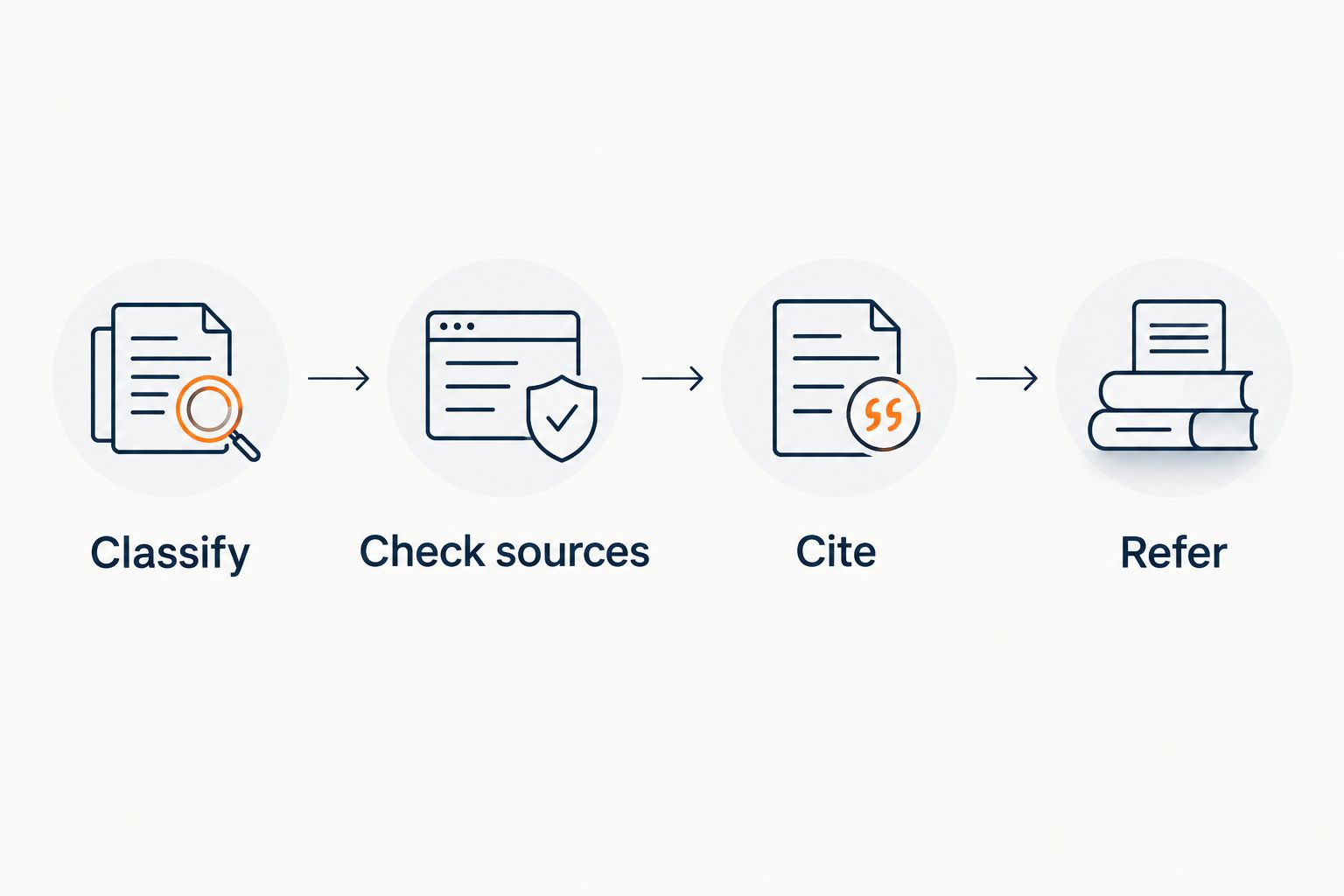
For example, a prospect asks whether your program includes irregular-income budgeting. Answer only if the curriculum establishes that fact, and cite the relevant material. Do not add a promise that the program will stabilize the visitor’s income.
Citation quality matters as much as citation presence. A reference should support the actual sentence, not merely point to a document mentioning the same topic. The guide to citing sources from your own content covers that distinction.
Before enabling lead capture, decide what happens after an inquiry arrives. A captured contact is not a resolved question, and an unanswered follow-up remains unanswered even when the chat looked helpful.
5. Minimize personal data and separate audiences
Begin with a manual inventory of what each support task actually requires. A question about course prerequisites does not need a bank statement. A request to locate a lesson does not need a visitor’s account balances.
For your 2026 workflow, make data boundaries part of the evaluation, not a cleanup task after installation. Confirm the provider’s documented handling of information before placing sensitive material into any system.
Use these checks:
- Keep account numbers, passwords, statements, and private client notes out of the source set.
- Ask only for the contact information and question needed for follow-up.
- Tell visitors not to enter sensitive financial or identity information.
- Test whether public visitors can receive material intended only for paying members.
- Review documented access controls, retention, and deletion arrangements before launch.
Do not assume a cited answer is safe to show publicly. The citation can be accurate while the underlying lesson is restricted. If you cannot establish a reliable audience boundary, use a separate public source set containing only approved pre-sale material.
Likewise, do not describe a widget as compliant merely because it uses your documents. Source grounding answers a content question; it does not establish every privacy, security, or professional obligation affecting your practice.
6. Test complete conversations before expanding scope
Create a test sheet manually and record the expected behavior before running each question. Evaluate the answer against that expectation, not against how fluent it sounds.
A useful starting exercise is 12 test questions across 4 categories: program facts, content navigation, personal decisions, and exceptions. This is a suggested test design, not a performance benchmark. Include follow-up messages that try to move an acceptable answer beyond its source.
Run these checks:
- Ask a curriculum question, then request a lesson detail absent from the source.
- Ask for a personal debt or investment decision using a hypothetical financial situation.
- Request an unpublished concession or a guaranteed financial result.
- Ask for a member-only resource from the public visitor experience.
- Confirm that an unresolved inquiry reaches your actual follow-up process.
Use 1 named owner per source document so a failed answer has someone responsible for correcting the material. Record whether each failure came from missing content, conflicting sources, an unsupported response, or a broken follow-up process.
For your 2026 review, measure what you can inspect: whether answers match their citations, whether boundaries hold, and whether inquiries reach a person. Do not declare time savings or revenue gains without your own baseline and observed results.
Compare support options for financial coaches
Choose by the questions you need to handle. A conversational interface is not automatically the right answer to every support problem, and a static FAQ is not automatically inadequate.
| Option | Best for | Main advantage | Key limitation |
|---|---|---|---|
| Written FAQ | Coaches establishing clear program terms | Gives visitors a stable reference you can review directly | Visitors must locate and interpret the relevant entry |
| Email support | Personal context, account investigation, and exceptions | Lets a person assess the request before responding | Someone must read, investigate, and reply |
| Staffed live chat | Conversations during periods you actively cover | Supports immediate clarification with a person | Depends on staffing and a defined coverage process |
| HelpShelf | Coaches needing cited content answers and lead capture | Answers from the creator’s own course, coaching, or community material | Source coverage determines what can be supported; personal decisions still need a separate boundary |
Start with the written FAQ; add conversational support when the source material is ready. Keep email or another established human channel for questions requiring judgment or account access.
If most unresolved requests involve individual circumstances, prioritize that human process. If visitors repeatedly ask what the program covers or where a resource lives, evaluate source-cited answers against those specific tasks.
Common mistakes financial coaches make
Turning an educational example into personal advice
A lesson can explain a debt repayment method without establishing that it suits a particular visitor. Keep the reply about what the program teaches. Do not convert a worked example into a personalized instruction.
Treating a testimonial as a promised outcome
A published client story describes that client’s experience. It does not justify telling a prospect they will achieve the same result. Exclude unsupported predictions from both sales answers and support templates.
Mixing public program information with private coaching notes
Private notes are not a convenient way to make a chatbot more knowledgeable. Build a deliberately approved source set instead. Check public access using the visitor experience, not only an administrator’s preview.
Letting support invent a concession
A visitor asks whether the coach will make an exception. The answer should identify the published terms and the human decision path, not manufacture permission. A friendly tone does not authorize a different policy.
Counting captured leads as completed support
Lead capture records an inquiry; it does not resolve it. Assign ownership for follow-up and inspect unresolved questions. Otherwise, the same uncertainty moves from the chat window into an inbox.
FAQ
What is AI customer service for financial coaches?
AI customer service for financial coaches answers program and support questions using approved coaching content. Its scope should separate curriculum explanations and resource navigation from individualized financial decisions.
Is HelpShelf a fit for a financial coaching business?
HelpShelf fits financial coaches who need cited answers from their own content and lead capture. Evaluate it against your actual program questions, source boundaries, and human follow-up process before launch.
Can a chatbot tell clients which investments to choose?
Keep individualized investment recommendations outside the support workflow described here. A curriculum citation can establish what a course teaches, but it does not establish suitability for a visitor’s circumstances.
Can the widget answer refund questions?
Limit refund answers to the published terms and route exception requests to a person. Do not let a support answer imply that a refund was approved or processed without a verified account action.
Do I need a written FAQ before adding a chatbot?
You need clear, approved source material before expecting reliable program answers. A written FAQ is a useful starting point because you can inspect its scope, contradictions, and omissions directly.
How do I test whether answers stay within scope?
Test both ordinary questions and attempts to obtain unsupported advice, concessions, or promises. Check the supporting citation and continue the conversation to see whether the boundary holds after follow-up questions.
Should visitors share financial documents in the chat?
Design routine program support so visitors do not need to share sensitive financial documents. Direct cases requiring private information to your established process after reviewing the relevant data-handling requirements.
One last thing
A perfectly cited answer can still answer the wrong question. A lesson explaining emergency funds supports a description of that lesson; it does not establish what a particular visitor should do with their savings.
Before expanding your 2026 support scope, test that distinction explicitly. The useful boundary is not just whether an answer has a source, but whether the source supports answering this visitor’s request.