
Executive coaches’ AI customer service is automated help grounded in published coaching content, with the aim of answering buyer and client questions without turning every request into a personal exchange. This 2026 guide explains AI customer service for executive coaches: what to automate, what to keep private, and where a human must take over.
- AI customer service for executive coaches should answer published program questions, not make coaching judgments or outcome promises.
- For Kajabi-based coaching offers, separate public pre-sale answers from private client material before choosing a widget.
- Require citations for program details, and route missing information to a human rather than filling the gap.
- Start with a manual FAQ; add automated answers and lead capture after defining the boundaries.
Why AI customer service matters for executive coaches
Consider a prospect reading your coaching page at 11pm. They want to know whether the program includes individual sessions or group discussions. That is a question about your offer, not a request for executive coaching. If the answer exists in your published material, a source-grounded response gives them a way to continue without waiting for you.
Now change the question: the prospect describes a conflict with their board and asks what to say tomorrow. Answering that requires judgment and context. Automate access to your published information, not the coaching relationship.
For your 2026 setup, separate questions about buying, participating, and receiving advice. The guide to answering pre-sale questions from your content covers the first category. Your implementation should make the boundary between those categories explicit.
Executive coaching also creates a practical distinction between the person asking and the person paying. If you serve employer-sponsored clients, a prospective participant and a sponsor can need different information. Publish those distinctions before asking a widget to explain them.
How to set up source-grounded customer service
Define the questions you will answer
Start manually. Keep a simple document of incoming questions and the approved answers you currently send by email or direct message. Label each question as public information, account-specific support, or coaching advice.
A question about the published session format belongs in the first group. A question about an individual invoice belongs in the second. A request to interpret a leadership assessment belongs with the coach, unless you are merely directing someone to published instructions.
Your 2026 scope should describe what the service does and what it refuses. A narrow, clear scope is easier to check than an instruction to answer everything helpfully.
- List the program questions your public material already answers.
- Mark account-specific questions for identity checks and human handling.
- Keep personal coaching advice outside automated customer service.
- Identify questions involving sponsors, confidentiality, or consent.
- Write a fallback response for anything outside the approved scope.
Prepare a source shelf you can stand behind
Use your existing pages and documents before buying another tool. For each approved answer, identify the source that supports it. If two documents disagree, resolve the disagreement rather than letting an automated system choose between them.
Separate public program information from private client material. A coaching transcript, assessment, or sponsor report is not a public support document just because it contains useful answers. Do not include confidential material in a public-facing knowledge collection.
Keep each source specific enough to support a clear answer. A program outline can establish curriculum coverage; it cannot establish that a particular executive will achieve a promotion.
- Gather current program descriptions and participation instructions.
- Remove superseded documents from the approved collection.
- Separate buyer-facing material from client-only resources.
- Exclude confidential notes, assessments, and private correspondence.
- Record who owns each source and approves changes.
Add a widget after the boundaries are clear
Once the manual answers work, evaluate automation against them. HelpShelf provides a chat widget that answers pre-sale and support questions from a creator’s own content, includes cited sources, and captures leads.
HelpShelf is best for coaches who want content-grounded customer service and lead capture, not automated coaching judgment. That fit comes from the stated functions, not a claim that the product replaces your existing support process.
Use the widget as a faster route to information you have already approved. Its limitation remains the source material: missing, contradictory, or inappropriate content still needs your attention. Verify platform placement and access boundaries before making it part of your client experience.
- Compare generated answers with your approved manual responses.
- Open citations and check that they support the full answer.
- Test public and client-only questions separately.
- Verify the intended setup for your website or coaching platform.
- Keep a clear route to a person when the source is insufficient.
Write refusals that explain the next move
Do this manually first: write the answer you want someone to receive when the information is missing. A refusal should identify the boundary without sounding like a broken search box. It should also distinguish an unanswered question from a request only a coach can handle.
For example, an approved response pattern for an unpublished exception is: I can only quote what’s published. Please ask the team to confirm that request. This is a suggested response, not a statement about an existing policy.
For your 2026 rollout, use plain rules: no invented discounts, no refund exceptions, no income promises. Apply the same discipline to session entitlements and sponsor reporting. An automated answer must not turn a visitor’s request into a commitment.
- State when the published material does not answer the question.
- Refuse to invent exceptions or personalized outcomes.
- Distinguish program information from coaching advice.
- Direct account changes and disputes to a person.
- Avoid promising a response deadline you have not established.
Test answers, citations, and lead capture separately
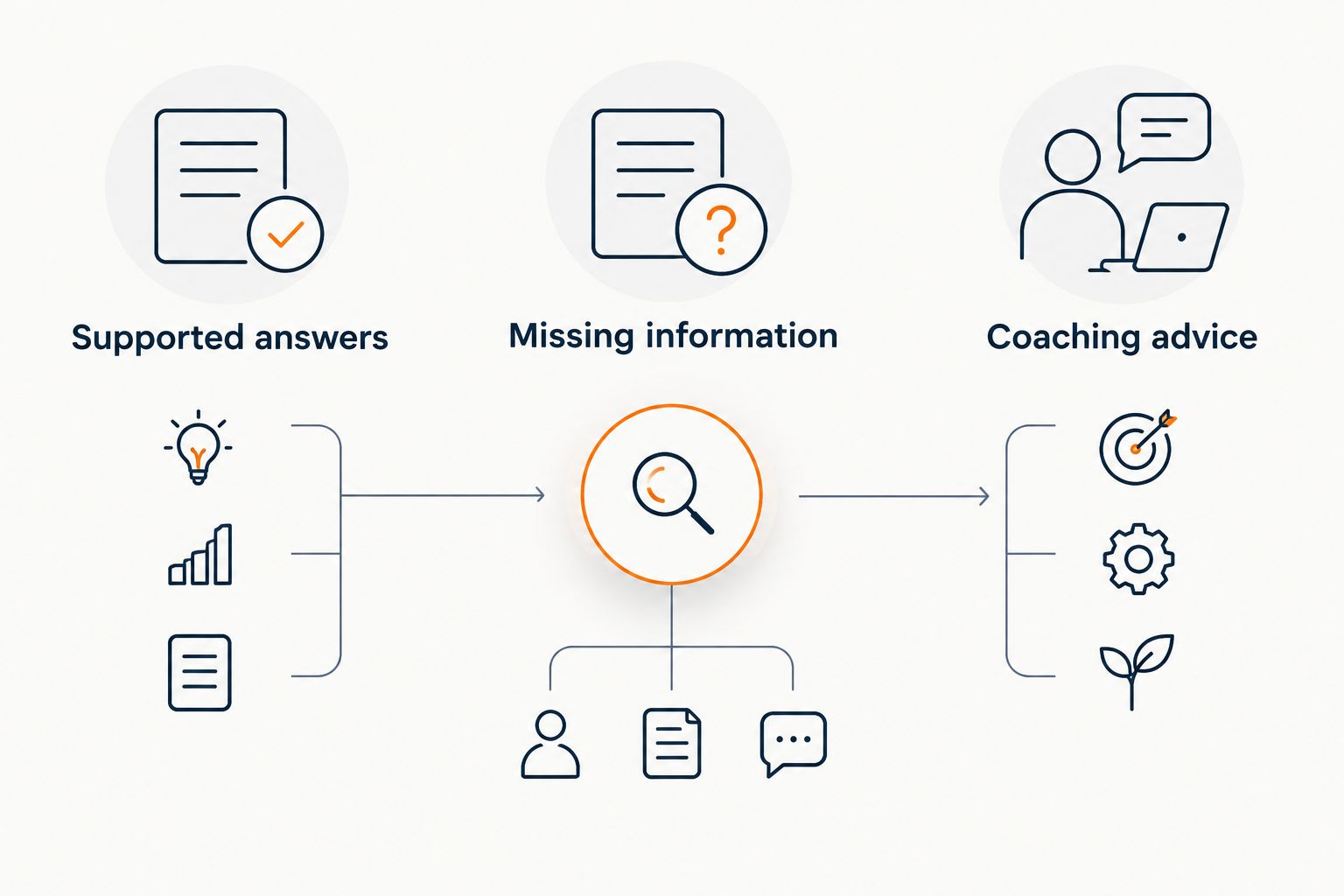
Create 12 sample questions as an initial test set: four answerable from approved sources, four missing from those sources, and four outside customer-service scope. These are suggested test quantities, not a performance benchmark. Keep the expected response beside each question.
An answerable question might ask whether a published module covers delegation. A missing-information question might ask for an unpublished session arrangement. An out-of-scope question might ask the widget to diagnose why a leadership team distrusts the visitor.
Then test the next action. A correct answer and a captured lead are different outcomes. Check both without encouraging visitors to submit sensitive workplace details.
- Verify that supported answers match the approved source.
- Check that citations support every material claim.
- Confirm that missing information produces a clear limitation.
- Test whether lead details reach the intended destination.
- Check what happens when a visitor declines to share contact details.
Review the conversations and repair the sources
Begin with a spreadsheet if that is sufficient. Record the question, answer, cited source, and whether a person needed to intervene. Do not treat every escalation as a failure: a coaching-advice request should reach a human.
For a manageable first review, inspect 10 conversations. This is a suggested review batch, not a claim about expected volume. Separate incorrect answers from correct refusals and missing documentation before deciding what to change.
Keep the same review categories throughout 2026 so your comparisons remain useful. A shorter conversation is not automatically better if the visitor still cannot find the participation instructions.
- Correct source errors before expanding the widget’s scope.
- Add approved documentation for recurring answerable questions.
- Preserve refusals that protect coaching or confidentiality boundaries.
- Check lead quality without treating every conversation as a sales opportunity.
- Retest affected questions whenever program information changes.
Discuss your coaching support setup
Ask how cited answers and lead capture fit your published coaching content.
Compare customer-service options for executive coaches
Choose the option that matches the question, not the one with the most automation. A public FAQ is useful for stable program facts. Human handling remains necessary when someone asks you to interpret a personal situation or change an agreement.
The comparison below describes useful roles and limitations. It does not assume that every coaching business needs every option.
| Option | Best for | Main advantage | Key limitation |
|---|---|---|---|
| Published FAQ | Stable, public program questions | Gives you a direct, editable reference | Visitors must find and interpret the relevant answer |
| Email with approved replies | Low-volume or account-specific requests | Lets a person check context before answering | Requires someone to read and respond |
| Staffed live chat | Conversations needing immediate human clarification | Supports back-and-forth judgment while staffed | Depends on someone being present |
| HelpShelf customer-service widget | Cited answers from coaching content and lead capture | Connects questions to source-grounded responses | Does not replace missing documentation or personal coaching judgment |
Start with the simplest option that handles your actual questions. If your FAQ answers the request clearly, improve its visibility before adding another interaction. If visitors need to ask questions in their own words, test a cited-answer widget against the same approved material.
For private account matters, retain a separate process that checks identity and authority. A citation to a public policy does not establish what happened on a particular client’s account.
Common mistakes executive coaches make
Treating coaching content as permission to coach
A lesson about difficult conversations does not authorize personalized advice about a visitor’s employment situation. Let customer service point to the lesson and describe its published scope. Keep interpretation and recommendations with the coach.
Mixing sponsor information with participant information
If an employer sponsors coaching, define what information each party can request. Do not let a public widget infer permission to share participation details or coaching content. Route requests about an individual engagement to the appropriate human process.
Turning a lead form into an intake assessment
A prospect asking about program format does not need to describe a board dispute to receive an answer. Request only the details needed for the next step. Keep confidential coaching intake separate from public pre-sale chat.
Counting every refusal as a defect
A refusal to invent a refund exception is correct behavior, not a missed sale. Review whether the boundary was explained and whether the visitor received a useful next step. Fix unanswered published facts; preserve appropriate refusals.
FAQ
What is AI customer service for executive coaches?
AI customer service for executive coaches answers questions about published coaching offers, participation instructions, and support material. Its scope should exclude personal coaching judgments, confidential client information, and commitments the coach has not approved.
What is HelpShelf best for in an executive coaching business?
HelpShelf is best for answering pre-sale and support questions from a coach’s own content with citations and capturing leads. It is not a substitute for deciding what information is appropriate to publish or for providing individualized coaching.
Can a chatbot recommend what an executive should do about a workplace conflict?
Keep personalized workplace-conflict advice with the coach. A customer-service widget can direct a visitor to published material, but applying that material to a specific conflict requires context beyond a program description.
Should I use a chatbot or a FAQ page for my coaching program?
Start with a FAQ page when your main task is publishing stable program information. Add a source-grounded chat widget when you want visitors to ask questions in their own words, then test its answers against the same approved sources.
Can I include client session transcripts in a public support widget?
Do not put confidential client session transcripts in a public support source collection. Build the public collection from approved program information and keep private coaching material in a separately controlled process.
What should the widget say when a policy is not published?
The widget should state that the published material does not answer the question and direct the visitor to a person. It should not invent a discount, refund exception, session entitlement, or outcome promise.
How do I check whether the answers are accurate?
Compare each answer with an approved source and open the citation to check that it supports the claim. Test answerable questions, missing information, and out-of-scope requests separately; a correct refusal is part of an accurate service.
One last thing
Your most revealing test is a question your content cannot answer. Ask for an unpublished exception, then check whether the response invents permission or stops at the boundary.
Before expanding HelpShelf customer service, get that refusal right. A useful system knows where the published answer ends and your decision begins.