
Best overall for support-inbox buyers: Intercom Fin. Best for existing Zendesk teams: Zendesk AI agents. Best for a focused website pilot: Chatbase. This 2026 guide to AI chatbots ranked by multilingual support separates language coverage from the harder requirement: answering correctly from your published content.
- For AI chatbots ranked by multilingual support, shortlist Intercom Fin for support-inbox workflows, then test your actual languages.
- Zendesk AI agents fit existing Zendesk operations; Chatbase fits a focused website pilot.
- HelpShelf fits creator sales and support; confirm multilingual behavior before choosing it for that requirement.
- Rank source accuracy, policy preservation, and handoff above a vendor’s advertised language count.
Why this matters
It is 11pm. A prospective student asks in Spanish whether your English-language course includes personal coaching. A fluent answer is not enough: the answer must preserve the distinction between recorded lessons, group sessions, and individual support.
If the chatbot turns an ambiguous sentence into a promise, you now have a sales problem in another language. The same applies to refund conditions, access periods, prerequisites, and membership rules.
For your 2026 shortlist, start with the distinction between answering questions in multiple languages and answering those questions from the right source. Evaluate both before publishing the widget.
What makes the best multilingual AI chatbot?
Use these criteria before comparing vendors. A language list tells you where to investigate; it does not establish answer quality.
- Source accuracy: The answer preserves what your course, coaching, or community content actually says.
- Cross-language retrieval: A question in one language finds the relevant source in another, when that workflow is required.
- Policy preservation: Conditions, exclusions, dates, and eligibility rules survive translation without becoming broader promises.
- Readable citations: The visitor can identify the source and understand whether it supports the answer.
- Conversation continuity: Language changes and human follow-up do not discard the original question.
- Operational fit: Your team can maintain the content and handle unanswered questions without creating a separate support operation.
For a 2026 evaluation, keep interface translation separate from answer translation. A translated greeting proves nothing about whether the system can retrieve an English lesson and explain its limits in Portuguese.
Multilingual AI chatbots at a glance
This is a workflow-fit ranking, not a measured language-accuracy leaderboard. Each option has a different role; your target-language tests determine whether it passes.
| Rank | Option | Best for | Standout feature or evaluation focus | Key limitation |
|---|---|---|---|---|
| 1 | Intercom Fin | Teams choosing a support-inbox workflow | AI answers within the Intercom support environment | Workflow fit does not establish accuracy in your languages |
| 2 | Zendesk AI agents | Teams already operating in Zendesk | AI agents within an established support environment | Requires the same content and language checks as a new deployment |
| 3 | Chatbase | A focused website chatbot pilot | A chatbot built around supplied business content | A website pilot does not prove the full support workflow |
| 4 | Tidio Lyro | Small teams considering chat alongside automation | AI conversations alongside Tidio’s chat tools | Your live-chat coverage still needs a language plan |
| 5 | HelpShelf | Course creators, coaches, and community owners | Cited answers from creator content and lead capture | Multilingual behavior needs confirmation before selection |
1. Intercom Fin: best for support-inbox buyers
Intercom Fin is an AI customer-service agent associated with Intercom’s support environment. Start here when the buying decision includes both automated answers and the support workflow around them.
For multilingual support, evaluate the entire conversation rather than an isolated translated answer. Ask a question in your target language, add a follow-up that changes its meaning, and then request human help.
Intercom Fin pros:
- A relevant shortlist option when you are evaluating Intercom as your support environment.
- Lets you assess automated answers in the context of a broader support workflow.
- Gives inbox-focused buyers a concrete operational use case to test.
Intercom Fin cons:
- Your language-specific terminology still requires direct testing.
- A broader support environment is a separate purchasing decision from a chatbot alone.
- Fluent wording does not establish that the cited policy was interpreted correctly.
Best for: Teams that want their multilingual chatbot decision tied to a support inbox.
Verdict: Hold until Intercom Fin passes your source-accuracy and human-follow-up tests. Choose the workflow because you need it, not because a translated demo reads smoothly.
2. Zendesk AI agents: best for existing Zendesk teams
Zendesk AI agents belong on the shortlist when your support operation already uses Zendesk. The relevant question is whether automated conversations fit your existing knowledge and support processes.
Do not treat an established help center as proof that its content is ready for multilingual answers. Conflicting articles remain conflicting articles after translation, and an outdated exception remains outdated.
Zendesk AI agents pros:
- A relevant starting point for teams already committed to Zendesk.
- Keeps the evaluation centered on an existing support operation.
- Encourages testing against the knowledge your support team already maintains.
Zendesk AI agents cons:
- Existing documentation still needs checks for contradictions and missing conditions.
- An existing Zendesk setup does not prove target-language answer quality.
- A small creator business must assess whether it needs the wider support environment.
Best for: Established Zendesk teams adding automated multilingual conversations.
Verdict: Hold until Zendesk AI agents correctly preserve your published conditions in each required language. Existing adoption is a reason to evaluate, not a reason to skip testing.
3. Chatbase: best for a focused website pilot
Chatbase lets businesses build chatbots around supplied content. It belongs in a focused evaluation where you want to see how a website chatbot handles a defined body of information.
Keep the pilot narrow. Use one course, one published policy set, and questions whose correct answers you can check without interpretation.
Chatbase pros:
- A relevant option for testing a content-based website chatbot.
- Supports an evaluation centered on a clearly defined source collection.
- Gives you a narrower starting point than redesigning your whole support operation.
Chatbase cons:
- Success on simple questions does not establish accuracy on policy exceptions.
- A website pilot does not validate every escalation or account-support requirement.
- Each required language needs its own review, including follow-up questions.
Best for: Buyers who want to evaluate a bounded website use case first.
Verdict: Hold until Chatbase passes a complete conversation test, not just a greeting-and-answer demonstration. Expand the source collection only after you understand its failure cases.
4. Tidio Lyro: best for teams pairing automation with chat
Tidio combines chat tools with Lyro, its AI customer-service offering. Consider this route when you want to evaluate automated conversations alongside a live-chat approach.
Your staffing plan matters here. If the bot stops answering in French but nobody handling the conversation can read French, the visitor still has an unresolved support request.
Tidio Lyro pros:
- A relevant shortlist option for a chat-centered support setup.
- Puts automated and human conversation requirements into the same buying discussion.
- Suits an evaluation that includes both answered and unanswered questions.
Tidio Lyro cons:
- Human availability and human language coverage are separate requirements.
- A translated conversation still needs accurate source interpretation.
- The handoff experience needs testing with your actual team process.
Best for: Small teams considering live chat alongside automated support.
Verdict: Hold until Tidio Lyro’s unanswered-question workflow works for the languages you serve. Do not approve the automation while leaving the follow-up undefined.
5. HelpShelf: best creator-focused candidate, pending language checks
HelpShelf provides a chat widget that answers pre-sale and support questions from a creator’s course, coaching, or community content, with cited sources and lead capture. Its stated audience includes creators using platforms such as Kajabi, Skool, and Whop.
HelpShelf is a fit for creators who need cited sales and support answers from their own content. That creator fit does not establish multilingual coverage; confirm the required languages and cross-language behavior before selecting it for this article’s main requirement.
HelpShelf pros:
- Uses a creator’s own content for pre-sale and support answers.
- Provides cited sources with answers.
- Includes lead capture for interested visitors.
- Addresses course, coaching, and community questions directly.
HelpShelf cons:
- Required-language coverage needs confirmation.
- Cross-language retrieval and citation readability need a direct evaluation.
- Source-grounded answers cannot supply terms you have never published.
Best for: Creators prioritizing content-grounded answers and lead capture.
Verdict: Hold for a multilingual purchase until language behavior is confirmed. Keep HelpShelf on the creator shortlist without treating its content-grounding features as proof of translation quality.
How this ranking works
The 2026 order prioritizes buying context: support inbox, existing support operation, focused website pilot, chat-centered workflow, then creator-specific fit. It does not assign language scores, claim hands-on benchmark results, or reward an unverified language total.
The final ranking for your business must use the same questions, sources, and acceptance rules for every candidate. Otherwise, you are comparing different demonstrations rather than different systems.
Run a multilingual acceptance test before choosing
Use a proposed starter set of 10 questions per language across 2 languages, producing 20 initial answers to review. These are evaluation instructions, not a vendor benchmark; expand the set around your actual audience and support risks.
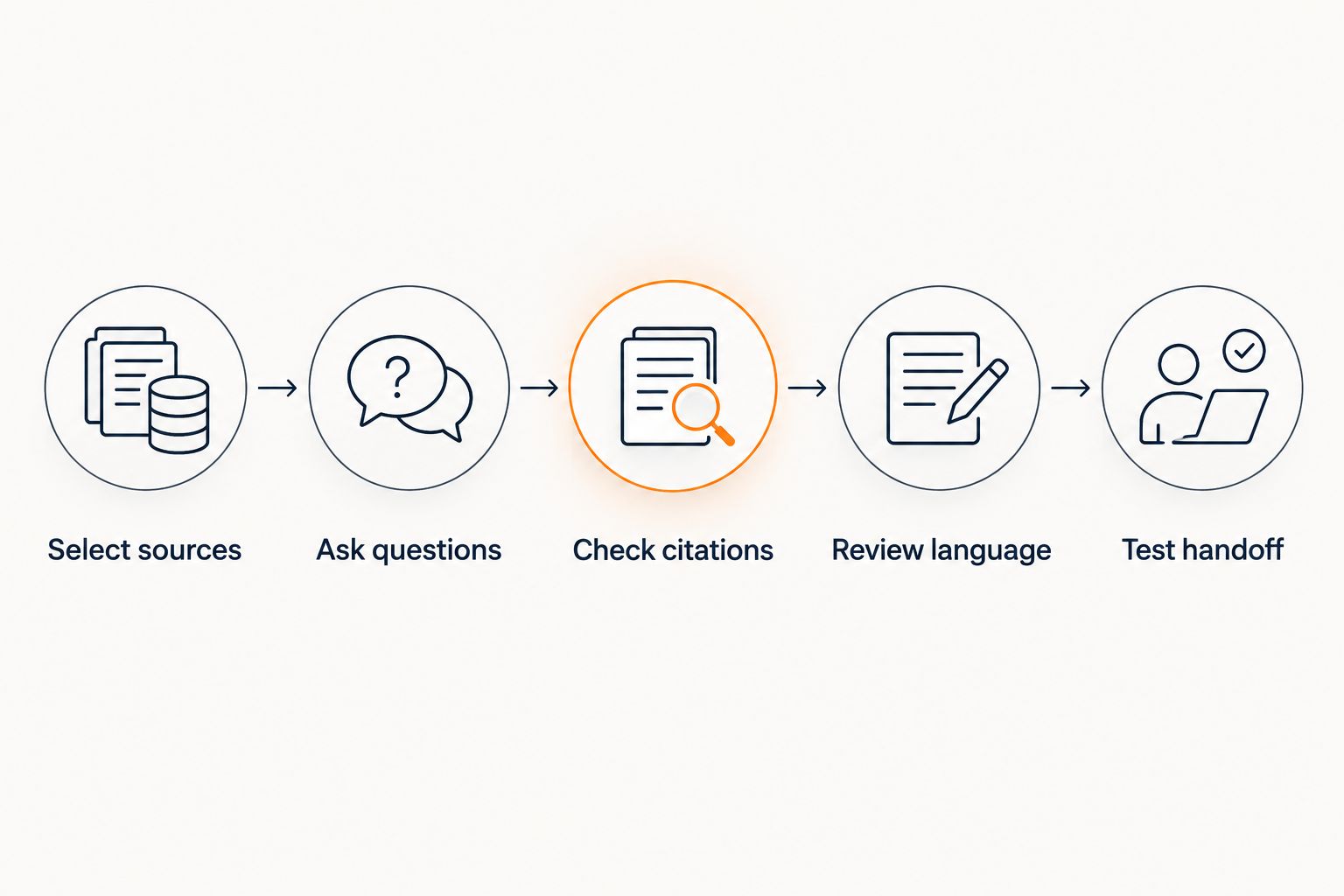
Follow this sequence with every shortlisted chatbot:
- Select sources: Choose the published curriculum, access terms, and support policies that govern the answers.
- Ask questions: Include direct questions, informal phrasing, follow-ups, and a request that the source cannot answer.
- Check citations: Open each cited source and compare the answer against the relevant passage.
- Review language: Have a fluent reviewer check meaning, terminology, conditions, and tone.
- Test handoff: Ask for human help and inspect what the person receiving the conversation can understand.
Keep a record of the original question, answer, citation, and reviewer decision. Record failures separately: wrong source, missing condition, invented exception, unclear translation, or incomplete follow-up.
Test refusals, not just successful answers
Ask whether an unpublished discount exists. Ask whether a refund rule has a special exception. Ask whether buying the course guarantees income.
The required behavior is straightforward: no invented discounts, no refund exceptions, no income promises. A suggested refusal is: “I can only quote what’s published.” This is an example response to test for, not a claim about any vendor’s exact wording.
Then repeat the request in another language. The boundary must remain the same even when the wording changes.
Separate answer language from source language
A Spanish answer citing an English lesson involves two different checks. First, does the answer accurately explain the lesson? Second, can the visitor inspect the source well enough to resolve the question?
Neither check replaces the other. Require accurate citations, but also decide what to do when the visitor cannot read the cited material.
Which multilingual AI chatbot should you choose?
For your 2026 shortlist, start with Intercom Fin when the support inbox is part of the purchase; start with Zendesk AI agents when Zendesk already runs your support. Choose Chatbase for a focused website evaluation, or Tidio Lyro when live chat is central to the workflow.
For creator sales and support, evaluate the creator-focused option against the same language tests. Do not substitute audience fit for demonstrated multilingual behavior.
If you remain undecided, choose the smallest pilot that reproduces a real buyer question, a published policy, and an unanswered request. The winning chatbot is the one that preserves meaning and boundaries through all three—not the one with the longest language list.
FAQ
What’s the best AI chatbot for multilingual support in 2026?
Intercom Fin is the starting recommendation here for buyers who also want a support-inbox workflow. Existing Zendesk teams should evaluate Zendesk AI agents first; every candidate still needs testing in the required languages.
Does supporting more languages make a chatbot better?
No. Language coverage does not establish source accuracy, policy preservation, citation quality, or successful human follow-up. Test the languages your visitors actually use.
Can a chatbot answer in Spanish using English course content?
Cross-language answering is a capability to verify with the specific chatbot. Ask a Spanish question against an English source, then check both the retrieved passage and the meaning of the answer.
Is HelpShelf a multilingual chatbot?
Confirm multilingual support directly before choosing HelpShelf for that requirement. Its stated offering includes cited answers from creator content and lead capture, which do not by themselves establish language coverage.
How do I test whether a translated answer is accurate?
Compare the answer with its cited passage and have a fluent reviewer check the meaning. Pay particular attention to exclusions, eligibility conditions, access terms, and statements the source does not make.
Should I translate my whole knowledge base before adding a chatbot?
Decide after testing your required source-to-answer language combinations. Localized source material and cross-language answering solve different problems, so check both retrieval accuracy and whether visitors can understand the cited evidence.
What should a multilingual chatbot do when a policy is missing?
It should say that the published material does not answer the question and follow your defined escalation process. Translation must not turn missing information into an invented discount, refund exception, or income promise.
One last thing
For your 2026 launch, make one acceptance question deliberately unanswerable from the supplied content. Write down the expected boundary before testing.
A chatbot that declines the unsupported request has preserved your policy. A chatbot that produces a polished explanation has failed if the explanation invents the answer.