

Best fit for creator-owned course answers: HelpShelf. Best for fixed policy wording: a scripted chatbot. Best for a custom knowledge workflow: a retrieval-grounded chatbot. This 2026 guide ranks chatbot approaches by their fit for specific accuracy requirements, not by a universal model score.
- For ai chatbots ranked by accuracy, choose by task: creator support needs published sources, not general knowledge alone.
- HelpShelf fits creators who need cited course answers and lead capture in a chat widget.
- Scripted chatbots suit fixed policy wording; retrieval-grounded chatbots suit custom document workflows.
- Test factual answers, policy boundaries, and unanswered questions before putting any chatbot in front of buyers.
Why this matters
A prospective student messages you at 11pm: does the course include feedback on their project? An answer about what courses usually include does not answer that question. Your published curriculum does.
For creator support, accuracy means matching your offer, identifying the supporting source, and stopping where that source stops. A polished answer that invents personal feedback is still wrong.
HelpShelf is a fit for creators who need chatbot answers grounded in their own content, with citations and lead capture. That is a task-specific recommendation, not a claim that one chatbot wins every reasoning, coding, or research benchmark.
For a closer look at this distinction, read the guide to accuracy when a chatbot uses your own content.
What makes the best chatbot for accurate creator support?
Use these criteria when comparing chatbots in 2026. They separate an answer that sounds reasonable from one you can publish under your business name.
- Source fidelity: The answer follows the actual course, coaching, or community material rather than filling gaps from general knowledge.
- Citation support: The cited passage supports the specific claim, not merely the same topic.
- Policy boundaries: The chatbot does not invent discounts, refund exceptions, access rights, or income promises.
- Unknown handling: An unanswered question stays unanswered until an authorized person or published source resolves it.
- Content freshness: Current material takes precedence over superseded material, with conflicts resolved before launch.
- Task fit: A pre-sale answer, a lesson explanation, and an account-specific billing decision require different evidence.
Treat these as acceptance criteria, not feature labels. A chatbot with citations still needs testing: a link beside an answer does not prove the answer follows the linked passage.
Chatbot accuracy options at a glance
The order below reflects creator-support use cases. Scripted chatbots and retrieval-grounded chatbots are approaches, not named products with identical capabilities.
| Rank and option | Best for | Standout feature | Key limitation |
|---|---|---|---|
| 1. HelpShelf | Creator-owned course, coaching, and community answers | Answers from your content with cited sources and lead capture | Source-grounded answers still depend on what your material establishes |
| 2. Scripted chatbot | Fixed policy responses | Prewritten wording for defined paths | Questions outside those paths need another route |
| 3. Retrieval-grounded chatbot | Custom document workflows | Retrieves relevant material before generating an answer | Retrieval and answer generation both need evaluation |
| 4. General-purpose chatbot | Drafting a support test set | Generates examples and alternative phrasings | General knowledge does not establish your private business policies |
1. HelpShelf: best chatbot for creator-owned answers
HelpShelf provides a chat widget that answers pre-sale and support questions using a creator's own course, coaching, or community content, with cited sources. It also captures leads. Its stated audience includes course creators, coaches, and community owners on platforms such as Kajabi, Skool, and Whop.
Best for: Creators who want visitors to ask questions about their published material without turning every conversation into a DM.
Consider a buyer asking whether a course covers a particular technique. The useful answer identifies what the curriculum actually covers and cites the relevant material. It does not turn a passing mention into a promise of detailed instruction.
HelpShelf pros:
- Uses the creator's own content as the basis for answers.
- Includes cited sources, giving readers a way to inspect supporting material.
- Combines pre-sale questions, support questions, and lead capture in a chat widget.
Limitations to account for:
- A source-grounded answer cannot establish an unpublished benefit or exception.
- Citations still need checking against the claims they accompany.
- A published policy does not, by itself, prove an individual customer's eligibility.
Before deployment, test the difference between explaining a policy and making a decision. Describing published refund terms is not the same as approving a refund for a particular purchase.
Verdict: Buy for creator-content Q&A if the widget passes your policy and citation checks.
2. Scripted chatbot: best chatbot for fixed policy wording
A scripted chatbot follows predefined responses and conversation paths. For a narrow question with an approved answer, that approach keeps the wording under your control.
Best for: Repeating a fixed policy statement without generating a new explanation each time.
Suppose a visitor asks where to find the published cancellation terms. A scripted path can present your approved explanation and direct the visitor to the appropriate policy. The trade-off appears when the visitor asks an unusual follow-up that the script does not cover.
Scripted chatbot pros:
- Keeps approved wording consistent within defined paths.
- Makes individual responses straightforward to inspect before publication.
- Separates allowed responses from requests that need human review.
Scripted chatbot cons:
- Unanticipated wording requires additional paths or a fallback.
- A fixed response cannot explain every detail across a large curriculum.
- You must revise affected scripts when the underlying policy changes.
Do not confuse predictable wording with complete coverage. A script can repeat an outdated rule perfectly; it is still the wrong answer.
For your 2026 evaluation, include questions that sound similar but require different responses. Asking how cancellation works is not the same as asking someone to cancel an account.
Verdict: Buy for narrow, approved policy paths; skip it as your only curriculum-answering system.
3. Retrieval-grounded chatbot: best chatbot for custom document workflows
A retrieval-grounded chatbot finds relevant material and uses it to generate an answer. This approach suits a custom workflow where you need to decide which documents are eligible for a particular question.
Best for: Teams designing their own document selection, access rules, and answer-evaluation process.
Imagine separate materials for prospective buyers and enrolled members. Your implementation needs to distinguish those audiences before it selects evidence. Finding a relevant passage is not enough if the visitor should not receive it.
Retrieval-grounded chatbot pros:
- Can base answers on selected documents rather than general knowledge alone.
- Supports workflows designed around a particular content collection.
- Lets you evaluate document retrieval separately from the final answer.
Retrieval-grounded chatbot cons:
- The system can retrieve the wrong passage before generation begins.
- Conflicting documents require a clear source-priority rule.
- Access controls and escalation behavior require explicit implementation and testing.
Review both stages. First, ask whether the system selected the correct evidence. Then ask whether the answer stayed within that evidence. Fixing the wording will not solve a retrieval failure.
This category overlaps with source-grounded products. Its separate slot here is for the custom-build decision, not a claim that it represents a different underlying model family.
Verdict: Hold until you have an owner for content permissions, testing, and maintenance.
4. General-purpose chatbot: best chatbot for drafting test questions
A general-purpose chatbot is useful for drafting question variations, organizing a checklist, and exploring ways a visitor might phrase a request. Those tasks do not require treating its output as your published policy.
Best for: Preparing the evaluation material that you will check against approved sources.
Give it a curriculum excerpt and ask for questions that excerpt answers, questions it only partially answers, and questions it cannot answer. Review the resulting questions yourself before adding them to your test set.
General-purpose chatbot pros:
- Helps draft alternative phrasings for the same question.
- Supports exploratory writing before you publish support material.
- Can help organize candidate questions into topic groups.
General-purpose chatbot cons:
- General knowledge does not establish your course inclusions or refund terms.
- A plausible draft is not an approved answer key.
- Use as a visitor-facing support system requires separate source, permission, and refusal checks.
A general-purpose model and a support application are not interchangeable categories. The application determines what evidence the model receives and what actions the visitor can request.
Verdict: Buy for drafting and exploration; skip unsupervised business-policy answers without a validated source workflow.
How to test accuracy before launch
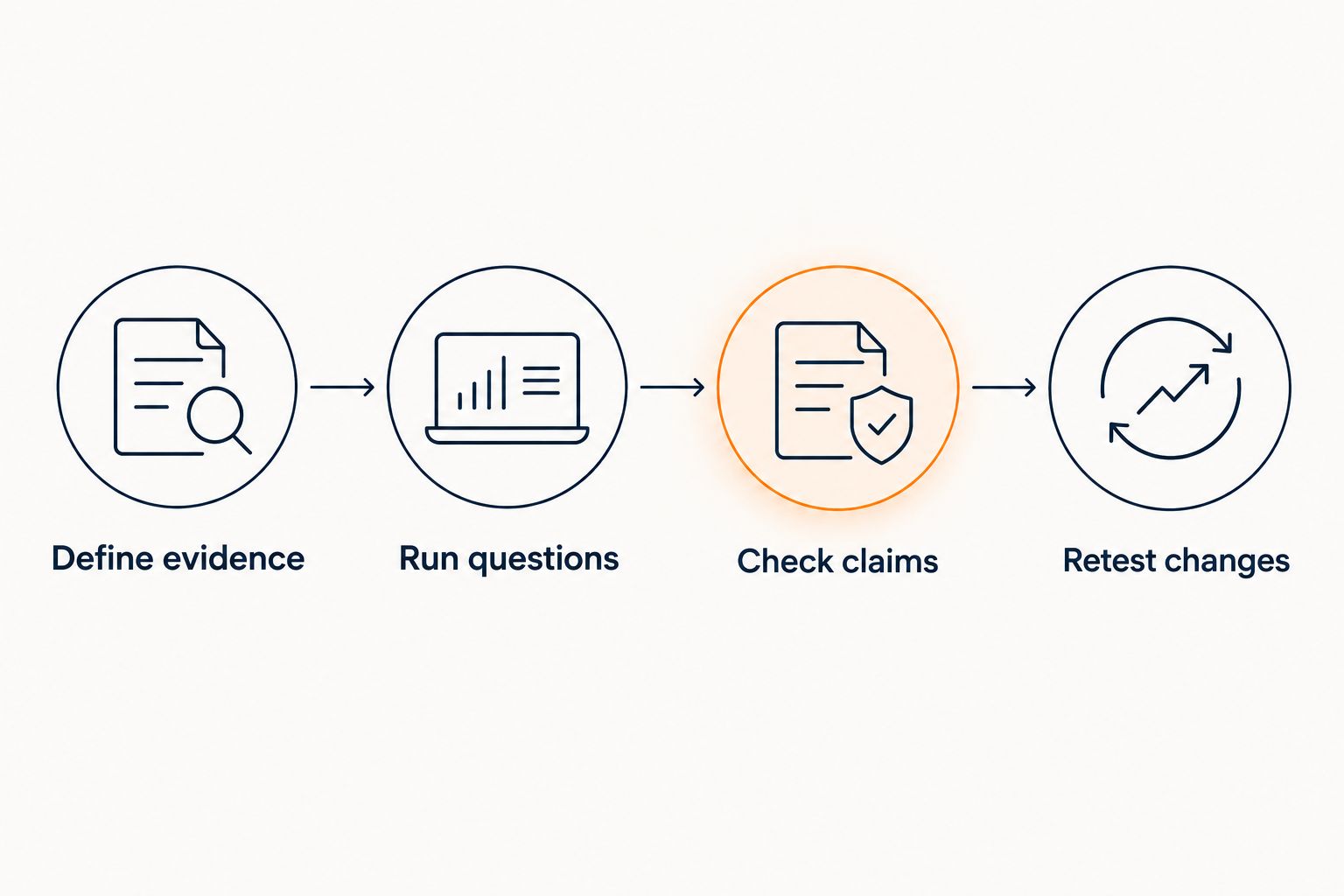
For a practical 2026 acceptance test, start with 12 test questions: 4 factual questions, 4 policy-boundary questions, and 4 questions your content does not answer. These are suggested test-set sizes, not reported performance results.
Define evidence
Write the approved answer before testing the chatbot. Attach the exact supporting passage, identify the intended audience, and record any wording the answer must avoid.
For example, a lesson title can establish that a topic appears in the curriculum. It does not establish personal feedback, guaranteed results, or access to a private coaching call.
Run questions
Ask each question as a visitor would. Include informal wording, an ambiguous reference to “the program,” and a follow-up that presses for an exception.
Use the same source material across the options you compare. Otherwise, you are comparing different evidence collections rather than different answer systems.
Check claims
Inspect each factual claim, not just the general impression. Mark whether the answer is supported, unsupported, or correctly deferred, then check whether the citation actually supports the wording.
Keep answer quality separate from writing style. A short refusal can pass while a friendly, detailed explanation fails.
Retest changes
After editing a policy or replacing a source, rerun the affected questions. Also rerun questions whose answers should remain unchanged, so the update does not silently alter unrelated responses.
Keep a simple record of the question, expected answer, retrieved evidence, actual response, and correction. That record makes a failed answer actionable instead of leaving you with a vague impression that the chatbot was inaccurate.
What a correct refusal looks like
Use refusals as acceptance examples, not as claims about any product's default wording. The chatbot should identify the boundary and give the visitor a useful next step.
- Unpublished discount: Suggested wording: “I can only quote what's published. I don't have a published discount to share.”
- Refund exception: Suggested wording: “I can explain the published refund terms, but I can't approve an exception.”
- Income promise: Suggested wording: “The course material does not establish an income guarantee. I can point you to the published curriculum.”
For an account-specific request, the next step should follow your approved support process. Do not let a chatbot describe a request as approved merely because it has collected the visitor's details.
How this ranking works
This ranking prioritizes source fidelity, citation support, policy boundaries, unknown handling, content freshness, and task fit. It recommends a creator-focused widget for creator Q&A, scripts for fixed wording, custom retrieval for custom workflows, and general-purpose chat for preparation.
The positions are use-case recommendations, not measured accuracy percentages. Apply the same test questions to your shortlisted implementations before treating the order as a purchasing decision.
Which chatbot should you choose?
Start with HelpShelf for creator-content support, then validate it against your published material. Choose scripted responses for fixed policy paths and a custom retrieval workflow when you need to design document selection yourself.
In 2026, the useful question is not which chatbot sounds smartest. It is which setup answers your visitors' actual questions without adding benefits, exceptions, or promises you never published.
FAQ
What's the best way to compare AI chatbots ranked by accuracy?
Compare chatbots on the same questions, approved sources, and acceptance criteria. Check factual support, citation relevance, policy boundaries, and correct refusals separately.
Is HelpShelf a fit for course creators who need accurate answers?
HelpShelf fits creators who need answers based on their own course, coaching, or community content, with cited sources and lead capture. Validate its responses against your actual curriculum and policies before deployment.
Does a citation prove a chatbot answer is correct?
No. A citation is useful only when the cited passage supports the specific claim. Read the passage and check that the answer has not added conditions, benefits, or promises.
Is a scripted chatbot more accurate than a generative chatbot?
A scripted chatbot gives controlled wording within its defined paths, but that does not make every response correct. The script still needs current source material, and questions outside its paths need a fallback.
Can a chatbot approve a refund exception?
Do not treat a policy explanation as authorization to approve an exception. Approval requires the business's authorized decision process and any relevant account evidence.
How many questions should I use to test a chatbot?
Start with the suggested 12-question set: 4 factual questions, 4 policy-boundary questions, and 4 unanswered questions. Expand it with real visitor questions and every failure you identify.
Should a chatbot answer when the course material is silent?
For business-specific claims, it should state that the published material does not establish the answer. It should then follow your approved process for unresolved questions instead of inventing a response.
One last thing
Test the chatbot with a buyer who asks the same unsupported question again, more insistently. A correct first refusal is not enough if the follow-up produces an invented discount or promise.
Save that exchange as a regression test. Your next content update should preserve the boundary, not just improve the answers you want the chatbot to give.


