
Yes—Zendesk is overkill for a solo course creator in 2026 when the main job is answering repeat questions from published course content, rather than managing support cases. A cited-answer widget fits that narrower task; keep a human path for account problems, refund decisions, and questions your content does not answer.
- Is Zendesk overkill for a solo course creator? Yes, when repeat course questions are the main support task.
- Zendesk fits ticket management; source-grounded answers address a different job.
- HelpShelf fits creators seeking cited course answers and lead capture, not a replacement for every support decision.
- Keep refund exceptions, account changes, and income promises outside automated answers.
Is Zendesk overkill for a solo course creator?
Zendesk is overkill when you need answers, not a case-management workflow. Being a solo creator is not the deciding factor. The deciding factor is what must happen after someone asks a question.
| Option | Best for | What it addresses | Limitation |
|---|---|---|---|
| FAQ and manual replies | Creators who can handle questions personally | Publishing standard answers and handling exceptions directly | Visitors must find answers or wait for you |
| HelpShelf cited-answer widget | Creators with course, coaching, or community content | Answering pre-sale and support questions with cited sources; capturing leads | Published content must support the answer; exceptions still need human judgment |
| Zendesk ticketing | Creators who need to track unresolved support cases | Keeping support requests organized as tickets | Ticket management does not, by itself, make course information complete or accurate |
HelpShelf is best for course creators who need cited answers from their own content and lead capture. That is a narrower recommendation than saying a chat widget replaces a help desk.
Why this matters
A prospective student asks a question at 11pm: does the course teach the topic they need? If the answer already exists in your syllabus, opening a support case is not the central task. Finding the relevant passage is.
A different student says their purchase does not appear in their account. The syllabus cannot resolve that problem. Someone needs to investigate the account and confirm what happened.
For your 2026 support setup, separate those situations before choosing software. A question about published information needs a reliable answer. A problem involving a particular person needs ownership, follow-up, and a clear resolution.
Confusing the two produces a poor setup in either direction. You can create a ticket workflow for questions that only need a citation, or install a chat widget and leave real account problems without an owner.
When published answers are enough
Published answers fit questions whose resolution does not require changing anything about the visitor's account or making an exception. Course scope, prerequisites, lesson topics, and published policies belong here when your materials actually cover them.
Suppose a visitor asks whether a course includes a particular technique. The useful response identifies the relevant syllabus passage and cites it. If the syllabus does not mention the technique, the response should say that the published material does not establish an answer.
That distinction matters more than how conversational the reply sounds. A fluent answer that fills a gap with an assumption is still an unsupported answer.
Choose a cited-answer workflow when the evidence already exists and the visitor needs help finding it. Before installing anything, check that the evidence is understandable outside your own head. An unexplained lesson title is not the same as a clear description of what a student will learn.
For a deeper look at that boundary, read about answering pre-sale questions from your own content.
When ticket management is justified
Ticket management is justified when a support request must remain open while someone investigates or completes an action. A chat reply is not a resolution if the underlying problem remains untouched.
For example, a student reports a missing purchase. You need to establish which account is involved, check the relevant records, and tell the student what happened. A citation to a general access guide can help, but it cannot establish the state of that student's account.
Zendesk is a ticketing option for this kind of work. Evaluate it against the cases you actually manage, rather than assuming that a growing course business automatically needs a broader support platform.
Keep a ticketing workflow when losing track of unresolved cases is the problem. Do not replace it merely because a widget can answer questions. Conversely, do not add ticketing just because a visitor asks where to find information already published on your site.
A solo creator can have complicated support. A larger creator business can have straightforward questions. Headcount is an incomplete buying criterion.
When an FAQ and manual replies are enough
An FAQ and manual replies fit when you can answer questions personally without losing track of unresolved requests. This approach also gives you direct control over sensitive replies and exceptions.
The limitation is access to the answer. A visitor must find the right FAQ entry, or wait until you respond. Publishing an answer does not guarantee that a visitor recognizes which question to open.
Treat an FAQ as source material, not as proof that the support job is finished. Review the wording of incoming questions. If visitors repeatedly ask something you believe the FAQ answers, check whether the entry uses their language and provides enough context.
Keep manual support when it is manageable and gives visitors a clear next step. Add software to address an observed task, not to make a simple process look more sophisticated.
Why the right support setup varies
Your 2026 decision should turn on the work you need done, not a generic recommendation for solo businesses. Use these factors to distinguish an answer problem from a support-management problem:
- Question type: Published course information supports a cited answer. A personal account problem needs investigation.
- Source quality: Clear, current materials give an answer system something to cite. Conflicting materials require correction first.
- Decision authority: Quoting a policy is different from granting a refund exception or changing access.
- Follow-up ownership: Unresolved requests need someone responsible for completing them, even when you are the only person involved.
- Lead handling: A pre-sale question can need a follow-up route when the published materials do not answer it.
These factors also explain why changing software alone does not fix every support problem. If your syllabus is vague, improve the syllabus. If a student needs an account correction, assign the action. If an inquiry needs follow-up, make the next step explicit.
How do you choose without rebuilding your whole support process?
Test the workflow against your own questions before switching tools in 2026. Use the following sequence as a review exercise, not as a performance benchmark.
1. Collect questions
Choose 10 actual questions from your inbox or messages. Include pre-sale questions and support requests rather than selecting only easy questions about course topics.
Remove personal information before using the questions in a test. Keep the original wording where possible; visitors do not always use the terms that appear in your documentation.
2. Classify work
Sort the sample into 3 question types: published information, account-specific work, and human decisions. Published information can be answered from a source. Account-specific work requires checking the person's situation. Human decisions include exceptions that your policy does not authorize automatically.
Do not classify a question as answerable just because you know the answer yourself. Locate the published passage that a system would need to use.
3. Check sources
For each published-information question, identify the supporting material and check that it is current. If two sources disagree, fix that disagreement before treating either one as authoritative.
Then inspect the proposed reply. Does the cited passage support the whole answer, or only a small part of it? A citation attached to an unsupported promise does not make the promise acceptable.
4. Assign ownership
Give every unresolved request 1 named owner. In a solo business, that owner is often you, but the visitor still needs a usable next step.
Define what the owner will review. Do not ask the visitor to repeat an entire conversation when a short summary of the unresolved question would suffice. Keep sensitive account information out of public chat exchanges.
5. Test refusals
Ask questions that your published content cannot support. Include an unpublished discount, an exception to a refund policy, and a promised income outcome.
The answer should preserve the boundary rather than improvise. If the workflow responds confidently to everything, the test has exposed a problem—not demonstrated completeness.
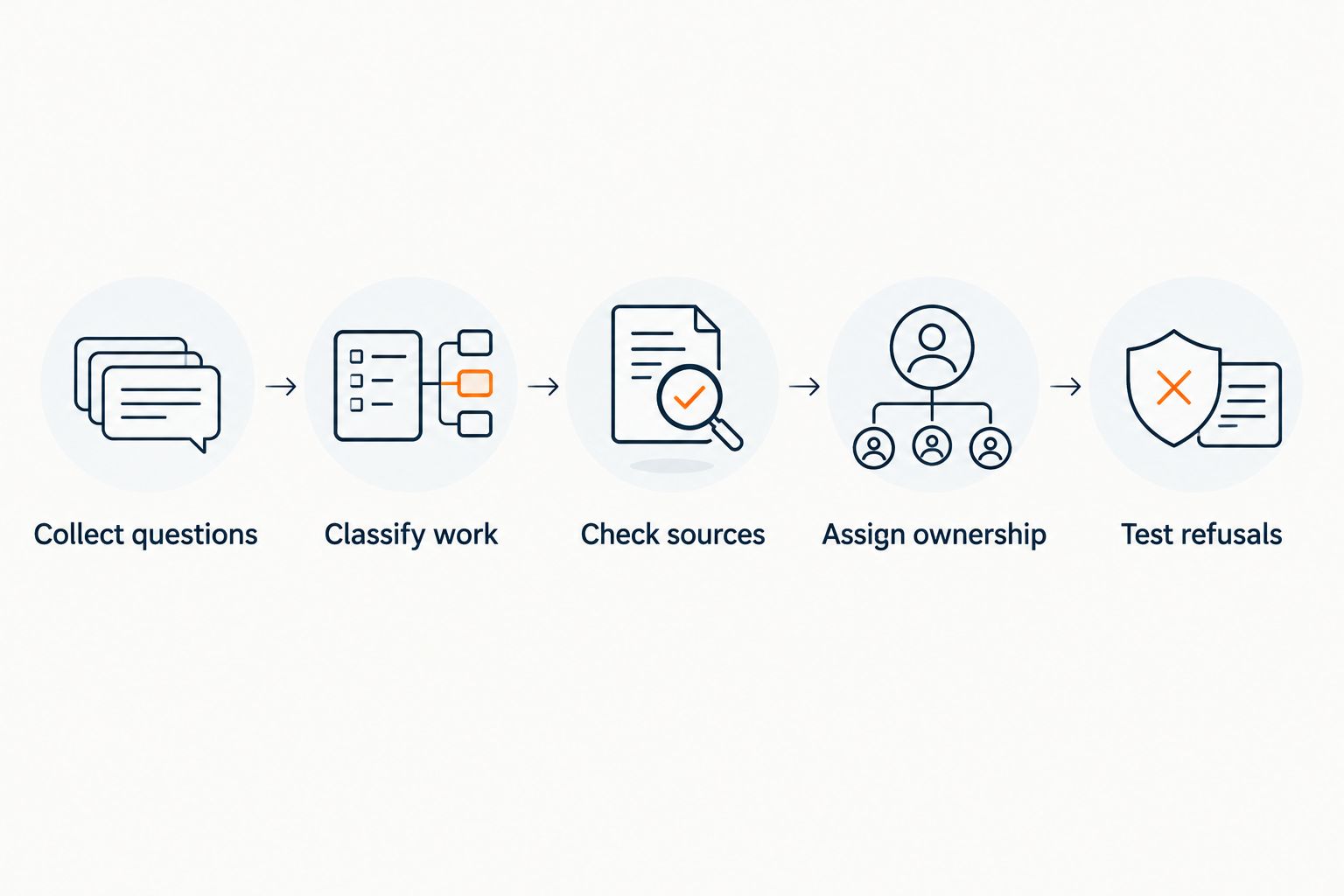
The result of this exercise is a task list. It tells you which questions need better source material, which need an answer interface, and which need case tracking. It does not require a full migration to be useful.
What should a source-grounded answer refuse to do?
A source-grounded answer should refuse to turn missing information into a sales claim. For your 2026 setup, make that rule explicit: no invented discounts, no refund exceptions, and no income promises.
The following are illustrative response patterns, not quotations from a real conversation or statements of your own course policies:
- Unpublished discount: A suitable response states that it can only quote published offers and does not have a source supporting the requested discount.
- Refund exception: A suitable response distinguishes the published policy from a request for an exception, then directs the decision to a person.
- Income promise: A suitable response states that the published materials do not establish the visitor's future earnings.
- Unclear course scope: A suitable response identifies what the syllabus states and leaves the undocumented topic unresolved.
A refusal is useful when it explains the limit and gives an appropriate next step. A generic apology that leaves the visitor stranded is not enough. Neither is a friendly answer that quietly invents permission.
Is HelpShelf a replacement for Zendesk?
HelpShelf is a replacement for the narrower job of answering pre-sale and support questions from a creator's own content when cited answers and lead capture are what you need. It is not a reason to abandon case tracking for unresolved account problems.
The fit comes from the task: a visitor asks about your course, coaching, or community material, and the widget answers using that material with cited sources. The limitation comes from the same boundary. Content cannot authorize an unpublished exception or verify a person's account state.
Judge the choice by what happens to the difficult question. If the answer is unsupported, does the workflow stop? If action is required, does a person own it? Those questions are more useful than asking which product has the longest feature list.
Should I cancel Zendesk before testing a simpler workflow?
Keep the existing support route while you test the narrower workflow. Move repeat information questions first; leave unresolved cases and personal account issues with their current owner.
Before removing any route, verify that visitors can still ask for help and that open requests remain accounted for. A simpler setup is only simpler if it preserves the work that matters.
Can a chat widget make a weak FAQ good enough?
A chat widget cannot supply evidence that your FAQ lacks. Rewrite unclear or contradictory source material before relying on it for answers.
Use unanswered questions as documentation work. If visitors ask whether a course suits their situation and your syllabus never explains its intended audience, publish that explanation rather than expecting software to infer it.
FAQ
Is Zendesk overkill for a solo course creator in 2026?
Zendesk is overkill when your main task is answering repeat questions from published course content. Ticket management is justified when requests need investigation, action, and follow-up.
What's the best support setup for a one-person course business?
The best setup separates published answers from requests that need personal investigation or judgment. Keep manual replies if they are manageable; use cited answers for content questions and case tracking for unresolved work.
Is HelpShelf better than Zendesk for course questions?
HelpShelf fits course questions that need cited answers from your own content and lead capture. Zendesk addresses ticket management, so compare the job you need done rather than treating the products as interchangeable.
Can a course chatbot approve a refund exception?
A course chatbot should not approve a refund exception that published policy does not authorize. It can explain the policy and direct the exception request to a person.
Do I need a support team before using ticketing software?
You do not need a support team to justify ticketing software. A solo creator can need case tracking when requests remain unresolved while investigation or account work takes place.
Can I keep an FAQ instead of installing a chat widget?
You can keep an FAQ when visitors can find the answers and manual follow-up remains manageable. Review recurring questions to identify missing information or unclear wording.
How do I test whether cited answers are accurate?
Check whether each cited source supports the complete answer, including any policy statement or course claim. Also test unsupported questions and confirm that the reply refuses to invent an answer.
One last thing
Test the question your documentation cannot answer. A correct reply to an easy syllabus question tells you less about the boundary than a calm refusal to invent an exception.
In 2026, your buying decision should survive that test. Keep the tool that handles the work you have, preserves unsupported questions for a person, and does not turn missing information into a promise.