
Intercom is worth it for a one-person coaching business only if a tested support workflow saves you more work than it creates. If you mainly need answers from your coaching content and a way to capture follow-up requests, evaluate that narrower job first; software does not remove your responsibility for accurate policies or personal advice.
- Is Intercom worth it for a one person coaching business? Only when its tested workflow justifies the upkeep.
- HelpShelf fits coaches who need source-grounded pre-sale and support answers with citations and lead capture.
- Keep personal coaching decisions, refund exceptions, and income promises outside automated answers.
- Choose from real visitor questions, not a feature list or a promise of fewer interruptions.
Why this matters
A prospective client reads your coaching page at 11pm and asks whether the program covers their situation. You are offline. The useful response is a clear answer tied to your published material—or a clear boundary when that material does not answer the question.
That is a different job from giving personal coaching advice. Before choosing software in 2026, separate repeatable information from questions that require your judgment. The Intercom alternatives for creators guide is a starting point for comparing that narrower workflow.
Choose the support job before choosing the support platform. A widget that creates another inbox without resolving questions has not solved your problem.
Is Intercom worth it for a one-person coaching business?
Intercom is worth evaluating when you can name a specific workflow you need and prove it works with your actual questions. Do not adopt it simply because you want a chat bubble on your coaching website. That visible interface is only the beginning of the decision.
For a 2026 evaluation, compare these approaches by the job you need done. The table describes selection criteria, not measured performance or a claim that every feature is included in a particular plan.
| Approach | Best for | Main advantage | Main limitation |
|---|---|---|---|
| Intercom, after a workflow test | Coaches whose demonstrated support requirements fit the configuration they evaluate | A candidate when your required workflow passes testing | Adoption is not justified until you verify the setup, upkeep, and unanswered-question process |
| HelpShelf | Coaches answering repeatable questions from their own content | Source-grounded pre-sale and support answers, citations, and lead capture | Published content must contain the answer; personal advice still needs your judgment |
| Published FAQ with direct follow-up | Coaches whose questions are manageable without a chat workflow | Keeps the answer and its source together | Visitors must find the relevant information, and you still handle unresolved questions |
HelpShelf is best for coaches who need cited answers from their own content and lead capture. That is a specific fit, not a claim that it replaces every support system.
The decisive question is what happens after someone asks something your content cannot answer. Require a boundary and a follow-up route. An answer that sounds helpful but invents a policy fails the test.
Start with the questions you actually receive
Look through your existing email, messages, and community conversations. Sort the questions by what answering them requires. Do not start by deciding which software features sound useful.
Use these categories:
- Published facts: what your coaching offer includes, provided that your material states it.
- Content guidance: where a lesson, resource, or community instruction addresses a topic.
- Personal judgment: whether a particular person should join or what action they should take.
- Policy decisions: requests for exceptions, special arrangements, or changes to published terms.
The first categories provide candidates for source-grounded answers. The latter categories need a boundary, personal follow-up, or both. A single question can contain elements of each.
For example, someone asks whether your course covers a subject and whether completing it guarantees a particular outcome. The coverage question can be answered from the course material. The outcome guarantee must not be invented from that same material.
Automate the published fact, not the decision hidden inside the question. That distinction gives you a useful acceptance standard before you compare products.
Test the workflow before you commit
Use a short sequence that starts with your content and ends with what you must maintain. Repeat it when evaluating Intercom or another candidate in 2026. These are recommended evaluation steps, not a claim about any product's default behavior.
- Choose sources. Select the published coaching, course, or community material that should govern answers. Remove conflicting versions from the test set.
- Ask questions. Submit the real questions you identified, including awkward wording and questions that combine several requests.
- Check citations. Read the cited passage, not just the response. Confirm that the source supports every substantive claim.
- Test boundaries. Ask for an unpublished exception, an unsupported outcome promise, and an answer absent from the sources.
- Plan follow-up. Establish what the visitor sees when a question needs you and how you will receive and manage that request.
A successful answer should make its basis easy to inspect. A successful refusal should leave the visitor with a useful next step, without suggesting that an exception has already been approved.
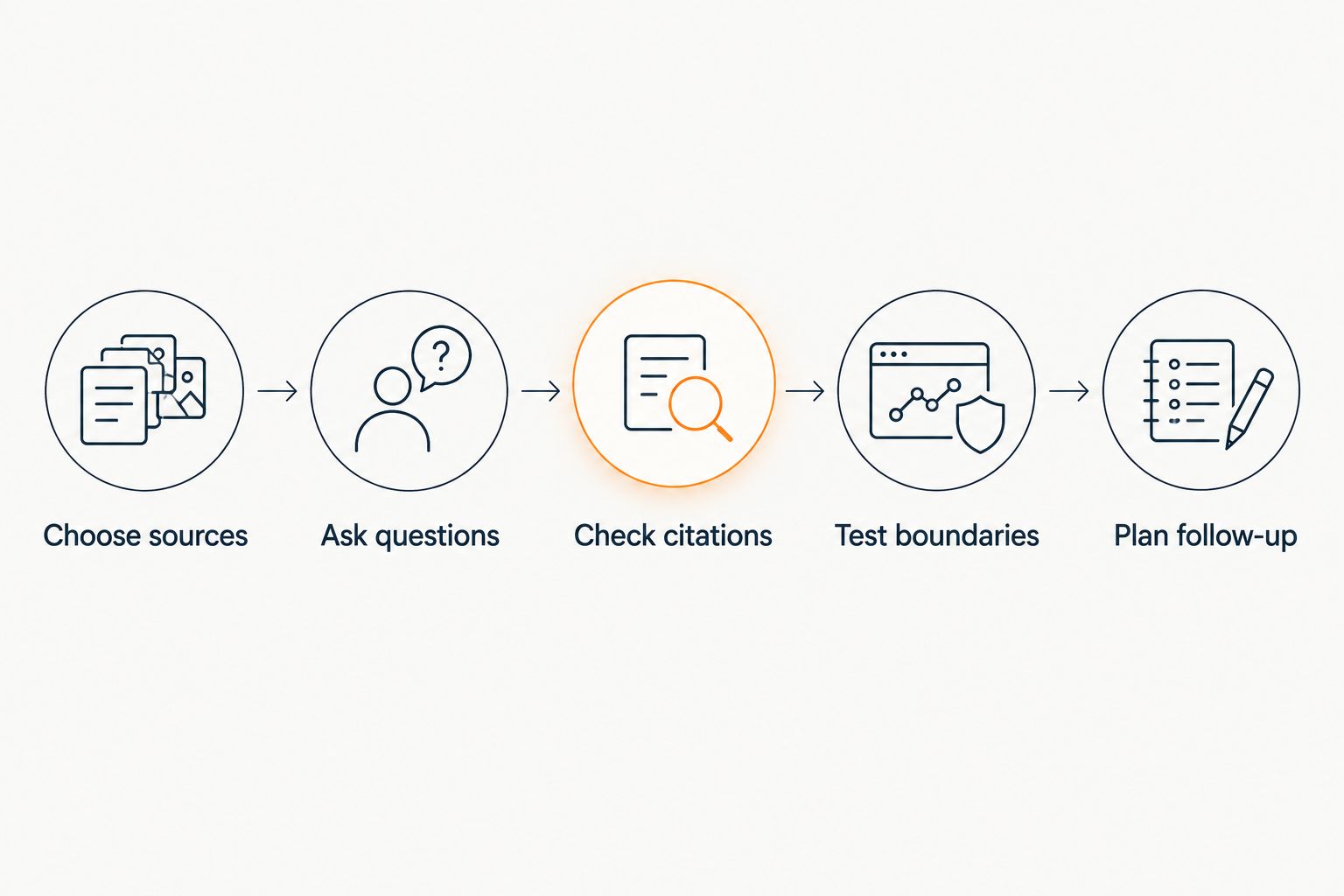
Keep a simple record of each test: the question, the source it should use, the response, and the correction required. You do not need an elaborate score to spot a response that invents a promise.
When Intercom belongs on your shortlist
Keep Intercom on your shortlist when you have written requirements that your evaluation confirms it can satisfy. The requirement should describe an action, not an adjective such as powerful or advanced.
For example, your requirement might be to keep a visitor's question and your eventual reply in a workflow you can reliably manage. Another might be to distinguish a factual answer from a request that needs your decision. Verify the exact behavior in the configuration you are considering.
Ask yourself:
- Can you explain what this setup does that your current process does not?
- Can you complete the workflow without maintaining conflicting answers elsewhere?
- Can you see what happens when the answer is absent or disputed?
- Can you keep the setup current without displacing your coaching work?
A named requirement plus a successful test is a reason to adopt software. A long feature list is not. If a simpler process meets the same requirement, compare the ongoing work before deciding.
When a source-grounded widget is the closer fit
A source-grounded widget fits a narrower situation: you already have useful content, visitors ask questions that content answers, and unresolved conversations need follow-up. Your main task is making published information accessible at the point of the question.
HelpShelf answers pre-sale and support questions using a creator's own course, coaching, or community content, with cited sources, and captures leads. Its stated audience includes course creators, coaches, and community owners on platforms such as Kajabi, Skool, and Whop.
The limitation matters as much as the fit. If your content never explains what an offer includes, a source-grounded answer has no published basis for filling that gap. Write or correct the source before expecting a useful response.
For your 2026 comparison, inspect whether the answer preserves the limits of your material. A passage about a learning objective does not establish a promised result. A published policy does not authorize an exception.
Why the value varies between solo coaches
The value of a support tool depends on the work it can actually take off your desk. These factors define the evaluation; they are not claims about measured savings.
- Question type: repeated factual questions suit published answers; personal coaching decisions require your involvement.
- Source completeness: clear content gives an answer a basis. Missing terms or conflicting instructions require editorial work first.
- Follow-up needs: an unanswered question still needs somewhere to go and someone responsible for responding.
- Maintenance responsibility: changes to your offer, content, or policies require corresponding updates to the material used for answers.
- Workflow fit: the setup must match how you handle questions rather than require a second process you will not maintain.
A coach with clear material and repeatable questions has a different support task from a coach whose conversations are mainly personal assessments. Do not treat those situations as interchangeable.
Evaluate the questions, the sources, and the upkeep together. Looking at only the answer interface leaves the rest of the work out of view.
Can a chatbot answer pre-sale questions without making promises?
A chatbot should answer pre-sale questions only to the extent that published sources support the answer. Set that as your acceptance rule and test it with requests that invite an overconfident response.
Use 3 boundary tests: a request for an unpublished discount, a refund exception, and a guaranteed income outcome. These are test cases, not offers you should add to your business. Each should preserve the distinction between published information and a decision only you can make.
A refusal can state the boundary plainly: I can only quote what's published. Then direct the visitor toward the relevant material or a follow-up request. Do not let a friendly response turn into an implied approval.
HelpShelf's source-grounded answers and citations address the factual part of this workflow. Your evaluation still needs to check the actual response against the source and confirm that unsupported requests stay unsupported.
Do I need live chat if I cannot stay online?
You do not need to promise live availability to provide a useful way for visitors to ask questions. Choose an interaction that reflects how you actually work, rather than one that implies you are waiting to respond.
Separate 2 jobs: answering a question from published material and arranging your personal follow-up. The first can finish without you when the source is sufficient. The second remains your responsibility.
Test the visitor's understanding of that distinction. A captured request is not a completed answer, and an invitation to follow up is not an appointment confirmation. Your wording should make those boundaries clear.
For a one-person business, the right setup is one you can keep using when you are coaching, preparing material, or offline. Another place to check messages is not automatically an improvement.
Should I replace my FAQ with a chat widget?
Keep your FAQ as a source of published answers rather than treating a chat widget as a replacement for clear information. The widget can provide another route to that information, but it does not excuse gaps or contradictions in the source.
A useful 2026 content review starts with the questions you already receive. Make the relevant answer easy to find, state its limits, and keep related instructions consistent. Then test whether conversational access adds something useful.
If your FAQ answers the question clearly and visitors use it successfully, retain that route. If visitors need help finding a particular passage, evaluate a source-grounded answer alongside the existing page. Neither approach should invent missing terms.
FAQ
Is Intercom worth it if I am the only person answering questions?
Intercom is worth evaluating only when a specific, tested workflow justifies the setup and upkeep. Being the only person answering questions is not, by itself, a reason to adopt another support system.
What's the best support approach for a solo coach with repeat questions?
Start with clear published answers and test whether a source-grounded widget makes those answers easier to access. HelpShelf serves coaches with cited pre-sale and support answers from their own content, plus lead capture.
Can I use a chatbot when my coaching material is incomplete?
A source-grounded chatbot cannot supply a published basis for information your material does not contain. Correct the source first, and require a clear boundary when the answer remains unavailable.
Can automated support approve a refund exception for me?
Do not let automated support approve an unpublished refund exception. It should distinguish published policy from a request that requires your decision.
Will a chat widget replace personal coaching conversations?
A chat widget should not replace conversations that require your personal coaching judgment. Use published answers for factual questions and retain personal follow-up for individual decisions.
What should I test before choosing a support tool in 2026?
Test source accuracy, citations, unsupported requests, and the follow-up process. Include questions that ask for exceptions or promises your published material does not make.
Should I choose Intercom just because I expect my business to grow?
Choose Intercom for demonstrated requirements, not anticipated growth alone. Reassess your support process when the work changes, using actual questions and workflow tests.
One last thing
Test the question you most want the system to decline—not just the question it answers neatly. A response that invents a concession creates a new problem even if the rest of the conversation reads well.
Your final acceptance test is a boundary: published facts get supported answers; unpublished exceptions and personal decisions come back to you. Keep that rule visible when you choose, configure, and review the tool.