
Yes—an AI chat widget is worth it for a solo coach in 2026 when it answers repeated pre-sale or support questions from content you have already published. It is not worth adding when most questions require your personal judgment, your offer is still changing, or the answers are not documented. The deciding factor is repeatable questions with reliable sources, not the presence of a chat bubble.
- Is an AI chat widget worth it for a solo coach? Yes, for repeated questions with published answers.
- HelpShelf supports cited answers from your coaching content and lead capture; it does not replace your judgment.
- Use source-grounded answers for pre-sale questions, not invented discounts, refund exceptions, or income promises.
- Keep personal recommendations and unpublished exceptions with the coach.
Is an AI chat widget worth it for a solo coach in 2026?
An AI chat widget earns its place when a visitor can get a useful answer without waiting for you to finish a coaching session. Think of a prospect asking whether your program covers a specific topic. If the curriculum already answers that question, chat can point to the relevant source instead of leaving the visitor to search.
HelpShelf provides an AI sales and support chat widget that uses a creator’s own content, includes cited sources, and captures leads. HelpShelf is for solo coaches who want cited chat answers from their own content and lead capture. Its usefulness still depends on what those sources actually say.
Choose the channel according to the question, not according to how much automation it offers. For your 2026 setup, these are the practical trade-offs:
| Approach | Best for | Main advantage | Main limitation |
|---|---|---|---|
| Static FAQ | Stable questions with short answers | Visitors can read the published answer directly | Visitors must find the relevant entry themselves |
| Source-grounded chat | Repeated questions spread across coaching content | Visitors can ask in their own words and receive a cited answer | Incomplete or conflicting sources need correction |
| Manual replies | Personal fit, sensitive context, and exceptions | You can consider details that are not in the published offer | The conversation waits until you are available |
These approaches can coexist. A clear FAQ remains useful even when you add chat, and a coach remains necessary when a question goes beyond published information.
Why this matters when you are the entire support team
Consider an illustrative situation: a visitor opens your coaching page late in the evening and asks whether beginners can follow the material. You are away from your inbox. If the answer is published in your program overview, making the visitor wait adds an unnecessary step.
Now change the question: the visitor describes a complicated personal situation and asks whether your coaching will deliver a particular result. A fast answer is not automatically a good answer. That conversation needs boundaries, not a confident guess.
Automate access to information, not decisions that require your judgment. That distinction keeps the widget focused on work your content can support.
Published questions: use source-grounded chat
Source-grounded chat fits questions about topics covered, stated participation requirements, and instructions already present in your course or community materials. The answer should stay within the source and make that source visible.
Suppose your curriculum explicitly includes a lesson on preparing for client discovery calls. A visitor asks whether discovery calls are covered. The useful response identifies the relevant lesson and cites the curriculum; it does not add claims about closing clients or earning income.
The same principle applies after purchase. If your published welcome material explains where to begin, a chat answer can direct a member to that material. It should not invent an access arrangement or claim to have fixed an account problem.
For a closer look at this boundary, read whether a chatbot can answer pre-sale questions from your content. Start with the questions your existing documents can answer, rather than asking a widget to fill gaps in the offer.
Personal-fit questions: keep the coach involved
Personal-fit questions depend on more than your public description. A prospect’s experience, goals, constraints, and expectations can change the appropriate response. A widget can explain published prerequisites, but those prerequisites do not establish that a particular person is a good fit.
Use this distinction when deciding what belongs in chat:
- A question about a stated prerequisite belongs with the published information.
- A request to waive that prerequisite belongs with you.
- A question about a listed coaching topic belongs with the curriculum.
- A request for a guaranteed personal outcome should not become a sales promise.
The benefit of a manual conversation is contextual judgment. The limitation is your availability. Keep that trade-off explicit instead of treating every unanswered question as an automation failure.
Unpublished answers: fix the source before adding chat
If you repeatedly explain the same point in DMs but never publish it, the problem starts before the widget. Write the answer down, decide where it belongs, and remove conflicting versions.
A source-grounded answer needs a source that supports the claim. An old welcome document and a current program description should not leave visitors with incompatible instructions. Adding chat does not resolve that conflict for you.
This is also a reason to wait. If you are still deciding what your coaching includes, keep the conversation manual until the offer is clear enough to document. An unresolved business decision should not become an automated answer.
Why an AI chat widget’s value varies for solo coaches
The value of a coaching chat widget depends on the work it can safely take off your plate. Use these factors to decide where it belongs:
- Question repetition. Repeated questions with the same published answer suit automation better than open-ended coaching conversations.
- Source clarity. Direct, current answers give the widget something concrete to cite; vague descriptions leave the underlying question unresolved.
- Need for judgment. Curriculum questions and personal recommendations require different levels of context.
- Timing. Chat is relevant when visitors seek published information while you are unavailable.
- Content maintenance. Changes to your offer need corresponding changes to the material used for answers.
- Follow-up needs. Lead capture is useful when a visitor wants a conversation beyond the published answer, but you still need a process for replying.
None of these factors establishes a universal return on investment. For your own coaching business, compare useful answers with the work required to maintain sources, review conversations, and handle follow-up.
How do you decide whether the widget is helping?
Evaluate the actual questions and answers in your 2026 setup. A lively conversation is not proof of value; an answer that resolves a question without creating another problem is more meaningful.
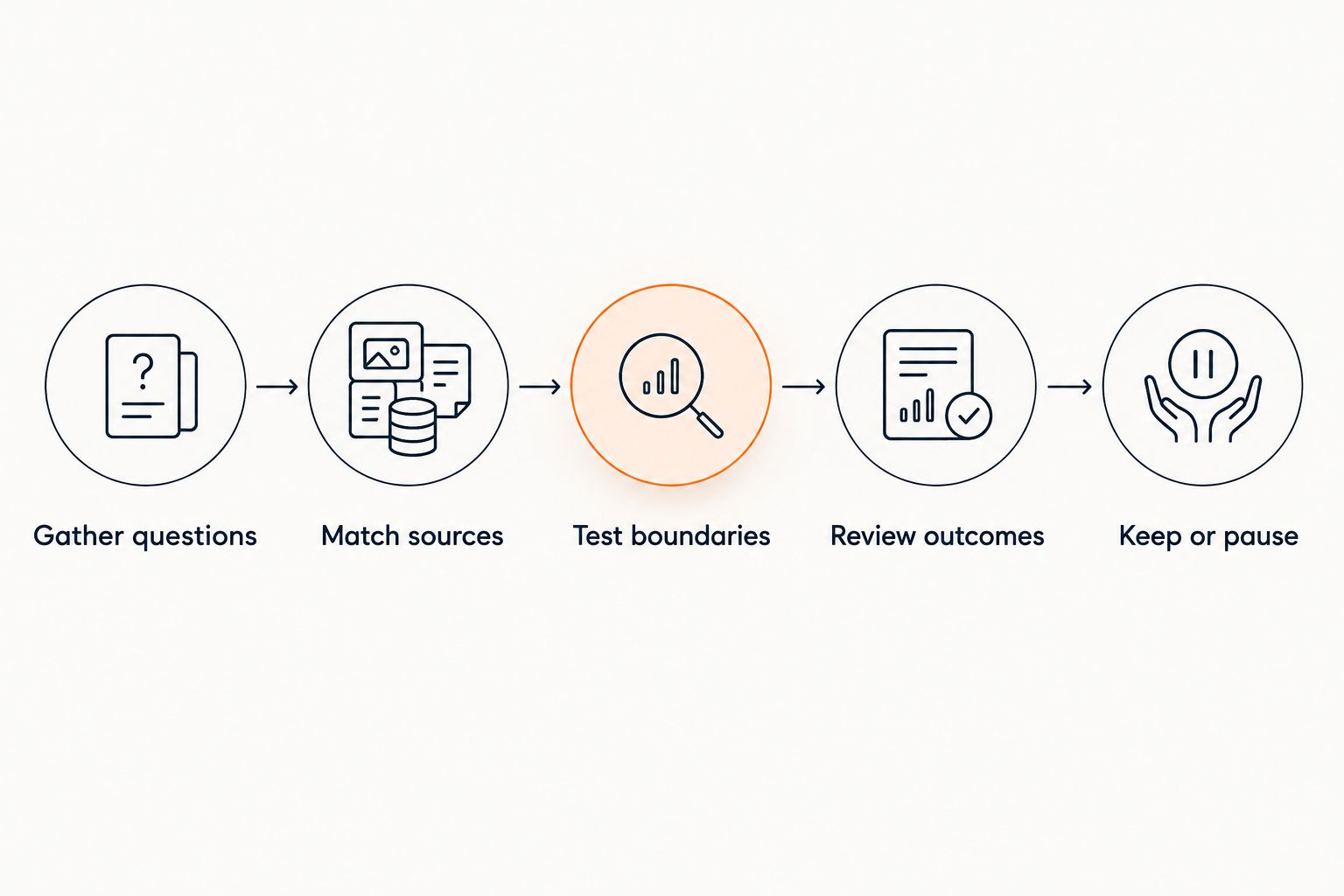
Gather questions
Collect questions from your existing DMs, email, and course or community conversations. Separate repeated factual questions from requests for advice. Keep the visitor’s original wording so your evaluation reflects how people actually ask.
Do not start by writing ideal questions that neatly match your documents. Include short, ambiguous messages as well as clear ones. Those are the situations in which boundaries matter.
Match sources
For each factual question, identify the published passage that supports the answer. If you cannot find one, add or clarify the content before treating the question as suitable for automated answering.
Check whether the passage answers the whole question. A curriculum heading can establish that a topic is included; it does not establish how much individual feedback a participant receives unless the source says so.
Test boundaries
Ask about something absent from the source, a conflicting instruction, and an exception you have not published. A useful evaluation includes questions the widget should not answer as though the facts were known.
For example, ask whether a visitor can receive extra individual coaching when the source does not state that entitlement. The response should identify the limit rather than turn a request into an offer.
Review outcomes
Read the answer beside its citation. Did the cited passage support the claim? Did the response leave out an important condition? Did a request for personal advice stay separate from the published facts?
Record what needed correction. Then distinguish a source problem from an answer problem: rewriting unclear content is different from correcting an unsupported response.
Keep or pause
Keep the widget when it consistently handles the questions you assigned to it and the maintenance work makes sense for your business. Pause the affected use case when answers exceed the sources or repeated corrections remain unresolved.
Judge the widget by supported answers, not confident wording. A refusal can be the correct outcome.
What should the widget say when the source is silent?
A useful refusal states the limit and leaves a clear next step. It does not bury uncertainty under a long answer. The following are illustrative response patterns, not quoted product responses or promises about a specific configuration.
| Visitor request | Example response boundary | What to avoid |
|---|---|---|
| An unpublished discount | “I can only quote what’s published. The provided material does not state that discount.” | Inventing a promotion |
| A refund exception | “The published policy does not describe that exception. Ask the coach to review your request.” | Approving an exception |
| A promised result | “The provided material does not establish your individual outcome.” | Making an income promise |
| Unlisted personal support | “The source does not state that individual support is included.” | Expanding the offer |
These examples expose a useful boundary: the widget can report what the content says without deciding what the coach should agree to. A request remains a request until you make the decision.
Can a chat widget replace my DMs?
A chat widget can answer the subset of DM questions supported by published content; it does not replace personal conversations. Move recurring factual answers into your sources, and keep coaching advice, exceptions, and relationship-sensitive exchanges with you.
The goal is not to eliminate messages. It is to stop making visitors wait for information you have already made available.
Is an FAQ enough for a solo coach?
An FAQ is enough when visitors can easily find the answers they need and those answers stay short and stable. Chat becomes relevant when questions use varied wording or require locating information across several pieces of content.
Keep the FAQ clear either way. A chat widget should not become an excuse for leaving your offer page difficult to understand.
Does lead capture make the widget worth it?
Lead capture supports follow-up, but capturing a contact does not prove that the visitor received a useful answer or will become a client. Treat the unresolved question as the reason for the conversation, not just an opportunity to collect details.
HelpShelf’s coaching chat widget includes lead capture alongside cited answers. You still need to decide who replies, what they address, and how you keep that response within your published offer.
FAQ
Is an AI chat widget worth it for a solo coach in 2026?
Yes, when repeated pre-sale or support questions have reliable published answers. Keep personal recommendations, unpublished exceptions, and unclear offer details outside automated answers.
What should I automate first in my coaching business?
Start with repeated factual questions that your existing coaching content already answers. Match each question to a source before using it to evaluate chat.
Can an AI chat widget answer questions from my course content?
HelpShelf uses a creator’s own course, coaching, or community content to provide answers with cited sources. Check that the cited passage supports the whole answer, not just a related topic.
Is source-grounded chat better than a static FAQ?
Source-grounded chat fits questions asked in varied wording, while a static FAQ fits short, stable answers visitors can find directly. Neither replaces a coach’s judgment about personal circumstances.
What if my chatbot gets asked about an unpublished discount?
The answer should not invent a discount. A suitable response states that the provided material does not publish one and leaves any decision with the coach.
Do I need to publish answers before adding a chat widget?
Yes, source-grounded answers need material that supports them. Write down repeated answers and resolve conflicting instructions before expecting chat to explain them.
How do I know whether my coaching chatbot is useful?
Review whether real questions receive accurate answers supported by their citations. Also check refusals, unresolved questions, and the maintenance work required to keep the sources current.
One last thing
For your 2026 decision, test a question whose answer is deliberately absent from your content. That test reveals whether the widget respects the edge of what you have published.
A polished answer to a documented question shows retrieval. A clear refusal on an undocumented exception shows the boundary you need. Do not launch a broader use case until both behaviors fit the job.