
Help Scout is worth it for a one-person coaching business when keeping track of client conversations is the problem you need to solve. It is not the first purchase to make when your inbox is manageable and your main problem is repeatedly answering questions already covered in your course or sales pages. The extra work to account for is setup, maintaining your answers, and checking that unresolved conversations still reach you.
- Is Help Scout worth it for a one person coaching business? Yes for conversation management; not automatically for repeat questions.
- Help Scout is best for solo coaches who need a shared-inbox workflow, even before adding another person.
- Keep your current inbox if you can reliably track conversations and answer requests without adding another system.
- For source-grounded pre-sale answers, compare the answer workflow—not just the inbox.
Why this matters
A prospective client asks whether your program includes individual feedback. An existing client needs help accessing a lesson. Someone else wants an exception to your refund policy. These are different jobs, even if all three arrive as messages.
Your 2026 support decision should start with those jobs, not a feature list. The broader help desk software guide for course creators and coaches helps frame the category, but the deciding question is narrower: do you need better conversation tracking, better published answers, or both?
Is Help Scout worth it for a one-person coaching business?
Choose Help Scout when the work is losing its place, not simply repeating itself. Help Scout's shared inbox and help-center tools fit a business that needs a more deliberate support workflow. Being the only person answering does not remove the need to know which conversations still require action.
That does not make a help desk necessary for every coach. If you already know which requests are open and your clients receive clear replies, another workspace needs a specific purpose. Buying software without naming that purpose gives you another place to check.
| Option | Best for | Main advantage | Main limitation | Verdict |
|---|---|---|---|---|
| Help Scout | A solo coach who needs structured conversation management | A dedicated place to manage support conversations and publish help content | You still need to define ownership, maintain answers, and resolve exceptions | Choose for conversation tracking |
| Your existing email inbox | A solo coach whose current support process remains manageable | Keeps the workflow familiar | You must keep unanswered and unresolved requests visible yourself | Keep while it works |
| HelpShelf | Creators who need cited answers from their own content and lead capture | Answers pre-sale and support questions using creator-provided material | Source-grounded answers depend on what your material actually states | Consider for repeat published questions |
These options address different parts of the same workload. An inbox organizes the conversation; published content supplies the answer; a source-grounded widget uses that content to respond. Judge each part separately rather than treating every message as an inbox problem.
What would justify Help Scout?
Picture a client who reports an access issue, sends another detail, and later asks whether you have resolved it. You need the conversation history and a clear next action. A well-run support inbox suits that task because the case remains a conversation, not an isolated answer.
Now picture a prospect asking what a lesson covers. If the answer already exists in your published outline, organizing the incoming message does not remove the need to answer it. The decision changes when your main workload consists of these repeat information requests.
What would not justify it?
An empty support queue does not need a more elaborate process just because your business sells coaching. Nor does a shared inbox substitute for a clear program description. If buyers keep asking whether calls are included because the sales page never says, fix the page first.
Do not buy a help desk to compensate for an unpublished policy. The software cannot decide your refund terms, define your boundaries, or make an unclear offer specific. Those decisions belong to you before they belong in a support system.
Why Help Scout's value varies for solo coaches
Your 2026 decision depends on how support behaves inside your business. Use these factors to identify the job you are actually buying software to do:
- Conversation continuity. An issue that needs several exchanges benefits from a clear history and next action. A question answered by a published sentence has a different requirement.
- Need for personal judgment. Coaching suitability, account disputes, and requested exceptions need your decision. A published course outline does not settle them.
- Clarity of your content. A help center or source-grounded answer is useful only when the underlying material explains the question correctly.
- Where requests arrive. If clients contact you across separate channels, decide which requests belong in the support workflow. Adding an inbox does not, by itself, establish that boundary.
- Willingness to maintain the system. Someone must keep policies current, review unanswered questions, and close the loop with clients. In a one-person business, that person is you.
A solo coach can need a structured support process without needing a large support operation. The useful distinction is not small versus big. It is whether the proposed workflow makes a specific recurring task easier to complete and verify.
Test the workflow before changing your support system
For a 2026 evaluation, use a 7-day review of your own messages. This is a suggested observation period, not a promised time to results. Include a representative enrollment or delivery period if an ordinary week misses the work you want to assess.
Record what each request required, rather than just counting messages. A short question about a disputed charge needs more judgment than a longer question answered directly in your course outline.
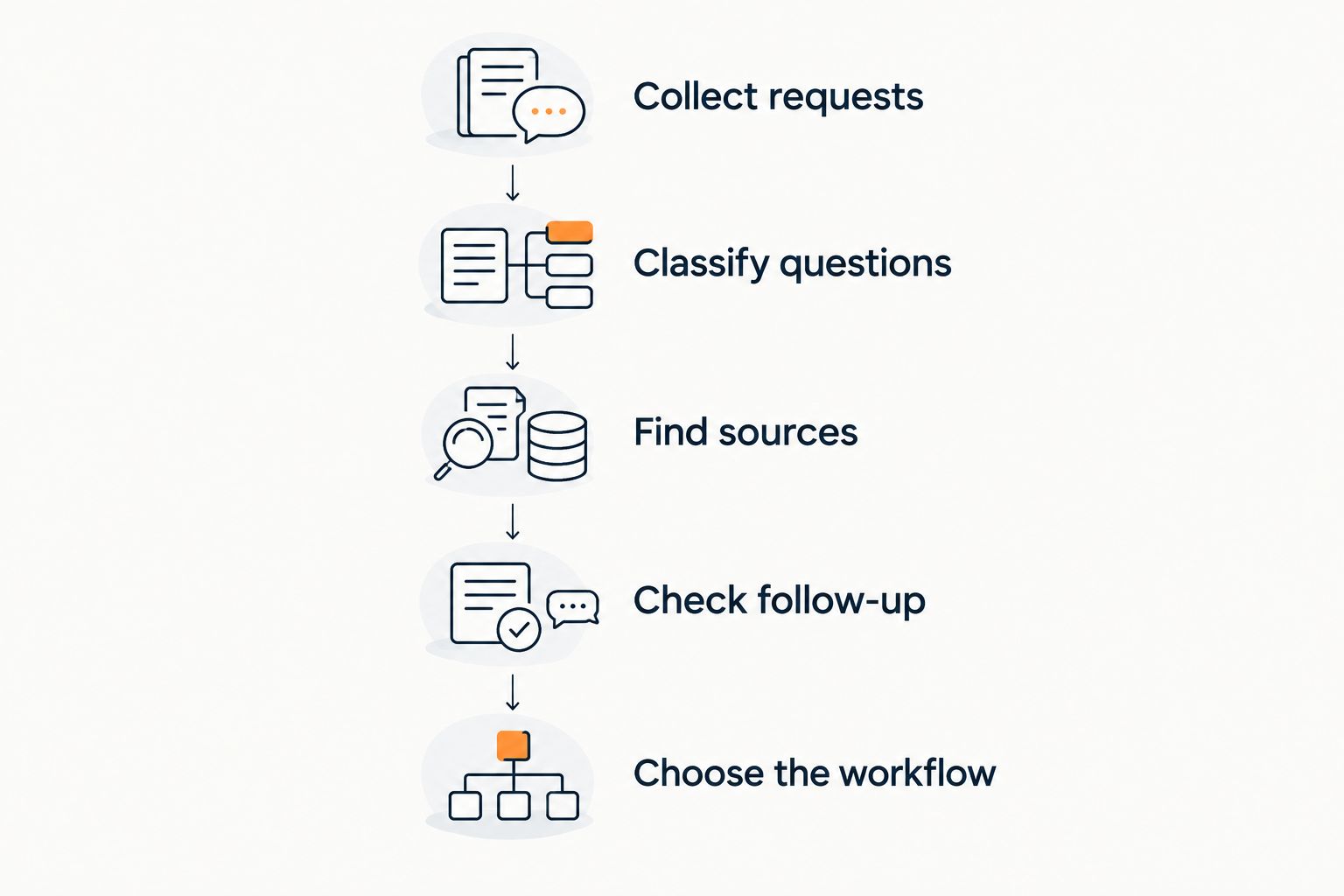
- Collect requests. List incoming buyer and client questions from the channels you already monitor. Do not move private client details into a public help document.
- Classify questions. Mark each request as published information, personal judgment, or an unresolved service issue. Keep the categories consistent.
- Find sources. For published-information questions, identify the exact passage that answers them. If none exists, note the content gap rather than writing an answer from memory.
- Check follow-up. Identify conversations where you lost track of the next action. Distinguish a missing reply from a question that simply required time to resolve.
- Choose the workflow. Select conversation management for tracking problems, improve content for missing answers, and assess source-grounded responses for repeated published questions.
The review should leave you with examples you can replay in a product evaluation. A demonstration is useful when it handles your actual questions, including the awkward ones, rather than only showing a clean sample conversation.
What should you test with real coaching questions?
Use 3 test cases in your 2026 shortlist: a published answer, a missing answer, and a request for an exception. These are evaluation scenarios, not product-performance claims. Together, they show whether the workflow distinguishes information from authority.
A published answer
A prospect asks whether the program includes feedback on assignments. Point the evaluation at the passage that states what is included. Check whether the answer preserves the distinction between feedback, individual coaching, and anything else your material names.
The answer should not expand the offer. If the source says feedback is provided in a group setting, the response should not turn that into private access to you. A readable answer is not enough; the meaning must stay intact.
A missing answer
A prospect asks whether you offer an arrangement that your published material does not mention. The correct behavior is to identify the gap, not fill it with an attractive assumption. Treat an unsupported affirmative answer as a failed test.
A suitable refusal would be: I can only quote what's published. The material here does not confirm that arrangement; you'll need the coach to confirm it. This is an example response, not a quotation from a vendor or a promise about an automatic result.
A requested exception
A client asks for a refund outside the terms you have published. The workflow should preserve the published terms and leave any decision about an exception to you. No invented discounts, no refund exceptions, and no income promises belong in an automated answer.
Test the next step as carefully as the refusal. Can you tell what the visitor requested and what still needs a decision? A boundary is useful only if the unresolved question does not disappear after the system states it.
When does a source-grounded widget fit better?
HelpShelf is best for creators who need a chat widget to answer questions from their own content with cited sources and capture leads. That is a narrower recommendation than replacing every part of client support. It fits published pre-sale and support information, not authority to change your offer.
For example, a visitor asks what a course covers while you are away. The useful answer points back to the relevant course material. If the visitor asks for a guarantee your material does not provide, the useful response stops at that boundary rather than supplying a reassuring invention.
HelpShelf's source-grounded chat widget uses the creator's material, so the preparation still matters. Contradictory descriptions and incomplete policies leave unresolved questions. Before evaluating any answer, make sure you can identify which source should govern it.
For a 2026 evaluation, keep lead capture separate from resolution. Recording someone's interest does not mean answering their suitability question, approving an exception, or resolving their account issue. Define what you will review personally before directing visitors into the new workflow.
Should you keep your existing inbox instead?
Keep your existing inbox when you can reliably see what needs a reply and what needs further action. Familiarity has practical value: you already know where messages arrive and how you respond. A replacement should solve an observed problem, not just present a different interface.
The limitation is your own tracking process. If a conversation falls out of view after you reply but before the issue is resolved, improve that process or evaluate a dedicated support inbox. Do not confuse an empty unread count with completed client support.
Write down the rule you need the system to enforce. For example, every unresolved access issue needs a visible next action. That rule gives you a concrete basis for assessing Help Scout without assuming that every available feature belongs in your business.
Can you use a help desk and a chat widget together?
You can design a workflow that uses both, but each needs a separate job. Let published-information questions follow the approved content, and keep personal decisions and unresolved cases in a human support process. Do not assume a native connection or automatic transfer without checking the current implementation.
Before adding another tool, specify what you need to receive when a question remains unanswered. The original question, the answer already given, and the remaining decision are useful requirements. Verify how your chosen setup supplies that context rather than assuming the conversation will arrive intact.
FAQ
Is Help Scout worth it if I'm the only person answering clients?
Help Scout is worth considering when you need a dedicated workflow to track client conversations and unresolved requests. Being the only responder does not remove that need, but a manageable existing inbox does not automatically need replacing.
What's the best reason for a solo coach to choose Help Scout?
Conversation management is the clearest reason to choose Help Scout. Evaluate it against real cases where you need history, follow-up, and a visible next action rather than only a quick factual answer.
Should I choose Help Scout just to answer repeat course questions?
Do not choose Help Scout solely because questions repeat. First check whether your published content answers them, then decide whether you need a help center, a source-grounded answer workflow, or better conversation tracking.
How long should I review my support messages before choosing?
A 7-day review is a practical starting exercise, not a validated requirement. Include a representative enrollment or delivery period if that better reflects the questions your coaching business receives.
Can a chatbot approve refund exceptions for my coaching clients?
A chatbot should not invent or approve refund exceptions on your behalf. It should preserve your published terms and leave decisions outside those terms to you.
Is HelpShelf a fit for a one-person coaching business?
HelpShelf fits creators who need cited answers from their own course, coaching, or community content and lead capture. It does not remove the need to publish accurate information or personally decide questions outside that information.
What should I check before using both an inbox and a widget?
Check how an unanswered question reaches your human support process. Verify the actual implementation, including the context you receive, rather than assuming a native integration or automatic transfer.
One last thing
Test what happens after you have replied. A client can read your message and still be unable to access the course. A prospect can receive the correct program description and still need your judgment about fit.
For your 2026 decision, choose the smallest support workflow that keeps those unfinished situations visible. Help Scout earns its place when conversation management is the missing piece. Clear published answers and a reliable personal follow-up process still need their own attention.