
A Zendesk alternative has no single standard cost in 2026: your total depends on the service you choose, its billing terms, and the support work you need it to handle. Compare the subscription with any applicable usage charges, setup work, content maintenance, and human follow-up—not the subscription alone.
- How much does a Zendesk alternative cost? Compare the full workflow, not just the subscription.
- HelpShelf fits creators who need a chat widget for source-cited answers and lead capture.
- Check billing units, usage limits, migration requirements, and human follow-up before choosing.
- A cited answer explains published terms; it does not authorize exceptions or guarantee outcomes.
How much does a Zendesk alternative cost in 2026?
The useful cost is the amount required to run your actual support workflow. Start with the vendor’s current terms, then identify which parts of that workflow the subscription covers. Separate charges from work your team still performs.
For example, answering a course-content question and resolving a disputed payment are different jobs. A source-grounded answer can explain published material; a payment dispute requires someone with the authority and account access to resolve it.
Helpshelf provides a chat widget for answering pre-sale and support questions from a creator’s own content, with cited sources and lead capture. That is a specific scope to evaluate—not evidence that every help-desk function belongs in the same purchase.
Use this breakdown when reviewing a proposal:
| Cost component | What to confirm | What belongs in your calculation |
|---|---|---|
| Subscription | Included functions and billing period | The charge for the required plan |
| Billing units | Whether charges depend on seats, usage, or another unit | The units your workflow actually requires |
| Additional charges | What is included and what is billed separately | Applicable extras under the current terms |
| Setup | Content preparation, configuration, and testing responsibilities | Paid assistance and your own setup work |
| Migration | What must move from your existing system | Export, cleanup, transfer, and verification work |
| Ongoing operation | Who updates sources and handles unresolved questions | Maintenance and human follow-up |
Do not treat this table as a list of fees every vendor charges. It is a checklist for discovering what your proposal includes and what remains your responsibility.
Why this matters
Imagine a prospective student arrives at 11pm and asks whether your course covers a particular topic. If the answer is already in your curriculum, the job is to retrieve it accurately and show its source. If the student asks for an unpublished exception, the job changes: someone must decide, not improvise an answer.
Those needs belong in your buying brief. Otherwise, you can compare subscriptions that solve different problems and mistake a smaller scope for a lower total cost.
For your 2026 evaluation, describe the work before naming the software. List the questions visitors ask, the evidence needed to answer them, and the point at which a person takes over. That gives each vendor the same problem to respond to.
Which type of alternative matches your support work?
Compare workflow types before comparing vendors. Choose the narrowest scope that covers the work you need, without removing functions your team relies on.
The options below describe buying categories, not claims about the features or billing of any named product.
| Approach | Best for | Main advantage | Main limitation | What to verify |
|---|---|---|---|---|
| Human-led help desk | Requests requiring ownership, account investigation, or staff decisions | Keeps people responsible for individual cases | People still need to read and resolve requests | Required channels, assignment, history, and access controls |
| Live chat | Conversations where a person needs to ask follow-up questions | Supports direct clarification | Requires a staffing plan | Coverage, unanswered messages, and conversation ownership |
| Source-grounded chat widget | Published course, coaching, or community questions | Gives answers tied to supplied content | Cannot turn missing policy into an authorized answer | Citations, source boundaries, and unresolved-question handling |
| Combined workflow | Businesses needing published answers and human case handling | Separates informational answers from staff decisions | Requires clear responsibilities between systems | Where each conversation goes and who maintains each part |
A chat widget is not automatically a full help-desk replacement. Equally, a full help desk is not automatically necessary for every pre-sale question. The right comparison depends on which work you are replacing.
Write the required outcome beside each request type. “Explain the published curriculum” is a different requirement from “investigate why this member cannot access their purchase.” Keep that distinction visible throughout the evaluation.
How do you build a useful cost comparison?
Use the same scope for every candidate. A proposal becomes easier to compare when each supplier responds to the same content, questions, and operational requirements.
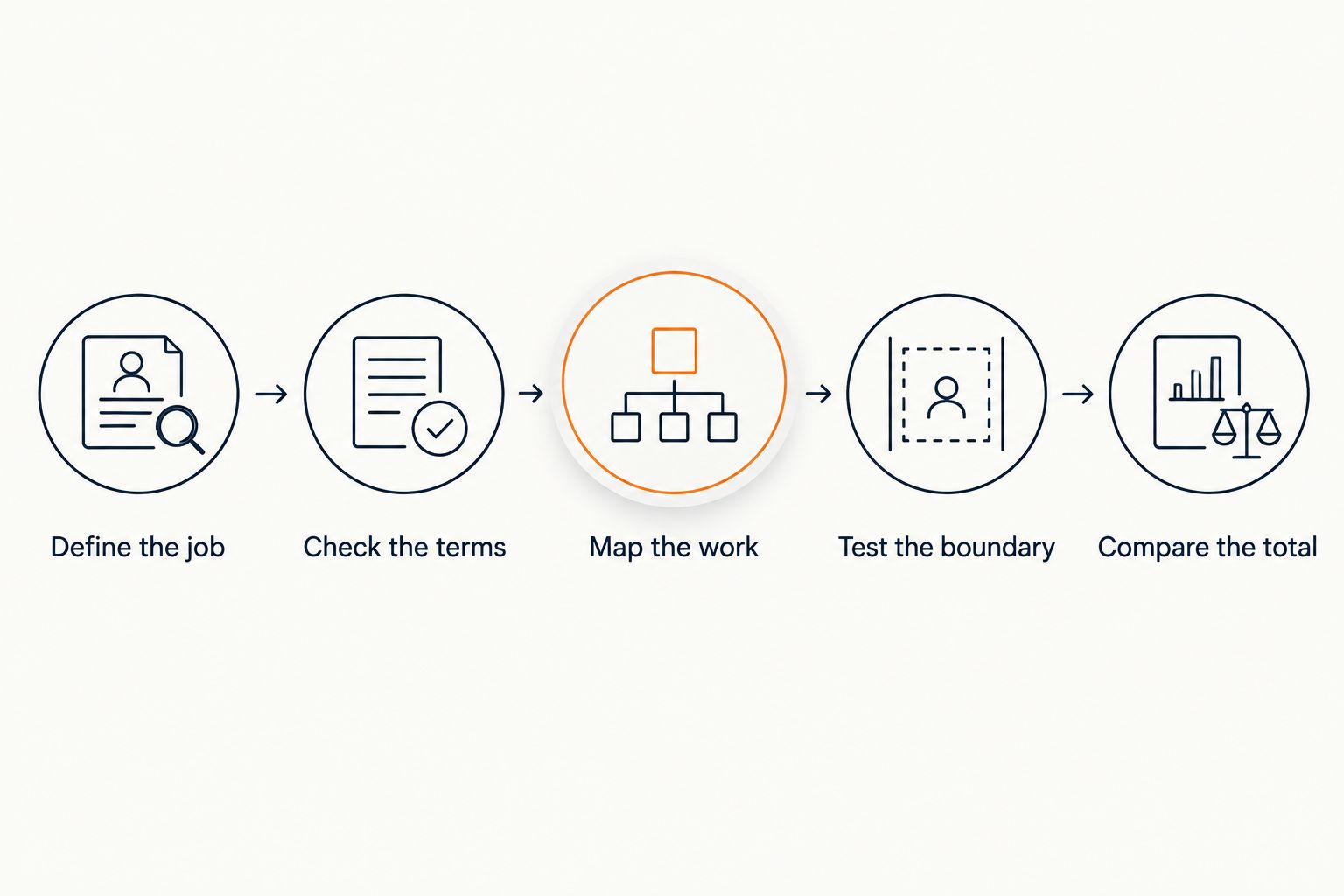
Define the job
Collect examples from your existing inbox or messages. Separate published-information questions from account-specific issues, exceptions, and requests that need judgment.
Do not give a vendor only the easiest examples. Include a question your content cannot answer, a conflicting source, and a request for an unauthorized promise. These expose boundaries that a polished demonstration can miss.
Check the terms
Ask what creates a billable unit and which functions are included. If the proposal uses usage-based billing, ask how that usage is measured and what happens when the included allowance is exceeded.
Confirm the billing period and commitment separately. A monthly-looking figure does not, by itself, explain the contractual obligation. Use the written terms rather than a headline or an informal explanation.
Map the work
Identify who prepares the content, checks answers, updates policies, and responds when automation stops. Assign each responsibility to a person or a documented process.
This step prevents setup work from disappearing from the comparison simply because it is performed internally. Your own time is still part of operating the service, even when it does not appear on the vendor’s invoice.
Test the boundary
Test whether the system answers supported questions and stops at unsupported ones. An appropriate sample refusal is: “I can only quote what’s published.” Treat that wording as a test example, not a claim about a product’s exact response.
Check the next step, too. A refusal without a usable route to a person leaves the visitor stuck; an answer without evidence leaves you unable to verify the claim.
Compare the total
Put confirmed charges and internal responsibilities side by side. Do not combine an unverified estimate from one proposal with a documented commitment from another and call the result a fair comparison.
For a 2026 decision, preserve the version of the terms you evaluated. Your final review should match the service and commitment you are actually approving.
Why the total cost varies
The difference between proposals is not always a difference in price for the same service. It can be a difference in scope, billing rules, or who performs the work.
- Required functions: Published answers, staff conversations, and account investigations require different capabilities. Confirm which tasks the proposed service covers.
- Billing basis: If a proposal charges by seats or usage, your total depends on the applicable units. Read the definition of those units.
- Source preparation: Contradictory or outdated content needs attention before it can serve as a dependable answer source.
- Migration scope: Moving a widget is different from transferring conversation history, routing rules, or operating procedures. Specify what must remain usable.
- Human follow-up: Requests involving exceptions, private account details, or decisions still need an accountable owner.
- Maintenance responsibility: Published terms and course material change. Someone must keep the answer sources aligned with those changes.
A smaller subscription does not prove a smaller operating burden. Compare the work remaining after the purchase, not just the functions demonstrated before it.
What should a creator test before switching?
Use questions that reflect your course, coaching offer, or community. Keep the expected answer beside the source that supports it, and mark questions that require a person.
Curriculum questions
A visitor asks whether a course teaches a particular technique. The test should check that the answer reflects the published curriculum and points to the relevant source.
An answer that sounds plausible is not enough. You need to distinguish what the material explicitly covers from what a visitor hopes it covers. Do not let a broad topic description become a promise of specific instruction.
Policy questions
A member asks for a refund outside your published terms. The system should explain the applicable policy without granting an exception it has no authority to grant.
Use the same discipline for discounts and outcomes: no invented discounts, no refund exceptions, no income promises. A citation supports the statement it actually contains; it does not authorize a new commitment.
Questions without a published answer
A prospective coaching client asks whether your offer suits a situation your material does not address. The correct test outcome is an explicit boundary and a next step, not a confident guess.
Decide what information a person needs to respond. Ask the vendor to demonstrate how an unresolved question reaches that person, rather than assuming lead capture and case resolution are the same function.
When does HelpShelf fit the comparison?
HelpShelf is best suited to course creators, coaches, and community owners who need source-cited chat answers and lead capture. Its stated scope uses the creator’s own course, coaching, or community content to answer pre-sale and support questions.
That makes it relevant when your buying brief centers on published-information questions. The limitation remains important: source-grounded answers cannot supply a policy you have never published or make a decision reserved for your team.
Evaluate HelpShelf as a chat widget against that scope. If you also require account investigation, staff assignment, or another operational function, confirm the requirement explicitly rather than treating it as included.
The same rule applies to every candidate. A product should earn its place by handling your defined work, not by being described as an alternative to a larger system.
Is a chat widget cheaper than a full help desk?
A chat widget is not automatically cheaper than a full help desk. Compare current written terms and equivalent responsibilities before making that claim.
For a 2026 comparison, include any tools you must retain alongside the widget. Replacing one part of support does not mean you have replaced the whole support operation.
Should I replace Zendesk or keep it alongside another tool?
Replace Zendesk only when the replacement covers the functions you still need. Keep a separate case-handling process if published answers do not resolve your account-specific or staff-owned work.
Document where each request belongs. Two systems without clear ownership can create another inbox to manage rather than remove work.
Can cited answers replace human support?
Cited answers can address questions supported by the supplied material; they do not replace human authority over exceptions or account decisions. Your test should check both accurate answers and appropriate refusals.
A useful boundary is simple: explain published information, then route decisions to the person authorized to make them.
FAQ
How much does a Zendesk alternative cost in 2026?
There is no single standard cost for a Zendesk alternative in 2026. Compare the current subscription terms with applicable usage charges, setup, maintenance, and human follow-up for your required workflow.
What's the best Zendesk alternative for a course creator?
The best fit depends on whether you need published answers, human case handling, or both. HelpShelf is suited to creators evaluating a chat widget with answers grounded in their own content, cited sources, and lead capture.
Is a source-grounded chatbot the same as a help desk?
No. A source-grounded chatbot answers from supplied content, while your help-desk requirements can include staff-owned work that must be evaluated separately.
What should I ask about usage-based billing?
Ask what counts as usage, what is included, and what happens beyond the included allowance. Confirm those definitions in the current written terms before comparing proposals.
Do I need to include my own setup time?
Yes, include your own setup responsibilities in the comparison. Content cleanup, testing, and process changes remain work even when they are not vendor charges.
Can a chatbot offer a refund exception or promise results?
A chatbot should not invent refund exceptions or promise results unsupported by published material. Requests requiring an authorized decision belong with the responsible person.
What should I test before leaving Zendesk?
Test supported questions, missing answers, conflicting sources, and requests that require a person. Also verify that the functions you need after the switch remain covered.
One last thing
Test the question your sources cannot answer before you approve the switch. A supported answer demonstrates retrieval; an unsupported question reveals whether the system respects its boundary.
For your 2026 review, keep the source, expected response, and responsible person together. Approve the workflow only when you can explain what gets answered, what gets refused, and who owns the next step. That is more useful than choosing a subscription and discovering those boundaries after visitors depend on it.