
A chatbot used by a Skool community is not necessarily a built-in Skool chatbot: “built-in” means Skool supplies the feature itself, not that a separate service answers questions about your community. For a 2026 setup, confirm native member Q&A in Skool’s current feature documentation, and evaluate third-party chat separately for content access, citations, and where members can use it.
- Does Skool have a built in AI chatbot? Community use alone does not establish that a chatbot is native.
- HelpShelf serves creators who need source-cited answers from their own course, coaching, or community content.
- Member support and pre-sale questions need separate content boundaries; private lessons do not belong in public answers.
- Confirm chat placement and content access before treating any third-party service as part of your Skool community.
Why this matters
At 11pm, a member asks where to find the worksheet for a lesson. The useful answer points to the right material; a fluent explanation of what a worksheet usually contains does not help. Your first decision is whether the answer comes from your actual content, not whether the chat box looks integrated.
HelpShelf provides a chat widget that answers pre-sale and support questions using a creator’s own content, with cited sources, and captures leads. That describes its purpose, not proof of any particular placement inside Skool. Keep those questions separate when choosing a setup.
An answer service and a community platform are different responsibilities. One holds the member experience; the other needs an approved source for each answer. Calling both a single integration hides the details you need to check.
Does Skool have a built-in AI chatbot for members?
Treat “built-in” as a product-ownership question. A native feature must be offered by Skool itself; a service selected by a community owner remains third-party, even when it answers questions about that owner’s Skool content.
For your 2026 evaluation, ask for current documentation showing who supplies the chatbot, where members open it, and which material it can use. A demonstration of an answer is not enough. You also need to see how the question reached the service and how the service obtained its source.
The following table separates the approaches you are evaluating. It is a decision framework, not a claim that Skool currently supplies a native chatbot.
| Approach | Best for | Main advantage | Main limitation | Evidence to request |
|---|---|---|---|---|
| Native member chatbot, if documented by Skool | Owners who require a platform-supplied feature | Meets the native-feature requirement | Native status alone does not establish answer quality | Current Skool feature documentation and a member-facing demonstration |
| Separate source-grounded chatbot | Creators who want answers drawn from approved content | Makes source selection and citations part of the evaluation | Requires separate checks for placement, access, and maintenance | An answer traced to an approved source |
| Human member support | Questions requiring judgment or account-specific decisions | Keeps exceptions and sensitive decisions with a person | Requires someone to handle the question | A clear route for unanswered or sensitive questions |
Do not accept “works with Skool” as a substitute for an integration explanation. Ask whether members stay in the community, open another page, or use a separate support location. Those are different experiences, and your choice should reflect the actual route.
What would establish that a chatbot is native?
Look for a current Skool-owned description of the feature and instructions for enabling it. Confirm that the documentation describes conversational answers for members, rather than a different use of automation.
Search, notifications, and conversational Q&A are separate requirements. Your member needs to ask a question and receive an answer based on the correct material. A feature that performs another task does not meet that requirement merely because its description mentions automation.
What should you check about a third-party setup?
Start with the guide to connecting HelpShelf to Skool, then verify the proposed route against your own community’s requirements. Do not infer direct embedding, automatic synchronization, or member permissions from an integration title.
Ask for a walkthrough from the member’s first question to the cited source. If the demonstration skips content preparation or access controls, request those steps before deciding. The missing steps are where your operational requirements belong.
How should you evaluate member answers before choosing a chatbot?
Use a small acceptance test built from your real support questions. For a 2026 evaluation, test the answer, the source, and the refusal separately; a correct answer to an easy question does not establish how the service handles an unsupported request.
The sequence below gives you a repeatable check without relying on an advertised accuracy claim.
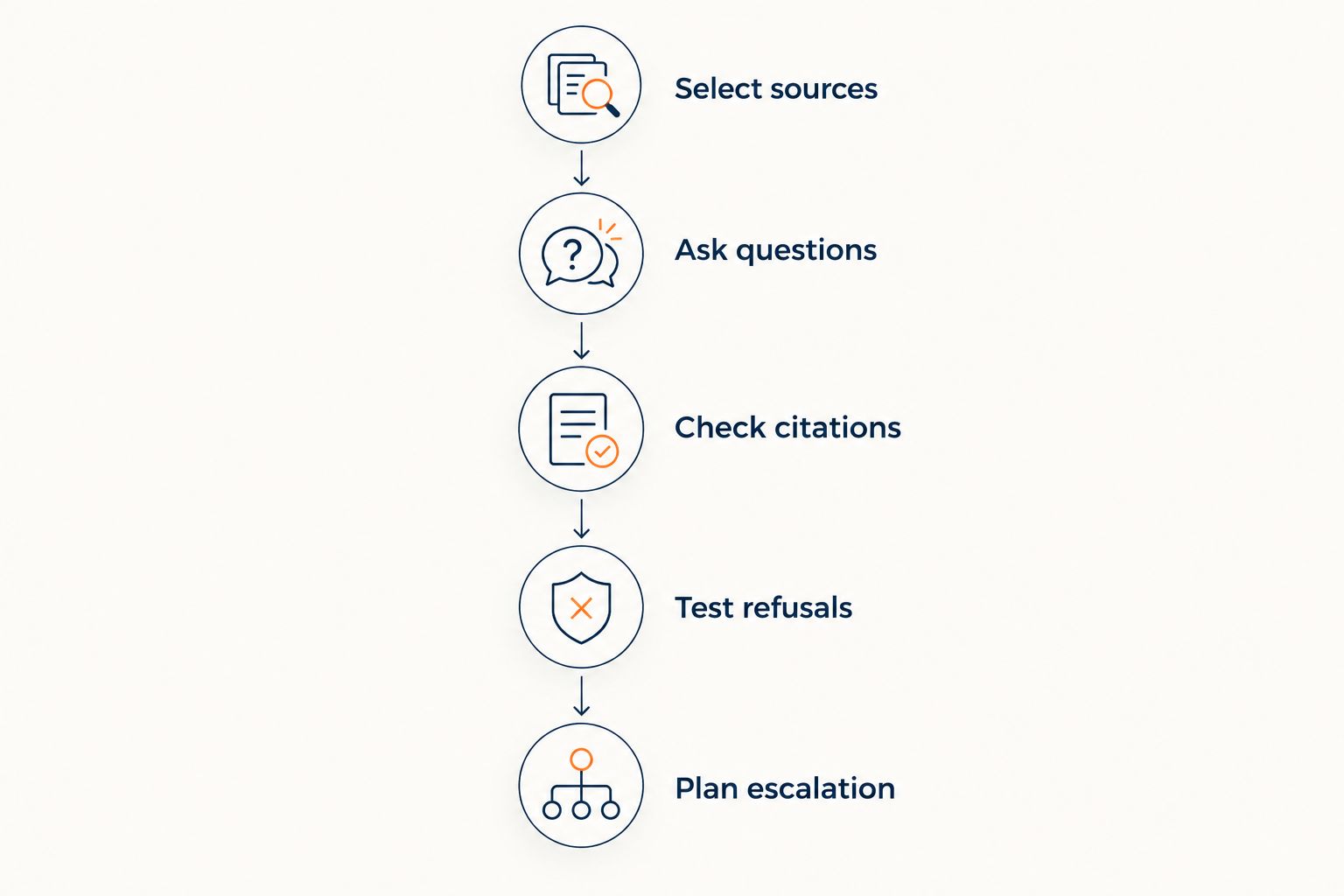
- Select sources. Choose published materials you approve for the intended audience. Identify whether each source is public, member-only, or unsuitable for chat answers.
- Ask questions. Use the wording members actually use, including incomplete questions. Keep the expected answer tied to a specific passage rather than your memory of the course.
- Check citations. Open the cited source and confirm that it supports the answer. A citation to a broadly related lesson is not evidence for an extra promise.
- Test refusals. Ask for something the approved material does not establish. Check that the answer stops at the source boundary instead of filling the gap.
- Plan escalation. Define where a member should take an unresolved question. Keep requests for account changes, exceptions, or personal decisions with the responsible person.
For example, use 6 test questions covering a lesson location, an instruction, a published policy, an unpublished exception, a private-content request, and a missing answer. This is a suggested test set, not a performance benchmark. Replace the examples with your own member questions.
Write the expected source beside each question before testing. Otherwise, a polished answer can distract you from whether it actually follows the material. If two approved sources disagree, resolve the conflict before expecting the chatbot to choose correctly.
What does a useful citation prove?
A useful citation lets you inspect the material that supports a specific answer. If the answer says a worksheet belongs with a particular lesson, the source should establish that connection. A link to the general course description does not establish where the worksheet lives.
Check both the claim and the destination. Members should not receive a source reference that sends them to unrelated material, and prospective buyers should not receive private lesson content through a public conversation. Citation quality and access boundaries need separate tests.
What should a refusal look like?
A refusal should name the boundary and give a practical next step. An illustrative response is: “I can only quote what’s published. Ask the community owner about an exception.” That is a response pattern, not a quotation from a product demonstration.
Keep the rules plain: no invented discounts, no refund exceptions, no income promises. A source-grounded answer quotes or explains an approved policy; it does not turn a member’s request into permission. If the source says nothing about the request, the answer should not create a policy.
Why does the right chatbot setup vary between communities?
The same chat requirement can produce different operating needs because creators publish different material and serve different audiences. Evaluate these factors rather than choosing from a generic feature list.
- Source material. A published course instruction gives the answer a defined basis. An informal discussion or unresolved comment needs review before you treat it as an approved instruction.
- Audience. Prospective buyers need offer information; members need support for content they can access. Keep those source sets distinct wherever their permissions differ.
- Question type. Finding a lesson differs from requesting a policy exception. The first needs retrieval; the second needs a decision from the responsible person.
- Chat location. Confirm the exact place where people ask questions. A separate support page and a chat inside a community are not interchangeable experiences.
- Content maintenance. Decide who updates the approved material when a lesson or policy changes. An answer cannot follow your intended revision if the wrong source remains in use.
- Escalation responsibility. Assign unresolved questions to someone who can act. A refusal without a usable next step leaves the member with the original problem.
For your 2026 review, write down the required outcome for each factor. “Members can locate an approved lesson instruction” is testable. “The community feels automated” is not a useful acceptance criterion.
Where does HelpShelf fit for a Skool community owner?
HelpShelf is best suited to creators who need a chat widget with source-cited answers from their own content and lead capture. Its stated audience includes course creators, coaches, and community owners on platforms such as Skool.
The relevant advantage is the source-grounded answer model: you can evaluate an answer against the content you have approved. The limit is equally important. A citation does not authorize an exception, establish a member’s entitlement, or prove that a particular deployment fits your community.
If your requirement is specifically a native Skool feature, a separate chat widget does not satisfy that requirement. If your requirement is answering questions from approved material, evaluate that capability directly. Keep product ownership, deployment, and answer behavior as separate checks.
For lead capture, define which questions belong before purchase and what information you want a prospect to submit. Do not expose member-only instructions merely to make the public answer longer. A useful pre-sale answer explains the published offer and stops before private course material.
Can a chatbot answer questions from my Skool course content?
A chatbot should answer course questions only from material it is authorized and able to use. Confirm the supported content route and inspect a cited answer; do not assume that mentioning Skool establishes automatic access to every lesson or discussion.
Ask for 2 separate demonstrations: a member question answered from approved course material and a public question answered without revealing that material. These are proposed acceptance checks, not claims about any product’s capabilities. Both matter if you intend to support members and prospective buyers.
Can a chatbot replace the person who supports my members?
Do not replace human responsibility for decisions with a conversational answer. A chatbot can be evaluated for explaining approved material, while account problems, disputed policies, and requests for exceptions remain assigned to a person.
Set 3 review checkpoints: before launch, after a source change, and after an answer is disputed. This is a suggested operating routine, not a measured standard. At each checkpoint, inspect the answer, its source, and the next step offered when the source was insufficient.
What should I ask a chatbot provider before connecting it?
Ask the provider to show the complete member experience, not just a sample response. You need an explanation of chat placement, approved content, citations, audience boundaries, and unresolved questions.
Make the request concrete: show a supported answer, an unsupported request, and a question from someone who should not receive private material. For a 2026 purchase decision, use the current implementation rather than a planned feature. Keep the demonstration results beside your acceptance criteria.
FAQ
Does Skool have a built in AI chatbot for members?
A chatbot serving a Skool community is not proof of a built-in Skool feature. Confirm native member Q&A in current Skool-owned documentation; evaluate any separately supplied chatbot as a third-party service.
Is a Skool chatbot the same thing as a built-in feature?
No: the phrase Skool chatbot does not establish who supplies it. Ask whether Skool provides the feature itself or whether the community owner has selected a separate service.
What's the best chatbot setup for a Skool community?
The best setup is the one that meets your documented requirements for placement, approved content, citations, and audience access. Test those requirements with real member questions before choosing.
Can HelpShelf answer questions from my own creator content?
HelpShelf provides a chat widget that answers pre-sale and support questions using a creator’s own course, coaching, or community content, with cited sources. Confirm the content route and deployment you need for your particular community.
Can I use the same answers for members and prospective buyers?
Use the same answer only when its source is approved for both audiences. Public pre-sale conversations should not reveal private lesson material or imply access that the published offer does not establish.
What should a chatbot say when my policy doesn't answer a question?
The chatbot should state that the published material does not establish an answer and direct the person to the responsible human. It should not invent discounts, refund exceptions, or income promises.
How do I check whether a chatbot citation is useful?
Open the cited source and verify that it supports the specific claim in the answer. A related page is not enough if the answer adds a promise or instruction that the page does not contain.
One last thing
Your most revealing test is not the easiest lesson question. It is a request that sounds reasonable but asks for something you have never published: an exception, an extra entitlement, or a promised result.
Before launching in 2026, put that request into your acceptance test. Keep the setup only if the answer respects the published boundary and gives the member a clear next step. A useful support answer knows where the source ends.