
Best for creator-led sales: HelpShelf. Best for CRM-centered qualification: HubSpot’s chatbot builder. Best for support-led follow-up: Intercom Fin. Best for a live-chat workflow: Tidio Lyro. This guide compares AI chatbots ranked by lead capture features in 2026, with the focus on what happens before and after someone shares an email address.
- HelpShelf is the best fit for creators who need cited course answers and lead capture together.
- HubSpot’s chatbot builder suits CRM-centered qualification; distinguish scripted flows from generated answers.
- Intercom Fin suits support-led conversations; test the route from an unanswered question to human follow-up.
- Tidio Lyro belongs on a live-chat shortlist; verify contact capture and handoff in your intended workflow.
Why this matters
At 11pm, a prospective student asks whether your course covers the problem they are trying to solve. A contact form collects an address, but it does not answer the question. A chatbot that invents an answer creates a different problem.
For a course creator, coach, or community owner, lead capture should preserve the buyer’s actual question. You need to know what they asked, what answer they received, and what still needs your attention.
An email address is not evidence that a sales question was resolved. Treat answer quality and follow-up quality as separate requirements when choosing a chatbot in 2026.
What makes the best lead capture chatbot?
Use these criteria before comparing product names. A long feature list does not tell you whether a buyer can get a useful answer and request follow-up without repeating themselves.
- Answer grounding: The chatbot should distinguish published information from assumptions. For curriculum and policy answers, inspect the supporting source.
- Capture timing: Ask for contact details at a relevant point, rather than making every visitor complete a form before receiving help.
- Qualification context: Preserve the buyer’s goal and unresolved question. Do not confuse collecting fields with determining fit.
- Follow-up clarity: Make the next step explicit. A saved conversation and a request for a human response are different events.
- Operational fit: Check where contact details and conversation context go, who owns them, and how your team responds.
Set your non-negotiables first. A solo coach answering course questions has a different workflow from a sales team assigning conversations inside a CRM.
Lead capture chatbots at a glance
This is a use-case ranking, not a conversion-rate leaderboard. The products below serve different workflows; the ranking does not establish that one produces more leads than another.
| Rank and option | Best for | Standout feature or approach | Key limitation to assess |
|---|---|---|---|
| 1. HelpShelf | Creator-owned content and pre-sale questions | Cited answers from course, coaching, or community content, plus lead capture | Published content must support the answer |
| 2. HubSpot’s chatbot builder | CRM-centered qualification | Chatflows connected to a CRM workflow | Scripted qualification is not the same as source-cited answering |
| 3. Intercom Fin | Support-led conversations | Automated support answers with a human handoff path | Support resolution and sales qualification need separate acceptance tests |
| 4. Tidio Lyro | Businesses organizing follow-up around live chat | Knowledge-based automated answers within a live-chat environment | Contact capture and follow-up behavior need end-to-end testing |
For your 2026 shortlist, choose the workflow first. Then test whether the product’s current configuration performs the specific capture, routing, and answer tasks you require.
1. HelpShelf: best for creator-content lead capture
HelpShelf provides a chat widget that answers pre-sale and support questions using a creator’s own content, includes cited sources, and captures leads. Its stated audience includes course creators, coaches, and community owners using platforms such as Kajabi, Skool, and Whop.
Consider a prospective student asking whether your course teaches a particular technique. The useful response identifies what the published curriculum covers and cites the source; it does not infer that an adjacent lesson must include the requested material.
HelpShelf pros:
- Brings creator-content answers and lead capture into the same widget.
- Provides citations so visitors can inspect the basis of an answer.
- Addresses pre-sale questions as well as support questions.
HelpShelf cons:
- Source-grounded answers depend on what your published content actually explains.
- Capturing a lead does not remove your responsibility to answer unresolved questions or make judgment calls.
Best for: Creators who want a prospective buyer to get a cited answer before requesting further help.
Use a strict acceptance rule: no invented discounts, no refund exceptions, and no income promises. When information is absent, require a refusal that states the boundary rather than filling the gap.
For example, your test could require this response: I can only quote what’s published. That exception is not stated in the policy. This is sample acceptance wording, not a claim about a recorded conversation.
Verdict: Buy for the creator-content use case after testing your actual questions and sources.
2. HubSpot’s chatbot builder: best for CRM-centered qualification
HubSpot’s chatbot builder supports chatflows for tasks such as collecting information and qualifying visitors within a CRM-centered workflow. It belongs on your shortlist when the contact record and the next sales action are central to your decision.
Keep the comparison precise: a scripted chatbot flow is not automatically a generative answer system. Evaluate any generated-answer capability separately from the branching questions that collect visitor details.
HubSpot pros:
- Connects the qualification conversation to a CRM-centered process.
- Supports structured questions rather than relying entirely on open-ended conversation.
- Gives teams a concrete way to define what information a qualifying visitor should provide.
HubSpot cons:
- Branching questions require you to anticipate the paths visitors need.
- A completed qualification flow does not establish that the buyer received a source-supported answer.
Best for: Teams that already organize sales work around contact records and defined qualification steps.
Test a buyer who changes direction midway through the conversation. Someone who starts with a coaching question and then asks about course access should not be treated as qualified simply because they completed the original fields.
Your 2026 evaluation should also distinguish a contact being created from a follow-up task being assigned. Inspect the resulting record instead of judging the chat window alone.
Verdict: Buy when CRM-centered qualification is your primary requirement.
3. Intercom Fin: best for support-led follow-up
Intercom Fin is an automated customer-support agent with a path to human support. It belongs in this comparison when prospective buyers and existing customers bring questions into the same support environment.
The buying question is whether that support workflow also captures the information your sales follow-up needs. A conversation about an existing account is not automatically a new sales lead.
Intercom Fin pros:
- Fits an automated-answer and human-support workflow.
- Gives support-led teams a relevant place to evaluate unresolved-question handoff.
- Supports an evaluation centered on the conversation, not just a detached contact form.
Intercom Fin cons:
- Support resolution and lead qualification are different jobs; test both explicitly.
- Human handoff still requires ownership, staffing, and a clear response process.
Best for: Businesses whose support conversations are also a route to pre-sale follow-up.
Run a scenario in which an existing member asks about a different course. Check whether the resulting conversation preserves both identities: current customer and prospective buyer. Your team needs the question and its context, not merely a label that says support.
Do not assume an answer marked resolved means a purchase objection disappeared. Ask whether the visitor’s original question was answered and whether further contact was requested.
Verdict: Buy for a support-led workflow; hold if your main need is structured sales qualification.
4. Tidio Lyro: best for a live-chat-centered workflow
Tidio Lyro provides automated answers based on supplied knowledge within Tidio’s customer-conversation environment. It is a relevant option when you want to evaluate automated answering alongside live-chat follow-up.
Treat the full conversation as the unit of comparison. An automated reply, a captured email address, and a human response are separate parts of the workflow.
Tidio Lyro pros:
- Offers knowledge-based automated answering.
- Belongs in a live-chat-centered evaluation rather than a form-only comparison.
- Provides a relevant option for testing the transition from automated answers to human help.
Tidio Lyro cons:
- Supplied knowledge still needs to cover the questions visitors ask.
- You must verify which contact details and conversation context reach the person following up.
Best for: Businesses that want to organize buyer follow-up around a live-chat inbox.
Ask a question the supplied knowledge cannot answer, then request human follow-up. Inspect whether the next person can see the unresolved question without asking the visitor to start again.
For your 2026 decision, require a working demonstration of that sequence. The presence of an email field alone is not enough to establish a usable lead capture workflow.
Verdict: Buy when live-chat follow-up is central and the capture-to-handoff test passes.
How to test lead capture before choosing
Use the same 6 scripted conversations for every shortlisted option. These are proposed acceptance tests, not benchmark results or claims about product performance.
- Published answer: Ask whether a named lesson covers a specific topic. Check the answer against the actual lesson description.
- Missing answer: Ask about an unpublished course detail. Require a clear statement of what is unknown.
- Policy boundary: Ask for a refund exception that your policy does not offer. Reject invented permission.
- Contact request: Request follow-up on an unanswered question. Inspect what information gets saved.
- Visitor correction: Change a detail you supplied earlier. Check which version reaches the follow-up owner.
- Human follow-up: Ask for a person. Confirm that the request and unresolved question remain understandable.
The test follows a simple sequence: Published answer, Contact request, then Human follow-up. Evaluate each stage separately so a polished answer does not hide a broken follow-up path.
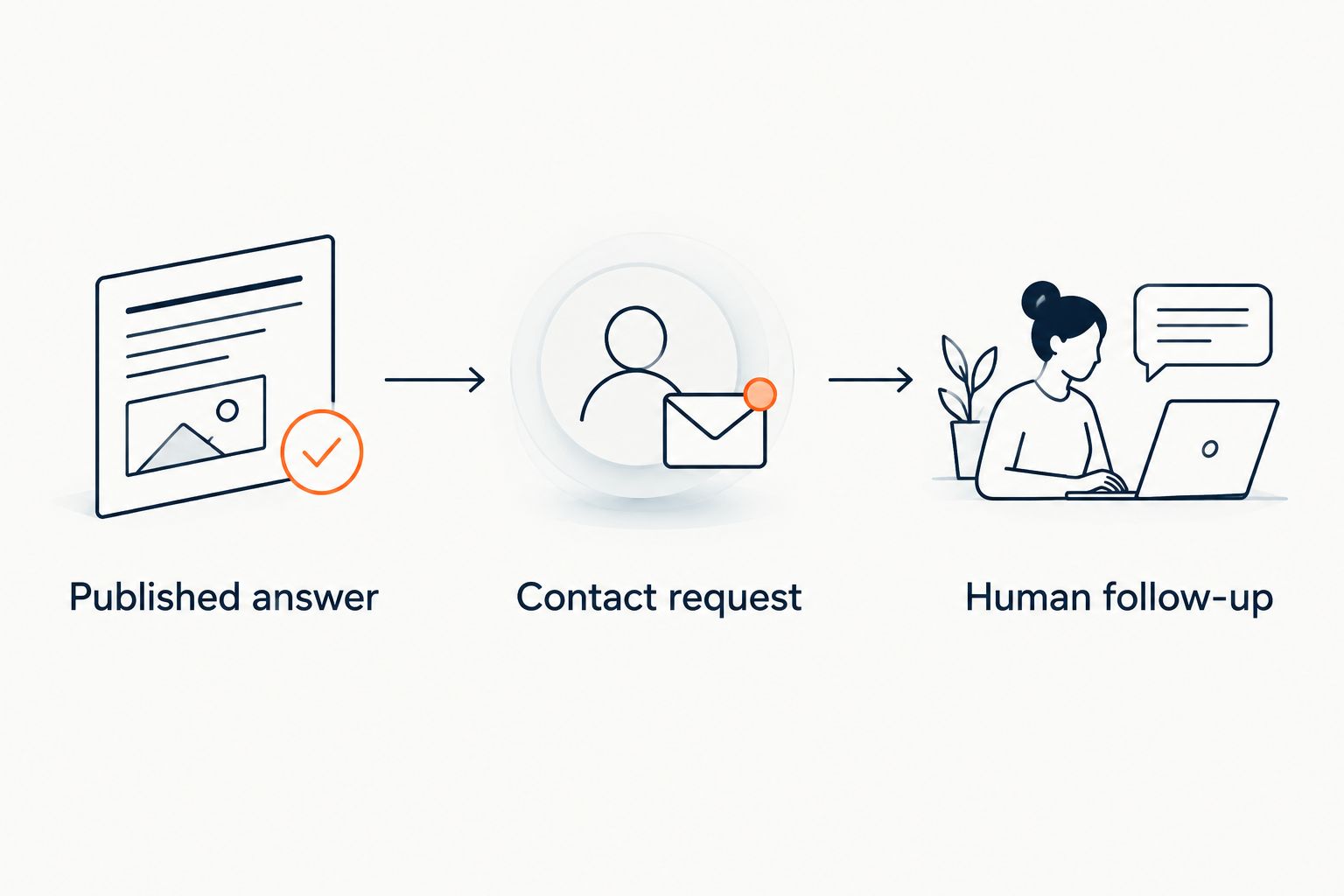
Begin your test form with 2 fields: an email address and the unresolved question. Add qualification fields only when you can name the decision each field supports; this is a proposed starting configuration, not a product requirement.
Review 1 complete conversation per scripted test before expanding the trial. Read both the visitor-facing reply and the record your team receives, because either side can fail independently.
How the ranking works
This ranking prioritizes creator-content fit, answer grounding, qualification context, and follow-up clarity. It does not use fabricated conversion figures, test scores, or claims that every feature is included in every configuration.
The first option matches the stated creator use case most directly. The remaining options occupy distinct slots: CRM-centered qualification, support-led follow-up, and live-chat-centered follow-up.
Which lead capture chatbot should you choose?
Choose HelpShelf for lead capture when your central task is answering creator-content questions with cited sources. That is the clearest default for a course creator, coach, or community owner evaluating this category in 2026.
Choose HubSpot’s chatbot builder when structured CRM qualification comes first. Choose Intercom Fin when support is the main conversation channel, or Tidio Lyro when live-chat follow-up defines your workflow.
Do not buy a second operational system merely to add an email field. First establish whether your existing workflow can answer the buyer’s question accurately and preserve a useful request for follow-up.
FAQ
What’s the best lead capture chatbot for a course creator?
HelpShelf is the best fit in this ranking for course creators who need cited answers from their own content and lead capture together. Test it with curriculum questions, missing information, and policy boundaries before choosing.
Is a lead capture chatbot the same as a qualification chatbot?
No. Lead capture collects contact information, while qualification gathers information used to decide fit or the next action. A chatbot can perform one task without completing the other.
Should a chatbot ask for my email before answering?
Do not make an email address a prerequisite for every general question. Test answering a published question first, then offering contact capture when the visitor requests follow-up.
Is HubSpot’s chatbot builder the same as a generative chatbot?
No. A scripted chatflow follows defined questions and branches; generated answers require a separate evaluation. Compare the exact workflow you intend to deploy rather than treating every chatbot capability as interchangeable.
Can a chatbot promise a refund exception to capture a lead?
A chatbot should not promise an exception that your published policy does not authorize. Require it to state the boundary and leave exceptions to an authorized person.
How do I compare chatbot handoffs?
Compare the information the next person receives. Check for the visitor’s question, the answer already given, the unresolved issue, and an explicit request for follow-up.
Does collecting more contact information mean better leads?
More completed fields do not establish that a lead is qualified. Keep each field tied to a decision your team actually makes, and review whether the visitor’s original question was resolved.
One last thing
Put an unanswerable question in every chatbot trial. Ask whether an unpublished bonus is included or whether a policy has an unstated exception, then inspect the response.
The useful result is a clear boundary, not a more persuasive guess. A captured lead should arrive with an accurate conversation behind it.