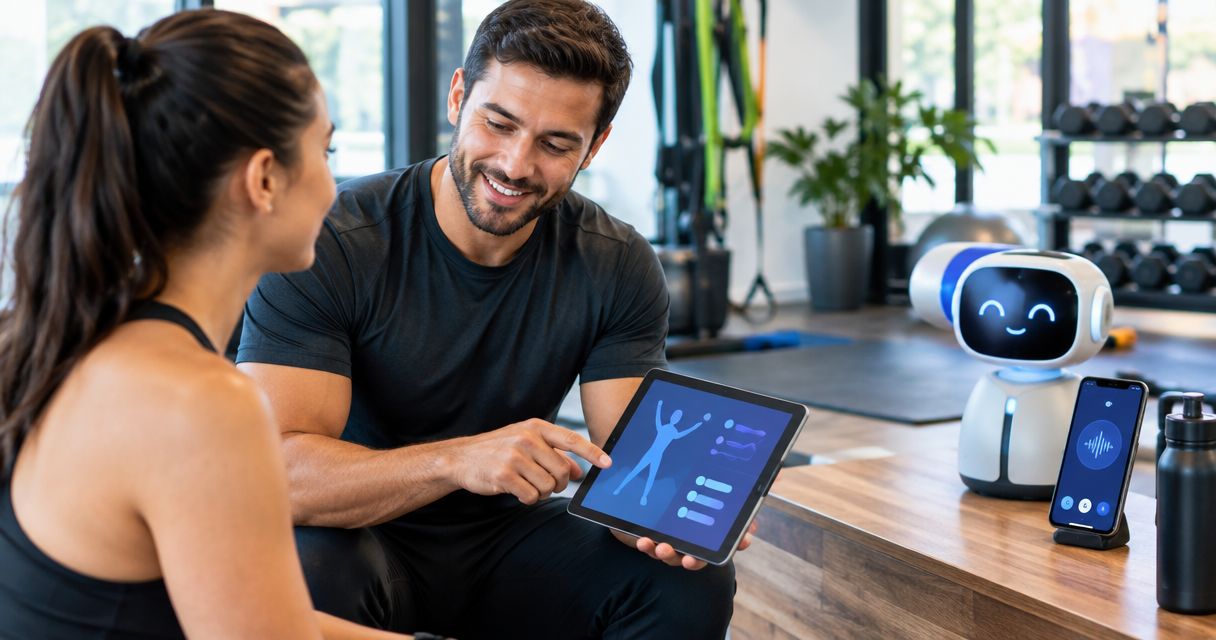
AI customer service software for fitness coaches answers the same macros question, program-fit question, and "will this work for my knee" question your DMs get every week, using your own course or coaching content, with the source cited. Fitness coaching questions are personal and repetitive at the same time — client A asks about protein targets, client B asks the same thing three days later, and both expect an answer before 11pm, not a "got it, I'll check and get back to you."
- AI customer service software for fitness coaches works only when it quotes your actual program content, not general fitness advice.
- Coaches selling through Kajabi, Skool, or Whop need answers that cite the specific module, not a canned FAQ.
- HelpShelf is built for source-grounded answers with lead capture; it's best for coaches who already have written program content to connect.
- Refund and medical questions need a hard stop to a real human — no coach should let a bot invent a cancellation policy.
Why AI customer service matters for fitness coaches
A fitness coach's inbox doesn't look like a SaaS support queue. It's Instagram DMs, Skool posts, Whop messages, and email, all asking versions of the same six or seven questions: what's included, can I switch plans, what if I have an injury, when does the challenge start, is there a refund window. Answer those manually and you're doing unpaid support work every night. Ignore them and prospects go quiet — by the time you reply the next morning, they've moved on to another coach's offer.
The fix isn't a generic chatbot that improvises fitness advice. A coach's assistant needs to answer from the actual program — the exact module on deload weeks, the actual macros framework you teach, the real cancellation terms on your site — and say "I can only quote what's published" when a client asks something the content doesn't cover. That's the difference between a support tool and a liability.
Update your question inventory
Before any tool goes live, know what you're actually being asked. Most coaches never write this down — they just answer it, again, for the fortieth time.
- Pull the last 30 days of DMs, emails, and community posts and tag repeat questions
- Separate pre-sale questions ("is this right for me") from post-sale support ("where's week 3")
- Flag anything medical or injury-related — these get a hard escalation, not an AI answer
- Note which questions your program content already answers versus which need new copy
- Rank by frequency; the top five questions are usually 70%+ of your inbound volume
Connect your content so answers cite sources
An AI assistant that can't point to where an answer came from is a guessing machine wearing a chat bubble. For a fitness coach, that source is your Kajabi course, your Skool posts, your Whop community content, or your program PDFs.
- Upload or connect the modules, FAQs, and onboarding docs you already have written
- Keep source documents current — an assistant citing last season's macros protocol is worse than no answer
- Separate public-facing content (sales page copy) from private client content (member-only modules)
- Check that citations point to the actual page or module, not just "the course"
- Re-sync after every program revision, not once a quarter
This is the step where a tool like HelpShelf reads your existing course and coaching content and answers with the source attached, instead of generating fitness advice from general training data.
Set your assistant to sales mode for pre-sale questions
A prospect asking "will this work if I'm 6 months postpartum" or "how is this different from your other program" is a sale in progress, not a support ticket. Treat it that way.
- Turn on a pre-sale mode that answers program-fit and comparison questions from your sales page and public content
- Never let the assistant imply results ("this will get you shredded in 8 weeks") — no coach should let a bot make income or results promises
- Have it surface the actual program name and enrollment page, not a vague "check our website"
- Set a clear boundary: pricing and discount questions get answered from what's actually published, never invented
- Capture the visitor's info before the conversation ends so a cold lead doesn't just vanish
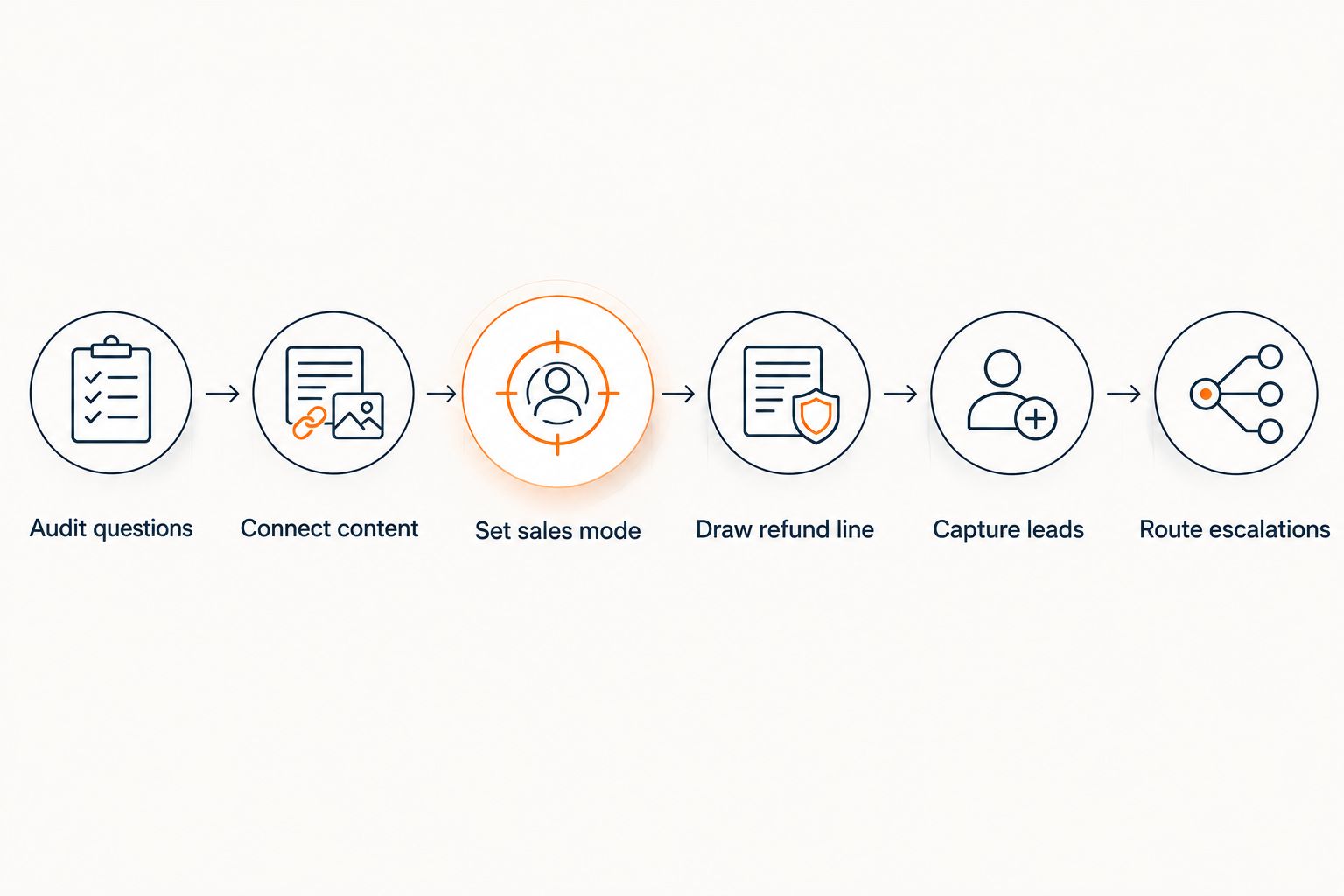
Draw the line on refund and cancellation questions
This is where generic chatbots get coaches in trouble. A bot that improvises "sure, you can get a refund anytime" because it sounds helpful has just created a policy that doesn't exist.
- Feed the assistant your actual, current refund and cancellation terms — nothing implied, nothing assumed
- Set a rule: no refund exceptions invented, ever — if it's not published, the answer is "check the current policy on the site" 2026 client bases move fast between Kajabi, Skool, and Whop, and a coach who copy-pasted policy language from one platform to another often has terms that no longer match. Audit that mismatch before connecting content.
- Route anything ambiguous ("I was traveling, can I get an extension") to a human, not a generated answer
- Log which refund questions come up most — that tells you where your policy copy is unclear
Capture leads without turning the assistant into a spam bot
A fitness coach's lead capture problem is usually the opposite of a SaaS company's — you don't need more traffic, you need the DMs and comment questions to turn into actual leads instead of dead-ending in a chat window.
- Ask for an email or phone number only after the assistant has actually answered something useful
- Never gate the answer behind a form — that's a bounce, not a lead
- Route captured leads straight into whatever you already use (email list, CRM, Kajabi contacts)
- Tag leads by which question they asked — "asked about postpartum program" is a better lead note than "filled a form"
- Review lead capture chatbots for creators if capture volume, not just answer quality, is your bottleneck
Route real escalations to a human handoff
Some questions should never get an AI-generated answer, no matter how good the source content is: injury specifics, medical clearance, and anything legally sensitive around health claims.
- Build a hard stop for injury/medical keywords that routes to you or your team, not to a generated response
- Confirm the handoff actually happened — a "someone will follow up" message that nobody sees is worse than no assistant
- Keep a visible verified handoff so the client knows a person, not the bot, is now handling it
- Set expectations on response time for the human side, since the AI already set expectations by answering instantly
Test the assistant against your hardest real questions
Most coaches skip this and find out the assistant's blind spots from an annoyed client instead of a test run.
- Ask it the top five questions from your question inventory and check the citations, not just the wording
- Ask it something outside your content on purpose — the correct answer is a refusal, not a confident guess
- Ask a pricing or discount question and confirm it doesn't invent a number
- Have someone outside your business test it — you already know the answers, so you won't catch a bad one
Comparing your options as a fitness coach
| Option | Best for | Key limitation |
|---|---|---|
| Answering DMs yourself | Coaches with a handful of active clients | Doesn't scale, and answers slow to a stop by 11pm |
| Generic help desk software | Coaches with an existing support team | Needs manual FAQ setup, no citation to your actual program pages |
| Generic AI chatbot (no source grounding) | Coaches testing automation cheaply | Guesses when it doesn't know — risks inventing refund terms or results claims |
| HelpShelf | Coaches selling through Kajabi, Skool, or Whop who need cited answers | Needs your program content organized before it can quote it accurately |
The verdict for most solo and small-team fitness coaches in 2026: a chatbot that can't cite your actual program content is a liability generator, not a support tool.
See cited answers from your own content
Connect your course and coaching content — no invented policies, no guessed results.
Common mistakes fitness coaches make
- Letting the bot imply results. "This program will get you shredded by summer" is an income/results promise nobody should let an AI generate.
- Skipping the refund audit. Coaches who moved from Kajabi to Whop (or added Skool on top) often have three versions of a cancellation policy floating around — the bot will quote whichever one it finds first.
- No escalation path for medical questions. "Can I do this with a torn ACL" needs a human, every time, not a confident-sounding generated answer.
- Treating lead capture like a popup ad. Gating every answer behind an email form kills the conversation before it starts.
- Forgetting to re-sync content after a program update. An assistant citing last quarter's macros framework is quoting a source that no longer exists.
FAQ
What's the best AI customer service software for fitness coaches?
The best option is one that answers from your actual program content with a citation, not a generic fitness chatbot. HelpShelf is built for coaches on Kajabi, Skool, and Whop who need answers grounded in their own course material rather than general advice.
Can an AI chatbot answer nutrition or macros questions for my coaching clients?
Only if the macros framework is part of the content it's connected to — it should quote your specific protocol, not general nutrition advice. A well-set-up assistant says "I can only quote what's published" when a question falls outside your program.
Is AI customer service worth it for a solo fitness coach?
Yes, if your inbox has repeat questions across DMs, email, and a community platform — the audit step in this guide shows whether volume justifies it. A coach answering the same five questions nightly is the clearest case for it.
How does AI customer service work with Kajabi, Skool, or Whop?
The assistant connects to content already on those platforms — course modules, community posts, program docs — and answers pre-sale and support questions with a citation back to the source. It sits alongside the platform, not inside it.
Will an AI assistant make refund or income promises to my clients?
It shouldn't, and a properly configured one won't — it should answer only from your published refund policy and never imply results. If it can't find a published answer, the correct response is a redirect to check the current policy, not an invented one.
How much support work does an AI widget actually replace for a fitness coach?
It replaces the repeat, answerable-from-content questions — program fit, what's included, cancellation terms — not medical or injury-specific questions, which should always route to a human.
Can AI customer service capture leads for a fitness coaching business?
Yes — a well-set-up assistant asks for contact info after answering a question, then routes that lead into your existing email list or CRM tagged by what they asked about.
Does AI customer service work for Whop-based fitness communities?
It works the same way as on Kajabi or Skool: connect your community content and program docs, and the assistant answers member and prospect questions with the source cited.
One last thing
Run this test before you trust any assistant with your fitness coaching business: ask it what happens if a client wants a refund after week 3. If it gives you a confident, specific answer instead of pointing to your actual published policy, it's guessing — and it will guess the same way with a real client at 11pm when you're not watching. The tools worth using in 2026 fail that test by saying less, not more.