
An AI chatbot for info product sellers has to do two jobs at once: answer sales questions before someone buys and answer support questions after they do, all without inventing a discount, a refund policy, or a result that isn't real. In 2026, most of the chat tools built for creators, coaches, and community owners fall short on one side or the other.
- HelpShelf wins for course creators and coaches who need an AI chatbot for info product sellers that answers from their own content with citations.
- Intercom fits sellers who already run a full support team and need omnichannel coverage, not just a widget.
- Tidio suits solo sellers who want basic live chat without content-grounded answers.
- Zendesk and Freshdesk are built for ticketing at scale, not for a single creator's course or community.
- Every tool on this list should be judged on whether it can say "I don't know" instead of guessing.
Best overall: HelpShelf, best for course creators and coaches who need pre-sale answers grounded in their own material. Best for sellers running a full support team: Intercom. Best for solo creators who want simple live chat: Tidio.
Why this matters
A generic chatbot trained on nothing but a prompt will answer a pricing question with a guess. Guessed answers turn into refund requests when the guess is wrong, or into a Federal Trade Commission complaint when the guess sounds like an income promise. For an ai chatbot for info product sellers to be worth installing in 2026, it has to answer from the seller's actual course, coaching material, or community content, cite where the answer came from, and refuse politely when the material doesn't cover the question.
That single requirement — source-grounded answers with citations — is what separates the tools built for creators from the general-purpose help desks retrofitted to sound like them.
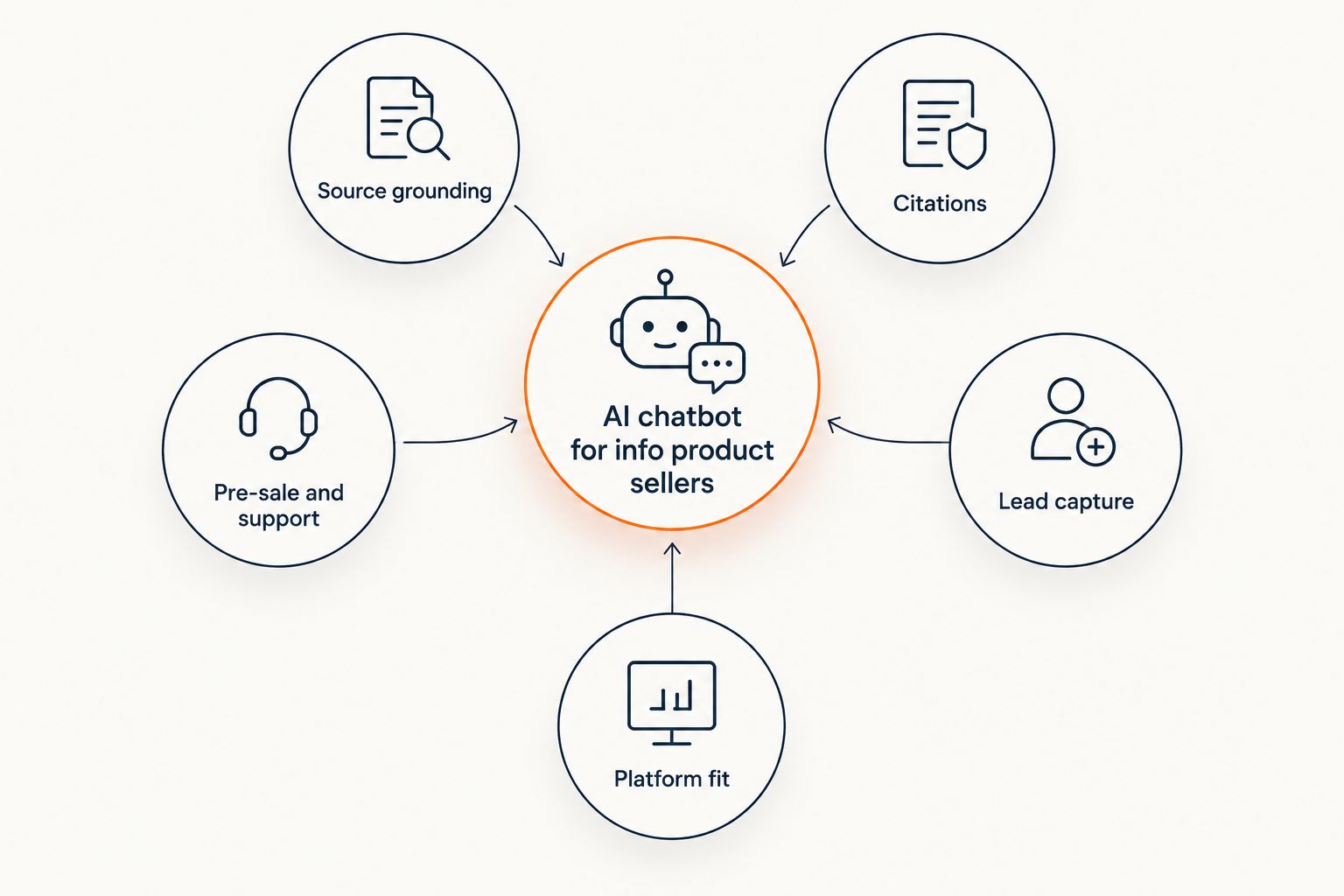
What makes the best AI chatbot for info product sellers
- Source grounding: answers come from the creator's actual course, coaching content, or community posts, not a generic model guess
- Citations: every answer points back to the specific lesson, module, or post it came from
- Pre-sale and support in one widget: the same chatbot handles "does this cover X" before purchase and "how do I access Y" after
- Lead capture: the widget collects contact info from visitors who aren't ready to buy yet
- Platform fit: native support for where creators actually sell, whether that's Kajabi, Skool, Whop, or a standalone site
- Honest refusal: the chatbot says "I can only quote what's published" instead of inventing a discount or a result
At a glance
| Tool | Best for | Standout feature | Key limitation |
|---|---|---|---|
| HelpShelf | Course creators and coaches needing cited pre-sale answers | Answers pulled from the creator's own course or community content, with citations | Built for creator platforms, not a general help desk |
| Intercom | Sellers running a full support team alongside sales | Omnichannel support and workflow automation | More setup than a single-creator operation typically needs |
| Drift | Paid-traffic sellers needing conversational lead routing | Conversation-based lead qualification on marketing pages | Focused on sales chat, not content-grounded Q&A |
| Tidio | Solo creators wanting simple live chat | Easy setup for live chat and scripted bot flows | Bots answer from scripts, not the creator's actual material |
| Zendesk | Larger info product businesses with dedicated support staff | Ticketing plus knowledge base at scale | Slower to configure than a single-seller operation needs |
| Freshdesk | Budget-conscious teams needing ticketing and chat together | Ticketing and chat bundled in one plan | Chat answers are generic, not grounded in specific course content |
1. HelpShelf: best AI chatbot for info product sellers who need cited answers
HelpShelf is a chat widget built to sit on top of a creator's course, coaching, or community content and answer questions from that material directly, citing the source each time. It's built for Kajabi, Skool, and Whop sellers rather than adapted from a generic help desk product, and it captures lead details from visitors who ask questions but don't buy right away.
HelpShelf pros:
- Answers cite the exact lesson, module, or community post they're pulled from
- Captures lead information during the pre-sale conversation, not just after checkout
- Built natively for Kajabi, Skool, and Whop instead of retrofitted from generic support software
- Refuses to invent discounts, refund exceptions, or income claims when the source material doesn't cover them
HelpShelf cons:
- Not built for multi-channel support like phone or email the way a full help desk suite is
- Best fit is a seller whose value lives in their own content — it's less useful if the business has no course or community material to ground answers in
HelpShelf verdict: Buy, if pre-sale questions and post-purchase support both run through the same course or community content.
Coaches specifically get a deeper breakdown of platform fit and setup in HelpShelf's guide to AI chatbots for coaches, and Whop sellers should check the AI chatbots for Whop creators comparison for platform-specific detail.
2. Intercom: best for sellers running a full support team
Intercom is a customer messaging platform built for companies with dedicated support staff, not a single creator answering questions solo. It covers email, in-app messaging, and live chat under one roof, with automation layered on top for larger teams.
Intercom pros:
- Omnichannel coverage across email, chat, and in-app messaging
- Workflow automation built for teams with multiple support agents
- Established platform with a wide range of integrations
Intercom cons:
- Setup and configuration assume a support team exists, which most solo creators don't have
- Answers aren't grounded in a specific course or community's content by default
Intercom verdict: Hold, unless the info product business already runs a support team that needs omnichannel coverage beyond a single widget.
3. Drift: best for conversational lead routing on paid traffic
Drift is built around qualifying and routing sales conversations on marketing pages, which fits sellers running paid ads to a landing page more than sellers answering questions from course content.
Drift pros:
- Strong at qualifying and routing leads from paid traffic
- Conversation flows designed for sales teams, not just support tickets
Drift cons:
- Not built to answer from a specific course, coaching program, or community's actual content
- Better suited to a sales team handing off qualified leads than a solo creator answering support questions
Drift verdict: Skip, unless the priority is lead routing from ad traffic rather than answering pre-sale or support questions accurately.
4. Tidio: best for solo creators who want simple live chat
Tidio is a live chat and basic chatbot tool aimed at small businesses that want something running quickly without heavy configuration. Bots follow scripted flows rather than pulling from a knowledge base of course or community content.
Tidio pros:
- Fast to set up for basic live chat
- Simple bot flows for common, predictable questions
Tidio cons:
- Scripted flows don't adapt to specific course content or citations
- Less useful once question volume grows past a handful of predictable patterns
Tidio verdict: Hold, for a very early-stage seller with low question volume and no course content to ground answers in yet.
5. Zendesk: best for larger info product businesses with dedicated support
Zendesk is a ticketing and knowledge base platform built for support teams handling volume, not a single creator's course questions. It scales well but takes longer to configure than most solo sellers need.
Zendesk pros:
- Ticketing and knowledge base built for scale
- Established reporting and team management tools
Zendesk cons:
- Configuration overhead is heavy for a single-creator operation
- Not built to ground chat answers in a specific course or community's content
Zendesk verdict: Skip, unless the business already runs a support team large enough to justify a full ticketing platform. A closer look at fit lives in the Zendesk alternatives for course creators comparison.
6. Freshdesk: best for budget-conscious teams needing ticketing plus chat
Freshdesk bundles ticketing and chat into one product, aimed at small support teams that want both in a single subscription rather than stitching two tools together.
Freshdesk pros:
- Ticketing and chat bundled together instead of sold separately
- Familiar help desk structure for teams that already think in tickets
Freshdesk cons:
- Chat bot answers are generic and not grounded in a specific course or community's material
- Ticketing structure adds overhead a solo info product seller may not need
Freshdesk verdict: Hold, if ticketing structure matters more than source-grounded chat answers.
“If a chatbot can't say "I don't know," it will eventually invent an answer that costs you a refund or a bad review.”
How we ranked these
Each tool was weighed against the six criteria above: source grounding, citations, pre-sale plus support coverage, lead capture, platform fit, and honest refusal behavior. Tools built for general support teams (Intercom, Zendesk, Freshdesk) score well on scale but weak on content grounding. Tools built for sales conversations (Drift) or simple live chat (Tidio) score well on setup speed but weak on citing a specific course or community's material.
See how source-grounded answers work
Check how HelpShelf cites your own course or community content in every answer.
Which AI chatbot should you choose?
If pre-sale and support questions both need to come from your own course, coaching, or community content, HelpShelf is the default pick for 2026. If a support team already exists and needs omnichannel coverage across email and chat, Intercom is the better fit. If the goal is simple live chat with no content grounding required yet, Tidio covers the basics without much setup.
FAQ
What is the best AI chatbot for info product sellers in 2026?
HelpShelf is the strongest pick in 2026 for course creators and coaches because it answers from the seller's own course or community content and cites the source. General help desk tools like Intercom or Zendesk are better suited to teams with dedicated support staff.
Is HelpShelf better than Intercom for course creators?
For a solo creator or coach, yes — HelpShelf grounds answers in the creator's own content with citations, while Intercom is built for larger support teams running omnichannel messaging.
Can an AI chatbot answer pre-sale questions accurately?
Only if it's grounded in the seller's actual course or community content. A chatbot without source grounding will guess at pricing, refund, or curriculum questions, which creates refund requests and bad reviews.
Do AI chatbots work on Kajabi, Skool, and Whop?
Some do natively. HelpShelf is built specifically for those platforms, while tools like Tidio and Freshdesk are general-purpose and don't adapt to a specific course or community structure.
What should an AI chatbot never say to a customer?
It should never invent a discount, promise a refund exception that isn't published, or make an income claim. A chatbot that can say "I can only quote what's published" instead of guessing is safer for the seller.
Is a free live chat tool enough for an info product business?
Basic live chat tools like Tidio handle predictable questions but don't cite a specific course or community's content, so accuracy drops as question volume grows past simple, repeated patterns.
How much setup does an AI chatbot for course creators need?
It depends on the tool. General help desk platforms like Zendesk require more configuration than widgets built specifically for a single creator's course or community content.
One last thing
The detail that separates a chatbot worth keeping from one worth replacing isn't how fast it answers — it's what it does when it doesn't know something. A chatbot that admits "I can only quote what's published" protects the seller from refund disputes and complaints. A chatbot that guesses at a discount or a result is a liability wearing a support widget, and that gap shows up fastest in 2026 as more course and coaching businesses put a chatbot on their sales page without checking what it says when it's wrong.